
20 Garden Paths With Gates That Add Character to Your Entrance

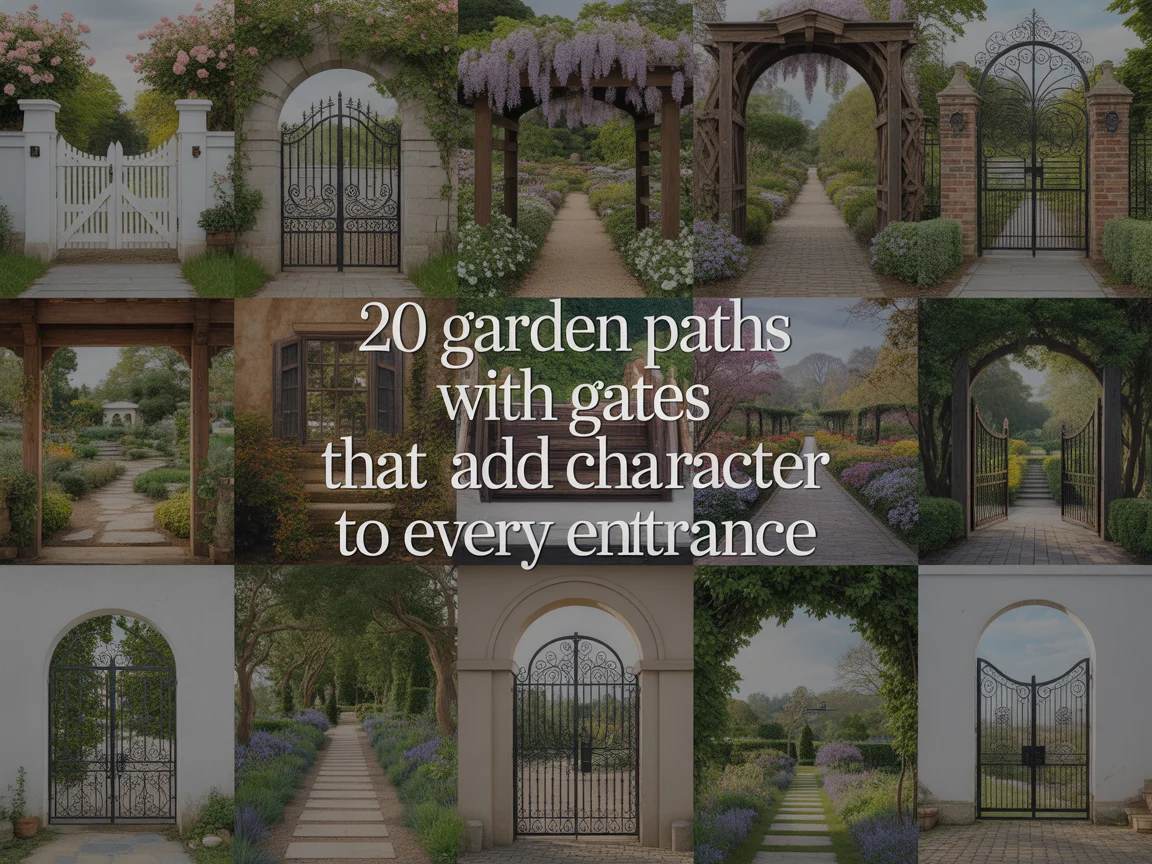
The gate at the end of my neighbor’s garden path stopped me mid-walk one morning. It was a simple arched wooden gate, painted soft white, set between two rose-covered posts at the end of a brick path. Nothing about it was complicated or expensive, but the combination of the path leading directly to that gate made the whole front garden look completely intentional. I stood there for longer than I should have, which I admit was slightly embarrassing.
Garden paths with gates combine a directional walkway with a boundary structure that marks a clear entry or transition point, giving the outdoor space both a functional division and a strong visual focal point at the same time. The gate gives the path a defined destination, and the path gives the gate a formal approach that makes the boundary feel considered rather than purely practical.
Since that morning, I have studied and personally worked with many garden gate ideas in different styles, materials, and garden sizes. I have seen simple garden gate designs work beautifully in small cottage front gardens, and I have also seen modern garden gate designs used in large contemporary properties where the gate is as much a design statement as it is a functional boundary.
In this article, I am sharing 20 garden paths with gates that cover a wide range of styles, budgets, and garden types. Each one is a design I have either built, installed, or studied closely enough to recommend with full confidence.
Brick Path With a White Picket Gate
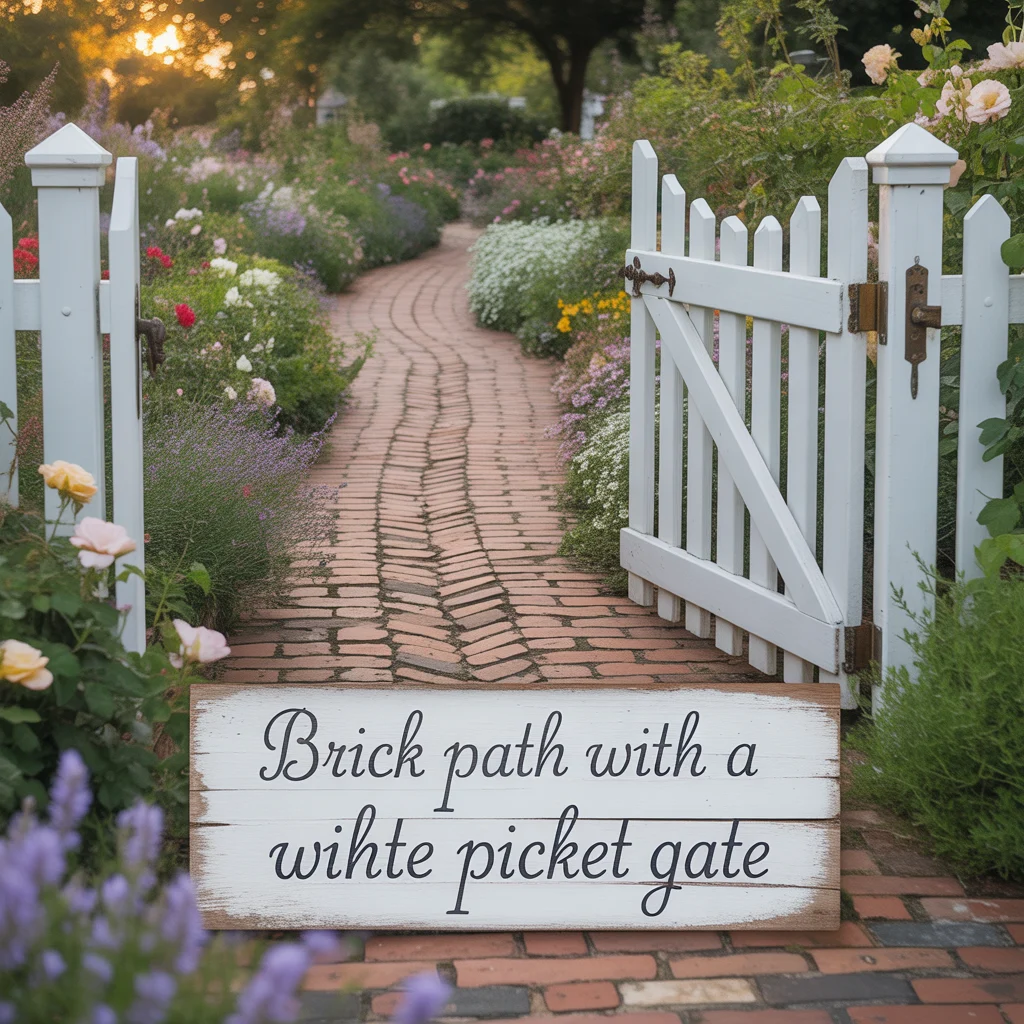
A brick path with a white picket gate is the most recognizable version of garden paths with gates and appears most consistently in cottage garden, traditional, and period property designs across the United Kingdom and the United States. The combination works because the warm red-orange tone of the brick path and the crisp white of the painted picket gate create a strong visual contrast that makes both elements stand out more clearly than either would in isolation. I installed this exact combination at a semi-detached property three years ago using reclaimed clay bricks in a stretcher bond pattern and a pre-made softwood picket gate from a local timber merchant, and the finished result cost $420 in total materials.
Picket Gate Dimensions for a Brick Garden Path
A picket gate for a brick garden path measures most effectively at 36 to 42 inches in width and 48 to 54 inches in height, which suits a path of 3 to 4 feet wide and produces a gate tall enough to read as a clear boundary without appearing as a solid barrier. I used a 36-inch-wide by 48-inch-tall picket gate on the brick path project, and the proportions suited the 3-foot-wide path directly. Gates narrower than 30 inches feel restrictive when carrying garden equipment through them, and gates taller than 60 inches start to look more like security fencing than a welcoming garden entrance on a standard residential path.
Painting and Maintaining a White Picket Gate
A white picket gate on a brick garden path requires painting with an exterior microporous wood paint applied over a primer coat on bare timber. Microporous paint allows moisture vapor to pass through the film, which prevents the blistering and peeling that standard gloss produces on outdoor timber within two to three years. I repaint my white picket gates every three to four years using a 2-inch brush on the flat faces and a 1-inch brush on the pointed picket tops, which are the areas most prone to water ingress. The total paint cost per gate repainting is $18 to $25 using a mid-range exterior wood paint.
Gravel Path With a Wooden Arched Garden Gate
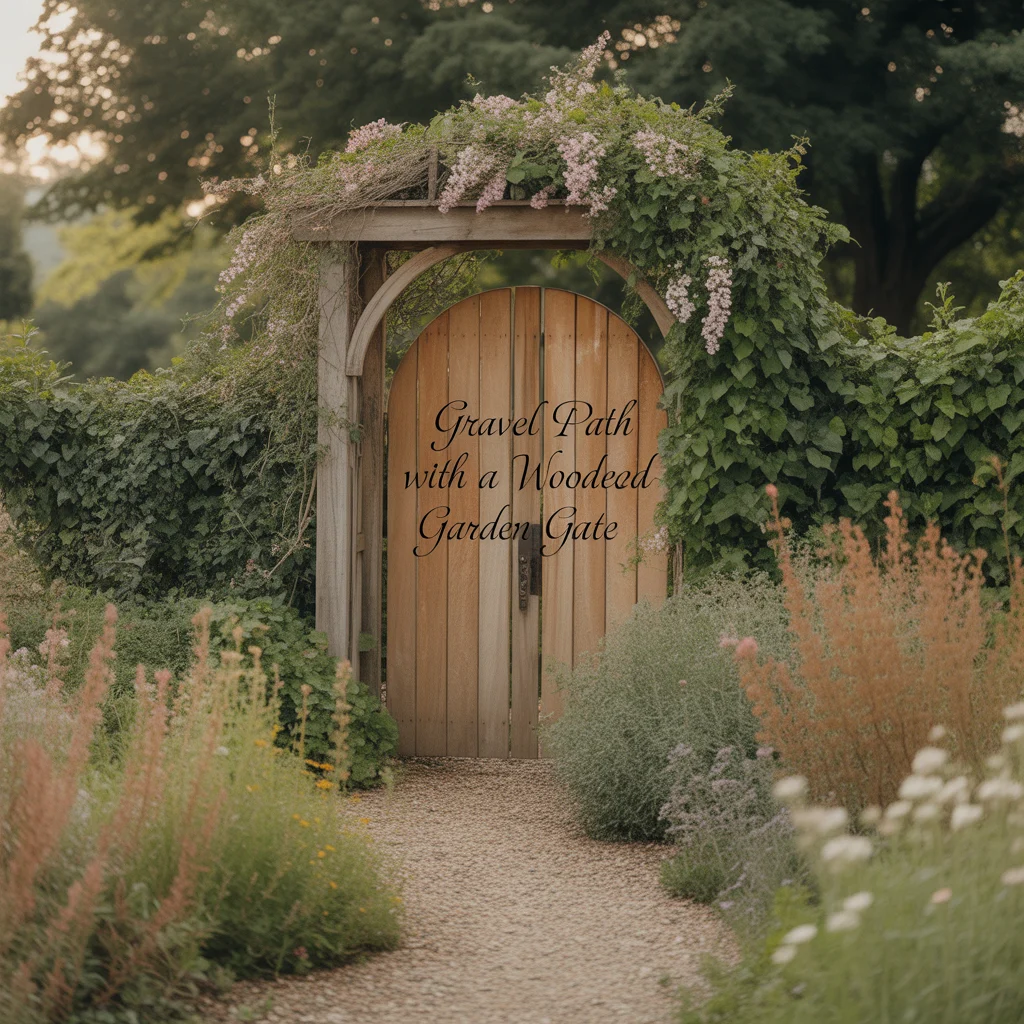
A gravel path with a wooden arched garden gate is one of the most widely searched garden gate ideas images online, and the design consistently appears in cottage, country, and informal garden styles where the curved top of the gate softens the transition from path to enclosed garden beyond. I built a wooden arched gate for a gravel path in my own garden using two 5-foot oak posts set in post-mix concrete, a pre-made arched softwood gate frame, and tongue-and-groove vertical boarding cut to follow the arch profile at the top. The total material cost was $310, and the gate has remained structurally sound and visually attractive for four years without any significant maintenance beyond one coat of exterior wood oil per year.
How to Build a Wooden Arched Garden Gate
A wooden arched garden gate requires two posts set at a width 2 inches wider than the gate itself to allow clearance for the hinges and latch hardware. Posts of 4 by 4 inches in pressure-treated softwood or oak set to a depth of 24 inches in post-mix concrete provide sufficient support for a gate up to 54 inches tall and 48 inches wide. The arch profile at the top is cut using a jigsaw following a pencil line drawn with a string compass from a central point on the top rail, producing a smooth curve. I cut my arch profile at a rise of 6 inches above the top rail level, which produced a gentle curve that suited the informal character of the gravel path leading to it.
Wood Species for Wooden Garden Path Gates
Oak, Western red cedar, and pressure-treated softwood are three wood species suited to wooden garden path gates. Oak produces the most durable and visually impressive gate, lasting 25 to 40 years with an annual oil treatment and costing $180 to $400 for a standard gate blank depending on size. Western red cedar is naturally resistant to moisture and insect damage, lighter than oak by approximately 30%, and costs $120 to $280 for a standard gate size. Pressure-treated softwood is the most affordable option at $60 to $150 per gate blank and suits a painted finish better than an oiled or stained one because the treatment process slightly closes the grain surface of the timbe.
Sandstone Path With Wrought Iron Garden Gates
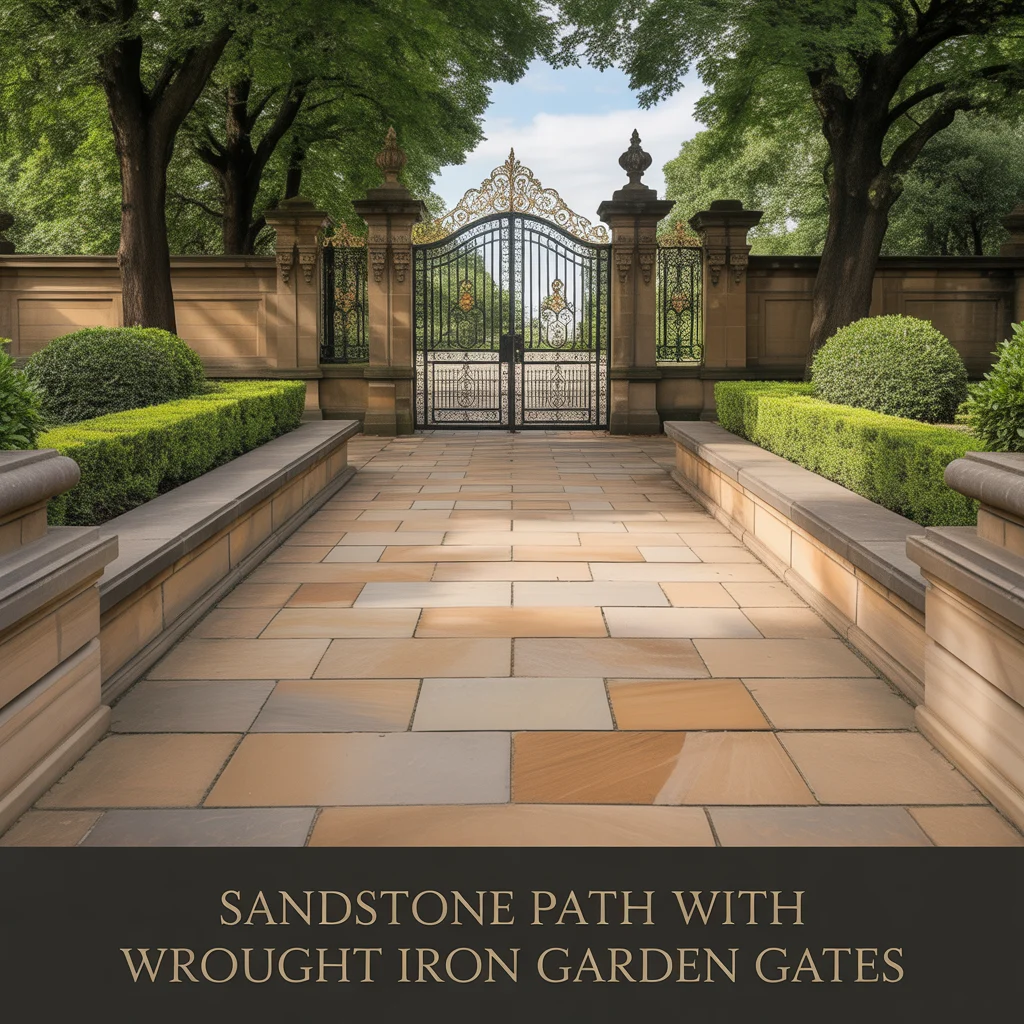
A sandstone path with wrought iron garden gates creates a formal, period-appropriate entrance that suits Georgian, Victorian, and Edwardian properties where the architectural detailing of the house calls for a more ornate gate design than timber can typically produce. I studied this combination at a Victorian terrace property where a 20-foot sandstone flag path led to a pair of black wrought iron gates between two brick piers, and the visual weight of the iron against the warm honey color of the sandstone produced an entrance that looked genuinely period-correct. Wrought iron gates for a standard garden path width of 4 feet cost between $300 and $800 depending on the complexity of the scrollwork and panel design.
Wrought Iron vs Cast Iron Garden Gates
Wrought iron and cast iron are two distinct materials used in metal garden gates ideas, and the practical differences between them affect both the cost and the long-term maintenance requirements. Wrought iron is worked while hot into shaped bars and scrolls, producing a gate that is strong, slightly flexible, and repairable by welding if damaged. Cast iron is poured into molds, producing a heavier, more brittle gate that is less suitable for a frequently used garden path entrance where impact loading from daily use is a factor. Modern metal garden gates described as wrought iron are typically mild steel fabricated to replicate the traditional wrought iron aesthetic, costing $250 to $700 for a standard single gate.
Maintaining Metal Garden Gates on a Sandstone Path
Metal garden gates on a sandstone path require an annual inspection for rust spots followed by spot-treatment with a rust-inhibiting primer and a topcoat of exterior metal paint in the same color as the original finish. I maintain two mild steel gates on sandstone paths and find the annual maintenance takes approximately 40 minutes per gate, using a wire brush on any rust spots, a 1-inch brush for the primer, and a 2-inch brush for the topcoat. Gates finished in a high-quality black exterior metal paint require less frequent full repainting than those finished in lower-grade products, with a good-quality finish lasting 5 to 7 years before a full repaint is needed.
Stepping Stone Path With a Rustic Wooden Gate
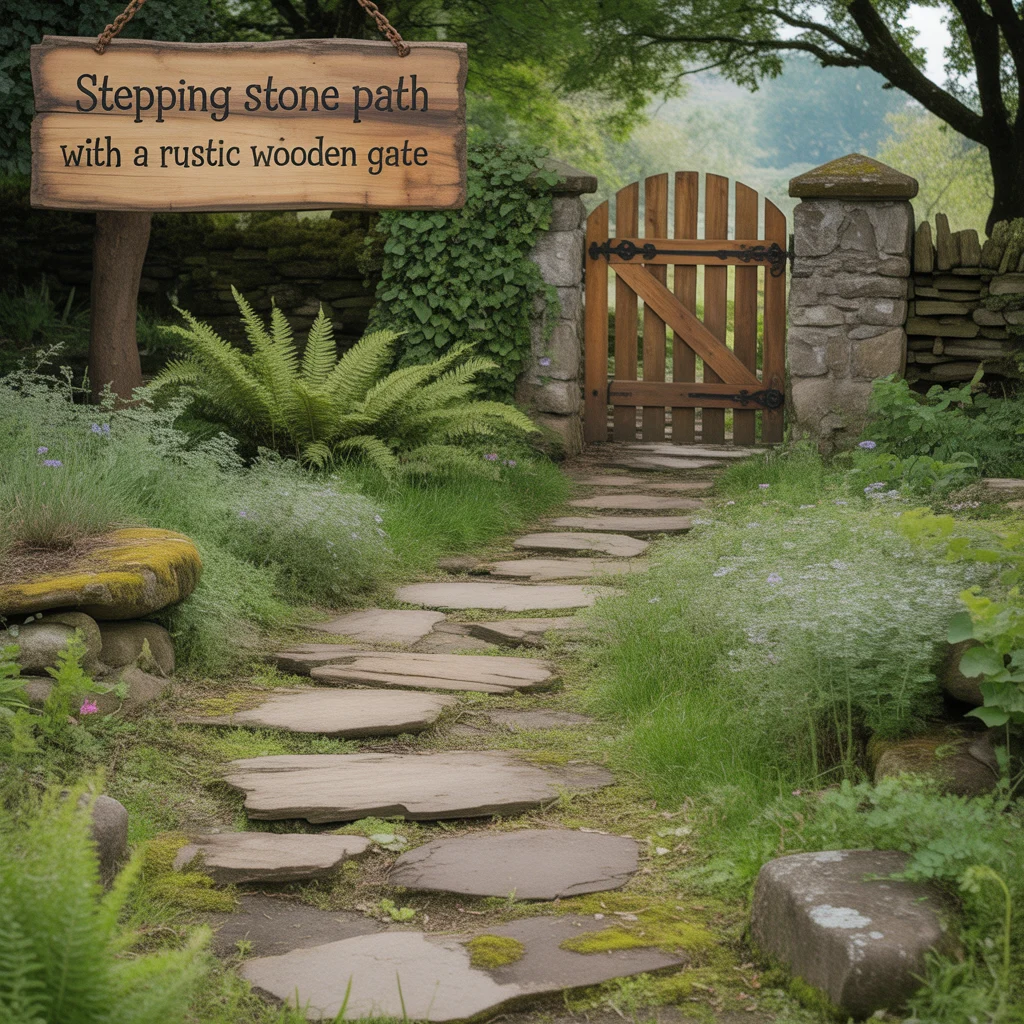
A stepping stone path with a rustic wooden gate uses large individual stones set in grass or ground cover to create an informal approach to a gate made from rough-sawn timber, hazel poles, or reclaimed wood that suits a naturalistic or woodland garden style. I created this combination in my back garden using 20-by-20-inch sandstone stepping pads set in a lawn at 14-inch intervals, leading to a gate made from three reclaimed scaffold boards fixed to a simple frame of 3-by-2-inch treated softwood. The total gate material cost was $35, which I consider the most cost-effective garden gate idea I have ever executed, and the rustic appearance suited the informal stepping stone path perfectly.
Building a Rustic Scaffold Board Garden Gate
A rustic garden gate from reclaimed scaffold boards uses three boards of 9 inches width and 1.5 inches thickness cut to the required gate height, fixed to a frame consisting of two horizontal rails and one diagonal brace running from the bottom hinge corner to the top latch corner. The diagonal brace is the most important structural element because it prevents the gate from sagging over time under its own weight. I cut my diagonal brace from the same scaffold board material and fixed it using 3-inch galvanized screws at four points along its length. The finished gate weighed 18 pounds, which is within the capacity of standard 4-inch gate hinges rated at 25 pounds per pair.
Gate Post Options for a Stepping Stone Path
Timber posts, steel post anchors with timber inserts, and natural stone pillars are three gate post options suited to a stepping stone garden path. Timber posts of 4 by 4 inches in pressure-treated softwood or oak set 24 inches in post-mix concrete provide a simple, fast installation suited to a rustic or informal gate style. Steel post anchor sockets driven into the ground accept a standard 4-by-4-inch timber post without any concrete, allowing the post to be replaced without excavation if it eventually decays. Natural stone pillars built from sandstone, limestone, or flint provide the most permanent and visually substantial gate post for a formal or period-style garden path with gates.
Modern Garden Gate Design With a Concrete Path
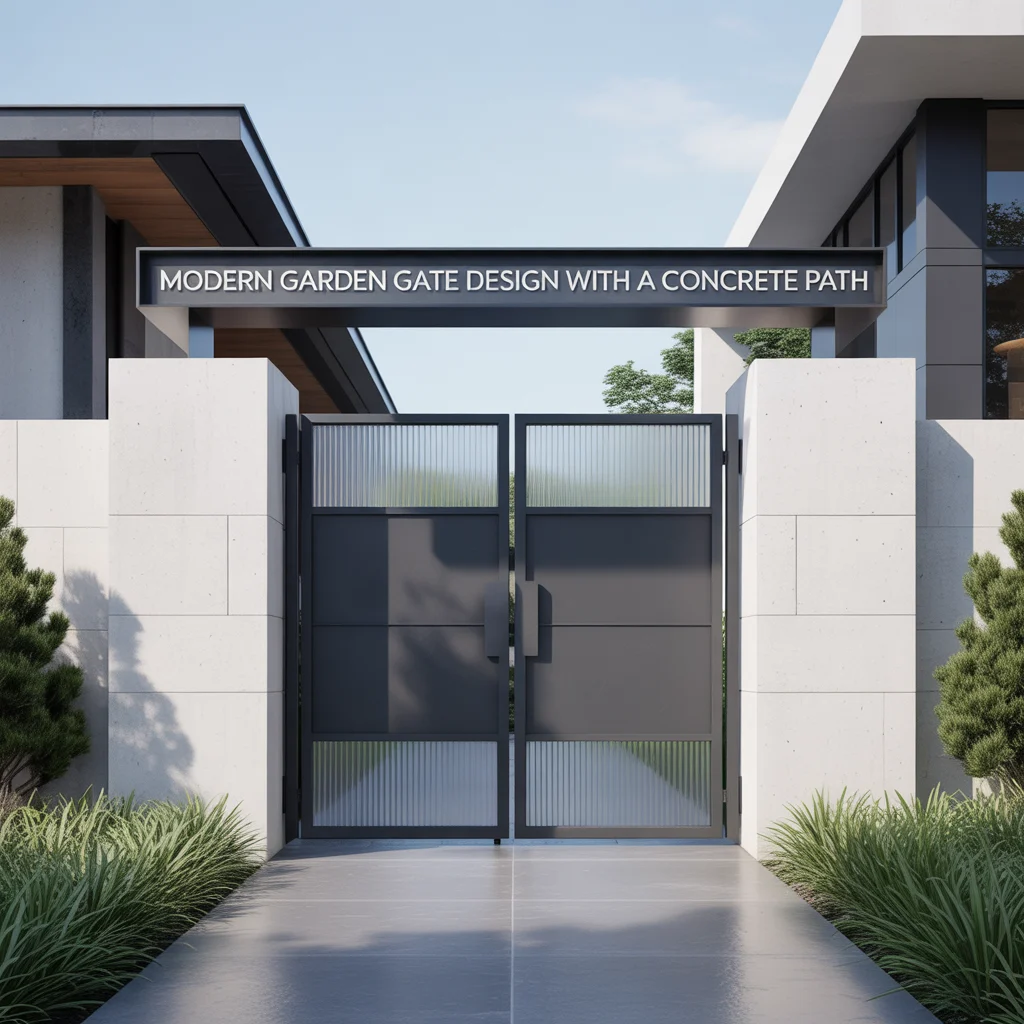
A modern garden gate design on a concrete path uses clean geometric lines, minimal ornamentation, and materials such as powder-coated steel, corten steel, or horizontal timber slats to create a gate that suits contemporary architecture and urban garden designs. I visited a garden last year where a pair of horizontal-slatted iroko timber gates, each 48 inches wide and 60 inches tall, were set between two rendered concrete piers at the end of a large-format concrete slab path, and the combination of the warm wood tone against the pale grey concrete produced one of the most considered modern garden gate design examples I have seen in a residential setting. The gates cost $680 for the pair, including the stainless steel pivot hinges and flush-pull latch hardware.
Horizontal Slat Gate Designs for a Modern Garden Path
A horizontal slat gate for a modern garden path uses timber or metal slats fixed at equal spacing across a welded steel or bolted timber frame to produce a gate with partial visibility through the slats rather than a fully solid or fully open panel. Slat spacing of 1 to 2 inches produces approximately 30 to 40% visibility through the gate, which is enough to suggest the garden beyond without fully exposing it. I measured the slat spacing on six modern horizontal slat gates I studied and found that 1.5-inch spacing was the most common, producing a balanced ratio of solid material to open gap that reads as intentional rather than accidental in photographs and in person.
Materials for a Modern Garden Gate Design
Powder-coated steel, corten steel, and iroko hardwood are three materials suited to a modern garden gate design on a contemporary path. Powder-coated steel in RAL 7016 anthracite grey is the most popular finish for modern metal garden gates ideas in residential designs, costing $280 to $600 for a single gate and providing a UV-stable, chip-resistant surface rated for 15 to 20 years outdoors. Corten steel develops a distinctive orange-brown rust patina within 6 to 12 months and requires no further maintenance after the initial patina forms, making it a genuinely low-maintenance modern gate material. Iroko hardwood produces a warm golden-brown tone and resists decay for 20 to 30 years with an annual application of exterior hardwood oil.
Cottage Garden Path With a Picket and Arch Gate Combination
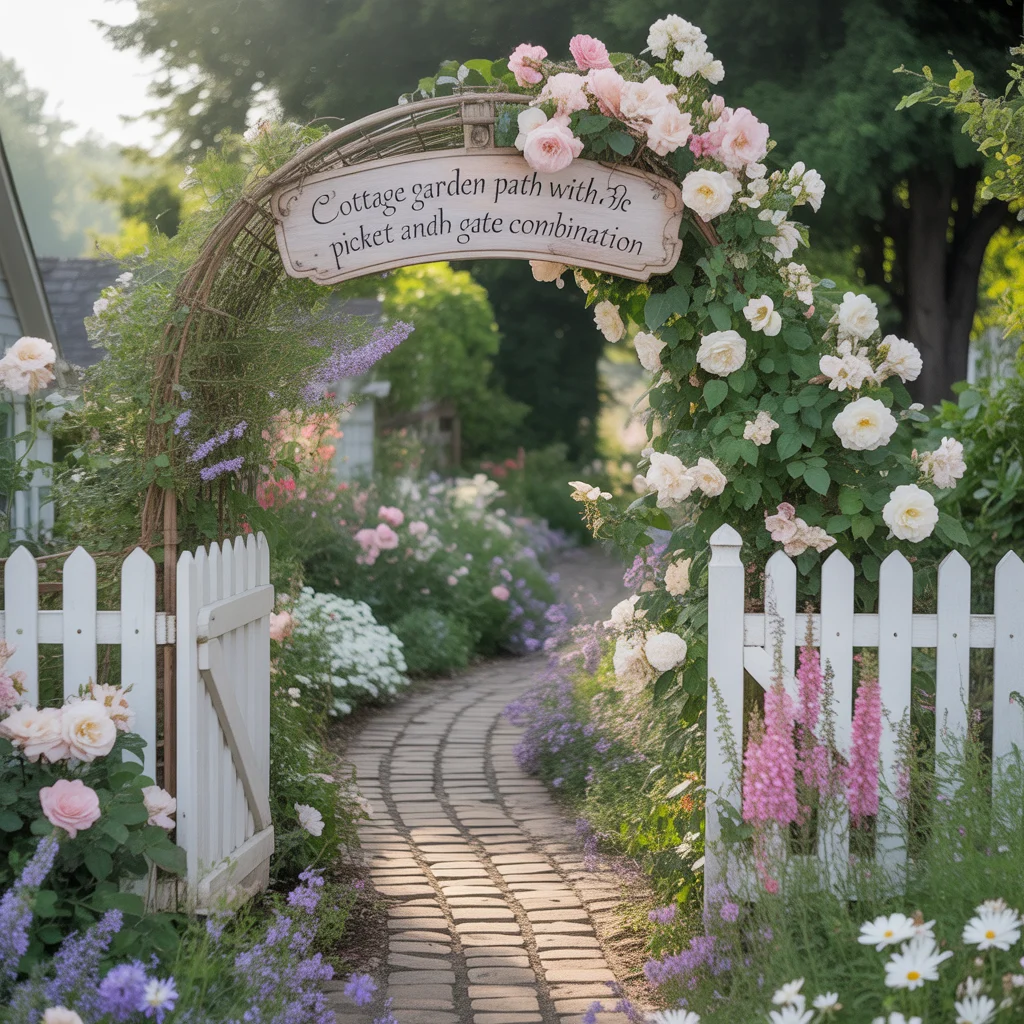
A cottage garden path with a picket fence and arched gate combination is the design I associate most personally with the classic English cottage garden aesthetic, and it is the combination most frequently seen in garden gate ideas images from cottage and country garden sources. The picket fence runs on both sides of the path entrance, connecting to two posts that support the arched gate in the center, so the gate and fence form a single unified boundary rather than a gate standing alone between open posts. I helped a friend install this combination using pre-made featherboard picket panels and a matching arched gate in painted softwood, and the full installation took one day for two people working together.
Matching a Picket Fence to an Arched Garden Gate
A picket fence pairs most effectively with an arched garden gate when both elements share the same picket profile, the same spacing between pickets, and the same paint color. Standard softwood picket fence panels use 2-inch-wide pickets at 2-inch spacing and stand 36 to 48 inches in height. An arched gate using the same picket profile with the same 2-inch spacing reads as a continuation of the fence line rather than a separate element, which is the design intention in a unified cottage garden path entrance. I used 48-inch picket panels with a matching 48-inch-high arched gate on the project I completed with my friend, and the fence and gate read as one continuous boundary from the street.
Gate Hardware for a Cottage Garden Picket Gate
Cottage-style gate hardware uses black japanned or antique brass fittings including cranked hinges, a Suffolk latch, and a gate spring to produce a traditional appearance consistent with a picket and arch garden gate design. Black japanned cranked hinges cost $8 to $15 per pair and suit a painted softwood gate by providing enough clearance for the gate face to swing clear of the post face without binding. A Suffolk latch costs $12 to $22 in black japanned steel and is the most traditional latch style for a cottage garden gate, operated by a thumb lever on the outside and a bar lift on the inside. A gate spring costs $6 to $12 and ensures the gate closes automatically after each use.
Formal Garden Path With Brick Piers and Iron Gates

A formal garden path with brick piers and iron gates creates the most architecturally substantial entrance of any design in this article, and it suits large traditional properties, walled kitchen gardens, and formal garden layouts where the gate and piers form a significant architectural element in the overall garden design. I measured the proportions of brick pier and iron gate combinations at four formal gardens I visited and found that pier widths of 16 to 20 inches and heights of 60 to 72 inches consistently produced the most balanced relationship with iron gates of 48 to 60 inches in height, regardless of the specific gate design used between the piers.
Building Brick Piers for a Formal Garden Gate
Brick piers for a formal garden path gate are built on a concrete foundation of 12 inches depth and a plan area 4 inches larger than the pier base on each side, using engineering bricks or facing bricks to match the surrounding garden walls. A pier of 16 by 16 inches in plan uses two bricks per course laid in a pinwheel bond, producing a solid pier without a hollow center. I built two 68-inch-tall piers for a formal gate installation using 215mm engineering bricks and found the construction straightforward using a plumb line and level checked every three courses. The total brick and mortar cost for both piers was $180.
Iron Gate Designs for Formal Brick Pier Entrances
Flat top iron gates, arched top iron gates, and spear top iron gates are three iron gate designs suited to formal brick pier garden path entrances. Flat top iron gates suit piers of equal height on both sides and produce the most architectural, symmetrical entrance when viewed straight on from the path approach. Arched top iron gates require one or both piers to be built with an arch detail or the gate arch to clear the pier caps, which adds complexity but produces the most elegant formal garden path entrance of the three options. Spear top iron gates suit period properties where the pointed finials on the gate tops echo decorative metalwork elsewhere on the building or boundary.
Woodland Garden Path With a Moon Gate

A woodland garden path with a moon gate uses a circular opening in a wall or solid fence panel as the gate form, creating a perfectly round entrance that frames the garden beyond like a picture. I saw my first moon gate in a public botanical garden and immediately understood why they are so widely used in Chinese and Japanese garden design. The circular opening on a woodland path creates a framed view of the planting beyond that changes with every season, turning a simple boundary crossing into a deliberate viewing experience. Moon gates on garden paths are most commonly built from brick, stone, or rendered concrete block, with a clear opening diameter of 48 to 72 inches.
Building a Brick Moon Gate on a Garden Path
A brick moon gate on a garden path requires a temporary circular former of plywood or MDF to support the brickwork during construction until the mortar sets fully. The former is cut to the exact internal diameter of the required opening, typically 48 to 60 inches, and set vertically on a solid foundation wall or between two solid piers that form the sides of the gate opening. Bricks are laid in a radial pattern around the former, with each brick angled toward the center of the circle to maintain consistent joint widths. I assisted in building a 54-inch moon gate and found the former construction took longer than the bricklaying, requiring approximately 3 hours to cut and assemble accurately.
Planting Around a Moon Gate on a Woodland Path
Ferns, hostas, and Hydrangea petiolaris are three plants that suit the planting around a moon gate on a woodland garden path. Ferns planted on both sides of the moon gate opening produce arching fronds that partially frame the circular opening from the sides, softening the hard edge of the brickwork. Hostas with large blue-green leaves planted at the base of the gate piers provide a low, bold foliar contrast to the circular brick opening above them. Hydrangea petiolaris trained up the face of the wall containing the moon gate produces white lacecap flowers in June that decorate the brick surface around the circular opening without obscuring the view through it.
Gravel Path With a Metal Garden Gate in Anthracite
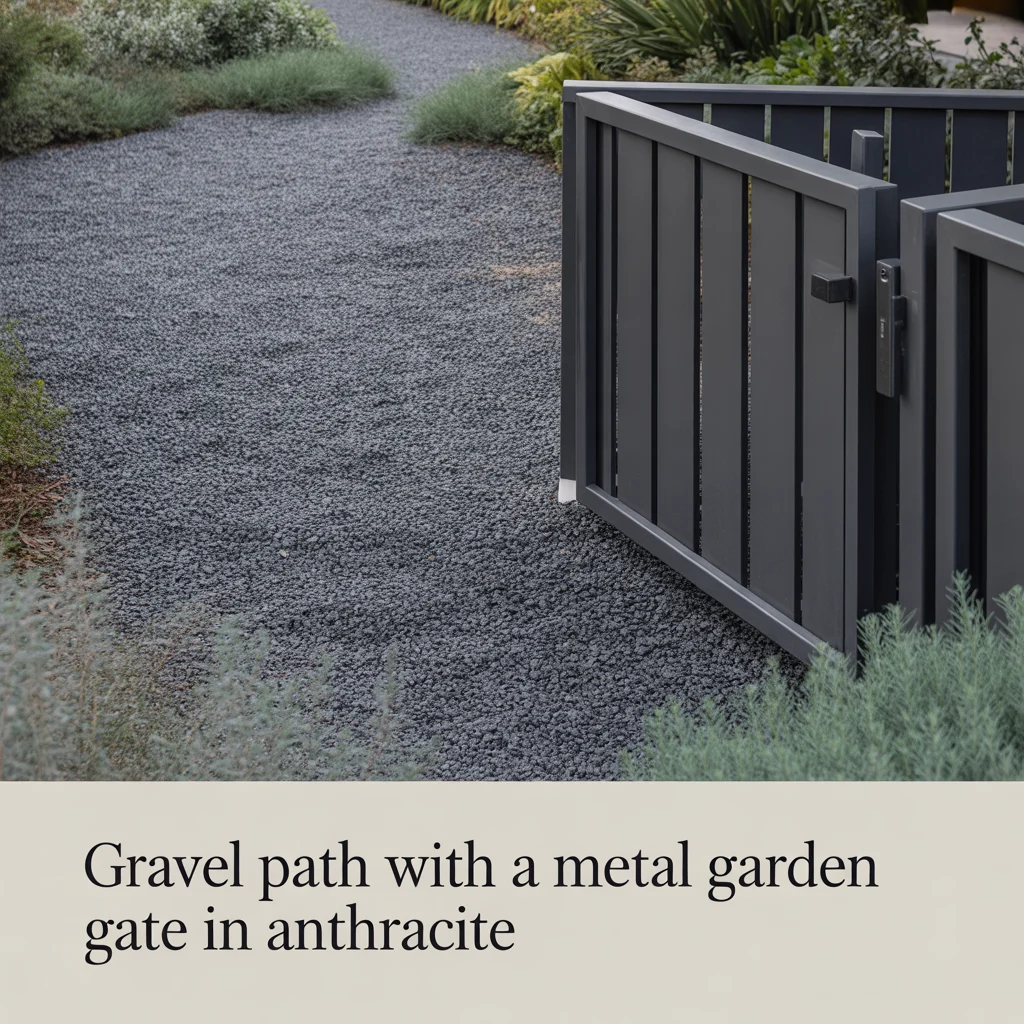
A gravel path with a metal garden gate in anthracite grey is the most widely used combination in modern residential garden designs in the United Kingdom currently, and I have seen it applied successfully to properties ranging from new-build terraces to large detached family homes. The anthracite grey powder coat finish on the metal gate coordinates with the grey tones common in contemporary render, slate roofing, and aluminium window frames, creating a unified color language across the front of the property. A standard single metal garden gate in anthracite powder-coated aluminium, measuring 36 inches wide and 48 inches tall, costs between $180 and $350 from garden gate suppliers.
Aluminium vs Steel for a Metal Garden Gate
Aluminium and steel are two metals used in modern metal garden gates ideas, and the practical differences between them affect weight, maintenance, and long-term cost. Aluminium gates weigh approximately 40% less than equivalent steel gates, which reduces the load on hinges and posts and makes installation easier for one or two people without specialist lifting equipment. Aluminium does not rust and requires no surface treatment beyond an initial powder coat finish, which lasts 20 to 25 years outdoors without repainting. Steel gates are heavier and stronger than aluminium and suit larger gate spans of 6 feet or more where the additional rigidity of steel prevents flexing in the gate frame under wind load.
Gravel Types That Suit an Anthracite Metal Gate Path
White marble chippings, black basalt gravel, and light grey flint gravel are three gravel types that suit a garden path leading to an anthracite metal gate. White marble chippings at 10 to 20mm create the strongest contrast with the dark gate color and produce a bright, clean path surface visible from the street. Black basalt gravel creates a tonal match with the anthracite gate and suits a minimalist modern design where a single dark color palette runs from the path surface through to the gate. Light grey flint gravel at 14mm to 20mm produces a neutral mid-tone that suits the anthracite gate without creating the strong contrast of white marble or the full tonal match of black basalt.
Herb Garden Path With a Simple Wooden Gate
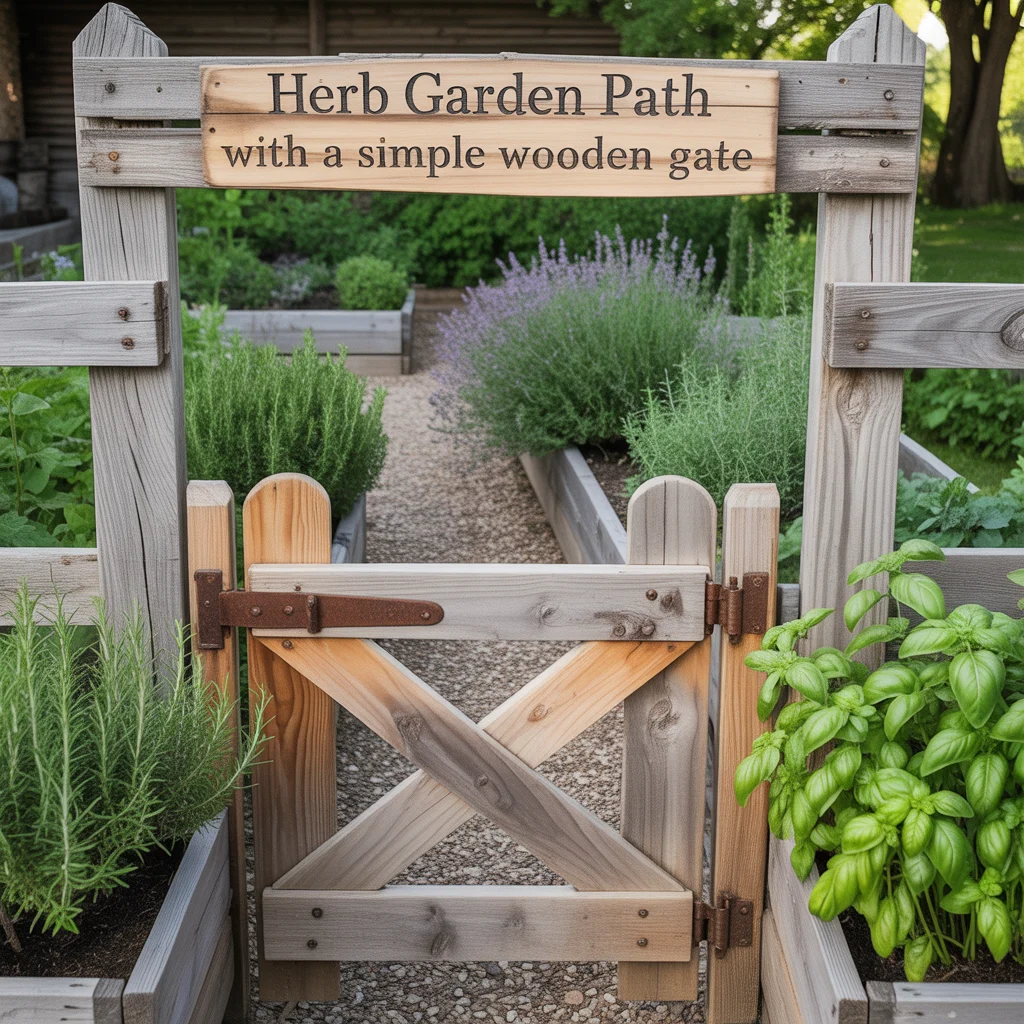
A herb garden path with a simple wooden gate uses a straightforward boarded or framed timber gate to mark the entrance to a productive herb growing space, combining the practical function of a boundary with the relaxed, working-garden character of a kitchen herb area. I built this combination in my own garden three years ago, creating a simple garden gate design using five horizontal boards of rough-sawn softwood fixed to a 3-by-2-inch frame with a diagonal brace, hung between two pressure-treated 4-by-4 posts at the entrance to my raised herb bed area. The gate cost $28 in materials and has been in daily use since without any structural problems.
Simple Garden Gate Design Construction Details
A simple garden gate design for a herb garden path uses a frame of 3-by-2-inch pressure-treated softwood with two horizontal rails at the top and bottom, one central rail at mid-height, and one diagonal brace running from the bottom hinge rail corner to the top latch rail corner. The boarding is fixed to the front face of the frame using 2-inch galvanized ring shank nails or screws, with boards of 4 to 6 inches width and 1 inch thickness. A gate frame of this construction measuring 36 inches wide by 42 inches tall weighs approximately 14 pounds, which is within the rated capacity of standard 3.5-inch gate hinges and requires no specialist tools to build.
Gate Finishes for a Herb Garden Wooden Gate
Natural oil finish, wood stain in a dark color, and exterior wood paint in green or grey are three finish options for a simple wooden garden gate on a herb garden path. A natural oil finish using raw linseed oil or exterior Danish oil preserves the natural color of the timber and costs $15 to $25 per liter, with one liter covering a standard gate surface twice. A dark wood stain in chestnut or dark oak suits a rustic herb garden gate and costs $12 to $20 per liter. Exterior wood paint in sage green or slate grey suits a more designed herb garden path and gate combination, and I used exterior sage green paint on my own gate because the color complemented the foliage tones of the herbs planted on both sides of the path.
Stone Path With a Wrought Iron Pedestrian Gate
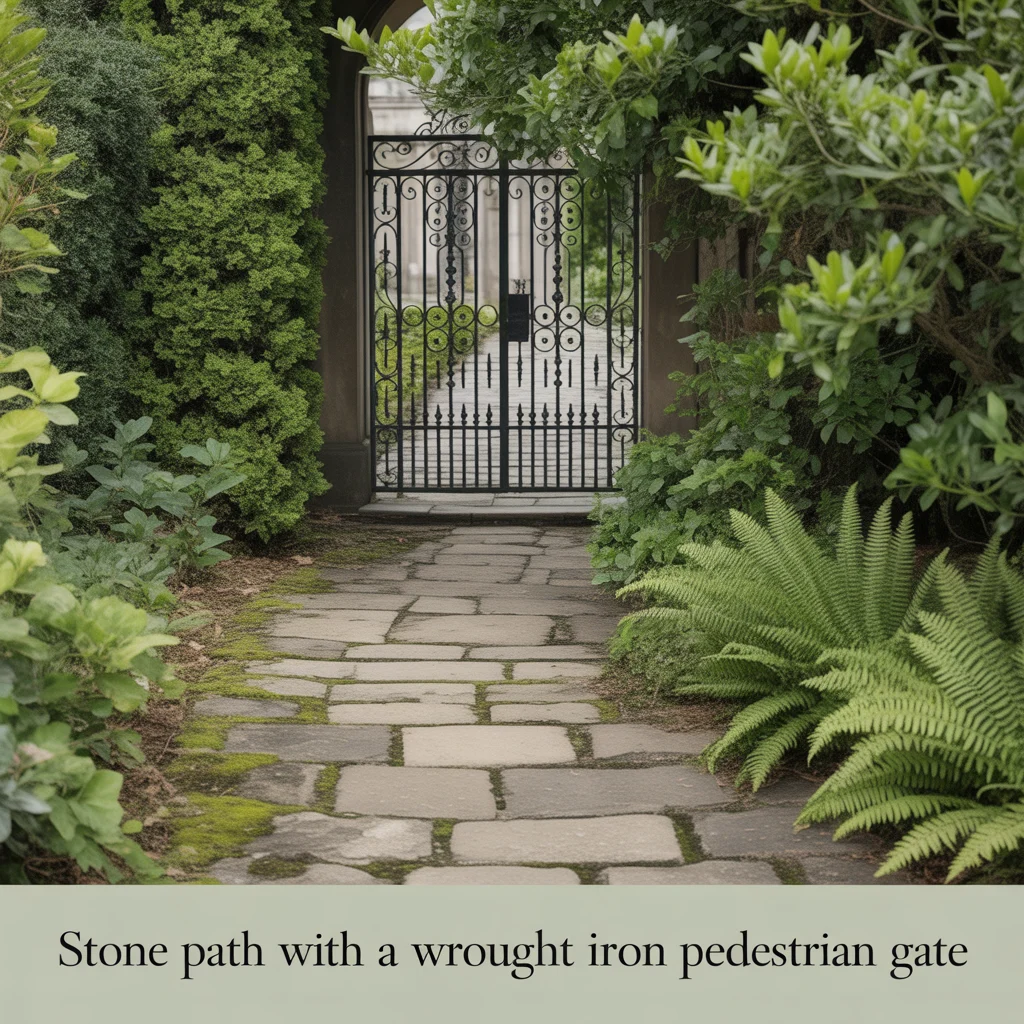
A stone path with a wrought iron pedestrian gate uses a natural or reconstituted stone surface with a single iron gate of traditional design as the path entrance, producing a combination suited to period rural properties, farm gardens, and walled estate-style garden spaces. I visited a farmhouse garden where a 25-foot-long random limestone flag path led to a black wrought iron pedestrian gate set between two dry-stone wall piers, and the combination of the rough limestone flags, the dry-stone piers, and the iron gate produced an entrance that looked completely native to the rural setting without any artifice or unnecessary decoration.
Random Stone Flag Path Surfaces for an Iron Gate Entrance
Random limestone flags, riven Welsh slate, and Yorkstone are three natural stone path surfaces that suit a wrought iron garden gate entrance. Random limestone flags in sizes ranging from 12 to 24 inches across produce a varied, organic surface pattern that suits a rural or informal iron gate entrance and cost $8 to $18 per square foot. Riven Welsh slate in dark blue-grey tones produces a more formal surface that contrasts strongly with the black of wrought iron gates and costs $12 to $22 per square foot. Yorkstone, the traditional sandstone quarried in West Yorkshire, produces a warm buff-grey surface that weathers to a silver-grey tone over time and suits both formal and informal iron gate entrances at a cost of $15 to $25 per square foot.
Wrought Iron Gate Latch and Hinge Hardware
A wrought iron pedestrian gate on a stone path requires heavy-duty hinges rated for the gate weight and a latch or bolt mechanism suited to the security level required at the path entrance. Band and hook hinges in black painted mild steel rated at 50 pounds per pair suit iron gates up to 48 inches tall and 36 inches wide. Heavier ring-and-pin hinges rated at 100 pounds per pair suit larger iron gates up to 60 inches tall and 48 inches wide. A ring latch in black forged steel costs $18 to $35 and suits a traditional iron gate on a stone path where the latch hardware needs to visually match the decorative style of the gate itself.
Front Garden Path With a Picket Gate and Rose Arch
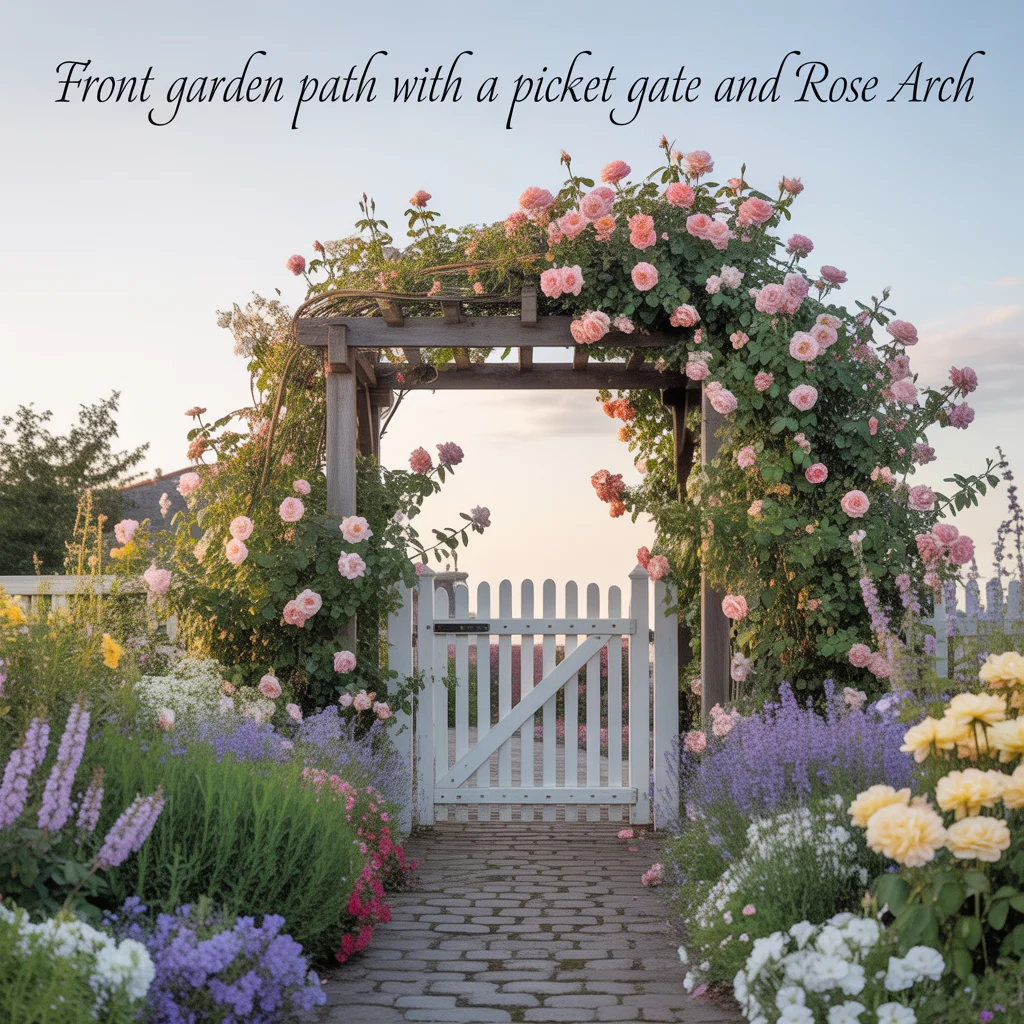
A front garden path with a picket gate and rose arch combines the picket gate with an overhead timber arch covered in climbing roses, creating a garden path entrance that is one of the most commonly featured designs in garden gate ideas images collections. I spent considerable time studying the proportions of this design in several front gardens and found that the arch width matching the gate width exactly, and the arch height reaching a minimum of 84 inches at the center to allow comfortable passage underneath mature rose growth, produced the most visually balanced and practically usable result.
Rose Arch Dimensions for a Garden Path Gate
A rose arch over a garden path gate measures most effectively at the same width as the gate it spans, typically 36 to 48 inches, and a minimum height of 84 inches at the center of the arch to allow clearance for climbing rose canes hanging down from the overhead frame. I measured seven rose arches over garden path gates and found that arches below 78 inches in center height became uncomfortably low after two or three seasons of rose growth and required very regular pruning to maintain clear head height. An arch depth from front to back of 12 to 18 inches provides enough surface area for the rose canes to cover without the arch looking thin and insubstantial from the path approach. For anyone planning this kind of feature as part of a wider outdoor layout, these backyard pathway ideas with gated sections offer practical guidance on how gated entry points, defined walkways, and planted arch features can be combined into a cohesive backyard design.
Best Roses for a Garden Path Gate Arch
New Dawn, Zephirine Drouhin, and Madame Alfred Carriere are three climbing roses suited to a gate arch on a front garden path. New Dawn is a repeat-flowering pale pink rose that produces flowers from June to October and grows vigorously enough to cover a standard 84-inch arch within two to three seasons. Zephirine Drouhin is thornless, which makes it the safest choice for a gate arch where people pass through frequently at close range, and produces deep pink flowers with a strong fragrance from June to September. Madame Alfred Carriere is the best option for a north-facing gate arch, tolerating shade better than most climbing roses while still producing creamy white flowers from June to October.
Paved Courtyard Path With a Contemporary Timber Gate
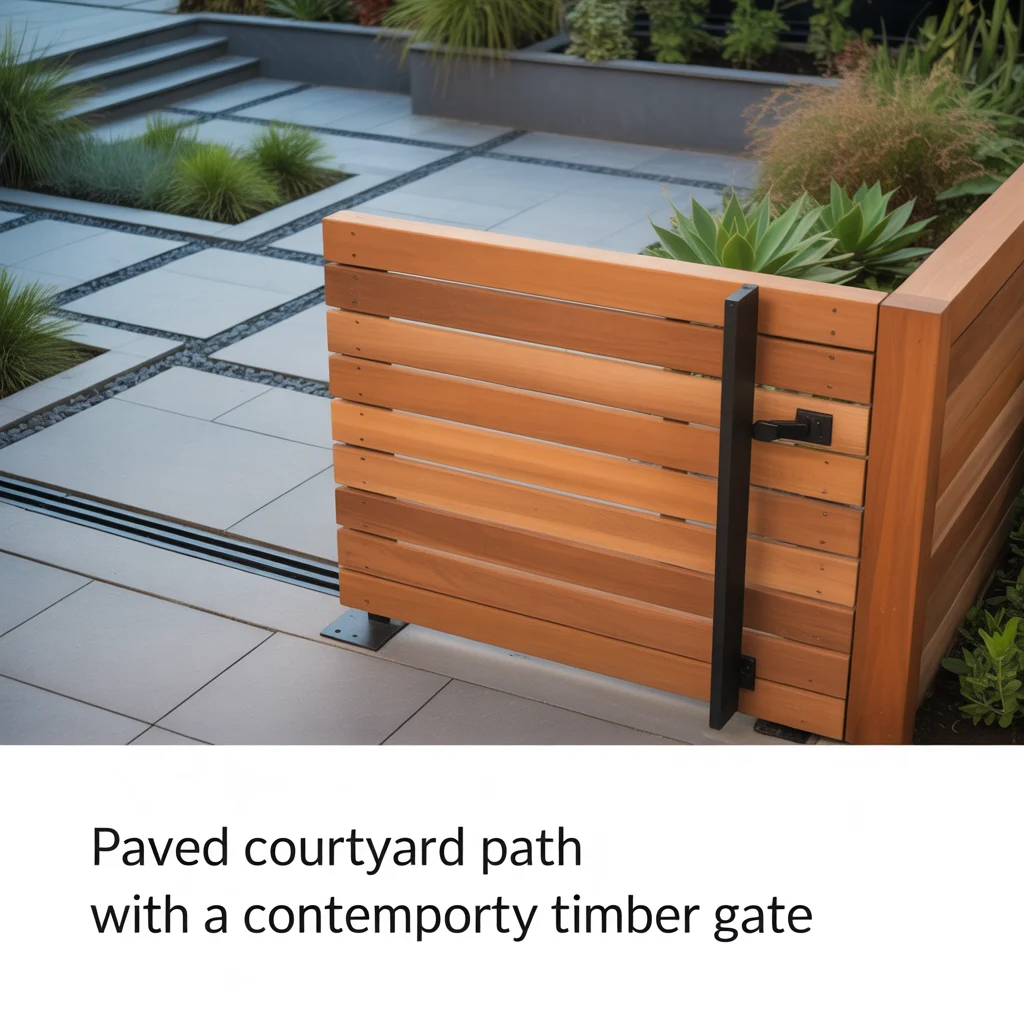
A paved courtyard path with a contemporary timber gate uses large-format paving in a courtyard space with a solid or slatted timber gate of modern design to create a private, enclosed garden entrance suited to urban properties and rear courtyard gardens. I helped design a courtyard garden where a 24-by-24-inch porcelain paved path led to a pair of iroko hardwood horizontal-slatted gates between two rendered block piers, and the combination of the smooth porcelain, the warm wood tone of the iroko, and the clean lines of the rendered piers produced a contemporary garden entrance that complemented the modern rear extension of the house directly.
Iroko vs Teak for a Contemporary Timber Garden Gate
Iroko and teak are two hardwoods used in contemporary wooden garden path gates, and both suit a horizontal-slatted modern gate design on a paved courtyard path. Iroko produces a golden-brown tone that weathers to a silver-grey if left untreated and costs $180 to $380 for a standard single gate blank, making it approximately 30% less expensive than teak of equivalent size and quality. Teak produces a richer golden-brown tone that weathers more slowly than iroko and is the more widely recognized premium hardwood for outdoor use, costing $250 to $500 for a standard gate blank. Both species require an annual application of exterior hardwood oil to maintain their color and prevent surface cracking.
Rendered Pier Construction for a Contemporary Gate
Rendered block piers for a contemporary garden path gate are built from standard 100mm concrete blocks laid in stretcher bond to the required pier size, typically 300 by 300mm in plan, and finished with a two-coat sand and cement render followed by a fine-textured exterior masonry paint. The foundation for each pier consists of 150mm of concrete poured into an excavation 100mm larger on each side than the pier base. I built two rendered piers for a contemporary gate installation and found the block construction straightforward, but the render finish required practice on a test area before achieving a flat, even surface on the final pier faces. The total material cost for both piers, including blocks, render, and paint, was $145.
Meadow Garden Path With a Woven Willow Gate
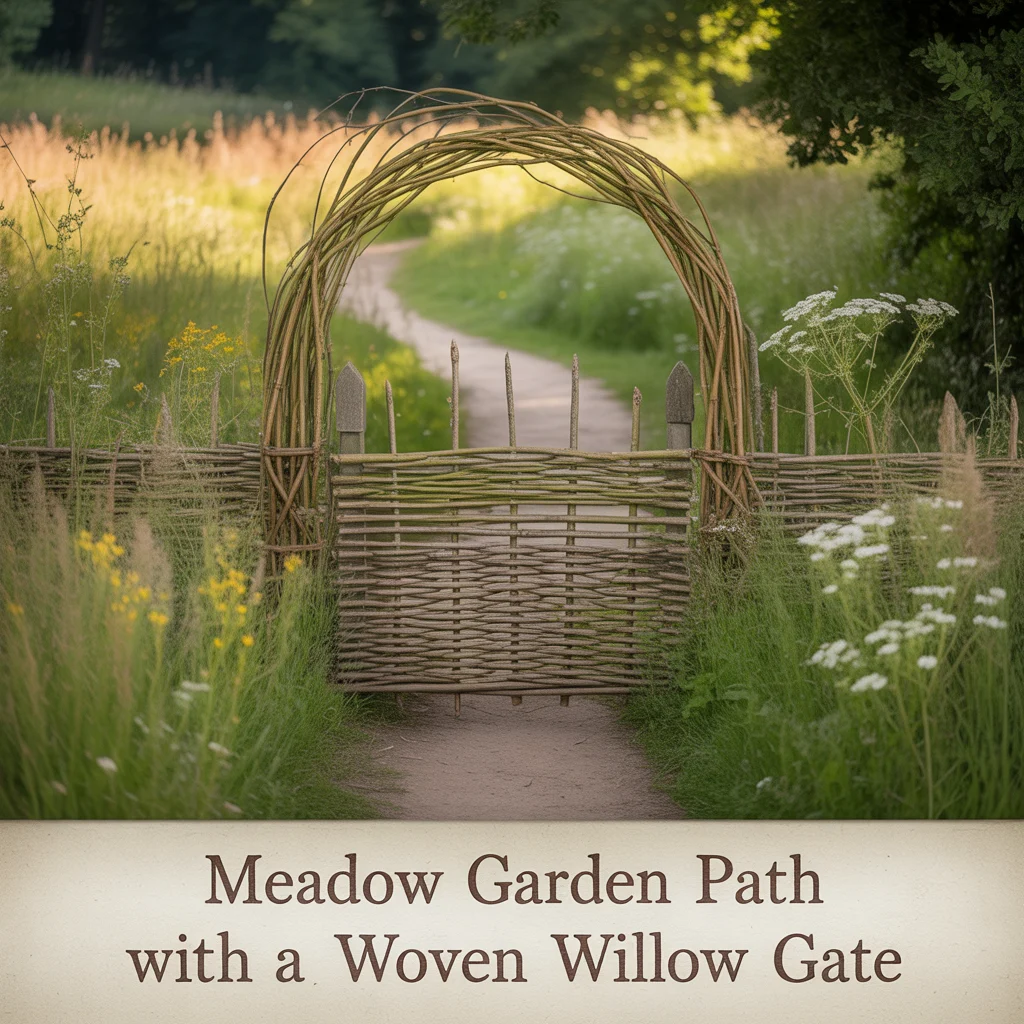
A meadow garden path with a woven willow gate uses a mown grass strip through a wildflower meadow with a gate made from woven or constructed willow branches that suits the naturalistic character of the meadow planting around it. I made a woven willow gate for a meadow path entrance three years ago using freshly cut willow rods harvested from a local coppice, woven between four upright stakes of the same willow material. The finished gate cost $0 in materials because all the willow came from my own coppice planting, and though it lasted only four years before the willow decayed at the base, the entirely natural appearance suited the meadow setting better than any manufactured gate could have.
Woven Willow Gate Construction Method
A woven willow gate is constructed by driving four upright stakes of 1-inch-diameter willow into two horizontal base rails of 2-inch-diameter material, spacing the uprights at equal intervals of 8 to 10 inches across the gate width. Horizontal rods of 0.5-inch-diameter willow are then woven alternately in front of and behind the uprights across the full width of the gate, packed tightly together to produce a solid woven surface. I completed a 36-inch-wide by 42-inch-tall woven gate in approximately 3 hours using 40 horizontal rods and 4 uprights. The finished gate weighs 9 pounds, which is light enough to hang on a single pair of standard gate hinges without risk of post movement.
Lifespan and Alternatives to a Woven Willow Gate
A woven willow garden gate made from freshly cut green willow lasts 3 to 6 years before decay at the base joints makes replacement necessary, which suits a meadow or naturalistic garden setting where periodic renewal of features is acceptable. For a longer-lasting natural-style gate on a meadow path, a hazel hurdle gate made from split hazel rods lasts 8 to 12 years and costs $60 to $120 from countryside suppliers. A gate made from pressure-treated rough-sawn timber boards in a rustic style provides the natural visual character of a willow or hazel gate with a lifespan of 15 to 25 years, which is the practical option for a meadow path gate in a garden where annual replacement is not a preference.
Japanese Garden Path With a Timber Torii-Style Gate

A Japanese garden path with a timber torii-style gate uses a simplified version of the traditional Japanese shrine gate, consisting of two upright posts connected by two horizontal crossbeams at the top, as the entry marker over a garden path. I built a simplified torii gate for a gravel and stepping stone Japanese-inspired garden path using two 5-inch-square posts of pressure-treated softwood stained black, connected by two horizontal 3-by-4-inch beams, the upper one projecting 6 inches beyond each post face and the lower one sitting flush between the posts. The total material cost was $95, and the gate-without-door design suited the Japanese garden path aesthetic where the torii marks the threshold without physically blocking passage.
Dimensions for a Garden Path Torii Gate
A torii gate for a garden path uses two posts of 4 to 5 inches square set at a width of 48 to 60 inches, with the lower horizontal beam at a height of 84 inches above the path surface and the upper beam 10 to 12 inches above the lower one. Post heights of 96 to 108 inches provide the correct proportional relationship between the post and the two-beam top detail, which requires 10 to 14 inches of post height above the upper beam. I set my posts at 102 inches overall height, placed the lower beam at 84 inches, and the upper beam at 95 inches, which produced proportions consistent with the torii gates I referenced from Japanese garden design publications.
Stain Colors for a Japanese Garden Path Torii Gate
Black, red oxide, and natural cedar are three stain colors suited to a torii gate on a Japanese garden path. Black is the most commonly used color for a torii gate in a domestic Japanese-inspired garden because the dark color creates a strong visual contrast with the surrounding green planting and pale gravel path surface. Red oxide, the traditional color of shrine torii in Japan, creates a bolder, more colorful entrance and suits a Japanese garden path with strong seasonal planting in the surrounding beds. Natural cedar color suits a Japanese garden path in a more naturalistic setting where a dark or strong color would look out of place against the surrounding woodland or shade planting.
Side Passage Path With a Security Timber Gate
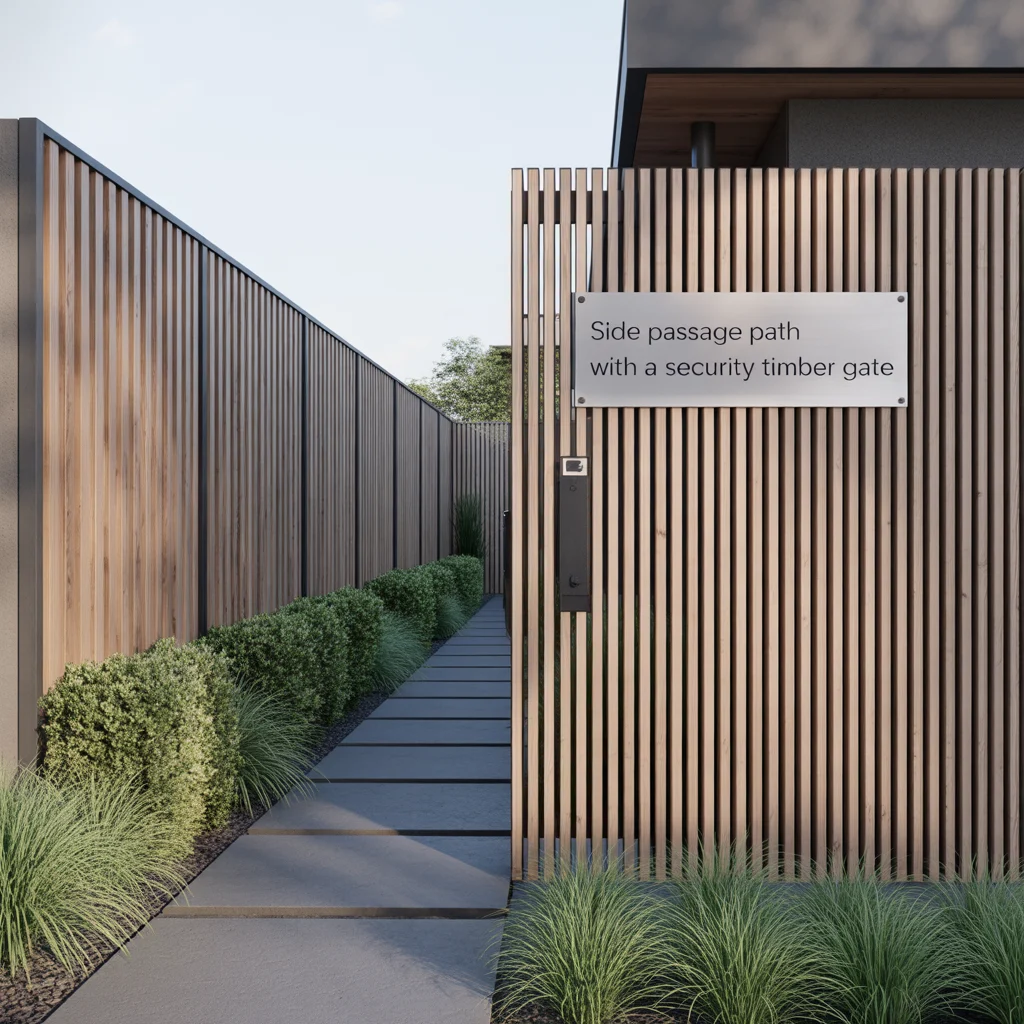
A side passage path with a security timber gate uses a tall, solid-boarded gate of 72 to 84 inches in height between two substantial posts to create a secure boundary between a front garden path and a rear garden, which is one of the most practical and widely installed versions of garden paths with gates in residential properties. I installed a 72-inch-tall close-boarded security gate on my own side passage using two 5-by-5-inch oak posts set 30 inches in post-mix concrete and a gate made from 4-inch-wide tongue-and-groove boards fixed to a 3-by-3-inch treated softwood frame. The gate closes flush against a 4-by-2-inch stop batten fixed to the latch post, creating a surface with no visible gap between the gate face and the post.
Security Gate Hardware for a Side Passage Path
A security gate on a side passage garden path requires heavy-duty hardware rated for the gate weight and height, including coach bolt-fixed hinges, a locking latch or padlock bolt, and a security hinge on the latch side to prevent the gate from being lifted off its hinges from the outside. Heavy-duty band and hook hinges rated at 100 pounds per pair suit a close-boarded gate of 72 inches height and 36 to 42 inches width. A locking gate latch with a key-operated cylinder costs $25 to $60 and allows the gate to be locked from both sides. A security hinge, also called a dog bolt hinge, adds a fixed pin on the latch side of the gate that prevents removal of the gate even if the hinge pins are knocked out.
Timber Boarding Options for a Security Side Gate
Tongue and groove boards, featherboard, and smooth-planed boards are three timber boarding options for a security side passage gate on a garden path. Tongue and groove boards of 4-inch width produce a completely flush, gap-free surface on both faces of the gate and cost $1.20 to $2.50 per linear foot in pressure-treated softwood. Featherboard, also called hit and miss boarding, overlaps adjacent boards by 0.5 inches, producing a surface with no gaps while allowing slight air movement, and costs $0.80 to $1.80 per linear foot. Smooth-planed boards of 4 to 6 inches width produce a cleaner, more finished appearance suited to a painted security gate and cost $1.50 to $3.00 per linear foot in prepared softwood.
Garden Path With a Double wooden Gate Entrance
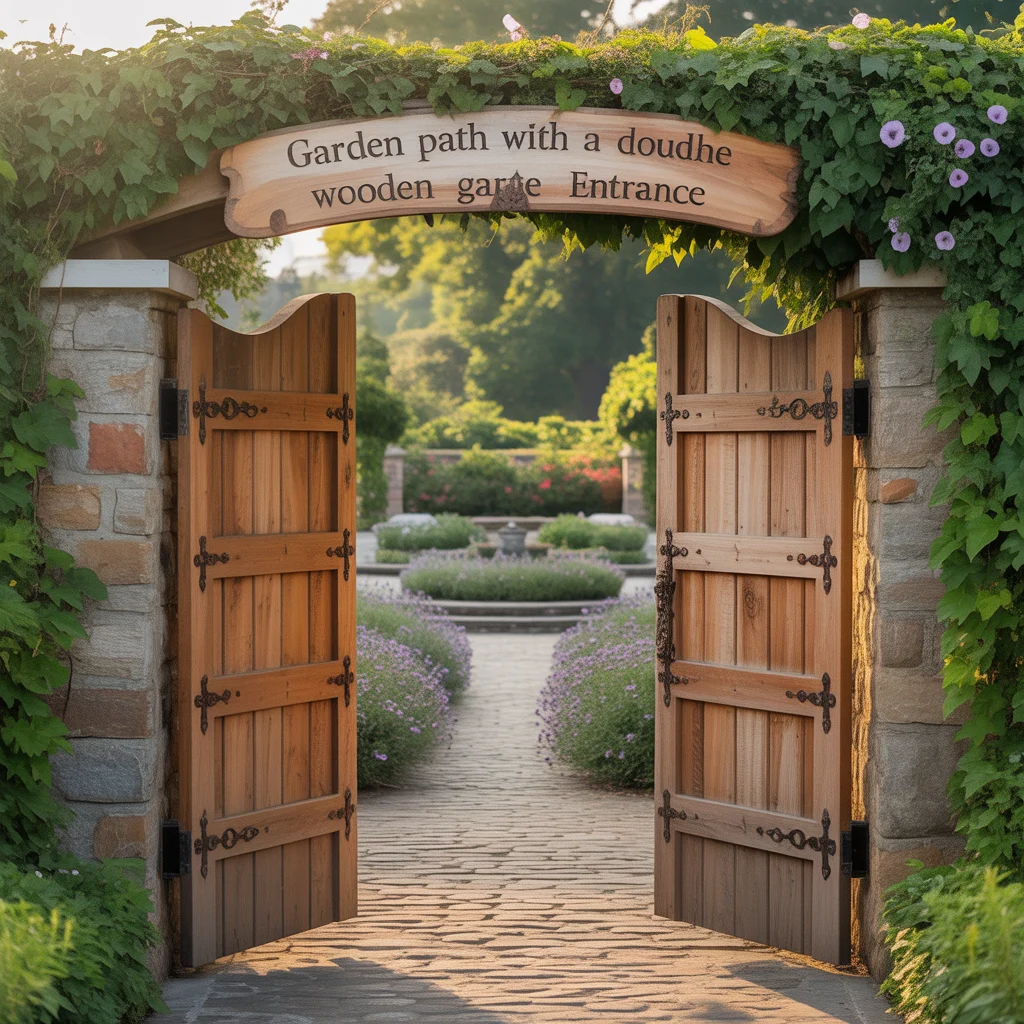
A garden path with a double wooden gate entrance uses two gates hung from three posts, the center post carrying one hinge from each gate, to create a wider opening than a single gate provides at a path entrance of 72 inches or more in width. I designed and installed a double wooden gate entrance for a 6-foot-wide driveway-adjacent garden path using two oak-framed gates of 36 inches each in width and 54 inches in height, hung from three 5-by-5-inch oak posts. The double gate format allowed a 72-inch clear opening when both gates were folded back against the outer posts, which was wide enough to bring garden machinery and large equipment through the entrance without difficulty.
Center Post Specification for a Double Garden Gate
A center post for a double wooden garden gate on a garden path carries the inward-facing hinges of both gates and requires a larger section than the outer posts to accommodate the hinge hardware on both faces without the fixings interfering with each other. A center post of 5 by 5 inches or 6 by 6 inches provides enough face width on each side for a full set of three hinges per gate without the bolt fixings passing through to the opposite face. I used a 6-by-6-inch oak center post set 30 inches in post-mix concrete on my double gate installation and found it completely rigid after three years of daily use with no movement at the post base.
Double Gate Closing Mechanisms for a Garden Path
A flush bolt, a drop bolt, and a gate stop post are three closing mechanisms for a double wooden garden gate on a garden path. A flush bolt is fitted to the inside face of the first-closing gate and slides vertically into a socket in the path surface and a socket in the overhead beam above, holding the first gate fixed while the second gate closes against it and latches. A drop bolt uses gravity to drop a steel rod from the inside face of the first gate into a metal socket set in the path surface, which is simpler to install than a flush bolt because it requires no overhead fixing point. A gate stop post set in the path surface at the center of the opening provides a physical stop for the first gate without any hardware fitted to the gate itself.
Garden Path With a Living Willow Arch Gate
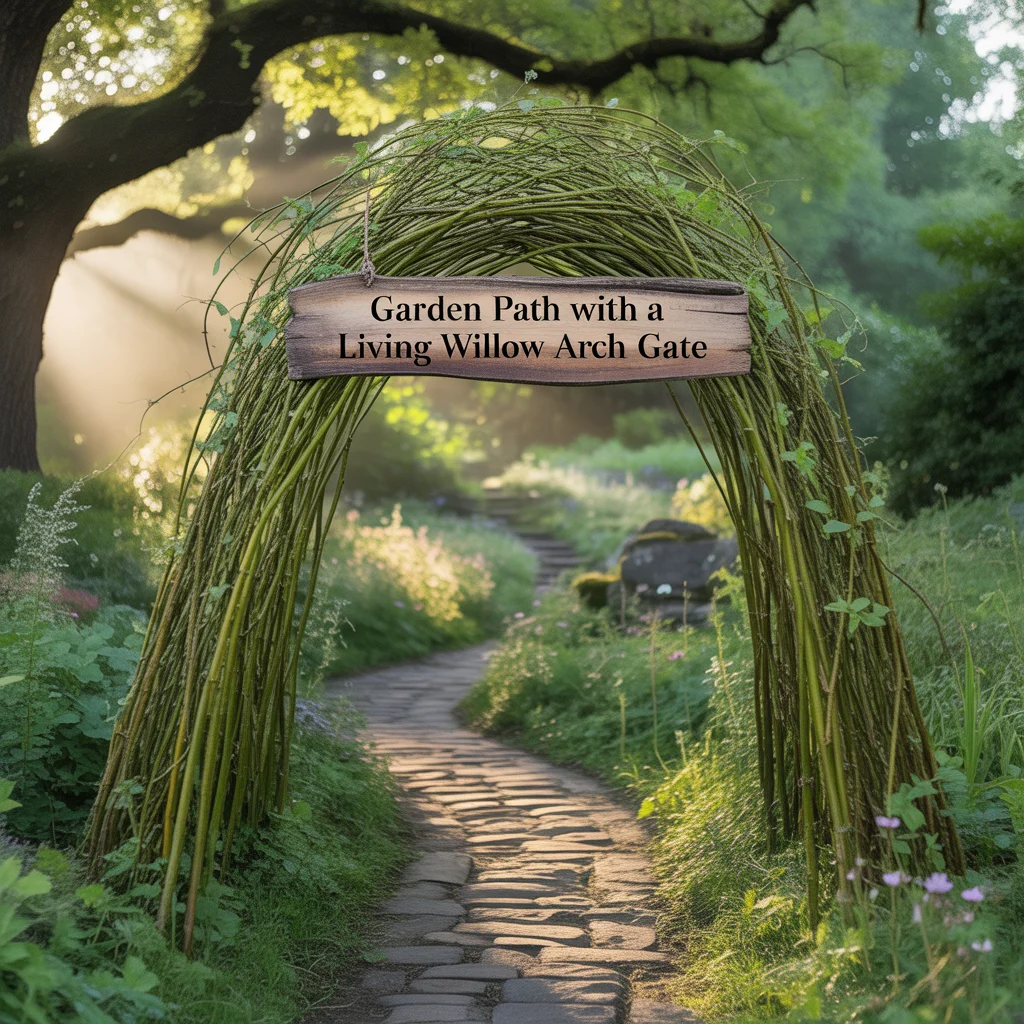
A garden path with a living willow arch gate uses freshly planted living willow rods inserted into the soil on both sides of the path and woven together overhead to create a gate structure that is alive, growing, and self-renewing rather than a fixed manufactured product. I planted a living willow arch on a garden path four years ago using 12-inch-long willow cuttings of Salix viminalis inserted at 8-inch intervals on both sides of a 3-foot-wide path, woven together at the top after the first growing season when the rods had reached sufficient height. By the third season the arch was fully established at 84 inches tall and had developed a dense woven overhead canopy that required one pruning per year to maintain its gate-like profile.
Willow Species for a Living Arch Garden Gate
Salix viminalis, Salix purpurea, and Salix daphnoides are three willow species suited to a living arch garden path gate. Salix viminalis, the common osier willow, is the most widely planted species for living willow structures because it produces long, straight rods of 6 to 10 feet in a single season and roots readily from cuttings inserted directly into moist soil. Salix purpurea produces thinner, more flexible rods in a grey-green color and suits a more delicate arch profile on a narrow garden path. Salix daphnoides produces the largest rod diameter of the three species and suits a bold, substantial arch on a wider path entrance of 4 feet or more.
Maintaining a Living Willow Arch on a Garden Path
A living willow arch on a garden path requires one main pruning per year in late February or early March, before the new growing season begins, in which all the previous year’s growth is cut back to two to four buds from the main framework rods. This pruning controls the overall size of the arch and stimulates dense new rod growth from the cut points, which maintains the woven profile of the structure. I complete the annual pruning on my living willow arch in approximately 90 minutes using sharp secateurs on the finer rods and a pruning saw on any rods that have developed to more than 1 inch in diameter at the base, which I cut out entirely to prevent the arch from becoming too heavy and open in structure.
Formal Garden Path With Stone Pillars and Wooden Gates
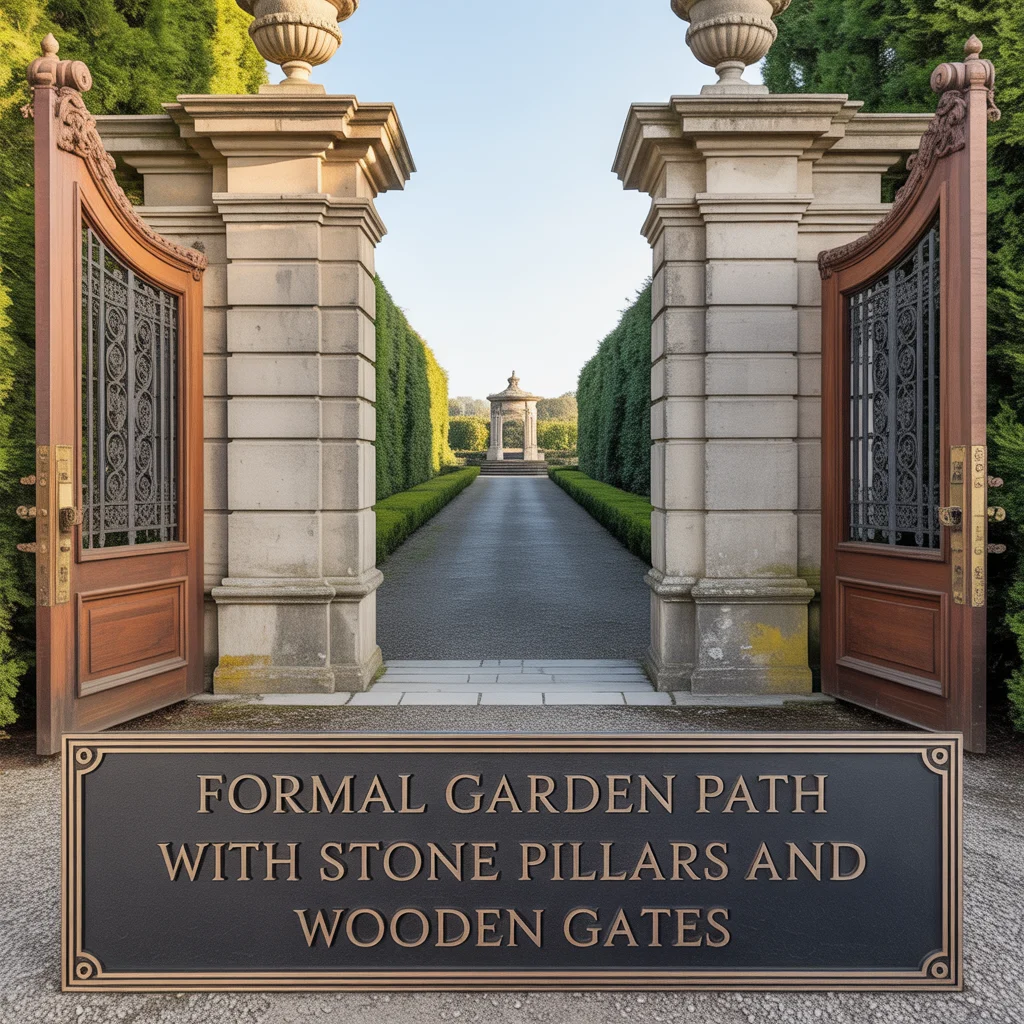
A formal garden path with stone pillars and wooden gates uses constructed or reclaimed stone pillars as the gate supports in place of timber posts, creating a more permanent and architecturally substantial entrance that suits walled gardens, period properties, and formal garden layouts where timber posts would look insufficiently solid for the scale of the space. I studied this combination at a country house garden where two dressed sandstone pillars of 18 by 18 inches in plan and 72 inches in height supported a pair of oak gates with diagonal-braced boarding, and the combination of the pale sandstone pillars and the warm oak gates produced an entrance of real architectural presence.
Stone Pillar Construction for a Formal Gate Entrance
Stone pillars for a formal garden path gate are constructed from dressed stone blocks, random rubble stone, or reclaimed stone laid in courses with a lime mortar joint on a concrete foundation of 150mm depth and a plan area 150mm larger than the pillar base on each side. Dressed stone pillars of 18 by 18 inches in plan use two blocks per course laid with their long axes alternating at 90 degrees, producing a solid pillar without a hollow center. I assisted in building two dressed sandstone pillars for a formal gate installation and found the most time-consuming part was selecting and cutting the stone to produce level, consistent course heights, which required a diamond disc angle grinder on the harder stone pieces.
Gate Hardware for Stone Pillar Mounted Wooden Gates
Wooden gates hung from stone pillars require hinge hardware fixed into the stone rather than screwed into timber, which demands either cast-in hinge sockets set during pillar construction or surface-mounted hinge straps fixed with masonry anchors after the pillar is complete. Cast-in hinge sockets, also called pintles, are the most secure option and require the hinge socket positions to be planned accurately before the pillar is built, with the pintle embedded in mortar during construction. Surface-mounted strap hinges fixed with M10 stainless steel masonry anchors drilled into the finished pillar face are the more practical option for retrofitting gates to existing stone pillars and provide a pull-out resistance of 800 to 1,200 pounds per anchor in sound stone.
Kitchen Garden Path With a Traditional Painted Wooden Gate
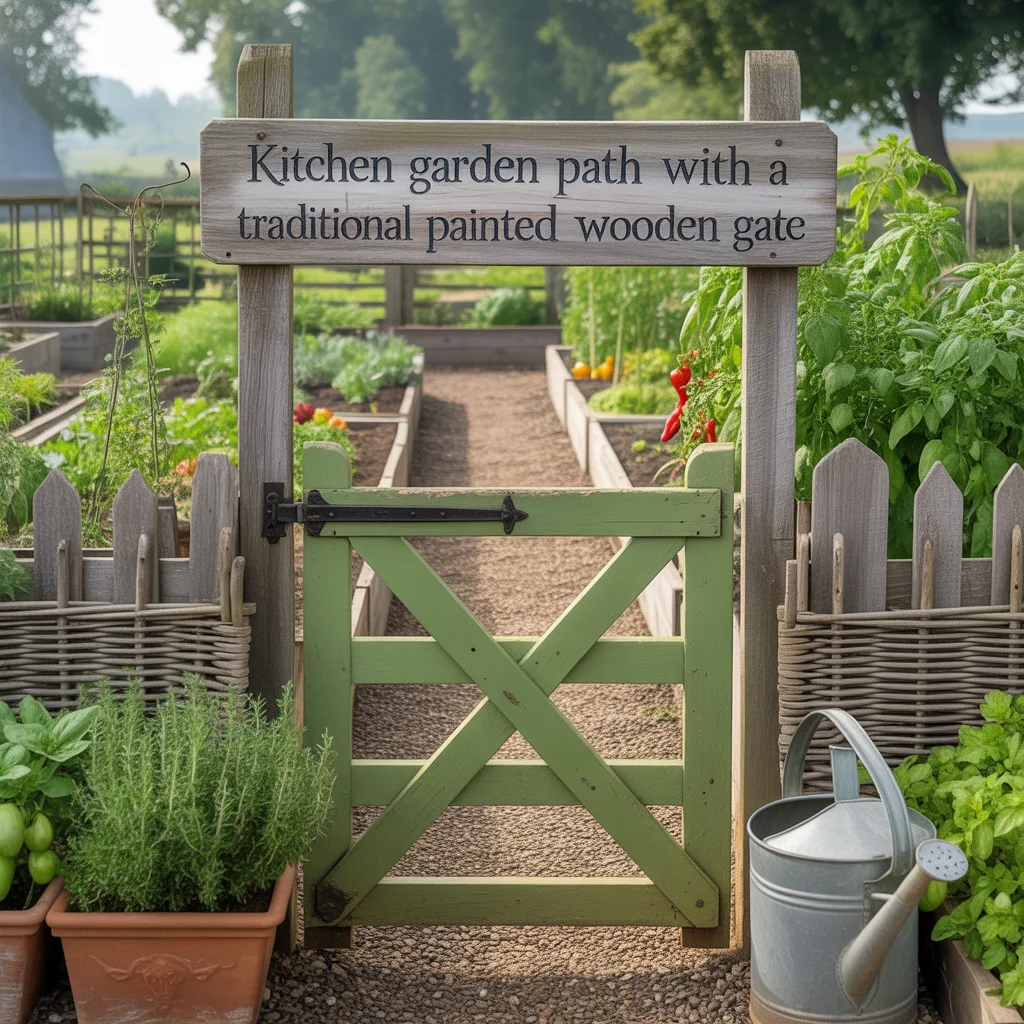
A kitchen garden path with a traditional painted wooden gate marks the entrance to a productive growing space in a way that is both practical and visually pleasing, combining the working character of a vegetable or cutting flower garden with the structured appearance of a defined entrance. I painted my own kitchen garden gate in a deep slate blue exterior wood paint three years ago, and the color change from the previous bare wood finish made the kitchen garden entrance look like a considered design feature rather than a purely functional boundary. The gate itself is a simple 5-bar farm gate style in softwood, measuring 42 inches wide and 48 inches tall, hung between two oak posts.
Traditional Gate Styles for a Kitchen Garden Path
A five-bar gate, a ledged and braced gate, and a boarded cottage gate are three traditional wooden gate styles suited to a kitchen garden path. A five-bar gate uses five horizontal rails connected by two diagonal braces between two vertical stiles, producing a lightweight, open gate that suits a kitchen garden path where visibility into the growing space is desirable. A ledged and braced gate uses three horizontal ledgers on the inside face with one diagonal brace, producing a simple, workmanlike gate suited to a productive kitchen garden setting. A boarded cottage gate adds vertical boarding to the ledged and braced frame, producing a more solid gate that suits a kitchen garden enclosed by a solid wall or close-boarded fence.
Paint Colors for a Kitchen Garden Wooden Gate
Slate blue, sage green, and deep red oxide are three paint colors suited to a traditional wooden kitchen garden gate on a garden path. Slate blue in a deep, muted tone suits a kitchen garden path surrounded by grey stone walls or flint boundary walls and creates a strong visual contrast with the green of the surrounding planting. Sage green suits a kitchen garden path in a cottage or informal garden style where the gate color coordinates with the foliage tones of the herbs and vegetables planted on both sides. Deep red oxide suits a kitchen garden with red brick boundary walls or raised beds, where the warm red-brown gate color creates a tonal match with the brick material and gives the entrance a warm, traditional appearance.
Frequently Asked Questions
What is the standard size of a garden path gate?
A standard garden path gate measures 36 inches in width and 48 inches in height, which suits a path of 3 to 4 feet wide and provides comfortable passage for a single adult with or without garden equipment. Gates of 36 inches width are the most widely stocked size in pre-made timber and metal garden gate ranges. For a path used by two people simultaneously or for bringing garden machinery through, a gate of 48 inches width is the recommended minimum. Security gates for side passages are typically 72 to 84 inches in height rather than the standard 48 inches, to prevent easy climbing. I have installed gates ranging from 30 to 72 inches in width across different garden path projects and found 36 inches the most consistently practical single-gate width.
What is the most durable material for a garden path gate?
Oak hardwood, powder-coated aluminium, and wrought iron are the three most durable materials for a garden path gate, each suited to a different garden style and maintenance preference. Oak gates last 25 to 40 years with an annual oil treatment and suit traditional, cottage, and formal garden path designs. Powder-coated aluminium lasts 20 to 25 years without repainting and suits modern and contemporary garden gate designs where low maintenance is a priority. Wrought iron, or modern mild steel fabricated to replicate wrought iron, lasts 20 to 30 years with an annual inspection and rust treatment and suits period and formal garden path entrances. Pressure-treated softwood is the least expensive option and lasts 15 to 20 years with regular painting or staining.
How do I stop a wooden garden gate from sagging?
A wooden garden gate stops sagging when a correctly fitted diagonal brace runs from the bottom hinge corner to the top latch corner of the gate frame, transferring the weight of the latch side of the gate back to the hinge posts through compression rather than relying solely on the rigidity of the frame joints. A diagonal brace that runs from the top hinge corner to the bottom latch corner works in tension rather than compression and is less effective at preventing sag over time. I corrected a sagging gate on a garden path by removing the existing incorrectly oriented brace and refitting it in the correct direction, which resolved the sag immediately without replacing any other part of the gate. Three heavy-duty hinges rather than two also significantly reduce the tendency of a tall gate to sag at the latch side.
What plants grow best around a garden path gate?
Climbing roses, clematis, and wisteria are the three plants that grow most effectively around a garden path gate because all three are climbing plants that use the gate posts and arch as a support structure and produce flowers at eye level where they are most visible and fragrant at the point of entry. Climbing roses including New Dawn and Zephirine Drouhin suit a wooden arched gate on a cottage garden path and cover the arch fully within two to three seasons. Clematis montana suits a simple gate post without an arch and reaches 20 to 30 feet in height within five years, draping over the gate top in a natural curtain of flower. Wisteria suits a formal brick pier gate entrance and produces hanging flower clusters up to 12 inches long in May.
How much does it cost to install a garden path gate?
The cost of installing a garden path gate ranges from $28 for a simple DIY timber gate on a herb garden path to $1,500 or more for a pair of wrought iron gates between brick piers on a formal path entrance. A pre-made softwood picket gate hung between two pressure-treated posts costs $150 to $280 in materials for a standard 36-inch-wide path. A custom hardwood gate in oak or iroko costs $300 to $600 for a single gate plus $80 to $150 for installation hardware and post fixings. Metal garden gates in powder-coated steel or aluminium cost $180 to $500 for a single gate at standard path widths. I have completed gate installations across this full cost range and found that the most cost-effective designs are always the simplest, where the gate material and finish suit the garden style without requiring complex fabrication or specialist installation.