
24 Garden Paths With Borders That Create a Finished Look

I relaid a perfectly functional stone path in my front garden three years ago, not because the stones were damaged or uneven, but because the path had no borders on either side. The stones ended at the lawn edge with nothing to separate the path surface from the surrounding grass, and the whole path looked unfinished despite being structurally sound. I added a brick soldier course border on one side and a lavender planting border on the other, and the path immediately looked like a designed feature rather than a practical afterthought. The difference a border makes to a garden path is genuinely difficult to overstate.
Garden paths with borders combine a walkable surface with a defined structural or planted edge on one or both sides, giving the path a clear visual boundary that separates it from the surrounding garden, strengthens its appearance as a designed feature, and adds decorative interest through materials, plants, or a combination of both. The border gives the path definition, and the path gives the border a clear linear structure to follow.
Since that front garden project, I have studied and installed many walkway border ideas across different styles, materials, and budgets. I have seen simple garden paths with borders transform a basic gravel track into a formal garden feature, and I have seen modern garden path ideas where a single steel edging border produced a complete contemporary design.
In this article, I am sharing 24 garden paths with borders that I have either created myself or researched thoroughly enough to recommend with full confidence.
Lavender Border Garden Path
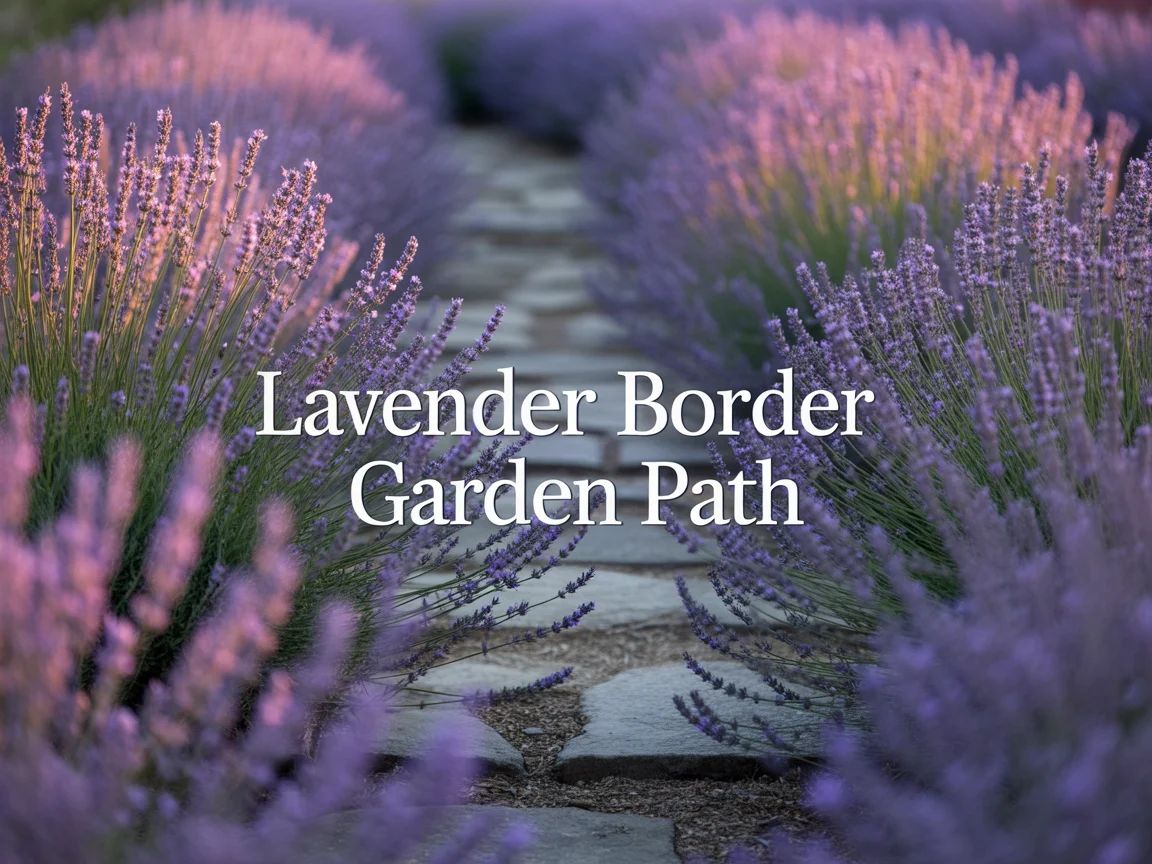
A lavender border garden path plants Lavandula angustifolia along one or both sides of a garden path to create a fragrant, structured planted border that provides a clear visual edge to the path while adding seasonal colour and scent from June to August. I planted a double lavender border alongside a 20-foot York stone path at a residential project, using Lavandula angustifolia Hidcote at 18-inch spacing in two staggered rows, and the border produced a dense, even hedge of 18 inches height that defined the path edge more clearly and attractively than any structural edging material I had used on previous projects. The fragrance on warm June afternoons was an additional quality the homeowner had not anticipated when the design was agreed.
Lavender Varieties for a Garden Path Border
Lavandula angustifolia Hidcote, Lavandula angustifolia Munstead, and Lavandula angustifolia Alba are three lavender varieties suited to a garden path border. Hidcote produces the deepest purple flower spikes and the most compact growth habit at 18 to 24 inches height, making it the most widely used lavender for a formal path border where a tight, even hedge is the design intention. Munstead produces slightly lighter purple flowers at the same height and spreads marginally wider than Hidcote, suiting a path border where a fuller, less rigidly formal appearance is preferred. Alba produces white flower spikes that suit a path border alongside pale stone or white-painted surfaces where a purple lavender would create too strong a contrast with the surrounding materials.
Spacing and Planting a Lavender Path Border
Lavender for a garden path border is planted at 18-inch centers in a single row for a path border of moderate formality, or at 12-inch centers in a double staggered row for a denser, more formal hedge-like border. I plant lavender in spring between March and May to allow root establishment before the first flowering season, watering weekly for the first six weeks after planting and applying a 1-inch layer of fine gravel mulch around each plant base to suppress weeds and retain moisture during establishment. A single row at 18-inch spacing for a 20-foot path requires 14 plants per side, costing $28 to $56 per border row at standard garden centre prices of $2 to $4 per plug plant.
Brick Soldier Course Border Path
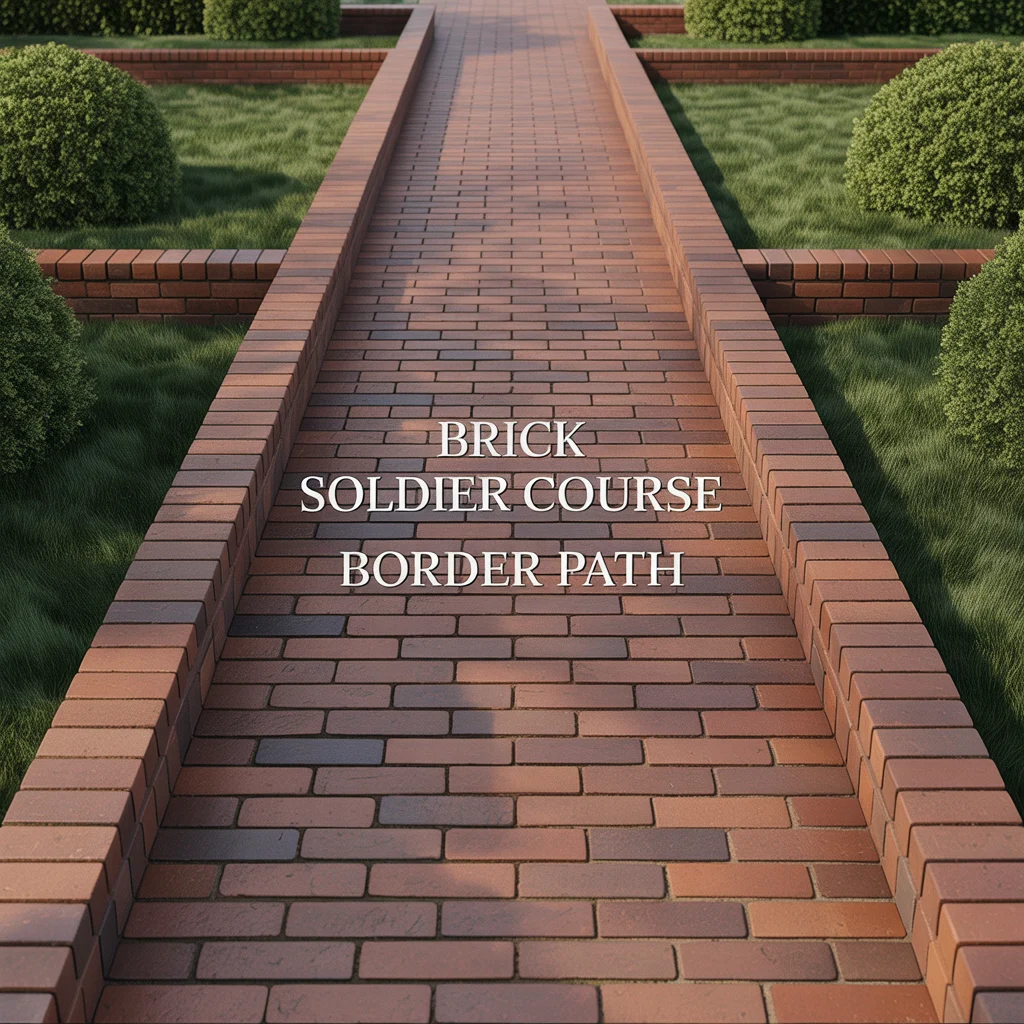
A brick soldier course border path uses bricks set upright with their narrow 65mm face exposed at the path edge to create a formal, defined structural border that suits both brick and stone path surfaces equally well. I added a brick soldier course border along one side of an existing gravel path at a cottage garden project, setting the upright bricks in a 1-inch dry mortar bed along the full 25-foot path length, and the border transformed the loose-edged gravel path into a formally contained walkway that required significantly less raking to maintain the gravel within the path boundaries after the border was installed.
Setting Brick Soldier Course Path Borders
Brick soldier course borders on a garden path are set by placing each brick vertically on its 215mm by 65mm bed face in a continuous line along the path edge, with the narrow 102.5mm brick width running across the path direction and the 65mm face forming the visible vertical surface at the path edge. Each brick is bedded in a 1-inch layer of 4:1 dry-mix mortar pressed firmly beneath the brick base, with a plumb check on the face and a level check on the top before the mortar sets. I use a string line at the correct top face height stretched between two pins at each end of the path to maintain consistent soldier brick height across the full border length without repeated individual checking.
Brick Colors for a Soldier Course Path Border
Red clay bricks, blue-black engineering bricks, and yellow stock bricks are three brick colors suited to a soldier course border on a garden path with borders. Red clay bricks suit a cottage, Victorian, or traditional garden path where the warm red-orange color of the border brick coordinates with existing brick buildings or walls in the surrounding garden. Blue-black engineering bricks produce the sharpest visual contrast between the path surface and the border, suiting a formal or period garden path where a bold defined edge is the design intention. Yellow stock bricks suit a garden path at a Georgian or Regency property where the yellow brick material is consistent with the architectural character of the surrounding buildings and boundary walls.
Box Hedge Border Garden Path
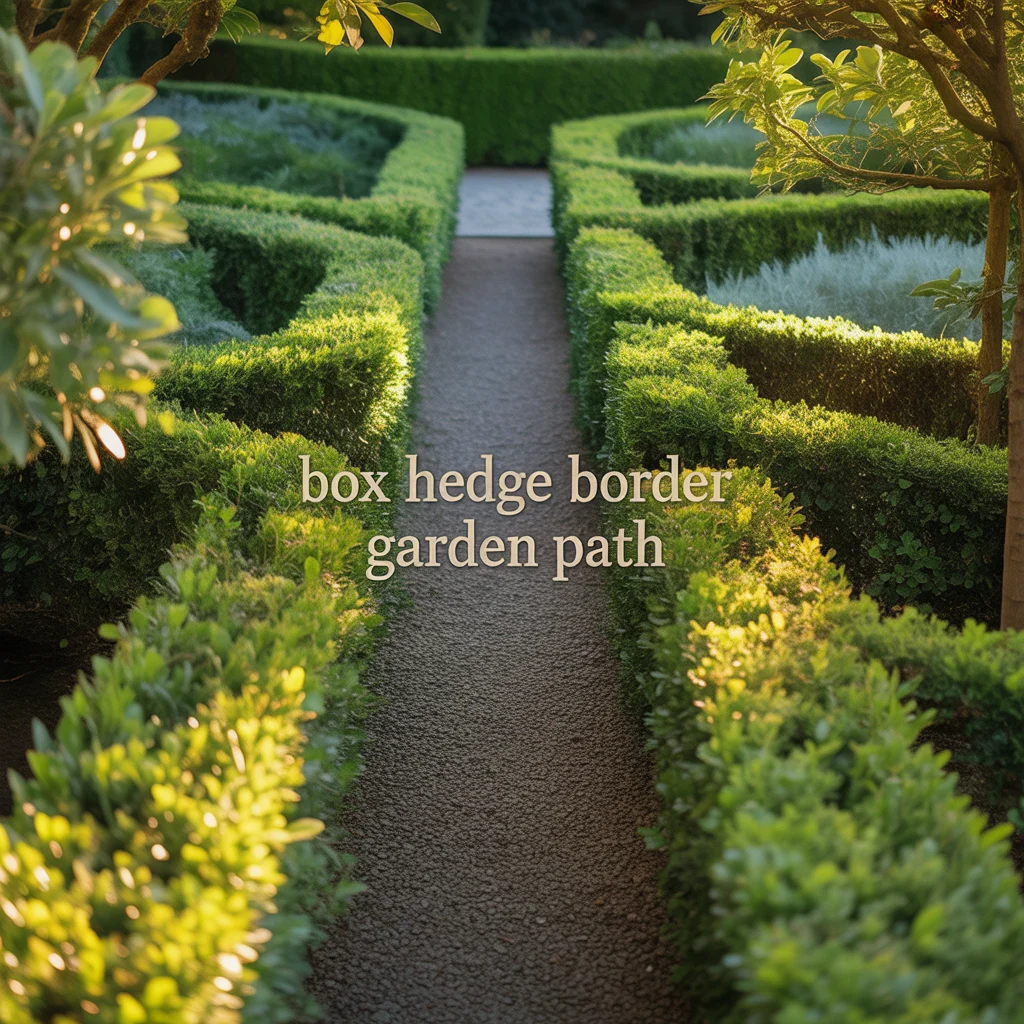
A box hedge border garden path uses clipped Buxus sempervirens hedging plants along one or both sides of the path to create the most formally precise planted border available in garden design, producing a low, tight green hedge of 12 to 18 inches height that defines the path edge with the same clarity as a structural edging material while adding the biological presence of a living plant. I designed a box hedge border path at a formal walled garden project, planting Buxus sempervirens at 9-inch spacing along both sides of a 30-foot York stone path, and the clipped box hedge produced a formal corridor that made the path read as the primary organizing axis of the entire walled garden layout.
Planting Box Hedge for a Garden Path Border
Box plants for a garden path hedge border are planted at 9-inch spacing in a single row for a hedge of 12 to 18 inches height, or at 6-inch spacing for a denser border that reaches the intended height in one fewer growing season. I plant box hedge in autumn between September and November or in spring between March and April, watering weekly for the first season and applying a balanced slow-release fertilizer in March each year to maintain healthy, dense growth. A single row of box plants at 9-inch spacing for a 20-foot path requires 27 plants per side, costing $54 to $108 per border at standard garden centre prices of $2 to $4 per 9-centimeter pot plant.
Box Hedge Alternatives for a Garden Path Border
Ilex crenata, Euonymus japonicus, and Lonicera nitida are three box hedge alternatives suited to a formal planted border on a garden path with borders. Ilex crenata produces a fine-textured dark green surface visually similar to box and resists box blight, making it the most practical alternative for gardens where Cylindrocladium buxicola box blight is established in the local area. Euonymus japonicus clips to a formal edge at 12 to 24 inches height and suits a path border in a coastal garden where box and ilex struggle in exposed salt-wind conditions. Lonicera nitida grows the fastest of the three alternatives, reaching 18 inches of clipped hedge height within two seasons of planting, and suits a path border where a faster-establishing box substitute is needed.
Steel Edging Border on a Modern Garden Path
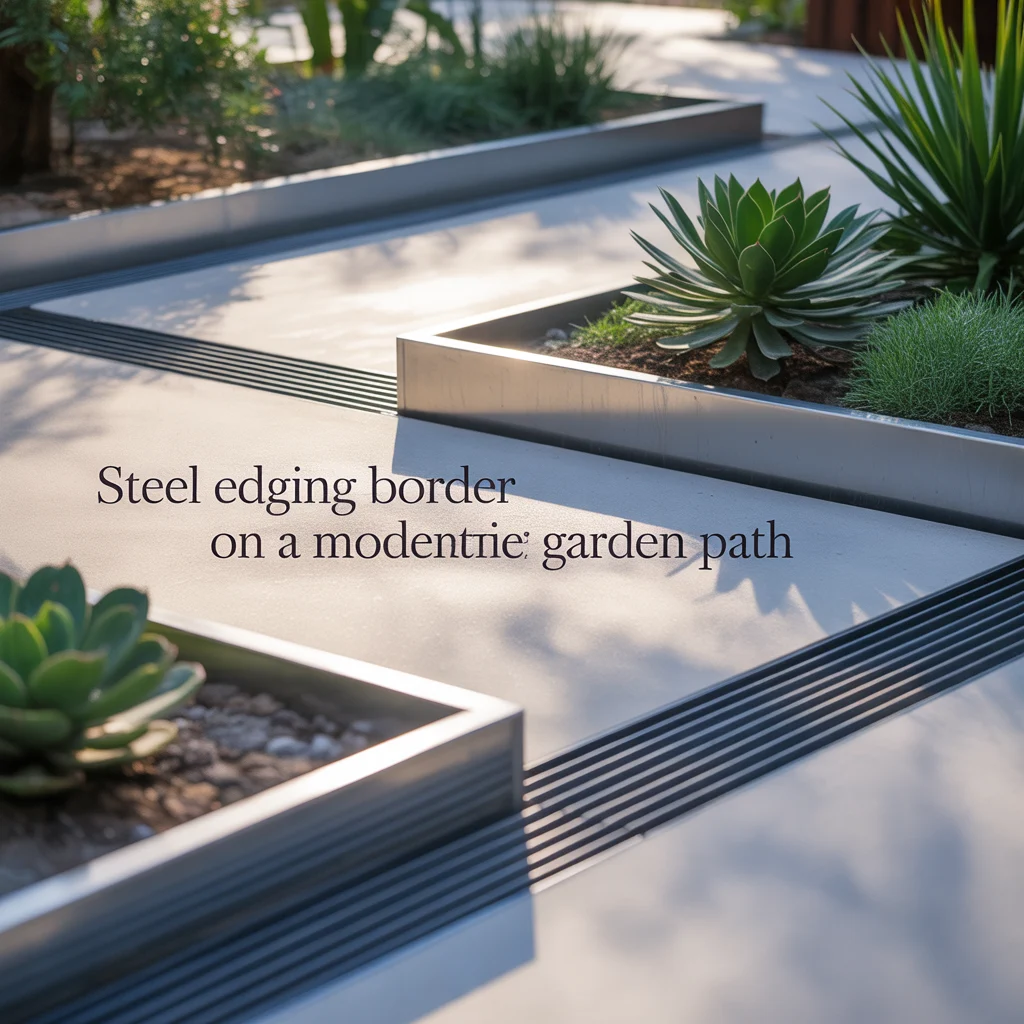
A steel edging border on a modern garden path uses 3mm-thick cor-ten or mild steel edging strips set flush with the path surface to create a precise, architectural border that suits contemporary garden path designs where clean geometric lines and minimal visual detail are the design intention. I specified cor-ten steel edging on a modern garden path at a contemporary residential project, setting 150mm-deep steel edging strips along both sides of a large-format porcelain path, and the weathering orange-brown patina of the cor-ten against the grey porcelain surface produced a modern garden path idea of strong visual character without any planted border element.
Steel Edging Types for a Modern Garden Path Border
Mild steel edging, cor-ten steel edging, and stainless steel edging are three steel edging types suited to a modern garden path with borders. Mild steel edging at 3mm thickness costs $3 to $5 per linear foot and develops a rust patina within 6 to 12 months that some homeowners find an attractive natural aging process and others prefer to prevent with an annual application of clear exterior metal lacquer. Cor-ten steel edging develops a deliberate, stable rust patina within 6 to 12 months that does not progress to structural corrosion, making it the most durable and intentionally weathering steel border option at $5 to $9 per linear foot. Stainless steel edging at $8 to $14 per linear foot remains silver-grey without any surface change over time and suits a contemporary path border where a permanent metallic finish is the design requirement.
Installing Steel Edging on a Garden Path Border
Steel edging for a garden path border is installed by driving the edging strip vertically into the soil alongside the path edge using a rubber mallet, with the top face of the edging set at the finished path surface level. Steel edging of 150mm depth requires driving 120mm into the soil, leaving 30mm of edging face visible above the path surface as a containment lip for gravel or loose path materials. I use a 600mm length of timber scrap pressed against the edging face during driving to distribute the mallet force evenly along the strip and prevent the top edge from bending or deforming during installation, which is the most common installation error on thin-gauge steel edging.
Ornamental Grass Border Garden Path
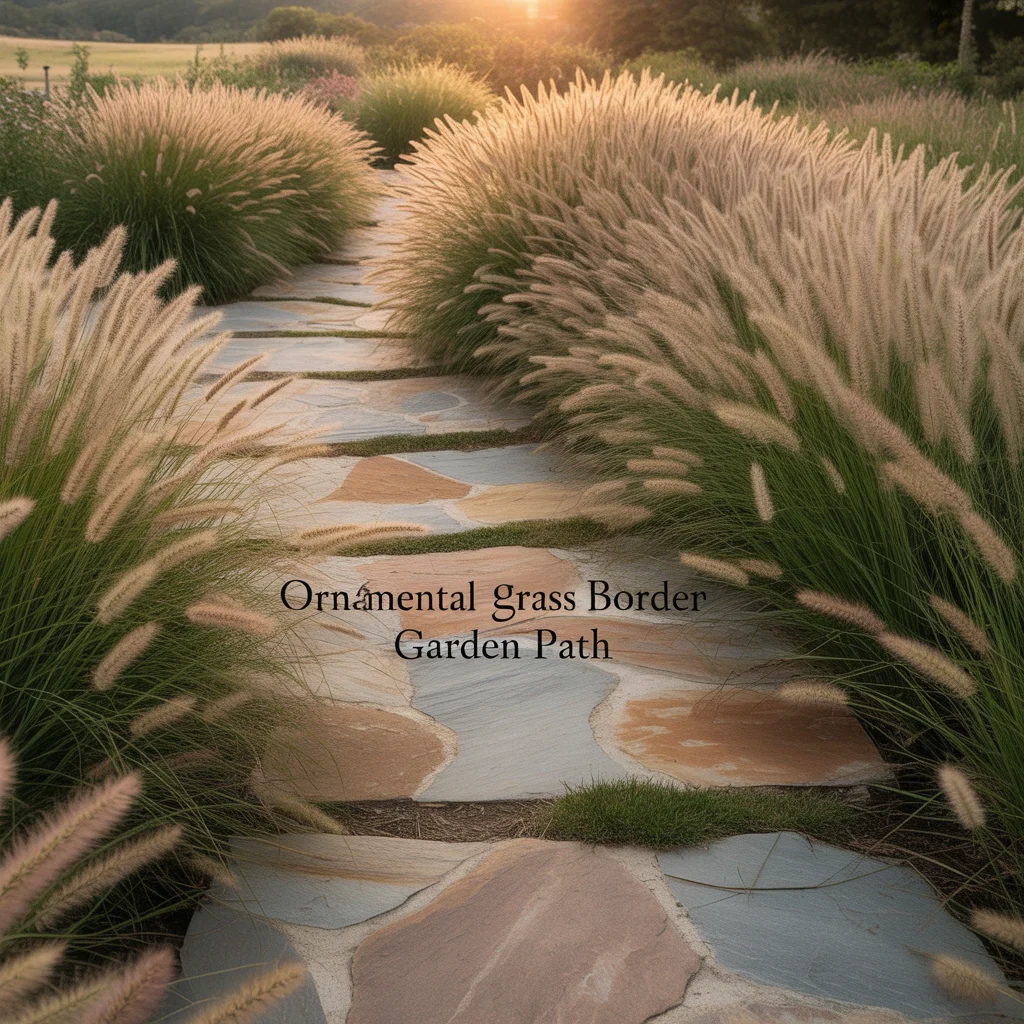
An ornamental grass border garden path plants low to medium-height ornamental grasses along one or both sides of the path to create a soft, flowing border that moves in the wind and provides year-round structural interest including seed heads and dried winter stems that remain decorative well beyond the main growing season. I planted Festuca glauca and Carex oshimensis Evergold in alternating positions along both sides of a 24-foot gravel path at a contemporary residential project, and the combination of the steel-blue Festuca and the gold-striped Carex produced a border that looked completely different in morning and afternoon light, which was an effect I had not predicted from the planting plan.
Ornamental Grass Varieties for a Path Border
Festuca glauca, Pennisetum alopecuroides, and Carex oshimensis Evergold are three ornamental grass varieties suited to a garden path border. Festuca glauca produces a steel-blue mound of fine-textured leaves at 12 inches height and 12 inches spread, providing a distinctive cool-toned border that suits contemporary and minimalist garden path designs. Pennisetum alopecuroides produces arching clumps of mid-green leaves at 24 inches height with purple-brown bottlebrush flowers from August to October, providing a taller border suited to a wider path of 4 feet or more. Carex oshimensis Evergold produces bright gold and green striped arching leaves at 12 inches height and suits a shaded path position where other ornamental grasses produce insufficient growth without direct sunlight.
Spacing Ornamental Grasses Along a Garden Path Border
Ornamental grasses for a garden path border are spaced at intervals equal to 1.5 times the mature spread of the individual plant clump, which produces a border rhythm where each grass reads as a distinct unit while the overall border line still reads as continuous. For Festuca glauca with a mature spread of 12 inches, the correct spacing interval is 18 inches. For Pennisetum alopecuroides with a mature spread of 24 inches, the correct spacing is 36 inches. I plant ornamental grass borders in spring between March and May to allow root establishment before summer, watering weekly for the first six weeks and applying a balanced granular fertilizer in March each subsequent year to maintain healthy dense clump growth.
Wildflower Border Garden Path Through Grass
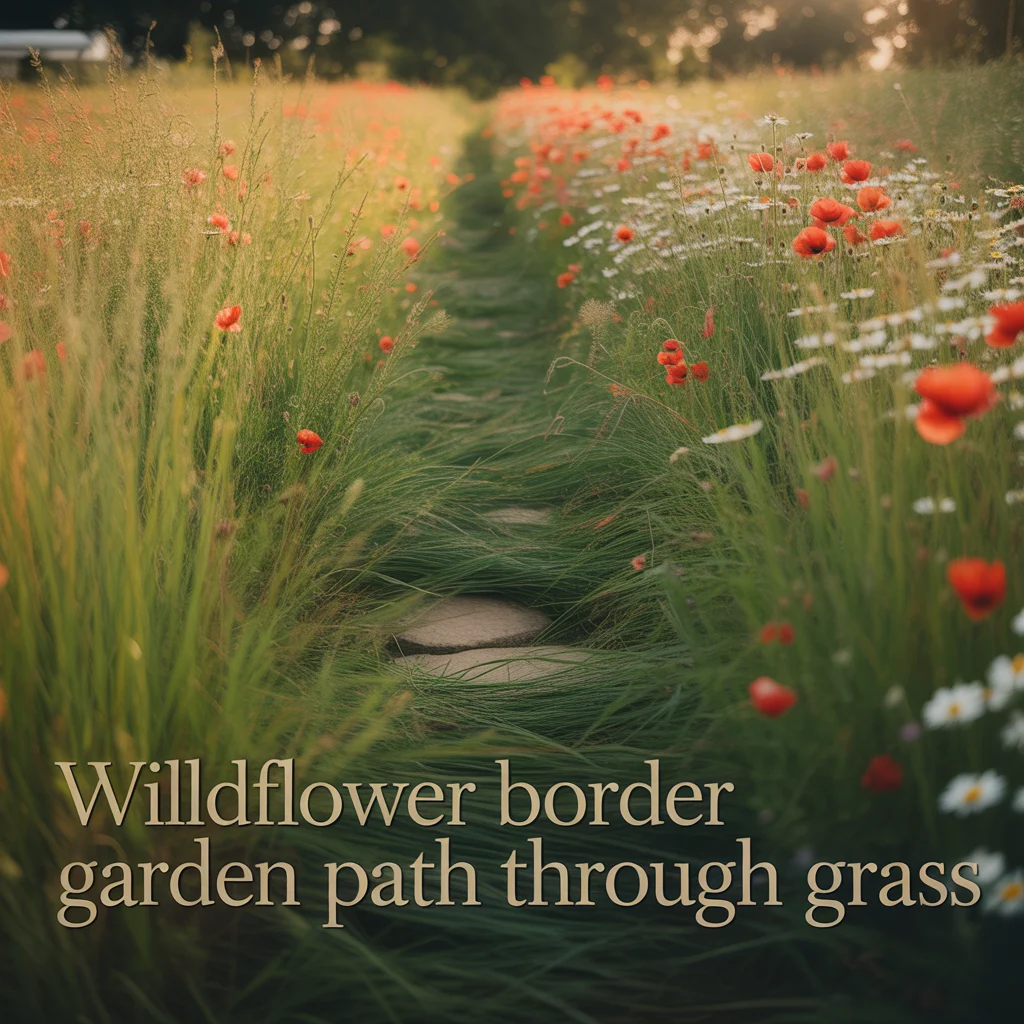
A wildflower border garden path through grass uses a mown grass strip as the path surface with wildflower meadow planting established on both sides to create a defined walking route through a naturalistic planted space, combining a simple garden path idea through grass with the seasonal colour and ecological benefit of a wildflower border. I created this design by converting 4-foot-wide strips on both sides of a 2-foot mown grass path in my back garden into wildflower areas, seeding them with a native meadow mix in April, and the wildflower border produced a path through grass that looked completely different from the plain mown lawn path it had been before the first flowers appeared in June.
Wildflower Species for a Garden Path Border Through Grass
Ox-eye daisy, field scabious, and Verbena bonariensis are three wildflower species suited to a border alongside a garden path through grass. Ox-eye daisy, Leucanthemum vulgare, produces white flowers from May to July at 24 to 30 inches height, providing the most abundant and visible flower display in the path border during the early summer period. Field scabious, Knautia arvensis, produces lilac-blue pincushion flowers from July to September at 24 to 36 inches height, extending the border flowering season beyond the ox-eye daisy period. Verbena bonariensis produces tall stems of small purple flowers from July to October at 4 to 5 feet height and suits the back of a wider wildflower path border where its height does not reduce the light reaching lower-growing species at the path edge.
Managing a Wildflower Path Border Through Grass
A wildflower border on a garden path through grass requires one main management cut per year in September or October after the last seed heads have ripened and shed their seed for the following season, using a strimmer or lawn mower on its highest setting to cut all above-ground plant material to 3 to 4 inches. The mown grass path strip between the two wildflower borders is cut at 25 to 30mm height every 7 to 10 days during the growing season from April to September, which maintains a clear contrast between the short path strip and the tall wildflower borders on both sides. I cut the path strip and the wildflower borders in two separate operations on different schedules, never cutting both on the same day.
Cottage Garden Mixed Border Path
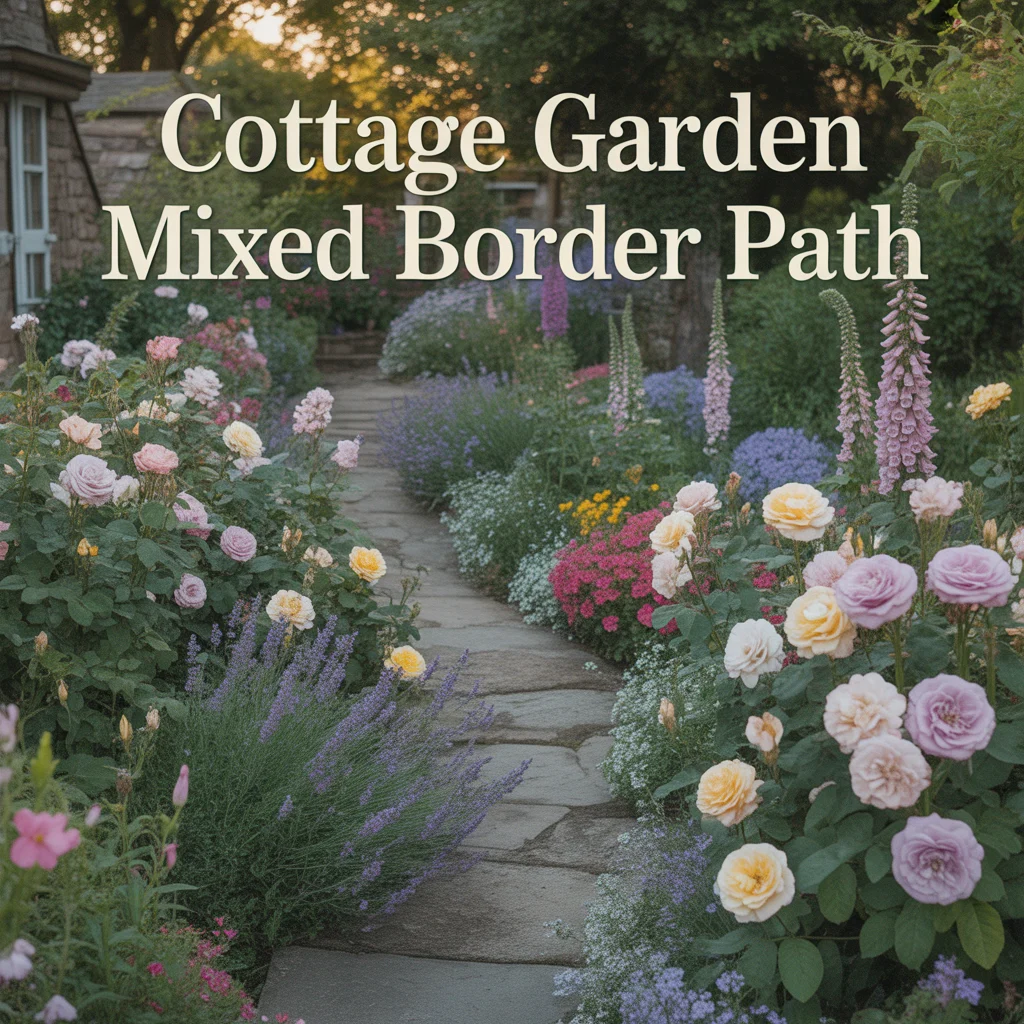
A cottage garden mixed border path uses a wide planted border of 18 to 36 inches on one or both sides of the path, containing a mixture of perennials, bulbs, biennials, and roses in an informal arrangement that produces a continuously changing seasonal display from February through October alongside the walking surface. I designed a cottage mixed border path at a residential project using Rosa Gertrude Jekyll, Alchemilla mollis, Geranium rozanne, Salvia nemorosa, and Nepeta x faassenii in drifts on both sides of a reclaimed brick path, and the combination produced a garden path with borders that was the dominant feature of the entire garden from May through September.
Perennials for a Cottage Garden Path Border
Alchemilla mollis, Geranium rozanne, and Salvia nemorosa are three perennials suited to a cottage garden mixed border alongside a garden path. Alchemilla mollis produces soft pleated leaves and small yellow-green flowers from June to August at 18 inches height, providing a low-growing, weed-suppressing border base that suits the front edge of a cottage path border at the path surface level transition. Geranium rozanne produces blue-violet flowers continuously from June to October and forms a mound of 12 inches height and 24 inches spread, providing the longest-flowering perennial coverage in a cottage path border. Salvia nemorosa produces dense violet-blue flower spikes from June to August at 18 inches height and repeats flowering if cut back immediately after the first flush. Anyone looking to extend this type of cottage planting into a fuller flower border scheme will find a comprehensive range of species, seasonal combinations, and design approaches in these garden paths with flowers as natural borders, which cover everything from lavender-lined walkways and rose-bordered paths to wildflower meadow strips and four-season flower border designs suited to different path widths and garden styles.
Roses for a Cottage Garden Path Border
Rosa Gertrude Jekyll, Rosa Munstead Wood, and Rosa The Generous Gardener are three roses suited to a cottage mixed border on a garden path with borders. Rosa Gertrude Jekyll produces large deep pink flowers with the most intensely fragrant scent of any modern English rose from June to October on a plant growing to 4 feet, suiting a back-of-border position on a path of 4 feet or more width. Rosa Munstead Wood produces deep crimson-purple flowers from June to October at 3 to 4 feet height with a strong old rose fragrance. Rosa The Generous Gardener produces soft pink flowers on a climbing or shrub form from June to October and suits the tallest back-of-border position on a wider cottage garden path border.
Formal Clipped Yew Border Garden Path
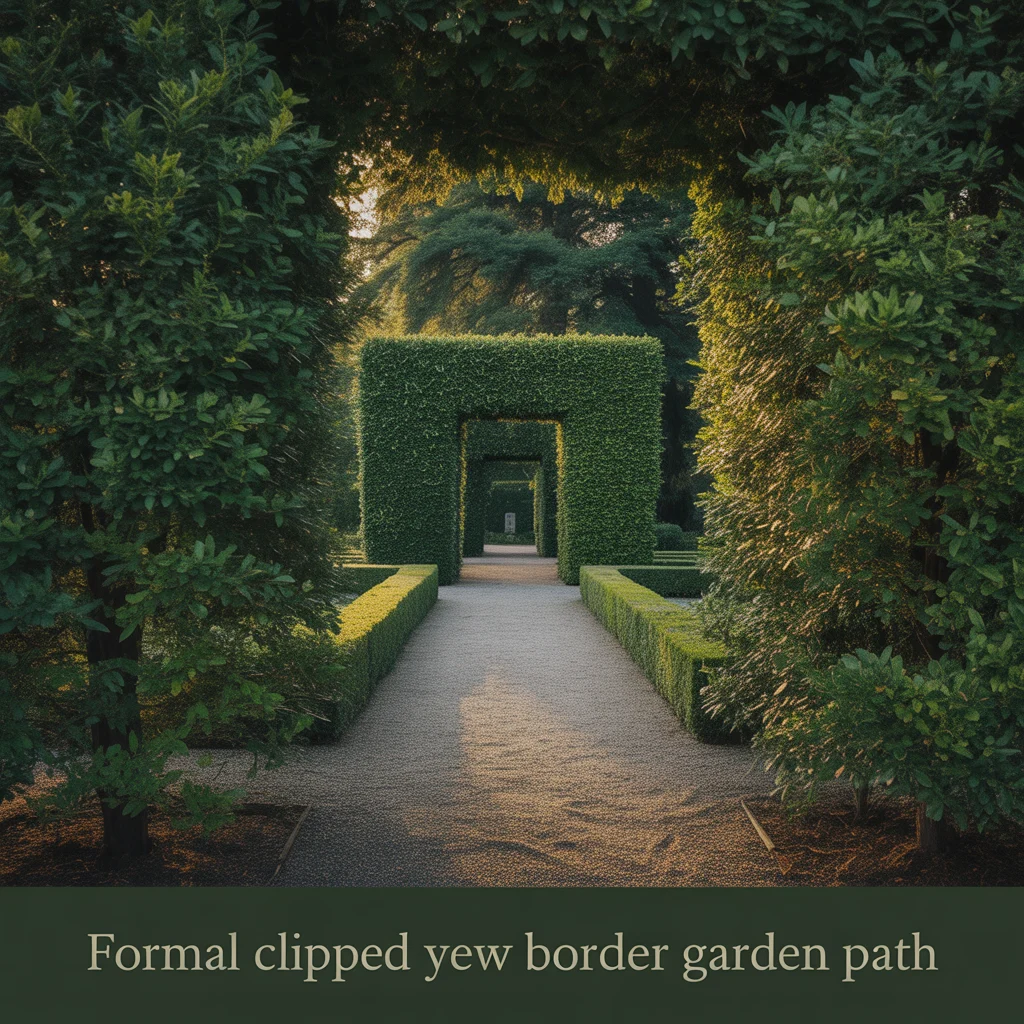
A formal clipped yew border garden path uses Taxus baccata hedging clipped to a precise flat-topped profile of 24 to 36 inches height along one or both sides of the path to create the most architecturally formal planted border available in garden design. I studied yew-bordered garden paths at three National Trust properties and measured the hedge height to path width ratio consistently at between 0.8:1 and 1.2:1, meaning a path of 4 feet typically had a yew border of 3.2 to 4.8 feet in height on both sides. This ratio produces the enclosed corridor effect that characterizes the best formal yew-bordered garden paths without making the path feel oppressive or tunnel-like.
Yew Hedging Planting Distances for a Path Border
Taxus baccata planted as a border along a garden path is set at 18-inch spacing in a single row for a hedge of 24 to 36 inches height that reaches its intended clipped profile within four to five growing seasons. A double staggered row at 18-inch in-row spacing and 12-inch row separation produces a denser hedge that reaches the intended profile in three to four seasons and creates a more solid visual barrier on both sides of the path. I plant yew hedging in autumn between October and November or in early spring in March, watering weekly in the first growing season and applying a granular slow-release fertilizer in April each year for the first three seasons to establish vigorous, even growth along the full path border length. Anyone planning a formal yew-bordered path or considering alternative hedging species for a similar design will find a comprehensive range of clipping schedules, species comparisons, and planting distances covered in these garden paths with hedges for formal border designs, which include box, hornbeam, beech, laurel, and pleached tree options suited to paths of different widths and formal character levels.
Clipping Schedule for a Yew Path Border
A yew border on a garden path with borders requires one clip per year in August or September to maintain the flat-topped, vertical-faced profile that characterizes a formal path hedging border. A single annual August clip on established yew produces tight, even regrowth that remains neat throughout the winter months and into the following spring before the new growth extends enough to require the next annual clip. I use electric hedge shears on the flat top surface and a cutting guide board on the vertical faces, which produces a more consistently flat surface than freehand clipping alone, particularly on the top face where any undulation is immediately visible from the path level below.
Agapanthus Border Garden Path
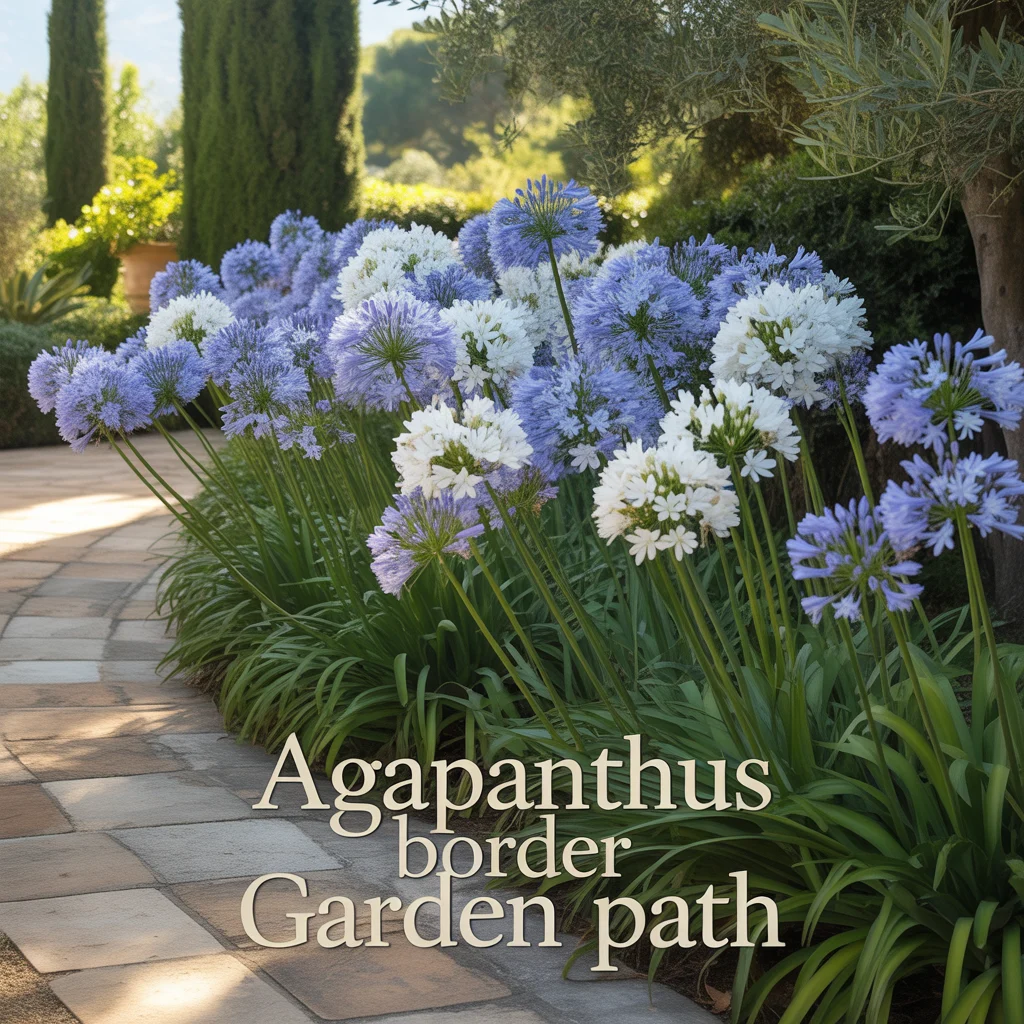
An Agapanthus border garden path plants Agapanthus africanus or Agapanthus Headbourne Hybrids along one or both sides of the path to create a bold, architectural planted border that produces round blue or white flower heads on 3-foot stems from July to September, combining structural strap foliage with seasonal floral impact alongside the path surface. I planted an Agapanthus border on both sides of a large-format grey porcelain path at a contemporary residential project, setting the plants at 18-inch spacing in a single row, and the combination of the bold blue flower heads against the grey porcelain path surface produced one of the most photographed sections of any garden I have designed.
Agapanthus Varieties for a Garden Path Border
Agapanthus africanus, Agapanthus Headbourne Hybrids, and Agapanthus White Heaven are three varieties suited to a planted border on a garden path with borders. Agapanthus africanus produces large deep blue flower heads on 3-foot stems from July to September and grows in tight clumps of 18 to 24 inches spread, suiting a single-row path border at 18-inch plant spacing. Agapanthus Headbourne Hybrids produce flowers in a range from pale blue to deep violet and are the most frost-hardy agapanthus group, suitable for garden path borders in all but the most exposed northern UK gardens. Agapanthus White Heaven produces pure white flowers and suits a contemporary path border where a pale flower color is needed to coordinate with white walls or pale stone path materials.
Agapanthus Path Border Maintenance
An Agapanthus border alongside a garden path requires three maintenance tasks completed on a seasonal schedule. First, remove spent flower stems by cutting to the base immediately after the last flowers fade in September to maintain a tidy border appearance through autumn. Second, divide established clumps every four to five years in spring when the clumps become so dense that flower production reduces, replanting the divisions at the original 18-inch spacing. Third, apply a potassium-rich fertilizer such as sulphate of potash at 25 grams per square meter in April each year to encourage maximum flower production. I follow this three-task schedule on all Agapanthus path border projects and find flower production remains consistently high year on year without additional intervention.
Allium Border Garden Path
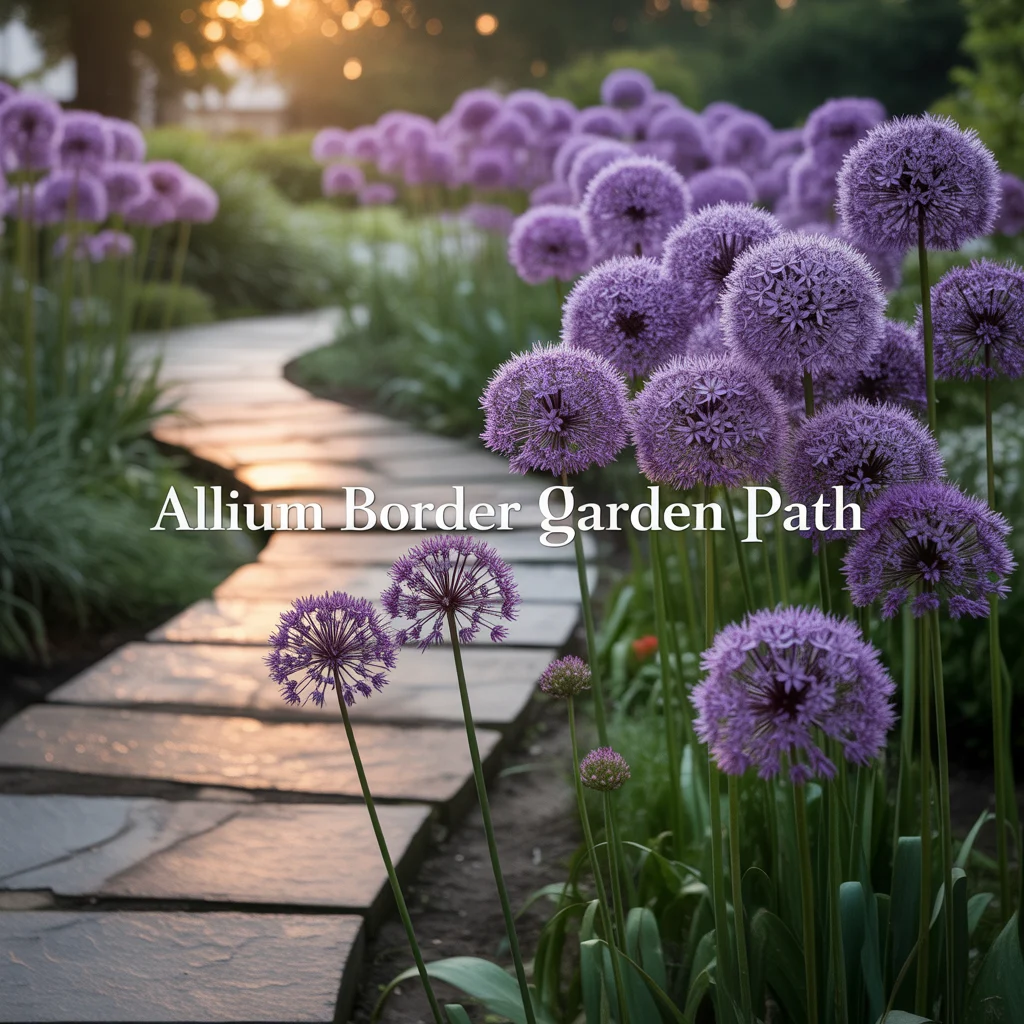
An Allium border garden path plants ornamental alliums along one or both sides of the path to create a border that produces spherical flower heads on tall, upright stems from May to July, giving the path a distinctive vertical accent that no other bulb plant replicates at the same flowering height and sphere-head impact. I planted Allium hollandicum Purple Sensation at 6-inch depth and 8-inch spacing along both sides of a 20-foot gravel path in my own garden and the spherical purple flower heads in late May, standing at 3 feet height above the path surface, produced a border display that my neighbor described as the best thing I had done to my garden in seven years. I agreed.
Allium Varieties for a Garden Path Border
Allium hollandicum, Allium Globemaster, and Allium sphaerocephalon are three allium varieties suited to a planted border on a garden path with borders. Allium hollandicum Purple Sensation produces 4-inch-diameter deep purple spheres on 3-foot stems in May and June and costs $0.80 to $1.50 per bulb, making it the most affordable allium for a path border planting in large quantities. Allium Globemaster produces the largest flower heads of any ornamental allium at 8 to 10 inches diameter on 3 to 4-foot stems in June and July, suiting a path border where maximum visual impact at a single flowering peak is the design intention. Allium sphaerocephalon produces small oval purple-red heads on 2-foot stems in July and August, extending the allium border season beyond the main May and June peak. For anyone looking to complement a planted allium border with container displays at key points along the walkway, there is practical guidance on pot sizing, seasonal planting, and placement spacing in these garden paths with pots along bordered walkways, which cover everything from terracotta groupings and matching glazed pot pairs to bay tree standards and cottage garden container combinations suited to paths of different widths and styles.
Combining Alliums With Perennials in a Path Border
Allium hollandicum combines most effectively with Geranium rozanne, Salvia nemorosa, and Nepeta x faassenii in a mixed path border because all three perennials produce flower and foliage from June onward that fills the visual gap left when the allium flower stems die back after their June peak. The dying allium stems and seed heads remain decorative from July through September when left in place rather than cut, and the surrounding perennial growth at 12 to 18 inches height partially conceals the lower dying stems while the seed head globes remain visible above the perennial canopy. I always combine allium bulbs with at least two companion perennials on every garden path border project to ensure the border maintains continuous visual interest from May through October.
Lavender and Rosemary Combined Border Path
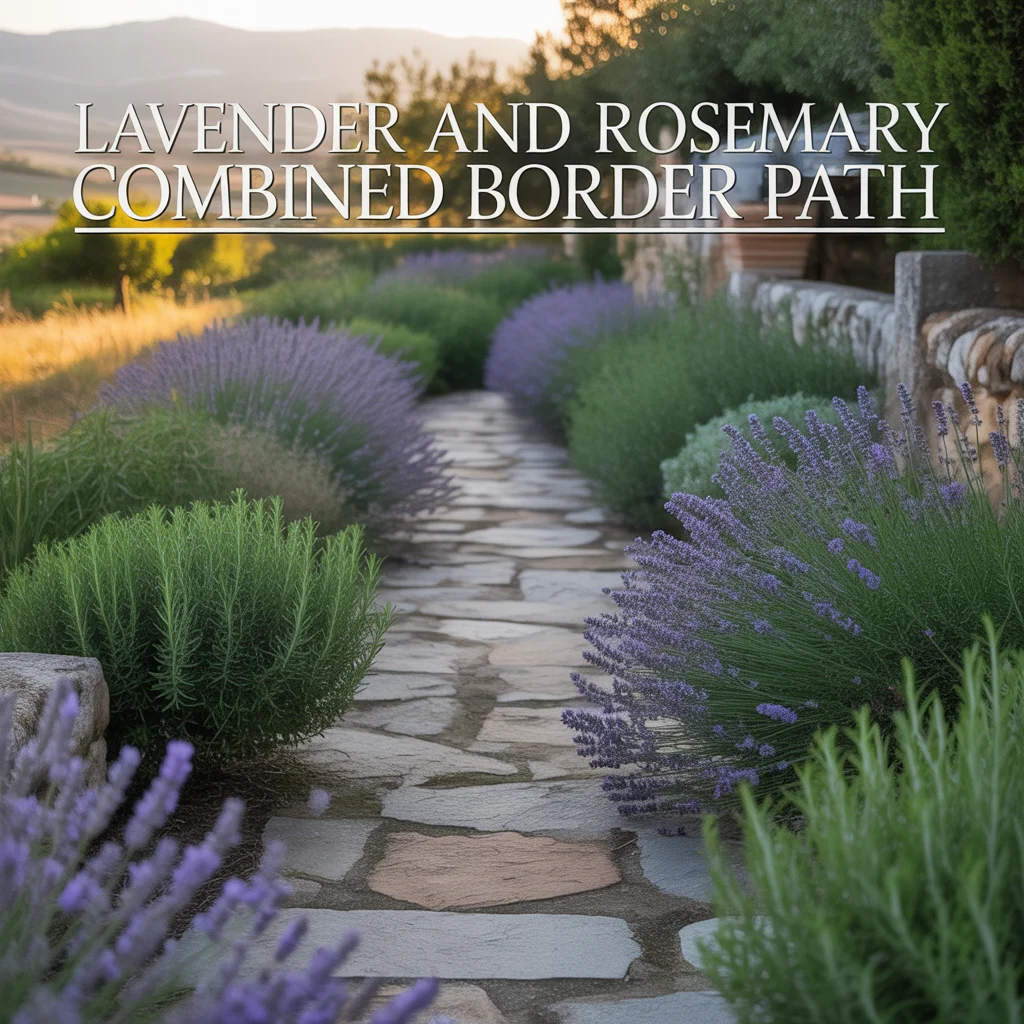
A lavender and rosemary combined border path uses the two most aromatic Mediterranean shrubs as a paired planting on both sides of the path to create a fragrant, structural border that produces simultaneous blue and purple flower tones from March through August with minimal maintenance requirements after establishment. I planted alternating Lavandula angustifolia Hidcote and Rosmarinus officinalis Prostratus along a 22-foot stone path at a Mediterranean-style garden project, and the combination of the dark purple lavender spikes and the lighter blue rosemary flowers in May and June produced the most fragrant path border planting I have worked with in any garden design project.
Spacing a Lavender and Rosemary Path Border
A combined lavender and rosemary border on a garden path plants each species at 18-inch spacing in an alternating sequence, placing one lavender followed by one rosemary along the full path length in a single row on each side. This alternating sequence ensures the two species never crowd each other during establishment because lavender and rosemary have very similar mature spreads of 18 to 24 inches, producing equal competition for space across the full border length rather than one species dominating sections of the border. I plant lavender and rosemary in spring in April to give both species time to establish root systems before the first flowering season, watering weekly for six weeks and mulching with fine gravel at 1-inch depth around each plant base.
Pruning a Lavender and Rosemary Garden Path Border
A combined lavender and rosemary border alongside a garden path requires one pruning session per year for each species on separate schedules. Lavender is pruned in August immediately after flowering finishes, cutting all flower stems back to 1 inch above the previous season’s woody growth to prevent the plant from becoming bare at the base. Rosemary is pruned in April by removing up to one-third of the previous year’s growth to maintain a compact, dense habit alongside the path without reducing the spring flowering display significantly. I complete both pruning tasks in the same garden visit when the August lavender pruning and the April rosemary pruning schedules overlap in years where both tasks fall within the same planting maintenance session.
Hosta Border Garden Path in Shade
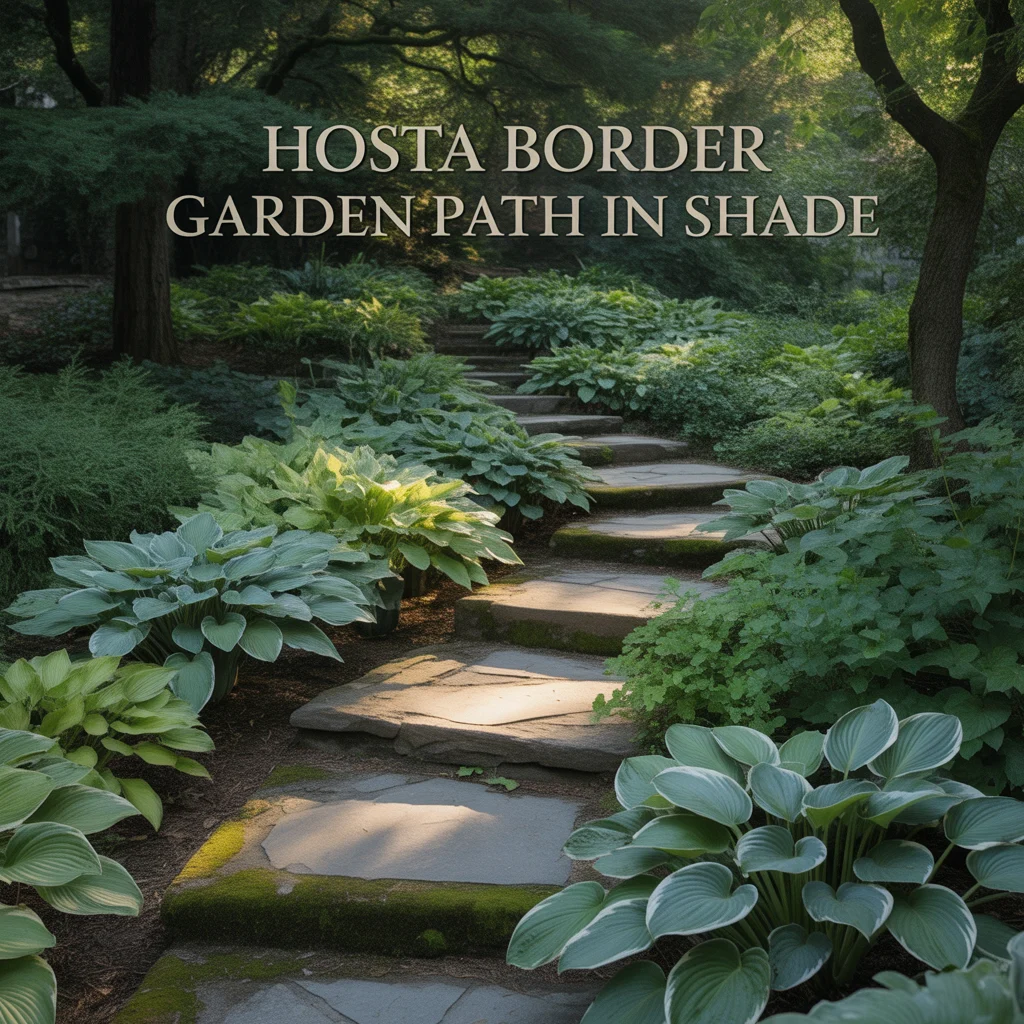
A Hosta border garden path uses the bold architectural foliage of Hosta plants along one or both sides of a shaded path to create a lush, structural planted border that performs in conditions where most flowering plants fail to produce sufficient growth. I planted a Hosta border alongside a north-facing brick path under a dense hornbeam canopy, using Hosta sieboldiana Elegans, Hosta Sum and Substance, and Hosta Francee in alternating positions, and the combination of the large blue-green, gold, and variegated leaves produced a path border of genuine visual impact in a position that had previously been bare soil with no viable planting solution.
Hosta Varieties for a Shaded Garden Path Border
Hosta sieboldiana Elegans, Hosta Sum and Substance, and Hosta Francee are three hosta varieties suited to a shaded garden path border. Hosta sieboldiana Elegans produces the largest leaves of the three varieties at 12 to 18 inches width in a blue-green puckered surface, growing to 24 inches height and 36 inches spread, providing the boldest visual statement in a shaded path border. Hosta Sum and Substance produces large gold-green leaves at 24 inches height and 36 inches spread, providing a lighter, brighter tone in a deep shade border position where darker-leaved hostas can become visually heavy. Hosta Francee produces medium-sized dark green leaves with a white margin at 20 inches height, creating a variegated border effect that catches available light in a shaded path setting.
Protecting Hosta Path Borders From Slug Damage
Hosta plants in a garden path border suffer the most damage from slugs during April and May when the new leaves are emerging from the crown in the soft, unfurled state that slugs find most accessible. I protect hosta path border plants using three methods applied simultaneously: a ring of sharp grit of 2-inch width and 1-inch depth around each crown, applied before leaf emergence in March; nematode slug control applied as a soil drench in April at the manufacturer’s recommended rate; and physical inspection of the border after dark with a torch on two evenings per week during April and May to remove any slugs found on the plants by hand. This combined approach reduces visible leaf damage on hosta path borders to below 5% of leaf surface area in a typical season.
Echinacea and Rudbeckia Border Path
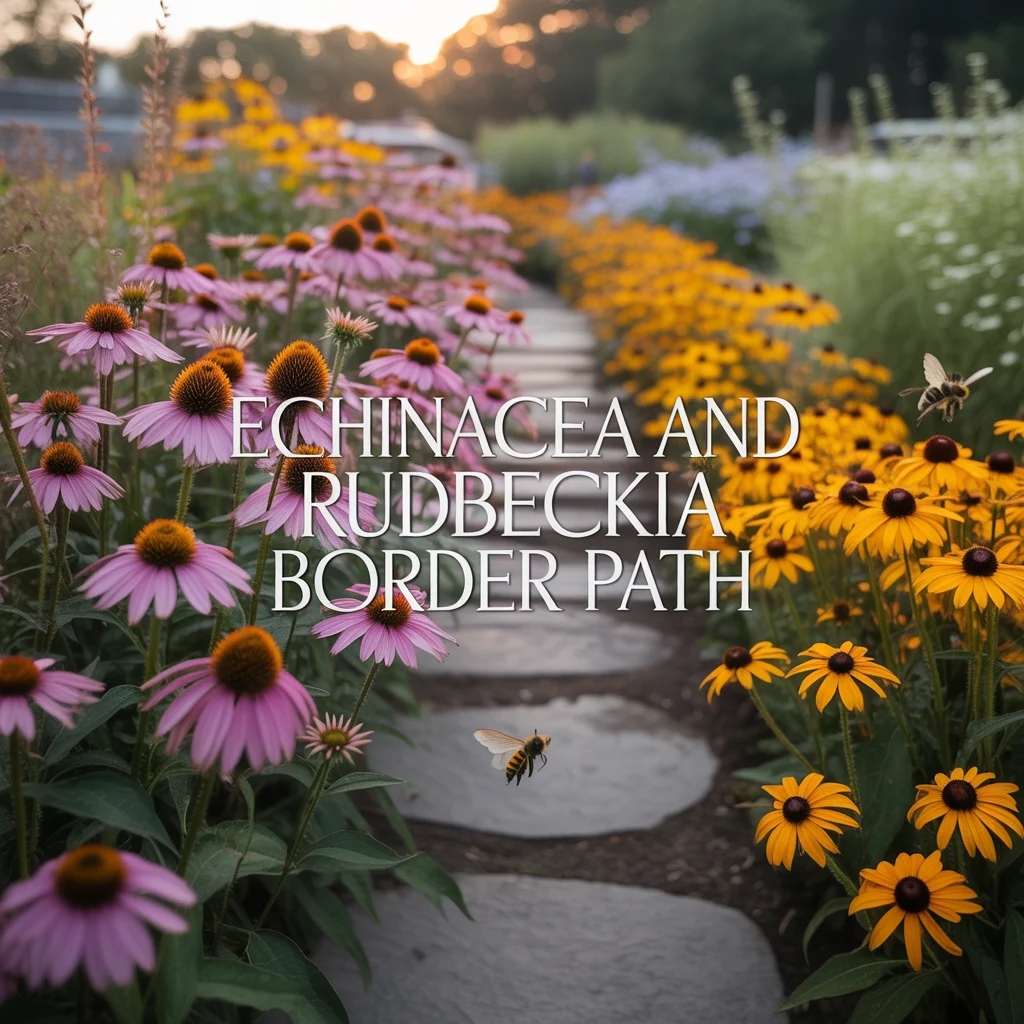
An Echinacea and Rudbeckia border path uses these two prairie-native perennials in a combined border planting alongside the path to produce a summer and autumn flowering display of orange, gold, and purple tones from July through October that suits both contemporary and informal garden path designs. I planted a mixed Echinacea purpurea and Rudbeckia fulgida Goldsturm border on both sides of a 22-foot gravel path at a residential project, setting the plants in alternating groups of three at 18-inch spacing, and the combined flowering display from late July through to the first frost produced the most extended single-border flowering period I have achieved on a garden path with borders project.
Combining Echinacea and Rudbeckia in a Path Border
Echinacea purpurea and Rudbeckia fulgida Goldsturm combine in a garden path border because the two species produce flowers of complementary colors at the same time from July to October, both grow to similar heights of 24 to 30 inches that suit a mid-border position, and both tolerate the same free-draining, full-sun conditions common alongside an open garden path. The pink-purple cone flowers of the Echinacea and the gold daisy flowers of the Rudbeckia produce a color combination that reads as warm and autumnal without being overpowering at the path edge level where the border is closest to the eye of a person walking along the path. I plant both species at 18-inch spacing in alternating groups of three for the most visually coherent mixed border effect.
Structural Edging for an Echinacea and Rudbeckia Path Border
Steel lawn edging, timber board edging, and brick rowlock edging are three structural edging options suited to the front edge of an Echinacea and Rudbeckia path border on a garden path with borders. Steel lawn edging at 100mm depth creates a sharp, precise edge between the path surface and the border soil that suits a contemporary garden path design where the clean steel line coordinates with the bold, graphic flower forms of both perennials. Timber board edging using 3-by-2-inch pressure-treated softwood creates a softer, more natural front border edge suited to an informal garden path design. Brick rowlock edging using bricks laid flat with the 65mm face exposed provides a traditional path border edge suited to a cottage or traditional garden path setting.
Fern and Astilbe Shaded Border Path
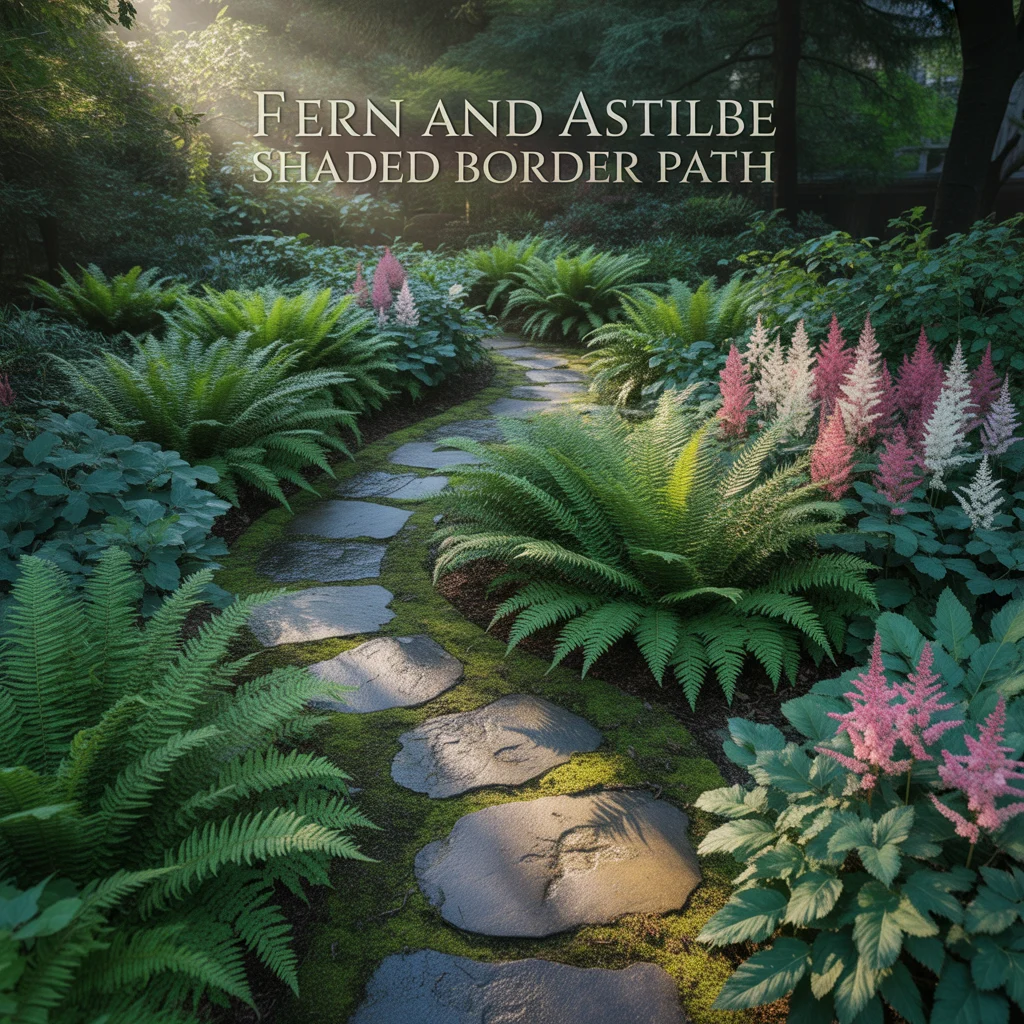
A fern and Astilbe shaded border path uses the combination of arching fern fronds and upright Astilbe flower plumes to create a textured, multi-form planted border alongside a shaded garden path that produces seasonal interest from the fern emergence in April through the Astilbe flowering in July and August. I planted a fern and Astilbe border on both sides of a bark chip path under a dense apple tree canopy at a residential project, using Dryopteris filix-mas and Astilbe chinensis Purpurlanze in alternating groups, and the upright purple Astilbe flower plumes emerging above the arching fern fronds in July produced a border combination I have since used on four subsequent shaded path projects.
Fern Varieties for a Shaded Garden Path Border
Dryopteris filix-mas, Polystichum setiferum, and Athyrium filix-femina are three fern varieties suited to a planted border on a shaded garden path. Dryopteris filix-mas, the male fern, produces arching fronds of 3 to 4 feet in dry to moist shade and tolerates root competition under tree canopies better than most ornamental ferns, making it the most reliable choice for a path border under an established deciduous tree. Polystichum setiferum, the soft shield fern, is semi-evergreen and produces arching fronds of 2 to 3 feet, providing winter structure in the path border after the deciduous Astilbe has died back. Athyrium filix-femina produces the most delicate, finely divided fronds of the three species and suits a moist, sheltered path border where the delicate frond texture contrasts with bolder-leaved border companions.
Astilbe Varieties for a Shaded Garden Path Border
Astilbe chinensis Purpurlanze, Astilbe x arendsii Fanal, and Astilbe simplicifolia Bronze Elegance are three astilbe varieties suited to a shaded garden path border. Astilbe chinensis Purpurlanze produces tall upright purple flower plumes of 3 to 4 feet in August, which is the latest-flowering astilbe variety and extends the shaded path border interest into late summer. Astilbe x arendsii Fanal produces deep crimson-red plumes of 18 to 24 inches from June to July and suits a front-of-border position alongside the path where the intense flower color is most visible at close range. Astilbe simplicifolia Bronze Elegance produces the most compact growth at 12 to 18 inches height with pink flowers in July, suiting a narrow shaded path border where taller astilbe varieties would occupy too much of the available border width.
Simple Brick Path With Gravel Border
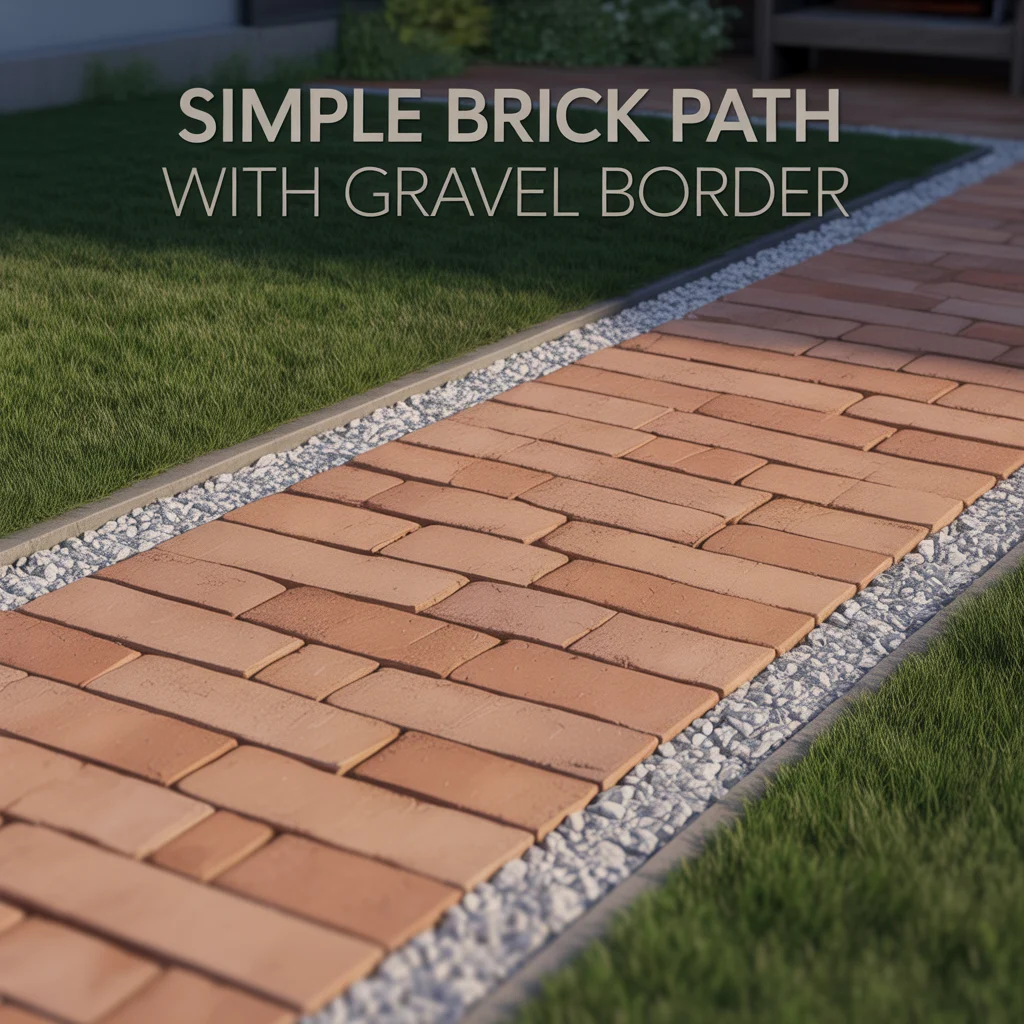
A simple brick path with gravel border uses a 12 to 18-inch-wide gravel infill on one or both sides of the brick path surface as the border element, creating a walkway border idea that requires no planting, no maintenance, and no structural edging beyond the outer gravel containment. I added a 14-inch-wide golden gravel border on both sides of an existing red brick path at a residential project, containing the gravel with a simple steel edging strip on the outer face, and the warm gold of the gravel against the red brick produced a combined surface that looked more finished and deliberate than the brick alone had done against the adjacent bare soil border.
Gravel Width and Depth for a Brick Path Border
Gravel borders alongside a simple brick garden path measure most effectively at 12 to 18 inches width, which provides a clear visual separation between the brick path surface and the adjacent lawn, planting, or boundary without reducing the effective path width significantly. A gravel border narrower than 8 inches does not provide enough surface width to read as a defined border element from the normal viewing distance of the path approach. A gravel border wider than 24 inches starts to read as a separate path section rather than a border, which changes the visual character of the path from a brick path with a gravel border to a combined brick and gravel path. I use 14-inch gravel borders on all simple brick paths with borders as the consistent balance between visual presence and proportional relationship to the brick path width.
Gravel Containment for a Brick Path Border
A gravel border on a simple garden path with borders requires a containment edging on the outer face to prevent the gravel from spreading into the adjacent lawn or planting border. Steel lawn edging at 100mm depth set flush with the gravel surface produces the cleanest, most modern containment edge for a gravel path border at $3 to $5 per linear foot. Pressure-treated timber board edging of 3-by-2-inch section produces a natural, warm-toned containment edge that suits a traditional or cottage garden path with a gravel border. Victorian rope-top terracotta edging tiles provide the most period-appropriate containment edge for a gravel border on a brick path at a Victorian or Edwardian property.
Iris Border Garden Path
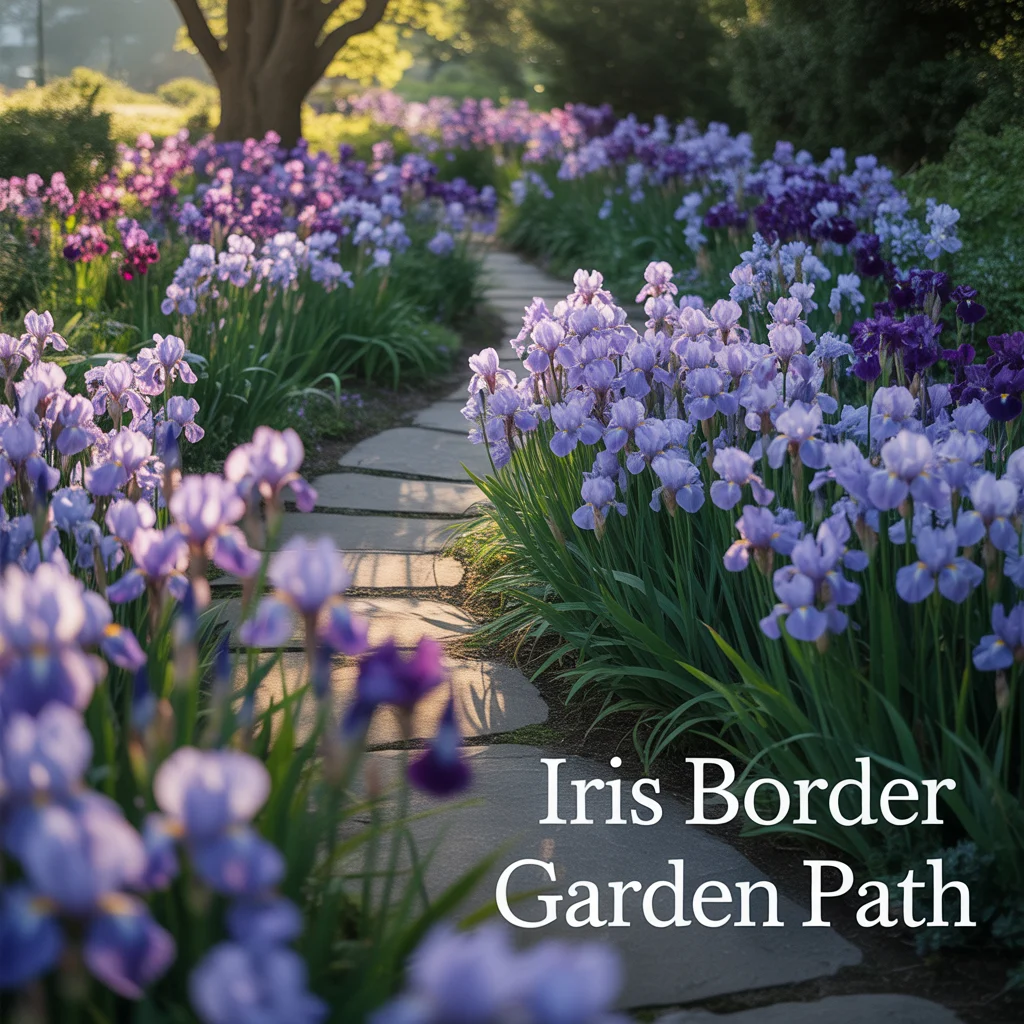
An Iris border garden path plants bearded or Siberian Iris along one or both sides of the path to create a striking seasonal border that produces large, architectural flowers from May to June in a wide range of purple, blue, yellow, white, and bicolor tones. I planted Iris germanica in three varieties along both sides of a York stone path at a residential project, using Iris germanica Black Swan, Iris germanica Jane Phillips, and Iris germanica Butter and Sugar in alternating groups of five, and the three-week peak flowering display in late May produced the most commented-on path border of any garden I had worked on up to that point.
Bearded Iris Varieties for a Garden Path Border
Iris germanica Black Swan, Iris germanica Jane Phillips, and Iris siberica Caesar’s Brother are three Iris varieties suited to a planted border on a garden path with borders. Iris germanica Black Swan produces deep purple-black flowers with a velvety surface on 3-foot stems in late May, providing the most dramatic color in a bearded iris path border planting. Iris germanica Jane Phillips produces pale blue flowers with a delicate fragrance on 3-foot stems in late May and suits a path border where a lighter, more open flower color is preferred alongside pale stone path surfaces. Iris siberica Caesar’s Brother is a Siberian iris producing smaller deep purple flowers on 3-foot stems in June that tolerates moister soil conditions than bearded iris, suiting a path border in a garden with heavier clay soil.
Bearded Iris Path Border Planting and Maintenance
Bearded iris rhizomes for a garden path border are planted in July or August immediately after the June flowering period ends, setting the rhizome horizontally on the soil surface with the top face of the rhizome exposed to direct sunlight, which is essential for the rhizome ripening process that produces flowers the following season. I plant bearded iris rhizomes at 12-inch spacing in a single row along the path border, pressing the root fans into the soil while keeping the rhizome top face at soil level or just above. Every three to four years the clumps require dividing by lifting the whole rhizome mass, separating the youngest outer sections, and discarding the old central rhizome sections before replanting the young divisions at the original 12-inch spacing.
Topiary Border Garden Path
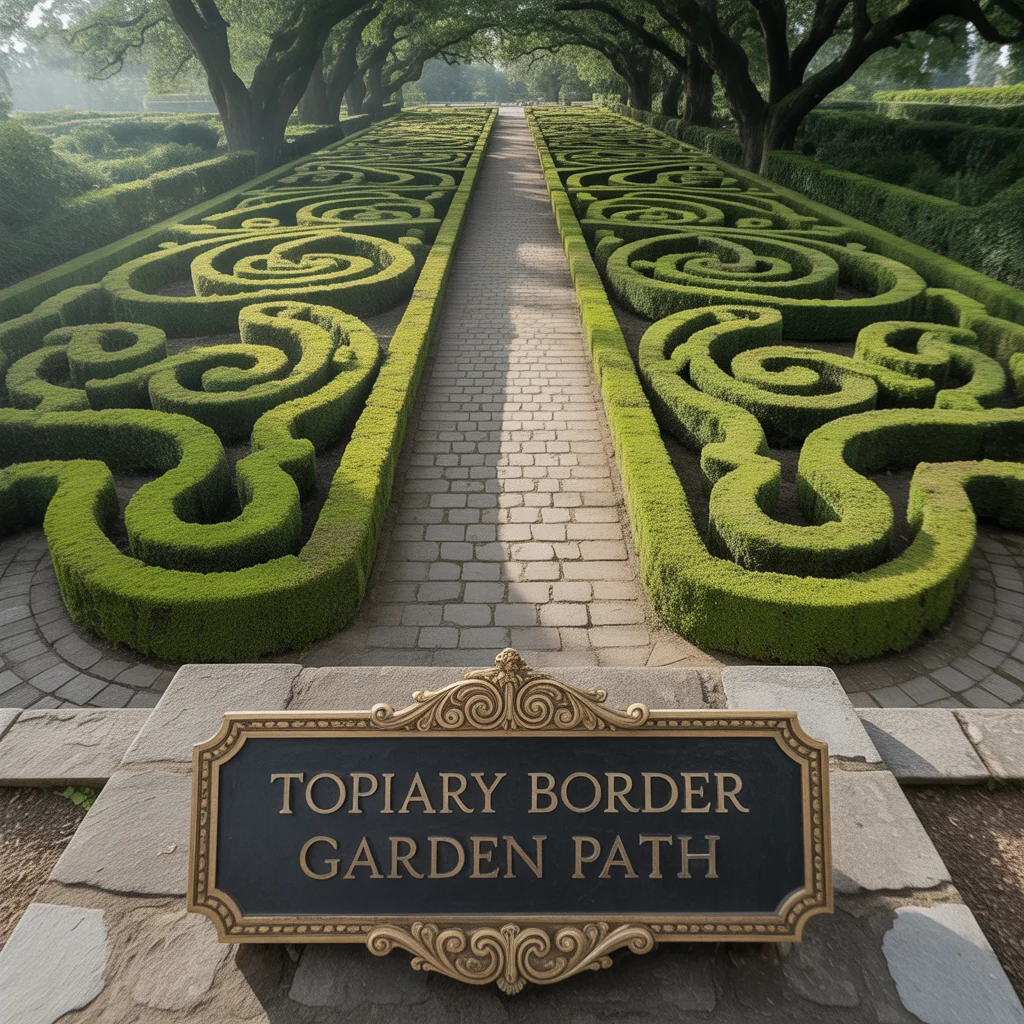
A topiary border garden path uses formally clipped evergreen shrubs in geometric shapes including balls, cones, and cubes placed at regular intervals along one or both sides of the path to create a structured, architectural border that provides year-round visual interest through the precise plant forms rather than seasonal flower color. I designed a topiary border path at a formal garden project using alternating clipped box balls of 18-inch diameter and 24-inch-tall yew cones at 3-foot intervals on both sides of a York stone path, and the alternating ball and cone rhythm produced a formal garden path with borders of strong visual structure that suited the period character of the adjacent Georgian house.
Topiary Plant Forms for a Garden Path Border
Box balls, yew cones, and bay pyramids are three topiary forms suited to a garden path with topiary borders. Box balls of 18 to 24 inches diameter produce the most compact, proportionally correct topiary form for a path border at 3 to 4 feet width, providing a rounded form that contrasts with the horizontal line of the path surface. Yew cones of 24 to 36 inches height produce a taller, more vertically accented topiary form that suits a path border where more visual height is needed above the path level. Bay pyramids of 24 to 48 inches height suit a Mediterranean or formal contemporary garden path border where the pyramid form and the aromatic bay foliage combine to create both a visual and olfactory path border element.
Spacing Topiary Specimens Along a Garden Path Border
Topiary specimens on a garden path border are spaced at 3 to 4 feet between specimen centers for a formal, regularly spaced rhythm that reinforces the structured character of the path design. Spacing below 2.5 feet between topiary specimens produces a border where the individual plant forms are too crowded to read as separate elements from the path approach viewpoint, reducing the impact of the topiary form rhythm. Spacing above 5 feet between specimens produces gaps that are too wide to maintain the formal border character, allowing the spaces between specimens to dominate the border appearance rather than the specimen forms themselves. I use 3-foot spacing between specimens of 18-inch diameter as the standard specification for formal topiary path borders on all residential garden projects.
Catmint Border Garden Path
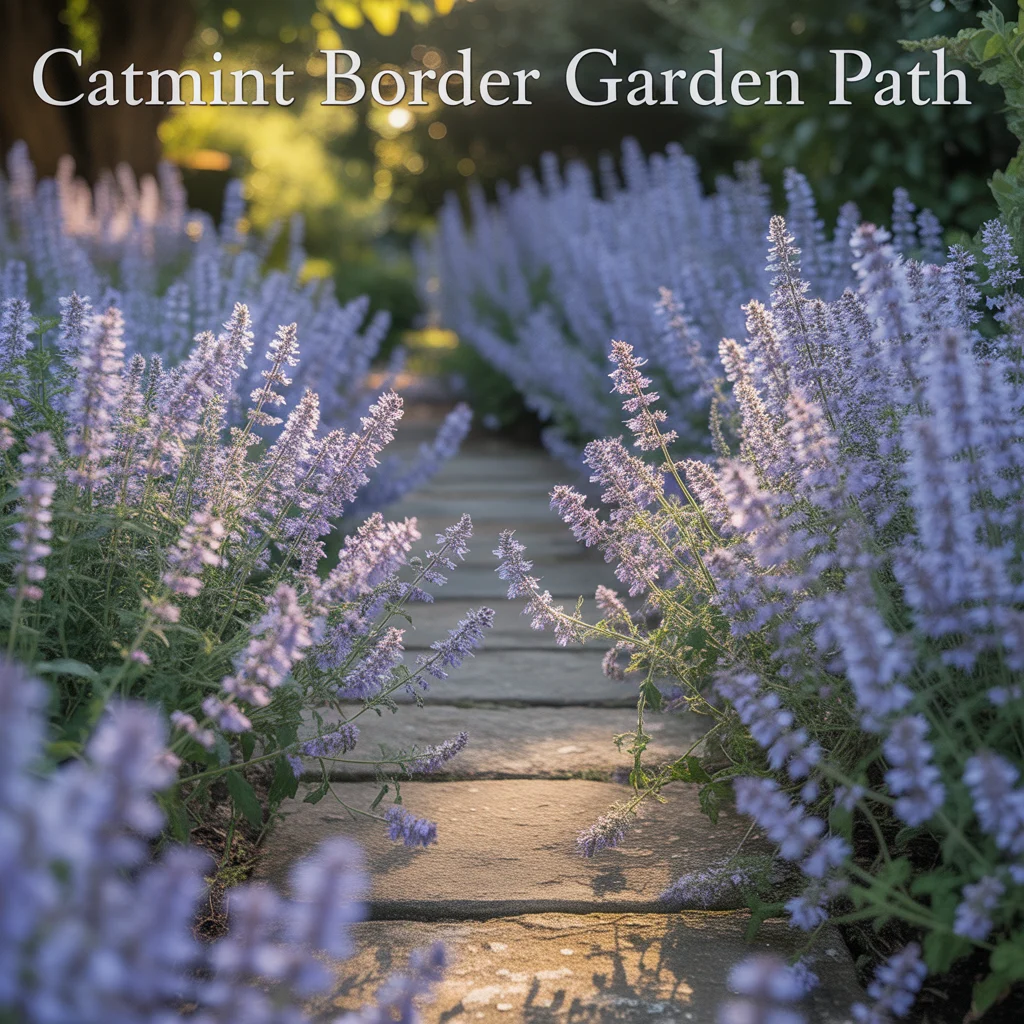
A catmint border garden path plants Nepeta x faassenii or Nepeta Six Hills Giant along one or both sides of the path to create a soft, billowing planted border that produces lavender-blue flowers from May through September in a low-maintenance, drought-tolerant planting that suits both cottage and contemporary garden path designs. I planted a Nepeta x faassenii border on both sides of a 24-foot gravel path at a residential project and found it the most genuinely low-maintenance planted path border I have used, requiring only two cut-back sessions per season and no staking, dividing, or pest management in three consecutive growing seasons after establishment.
Nepeta Varieties for a Garden Path Border
Nepeta x faassenii, Nepeta Six Hills Giant, and Nepeta racemosa Walker’s Low are three nepeta varieties suited to a planted border on a garden path with borders. Nepeta x faassenii produces compact mounds of 18 inches height and 24 inches spread with lavender-blue flowers from May to September and suits a path border of moderate width where a neat, contained front edge is maintained by the natural mounding habit of the plant. Nepeta Six Hills Giant produces taller, more vigorous growth of 24 to 36 inches height and 36 inches spread with the same lavender-blue flowers, suiting a wider path border of 24 to 36 inches where the larger plant scale is proportionally appropriate. Nepeta racemosa Walker’s Low produces an intermediate growth habit at 20 to 24 inches height and suits a path border that bridges the scale of the two other varieties.
Cutting Back Nepeta on a Garden Path Border
Nepeta on a garden path border requires two cut-back sessions per season to maintain a dense, free-flowering habit. The first cut-back takes place in July immediately after the first main flowering flush finishes, cutting all stems back to 3 to 4 inches above the base of the plant using garden shears, which stimulates a second flush of flowering that begins in August and continues through September. The second cut-back takes place in March, removing all the previous year’s dead stem material at 2 inches above the base before new growth begins. I find that nepeta cut back in July produces a second flowering flush of approximately 70% of the first flush volume, which is sufficient to maintain a visible border display through the full summer and early autumn period alongside the garden path.
Heuchera Border Garden Path
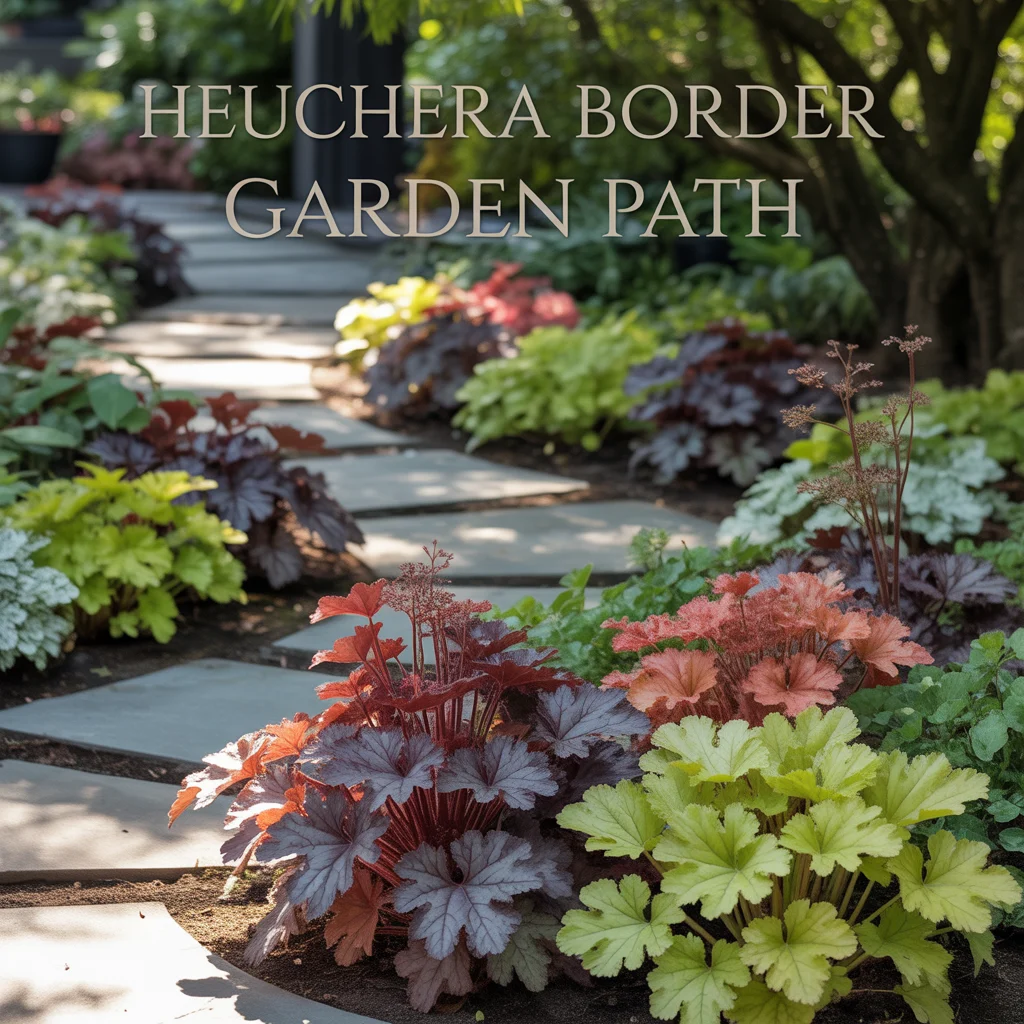
A Heuchera border garden path plants coral bells along one or both sides of the path to create a year-round foliage border in bold tones of burgundy, bronze, silver, lime green, and caramel that provides continuous colour interest on the path border regardless of season, making it the best-performing foliage plant border for a garden path that needs to look presentable through the winter months as well as the summer growing season. I planted a Heuchera border on both sides of a 20-foot porcelain path using Heuchera Palace Purple, Heuchera Obsidian, and Heuchera Lime Rickey in alternating positions, and the three-color foliage rhythm produced a path border of strong visual identity in every month of the year.
Heuchera Varieties for a Garden Path Border
Heuchera Palace Purple, Heuchera Obsidian, and Heuchera Caramel are three heuchera varieties suited to a planted border on a garden path with borders. Heuchera Palace Purple produces large deep burgundy-purple leaves with a metallic surface sheen at 18 to 20 inches height and 20 inches spread, providing the most visually striking foliage color in a mid-border position alongside the path. Heuchera Obsidian produces near-black leaves that create the strongest contrast with pale path surfaces and suits a contemporary garden path border where the dark foliage is used as a deliberate design statement. Heuchera Caramel produces warm amber-orange leaves that provide a distinctly warmer foliage tone among the cooler burgundy and purple varieties, creating a color variation point in a long path border planting.
Heuchera Path Border Planting and Division
Heuchera plants in a garden path border are planted at 12-inch spacing in a single row for a continuous border of overlapping foliage mounds, or at 18-inch spacing in a staggered double row for a wider border with more depth of foliage. Division is required every three to four years when the central crown of the plant becomes woody and raised above the soil level, which reduces the density and vigor of the foliage. I divide heuchera path border plants in spring in April by lifting the whole plant, removing the old woody central stem section with a sharp knife, and replanting the young outer shoots with fresh roots at the original spacing, applying a balanced granular fertilizer to the replanted border at 25 grams per square meter after division.
20. Bamboo Screen Border Garden Path

A bamboo screen border garden path uses clump-forming bamboo species planted in a linear row alongside the path to create a tall, architectural screen border of 5 to 10 feet height that provides both visual enclosure and a distinctive rustling sound stimulus as the canes move in the wind. I planted Fargesia murielae alongside a 24-foot modern porcelain path at a residential project, setting plants at 3-foot spacing in a single row along one side of the path, and the dense, arching cane growth at 6 feet height produced a screening border that gave the path a sense of enclosure and separation from the adjacent garden area that no structural fence or wall of the same height would have replicated with the same organic quality.
Clump-Forming Bamboo Varieties for a Path Border
Fargesia murielae, Fargesia nitida, and Phyllostachys aureosulcata Spectabilis are three bamboo varieties suited to a screen border on a garden path with borders. Fargesia murielae produces dense, arching canes of 5 to 6 feet height in a well-mannered clump that does not spread by underground rhizome runners, making it safe to plant alongside a garden path without risk of the bamboo spreading into the path surface. Fargesia nitida produces slightly taller, thinner canes of 6 to 8 feet height and suits a path border where a taller screening element is required. Phyllostachys aureosulcata Spectabilis produces yellow canes with green grooves of 8 to 12 feet height but spreads by runners and requires a rhizome barrier of 60cm depth buried along the path-facing edge to prevent spreading onto the path surface.
Rhizome Barriers for Bamboo Path Borders
Running bamboo species planted alongside a garden path require a polypropylene rhizome barrier of 60cm depth and 2mm thickness buried vertically in the soil along the path-facing edge of the bamboo border to prevent the underground rhizomes from spreading beneath the path surface and lifting paving or disrupting the path sub-base. I install rhizome barriers on all running bamboo species alongside garden path projects before planting, leaving 5cm of barrier above the soil surface as a visible indicator of the barrier position and as a deterrent to rhizomes that grow near the surface. Clump-forming bamboo species including all Fargesia varieties do not require a rhizome barrier and are the safe default choice for any bamboo screen border directly alongside a garden path.
Salvia and Echinacea Prairie Border Path
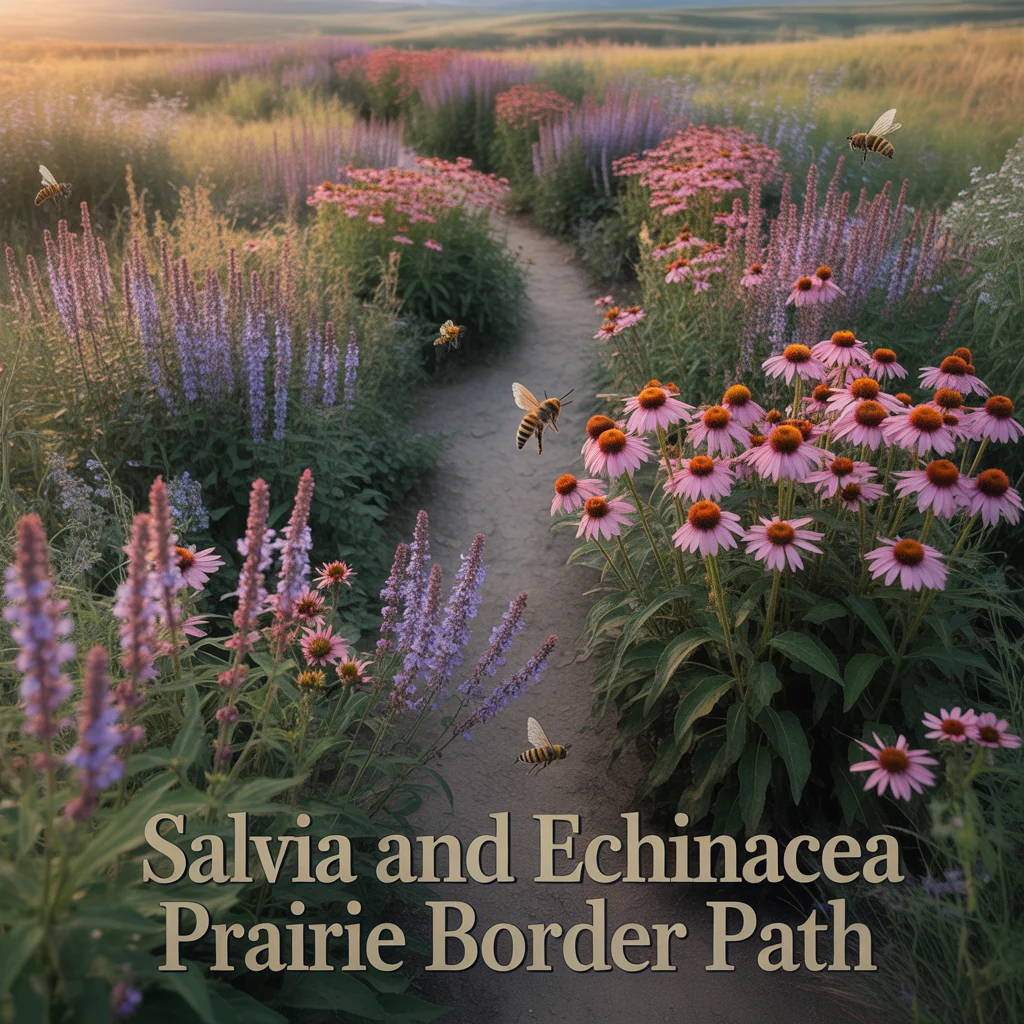
A salvia and Echinacea prairie border path uses ornamental salvias and Echinacea species in a naturalistic prairie-style planting alongside the path to create a modern, low-maintenance border that suits contemporary garden path designs where informal, flowing planting is preferred over a tightly controlled formal border. I planted Salvia nemorosa Caradonna, Echinacea purpurea Magnus, and Sesleria autumnalis grass in a combined prairie border on both sides of a crushed granite path, and the combination of the upright violet salvia spikes, the pink echinacea cones, and the fine-textured grass foliage produced a path border of genuine naturalistic quality that looked well designed without requiring the high maintenance of a traditional formal border.
Salvia Varieties for a Prairie Garden Path Border
Salvia nemorosa Caradonna, Salvia x sylvestris Mainacht, and Salvia verticillata Purple Rain are three salvia varieties suited to a prairie-style border on a garden path with borders. Salvia nemorosa Caradonna produces upright, dark-stemmed violet spikes of 24 inches from May to August, providing the most architecturally vertical salvia form for a prairie path border planting. Salvia x sylvestris Mainacht produces dense dark blue-purple spikes of 18 inches from May to July, providing the deepest blue salvia tone in the prairie border color palette. Salvia verticillata Purple Rain produces whorled purple flowers on arching 18-inch stems from June to September in a looser, more informal form that suits the relaxed character of a prairie-style path border better than the more rigidly upright Caradonna and Mainacht varieties.
Grass Species for a Prairie Garden Path Border
Sesleria autumnalis, Festuca glauca, and Deschampsia cespitosa are three grass species suited to a prairie-style garden path border alongside ornamental perennials. Sesleria autumnalis produces mid-green glossy leaves at 12 to 14 inches height that tolerate dry shade conditions, staying evergreen through winter and providing a year-round structural base to the prairie path border. Festuca glauca provides a steel-blue foliage contrast to the warm-toned Echinacea and Salvia flowers in the border and stays below 12 inches, suiting a front-of-border position at the path edge. Deschampsia cespitosa produces tall, airy flower panicles of 3 to 4 feet in June and July that add a cloud-like floating quality above the path border planting.
Dahlia and Cosmos Cut Flower Border Path
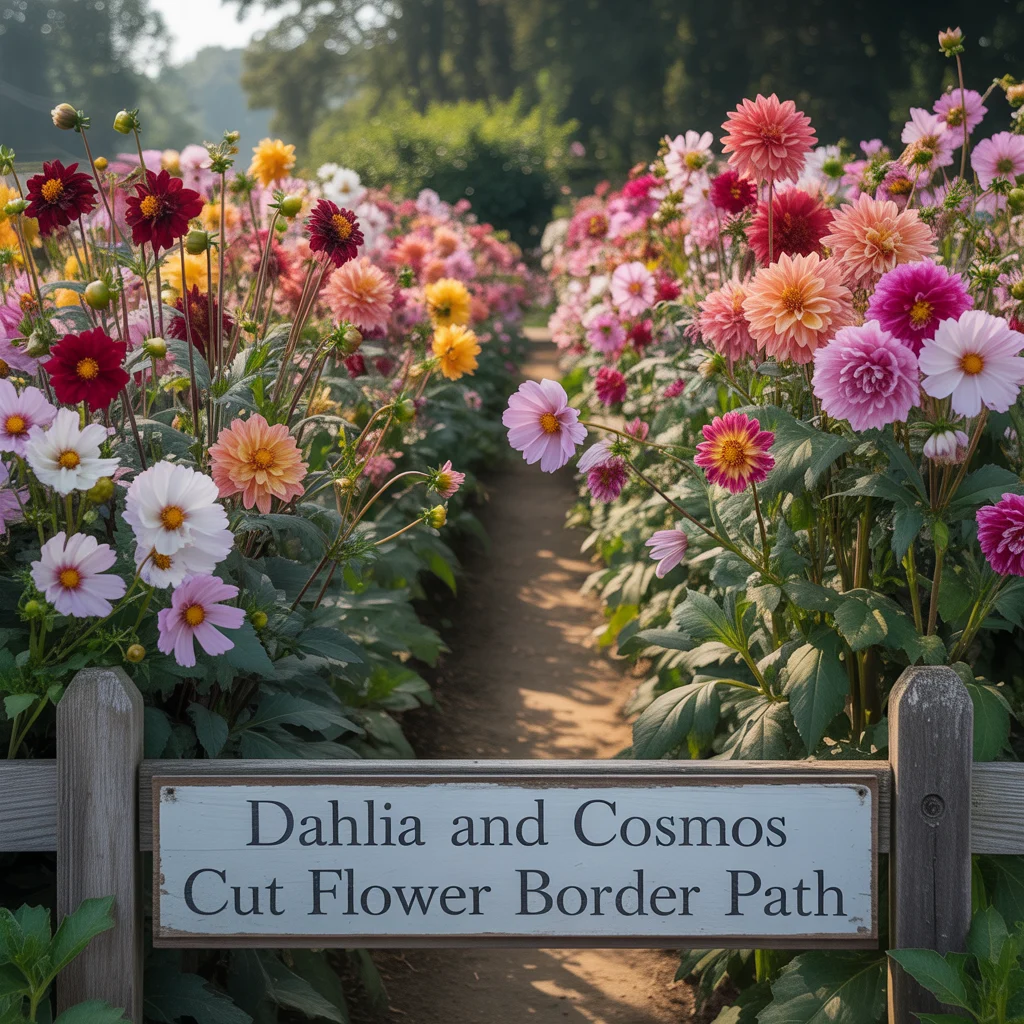
A Dahlia and Cosmos cut flower border path plants dahlias and cosmos in a productive cutting border alongside the garden path, creating a border that is both decorative and functional by providing a continuous supply of cut flowers from July through October while simultaneously serving as the planted border alongside the path surface. I planted a dahlia and cosmos cut flower border on one side of a 20-foot brick path in my own kitchen garden, using Dahlia Bishop of Llandaff, Dahlia Café au Lait, and Cosmos bipinnatus Purity in alternating groups, and the border produced enough cut flowers for weekly house arrangements from July through to the first frost without any reduction in the border’s decorative quality alongside the path.
Dahlia Varieties for a Cut Flower Garden Path Border
Dahlia Bishop of Llandaff, Dahlia Café au Lait, and Dahlia White Kerkrade are three dahlia varieties suited to a cut flower border on a garden path with borders. Dahlia Bishop of Llandaff produces single red flowers with dark bronze-black foliage on plants of 3 to 4 feet height from July to October, providing the most striking foliage and flower color combination in a cut flower path border. Dahlia Café au Lait produces large, blowsy blooms in soft peach, caramel, and cream tones from July to October and is the most widely photographed dahlia variety for cut flower and path border planting. Dahlia White Kerkrade produces pure white pompom flowers from July to October and suits a cut flower path border where pale tones are needed to balance deeper flower colors elsewhere in the combined planting.
Supporting Dahlias in a Garden Path Border
Dahlias in a garden path border require individual stake supports inserted at planting time to prevent the tall, top-heavy stems from falling across the path surface during late summer when stem height peaks and heavy flower heads make the plants vulnerable to wind damage. I use 4-foot bamboo stakes inserted 12 inches into the soil at planting time for each dahlia tuber, tying the main stem to the stake with soft garden twine at 12-inch intervals as the plant grows. A wire peony support hoop of 24-inch diameter and 36-inch height placed over the emerging dahlia plant in May provides the most secure support system for a path border dahlia, containing all stems within the hoop as they develop and eliminating the risk of individual stem collapse across the path surface during the main flowering period.
Formal Parterre Border Garden Path
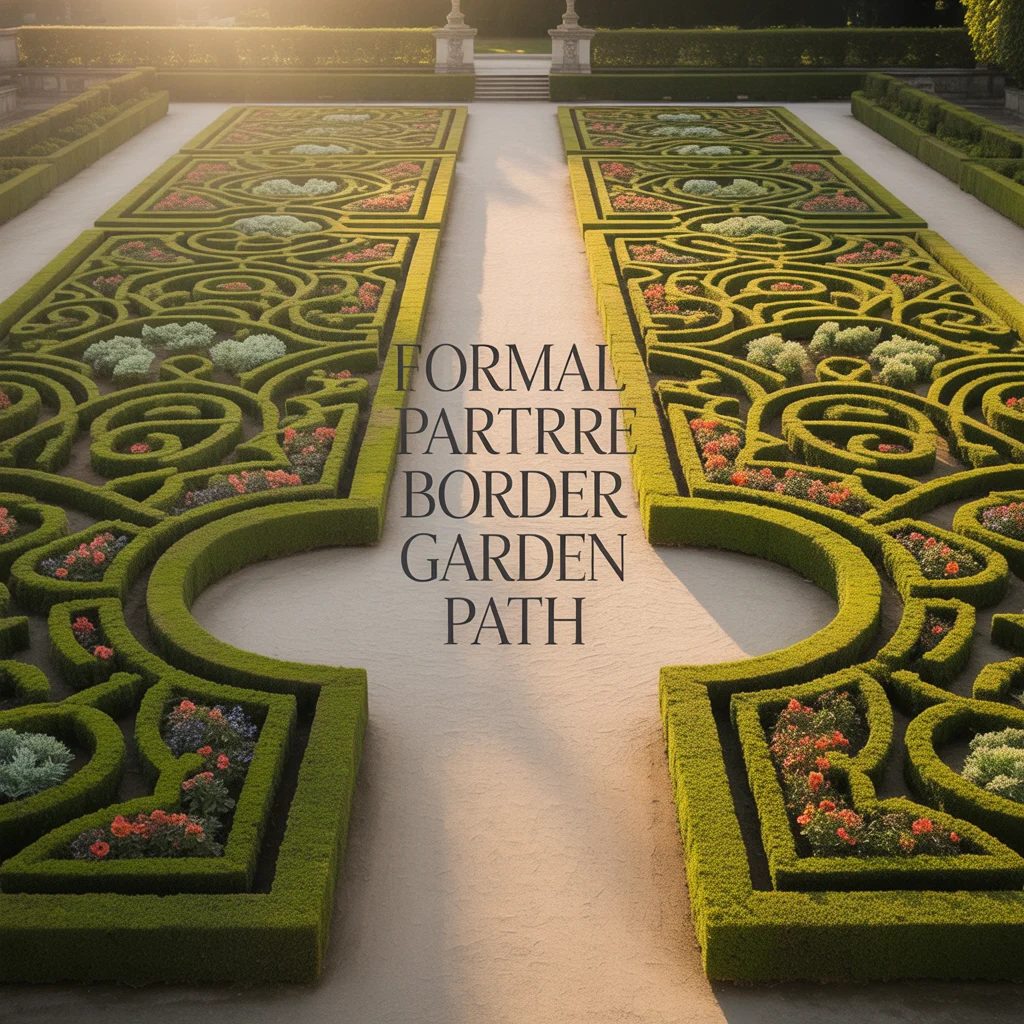
A formal parterre border garden path uses a low geometric pattern of clipped box hedging or lavender in a repeated unit design along both sides of the path, creating a decorative structural border with the character of a parterre garden reduced to a linear path border format. I designed a simplified parterre border for a formal garden path at a period property, using repeated diamond-shaped units of clipped Buxus sempervirens at 18 inches height set at 3-foot intervals along both sides of a 28-foot York stone path, and the geometric repetition of the box diamond units produced a path border of formal character that suited the Georgian proportions of the garden without requiring the complex internal pattern geometry of a full parterre garden.
Geometric Border Unit Ideas for a Formal Path
Diamond box units, alternating square and round forms, and repeated cone and ball sequences are three geometric border unit ideas suited to a formal parterre-style garden path with borders. Diamond box units use four box plants clipped to form a square outline planted at the corners of a 24-inch diamond, creating a repeated geometric unit that reads as a pattern element rather than an individual plant. Alternating square and round forms use clipped box squares of 18 inches and clipped box balls of 18 inches diameter placed alternately along the path border, creating a more varied rhythm than a single repeated form. Repeated cone and ball sequences alternate a 24-inch yew cone with an 18-inch box ball at 3-foot intervals, combining two topiary species in a formal border rhythm.
Parterre Border Maintenance on a Garden Path
A formal parterre border on a garden path with borders requires more precise and frequent maintenance than any other border type in this article, with clipping required two to three times per season to maintain the geometric accuracy of the unit forms. The first clip takes place in late April, shaping the new growth from the previous winter into the correct geometric profile for the season. The second clip takes place in mid-July after the summer growth flush extends the units beyond their intended profile. A third clip in late September maintains the border neatness through winter on gardens where the visual quality of the path border in the dormant season is important to the homeowner. I use topiary shears and a shaped cutting template cut from exterior plywood for all parterre border clipping to maintain consistent unit proportions across the full path border length.
Mixed Annual and Perennial Border Garden Path
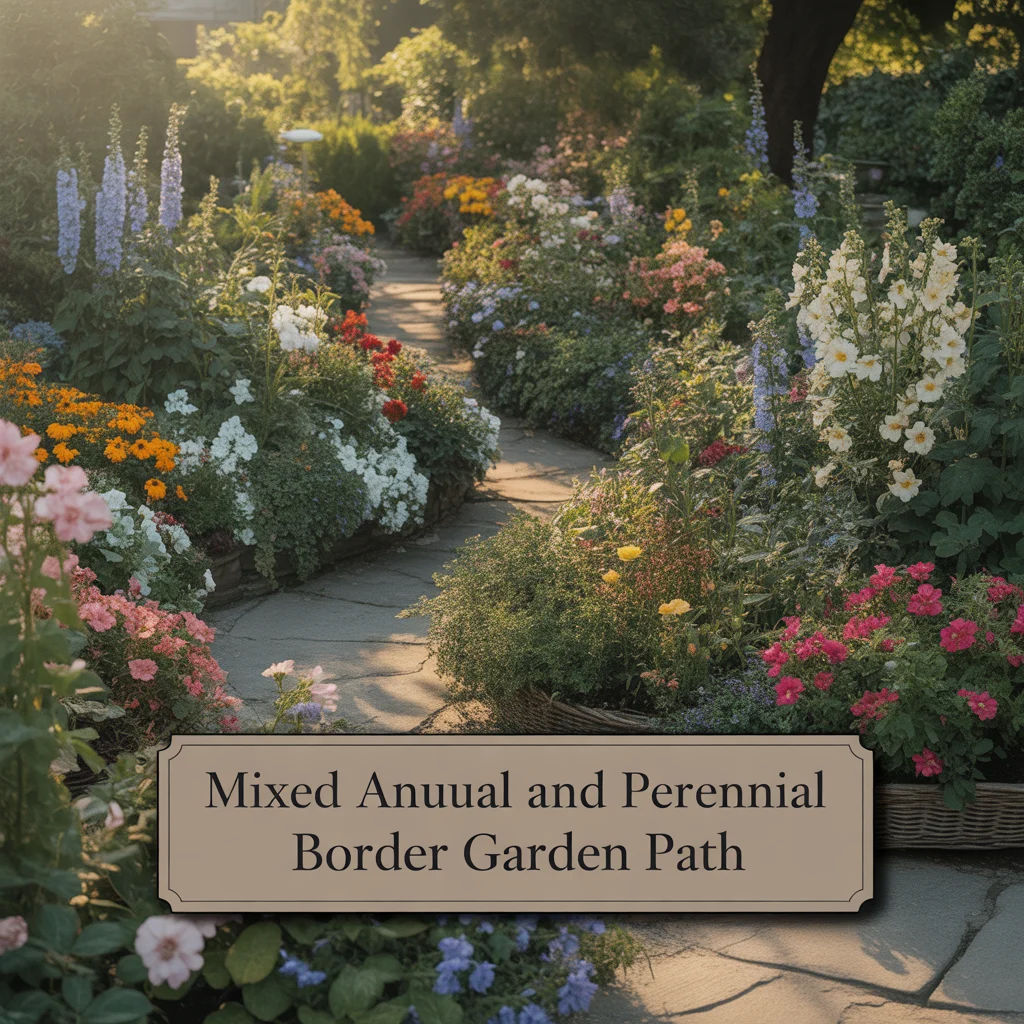
A mixed annual and perennial border garden path combines permanent perennial plants with seasonal annual bedding to create a garden path border that maintains year-round structure through the perennial framework while changing in color and texture each season through the annual additions. I designed this border type for a residential garden path where the homeowner wanted both a permanent planted structure and the flexibility to change the border color scheme each season, planting a permanent framework of Salvia nemorosa, Agapanthus, and Pennisetum alopecuroides with annual gaps left at 18-inch intervals for seasonal bedding plants changed in spring and autumn.
Perennial Framework Plants for a Mixed Path Border
Salvia nemorosa, Agapanthus Headbourne Hybrids, and Pennisetum alopecuroides are three perennial framework plants suited to a mixed annual and perennial border on a garden path with borders. Salvia nemorosa provides an upright violet-blue flowering accent from May to August at 18 to 24 inches height that acts as a repeating structural element in the border regardless of which annual plants fill the gaps between salvia clumps each season. Agapanthus Headbourne Hybrids provide a bold, architectural element with blue flower heads on 3-foot stems from July to September that reads as a strong permanent structure in the mixed border. Pennisetum alopecuroides provides a grass-textured framework element with arching foliage at 24 inches height that remains attractive from April through January.
Annual Plants for a Mixed Garden Path Border
Pelargonium, Verbena, and Nicotiana are three annual plants suited to the seasonal gap planting in a mixed annual and perennial garden path border. Pelargonium in a compact trailing or upright form provides continuous flower color from May to October in red, pink, white, and coral at 12 to 18 inches height, filling the annual gaps in the perennial framework with reliable, weather-resistant color that requires no deadheading to maintain flowering. Verbena bonariensis provides tall, airy purple flower stems of 4 to 5 feet from July to October that rise above the perennial framework plants and add a vertical annual accent to the mixed path border. Nicotiana sylvestris produces white trumpet flowers with a strong evening fragrance from June to September, adding an olfactory annual element to the mixed border alongside the garden path.
Related
best creeping thyme border ideas for garden paths
how to use bark mulch as a low-maintenance path border
stunning stone garden path ideas with layered borders
Frequently Asked Questions
What is the best border for a garden path?
Lavender is the best planted border for a garden path because it combines structural definition with seasonal flower colour, fragrance, and year-round evergreen foliage in a single low-maintenance plant that suits a wide range of garden styles from cottage to contemporary. Lavandula angustifolia Hidcote at 18-inch spacing produces a dense, even border of 18 to 24 inches height that defines the path edge as clearly as a structural edging material while providing the additional sensory qualities of a planted border. For a structural rather than planted border, cor-ten steel edging provides the cleanest, most durable path edge definition at 3mm thickness and 150mm depth, suiting any modern or contemporary garden path design.
How wide should a border be alongside a garden path?
A planted border alongside a garden path measures most effectively at 18 to 36 inches in width, which provides enough planting depth for two to three plant rows while keeping the border proportional to the path width. A border narrower than 12 inches does not provide enough planting depth for most perennials to establish a full root system, producing thin, poorly performing border plants. A border wider than 48 inches starts to compete visually with the path surface itself, making the path feel like a secondary element in the garden rather than the primary route the border is designed to enhance. I use 24-inch borders alongside paths of 3 to 4 feet width as the standard proportion on all residential garden path with borders projects.
What plants make the best low-maintenance garden path border?
Nepeta x faassenii, Lavandula angustifolia, and Heuchera are the three best low-maintenance plants for a garden path border because all three require only one or two maintenance interventions per season, tolerate a wide range of soil conditions, and provide continuous seasonal interest without staking, dividing more than every four to five years, or pest and disease management beyond routine garden hygiene. Nepeta requires two cut-back sessions per season at July and March. Lavender requires one prune in August. Heuchera requires division every four years and no other regular maintenance. I specify all three species on garden path border projects where low maintenance is the primary client requirement, planting them in combinations that provide interest from April through October.
How do I stop a garden path border from spreading onto the path?
A garden path border is prevented from spreading onto the path surface by installing a structural edging strip of steel, brick, or timber board along the front face of the border at the path edge, which creates a physical barrier between the border soil and the path surface and prevents plant stems from collapsing across the walking surface. Steel lawn edging at 100mm depth set flush with the path surface costs $3 to $5 per linear foot and provides the most permanent and precise containment edge for any planted path border. I install a structural front edging on every planted border alongside a garden path project because the edging reduces annual maintenance time significantly by eliminating the need for manual path edge trimming between path and border.
What is the best structural edging for a modern garden path border?
Cor-ten steel edging is the best structural edging for a modern garden path border because it develops a deliberate, stable rust patina within 6 to 12 months that provides a distinctive warm-toned metal edge without any ongoing surface maintenance, and it lasts 25 to 40 years in outdoor installation without structural deterioration. Cor-ten steel edging at 3mm thickness and 150mm depth costs $5 to $9 per linear foot, which is more expensive than mild steel at $3 to $5 per linear foot but requires no painting, sealing, or rust treatment after the initial patina forms. I specify cor-ten steel edging on all modern and contemporary garden path with borders projects where the homeowner wants a permanent, low-maintenance structural path border that weathers to a warm, organic tone over time.