
22 Garden Paths Around a Tree That Create a Stunning Feature

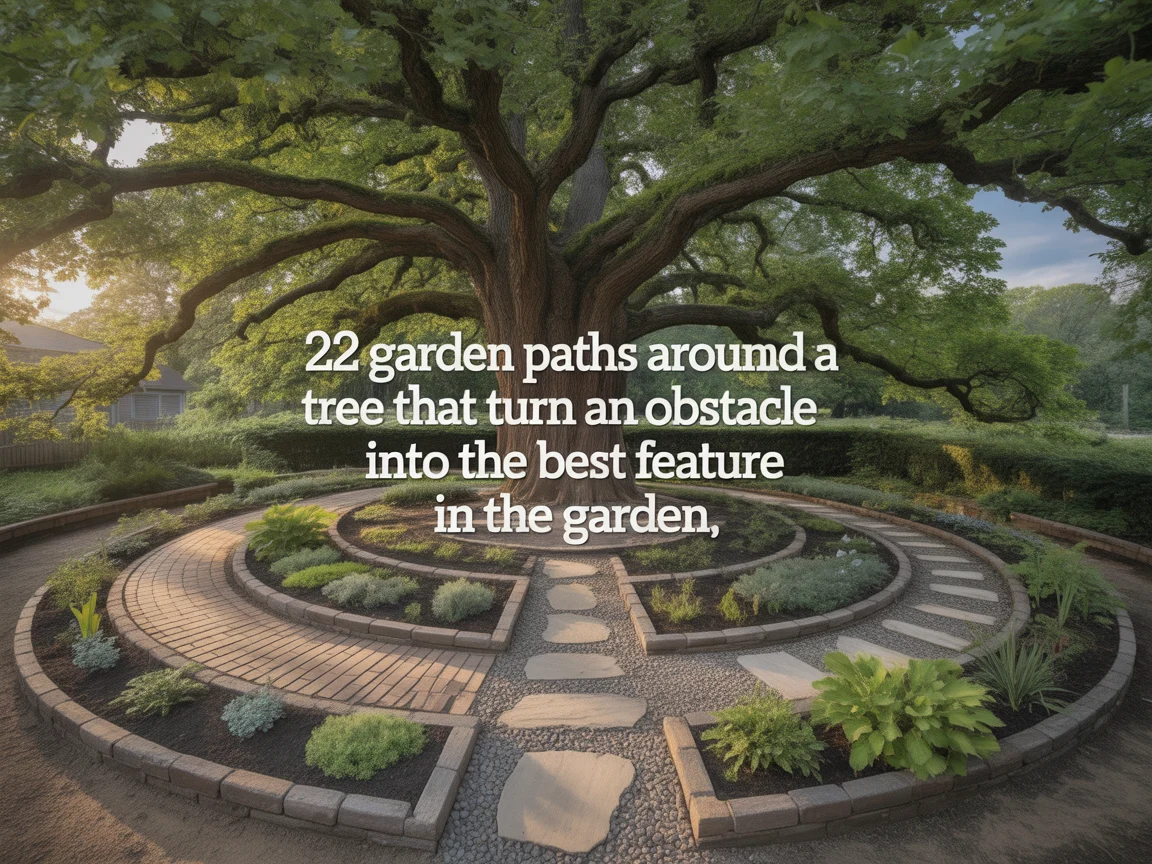
I spent two full summers ignoring the large apple tree in the center of my back lawn because I had no idea what to do with the ground beneath it. The grass died off in the dry shade, the roots made mowing uncomfortable, and the whole area looked neglected despite being the most structurally interesting part of the garden. Then I laid a circular gravel path around the trunk at a radius of 4 feet, added a simple curved stepping stone path leading to it from the lawn edge, and the tree became the focal point the garden had always needed.
Garden paths around a tree combine a curved or circular walkway with a tree as the central organizing feature, solving the practical problem of routing a path past an existing tree while simultaneously making that tree the most visually prominent element in the garden design. The path gives the tree a defined setting, and the tree gives the path a clear destination and reason to curve.
Since that apple tree project, I have designed and studied many garden paths around trees of different species, sizes, and garden settings. I have seen small garden paths around a tree work in compact lawns, and I have also seen grand circular designs become the organizing center of an entire large garden layout.
In this article, I am sharing 22 garden paths around a tree that I have either created myself or researched thoroughly enough to recommend with complete confidence.
Circular Gravel Path Around a Tree
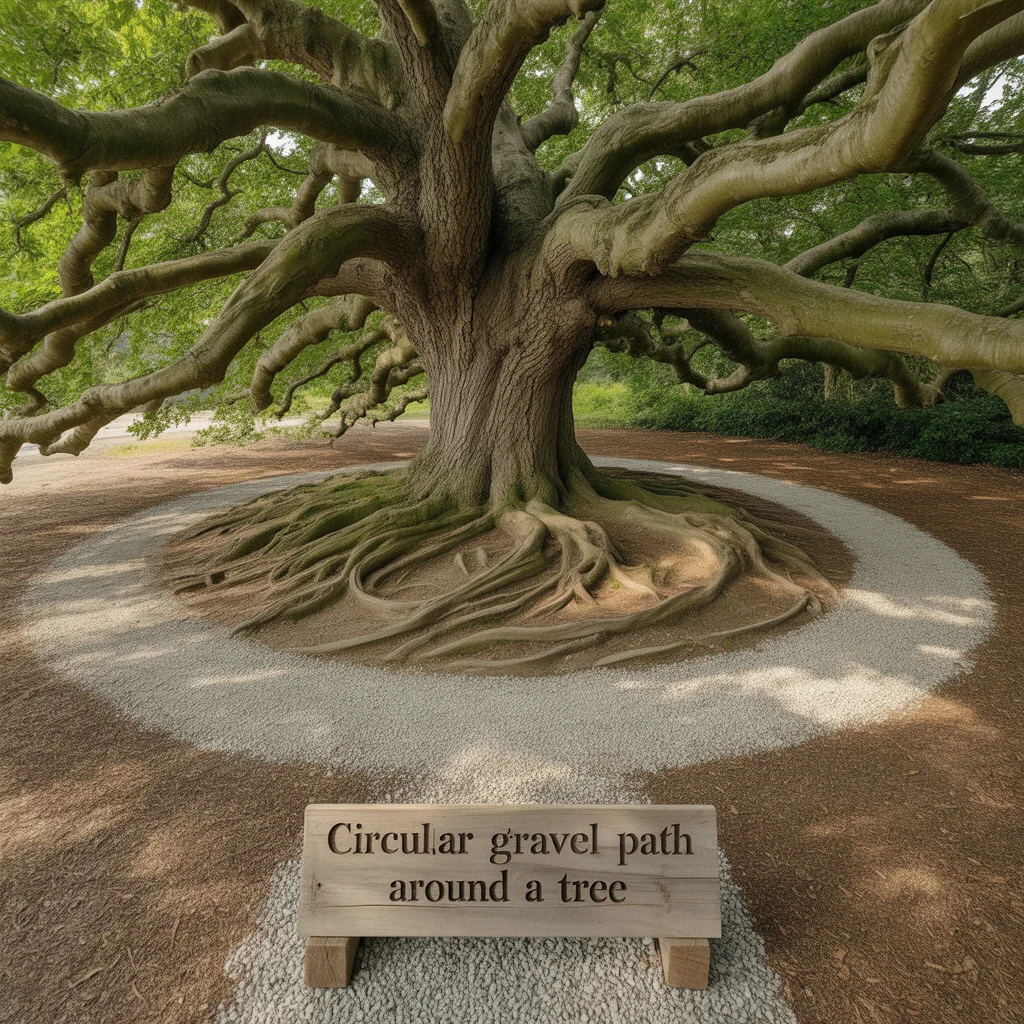
A circular gravel path around a tree uses a ring of gravel at a set radius from the tree trunk to create a defined circular feature that simultaneously functions as a path, a weed-suppressing mulch layer, and a visual frame for the tree as a garden focal point. I laid this design around my apple tree using a 4-foot radius from the trunk center, edging the circle with flexible steel lawn edging bent to the correct curve, and filling the interior and the path ring itself with 20mm golden gravel at 3-inch depth. The total material cost was $85 and the installation took one afternoon, producing an immediate change in how the tree read within the broader garden layout. Anyone working with established tree canopy and wanting to extend this concept into a fuller naturalistic garden design will find a wide range of bark chip, stepping stone, and log-edged path ideas in these woodland gardens with paths around mature trees, which cover everything from fern and hosta woodland path plantings to Japanese-inspired stepping stone routes and elevated boardwalk designs that preserve tree root systems while creating genuinely immersive garden spaces.
How to Mark a Circular Path Around a Tree
A circular gravel path around a tree is marked using a string compass made from a wooden peg hammered into the ground at the trunk base and a length of string tied to a second peg used as a scribing tool. The inner radius string length equals the desired clearance from the trunk, typically 3 to 4 feet, and the outer radius string equals the inner radius plus the desired path width of 2 to 3 feet. I mark both circles by scribing a continuous line in the turf with the outer peg while keeping the inner peg fixed at the trunk base, then cut along both lines with a half-moon edger before excavating the path area to the required depth of 4 inches.
Gravel Types for a Circular Tree Path
Golden gravel, grey flint, and white marble chippings are three gravel types suited to a circular garden path around a tree. Golden gravel at 20mm chip size produces a warm surface color that complements the bark tones of most deciduous trees and costs $2 to $4 per square foot. Grey flint at the same chip size produces a cooler, more neutral surface that suits a contemporary garden design where the path around the tree is part of a larger modern layout. White marble chippings produce the brightest surface and reflect the most light into the shaded area beneath a dense tree canopy, which suits a path around a tree in a position where ground-level light levels are low throughout the growing season.
Stepping Stone Path Through Grass Around a Tree
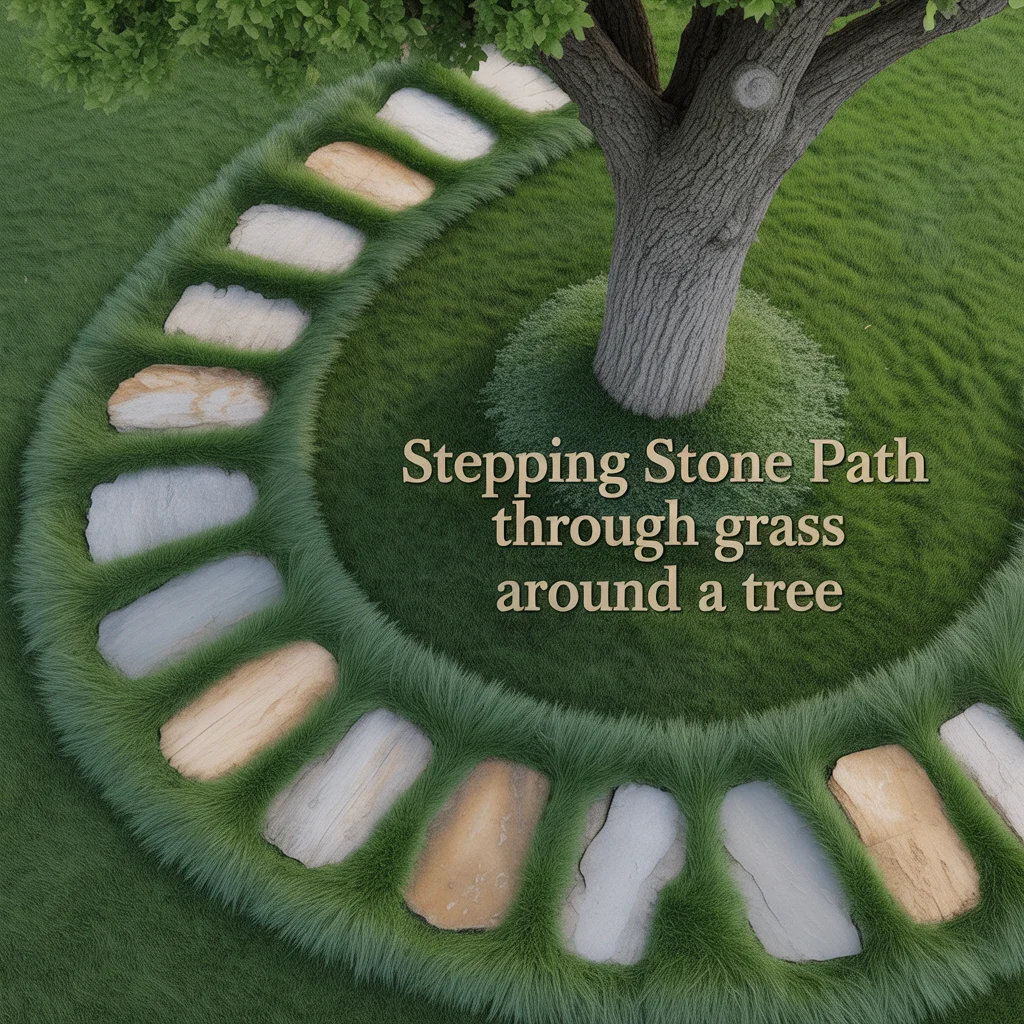
A stepping stone path through grass around a tree uses large individual stones set in the lawn surface to create a curved or circular walking route that connects the garden entrance path to the tree and continues around it without requiring any removal of the existing lawn. I created this as a cheap garden path idea around a silver birch tree in my front lawn, using six 20-by-20-inch sandstone pads set in the lawn at 14-inch intervals following a gentle curved route from the garden entrance to a point 3 feet from the trunk on the near side. The cost was $72 for the six stones and the installation required only a spade and a spirit level.
Setting Stepping Stones in Grass Around a Tree
Stepping stones set in a lawn surface around a tree require excavation to a depth equal to the stone thickness plus 20mm of sharp sand bedding, which places the finished stone surface 5mm above the surrounding lawn level to account for grass growth after installation. I set each stone by cutting the turf to the exact stone outline with a sharp spade, removing the cut turf section, adding 20mm of sharp sand to the base, placing the stone, and checking it with a spirit level before tamping it down with a rubber mallet. The full process takes approximately 15 minutes per stone, making a six-stone curved path around a tree a 90-minute installation project.
Stepping Stone Shapes for a Curved Tree Path Through Grass
Circular stepping pads, irregular random shapes, and large square slabs are three stepping stone shapes suited to a curved garden path through grass around a tree. Circular stepping pads of 18 to 20 inches diameter produce the most fluid curved path line in a lawn because the circular stone shape suits the curved route naturally without requiring cuts or awkward orientations at the path bends. Irregular random shapes produce the most naturalistic path appearance in a lawn and suit a garden where the informal character of the surrounding planting makes a more organic stepping stone layout appropriate. Large square slabs of 24 by 24 inches produce a bolder, more contemporary path statement in a lawn setting.
Bark Mulch Ring Path Around a Tree
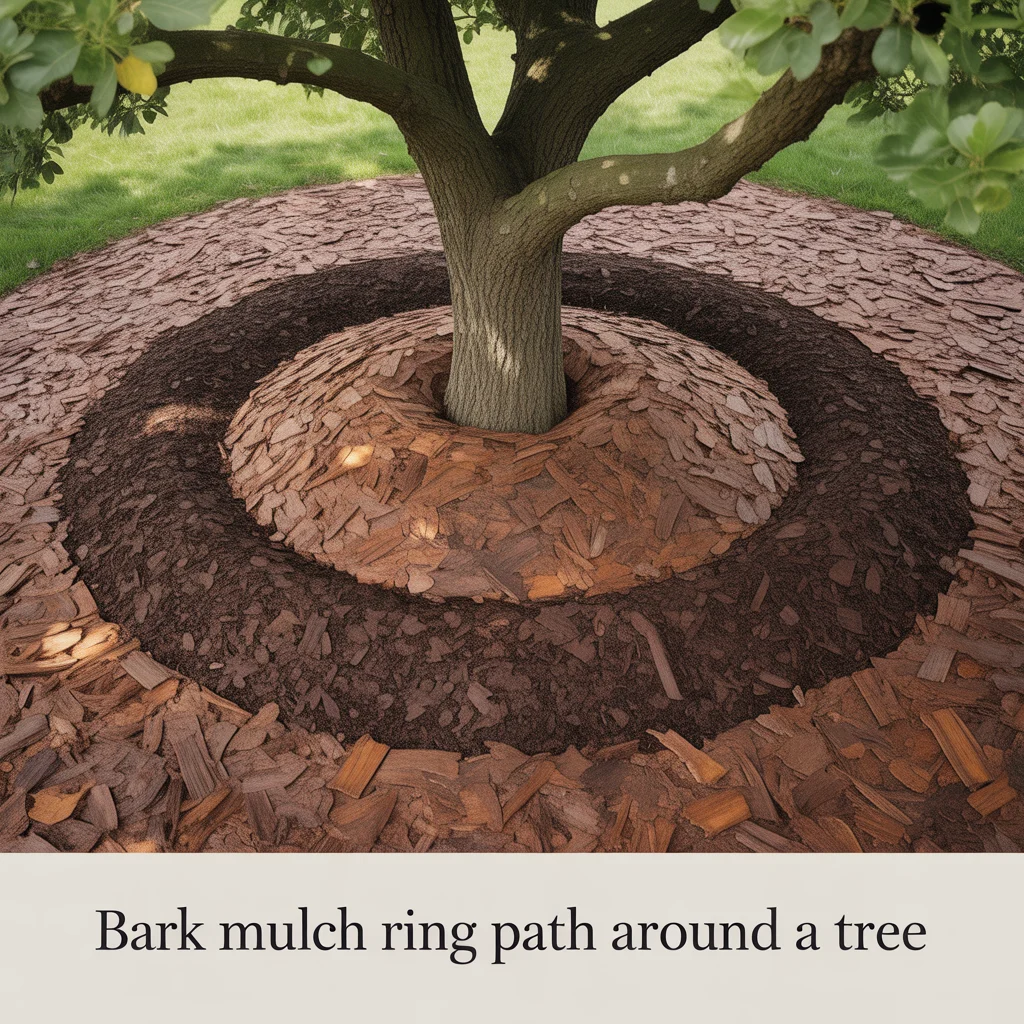
A bark mulch ring path around a tree uses a deep layer of bark chip as both the path surface material and the tree root protection layer, creating a circular path that benefits the tree’s health while simultaneously producing a defined decorative feature at the base of the trunk. I use this design as a cheap garden path idea for trees in lawn settings because bark chip costs significantly less per square foot than any paving material and requires no sub-base excavation that could damage the surface roots common under established trees. A bark mulch ring at 3-foot radius from the trunk and 3-foot path width costs approximately $25 to $40 in materials for a standard garden tree.
Bark Chip Depth for a Tree Ring Path
Bark chip on a garden path around a tree requires a minimum depth of 3 inches to provide an effective walking surface and suppress weed growth, and a maximum depth of 4 inches to avoid smothering the surface roots and soil gas exchange around the tree trunk base. Bark chip deeper than 4 inches against the trunk base creates conditions that promote crown rot in some tree species, particularly fruit trees and ornamental cherries, by keeping the bark at the base of the trunk permanently moist. I always leave a 6-inch clear gap between the inner edge of the bark mulch ring and the actual tree trunk surface, which prevents moisture accumulation directly against the bark while still providing the weed suppression and aesthetic benefit of the mulch path.
Bark Types for a Tree Ring Garden Path
Fine bark at 10 to 20mm chip size, medium bark at 25 to 40mm, and composted wood chip are three bark types suited to a circular garden path around a tree. Fine bark at 10 to 20mm produces the flattest, most stable walking surface of the three options and suits a path that receives frequent foot traffic around the tree. Medium bark at 25 to 40mm produces a more decorative, rustic surface appearance that suits a woodland or informal garden setting where the bold chip size coordinates with the natural character of the tree and surrounding planting. Composted wood chip, available free from many local councils and tree surgeons, provides the cheapest path surface for a tree ring path at $0 cost and improves soil fertility as it breaks down.
Curved Brick Path Around a Tree
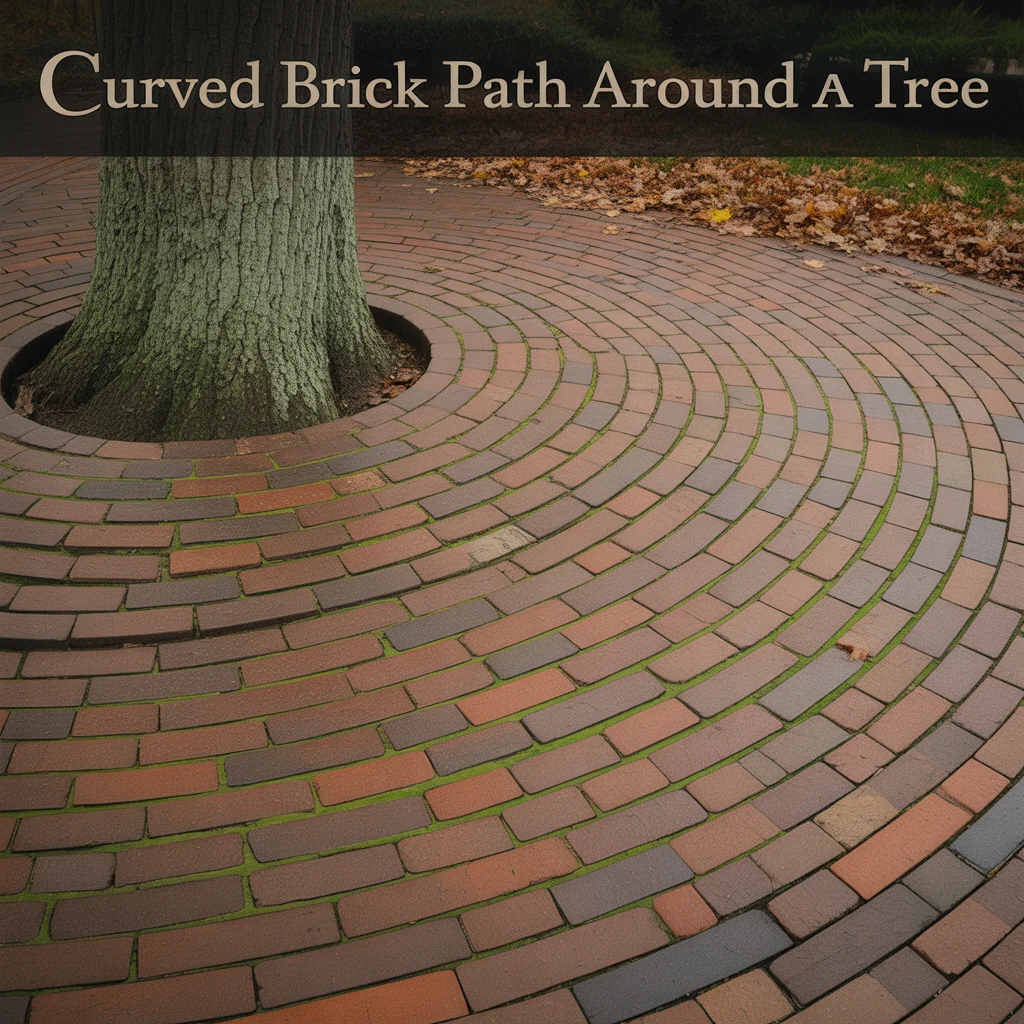
A curved brick path around a tree uses flexible brick laying techniques to create a smooth curved route that passes one side of the tree trunk at a safe root clearance distance of 3 to 4 feet, integrating the tree into the garden path layout as a natural waypoint rather than routing the path awkwardly around it. I laid a curved brick path around a mature oak tree at a residential garden project, using a gentle 8-foot radius curve on the path approach side and a tighter 5-foot radius on the departure side, producing a path that felt like it belonged to the tree rather than avoiding it. The curved brick sections required a tapered joint width of 8 to 14mm to maintain the curve without cutting any bricks on the inside radius.
How to Lay Bricks on a Curve Around a Tree
Bricks on a curved garden path around a tree are laid using a variable joint width technique in which the joint on the outside radius of the curve is wider than the joint on the inside radius, producing the tapered joint that accommodates the change in brick spacing across the path width. For a curve of 6-foot radius, the outside joint measures approximately 14mm and the inside joint measures approximately 8mm when using standard 215mm bricks on a 3-foot path width, producing a smooth curve without any brick cutting on the curve itself. I mark the curve center point with a peg and use a string compass to scribe both the inner and outer path edges before excavating and laying the sub-base for the curved section.
Brick Patterns Suited to a Curved Tree Path
Stretcher bond, soldier course, and random coursed bond are three brick patterns suited to a curved garden path around a tree. Stretcher bond adapts to a curve more easily than herringbone because the long axis of each brick runs along the path direction, requiring only joint width adjustment on the curved section rather than brick cutting. Soldier course uses bricks set on edge with their long axis running across the path width, producing a tight, regular surface that curves smoothly because the short brick dimension across the path allows more joint width variation per linear foot of curve. Random coursed bond suits an informal curved tree path where slight variations in joint width and brick spacing contribute to the relaxed character of the path design.
Circular Paved Seating Area Around a Tree
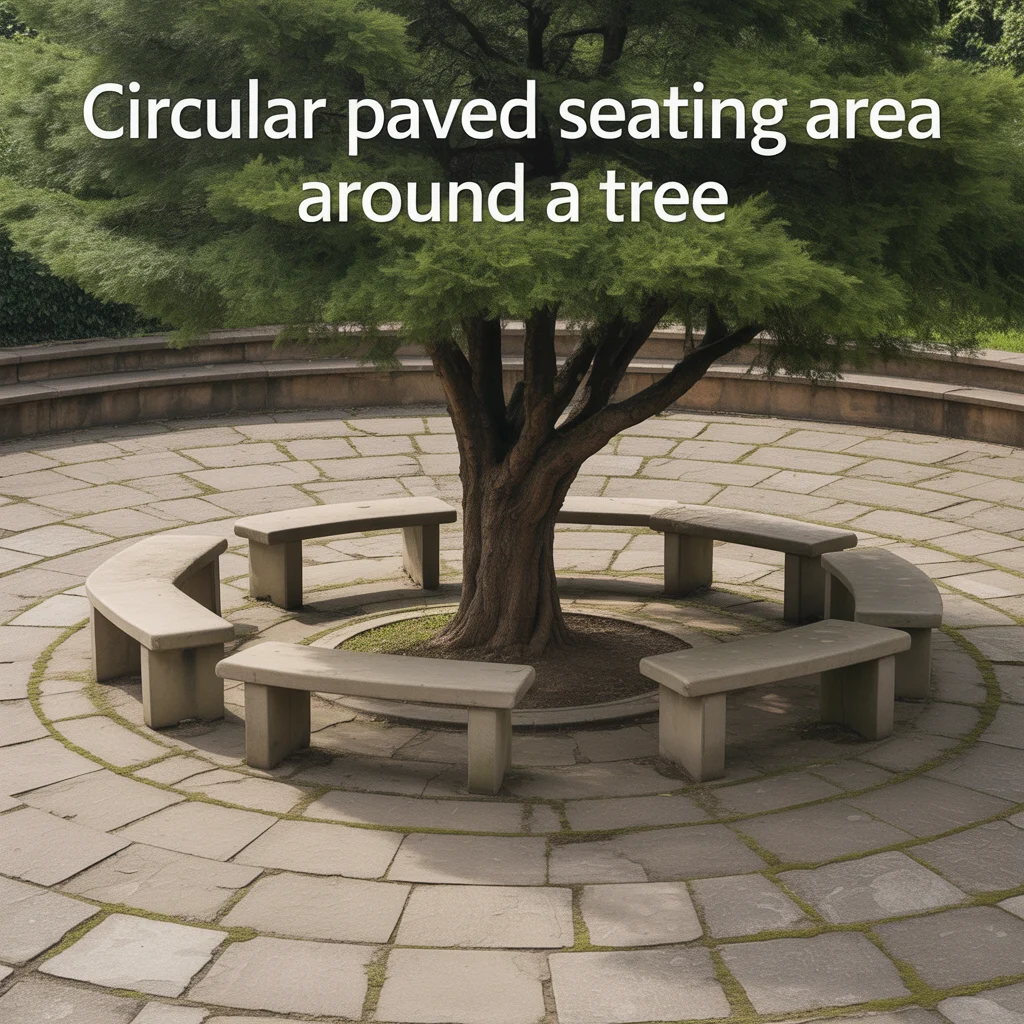
A circular paved seating area around a tree combines a full circular paved surface with a tree growing through a circular opening left in the center of the paving, creating both a practical outdoor seating space and the most formally organized version of a garden path around a tree. I designed this feature for a garden where a mature apple tree stood at the natural center of the rear garden space, laying a 10-foot-diameter circle of York stone flags around the trunk with a 3-foot-diameter unpaved planting collar left around the base. The circular paved area became the primary outdoor living space of the garden after installation, used for outdoor dining from May through September.
Paving Materials for a Circular Tree Surround
York stone flags, porcelain pavers, and granite setts are three paving materials suited to a circular paved seating area around a tree. York stone flags in random or coursed sizes produce the warmest, most naturally aged surface for a circular tree surround and suit gardens where the informal character of the stone coordinates with the organic form of the tree above it. Porcelain pavers in large 600mm by 600mm format cut to the circular edge profile suit a contemporary garden where the precision of the material matches a modern planting and furniture scheme around the tree. Granite setts at 100mm by 100mm suit a formal circular tree surround where the small unit size allows a precise circular edge without significant cutting waste.
Tree Root Clearance for a Paved Circle Around a Tree
A paved circular surface around an established tree requires an unpaved planting collar of minimum 24 inches radius from the trunk base to allow soil gas exchange and rainfall penetration to reach the main root zone. Paving installed within 24 inches of the trunk base on an established tree compresses the soil immediately around the root collar, restricting oxygen and water movement to the tree’s feeder root zone. I always specify a permeable sub-base of 4 inches of 20mm clean angular aggregate without any fine sand or cement mortar beneath all paving within 10 feet of a mature tree trunk, which maintains soil drainage and gas exchange through the aggregate voids even where paving covers the surface directly above the root zone.
Radial Stepping Stone Path Around a Tree
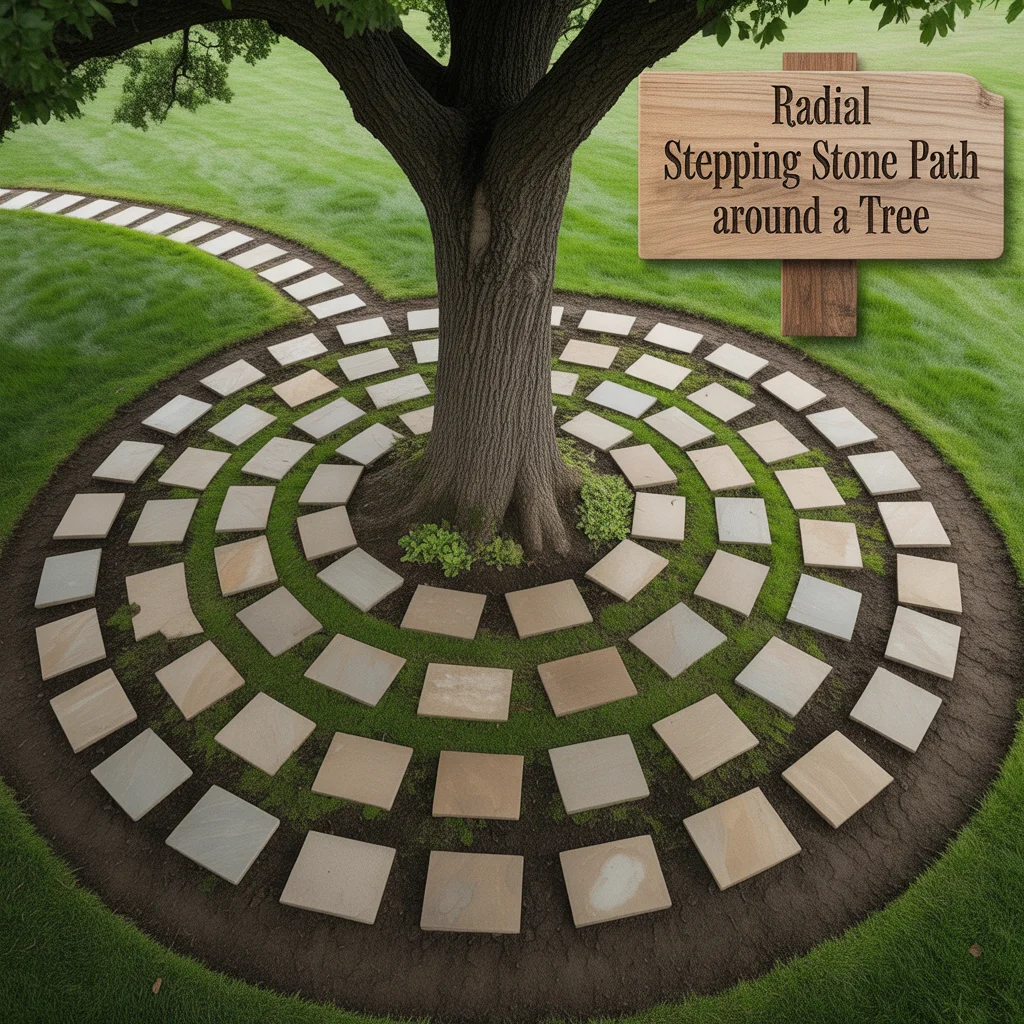
A radial stepping stone path around a tree uses stepping stones arranged in a spoke-like pattern radiating outward from the tree trunk center, connecting a circular inner ring around the trunk to the surrounding garden paths or lawn edges. I saw this design used at a public garden where a large cedar tree had eight radial stepping stone paths extending outward from a circular gravel collar at 3-foot radius to the surrounding lawn at a distance of 12 feet from the trunk, and the radial pattern produced a formal, organized tree setting that made the cedar tree read as the deliberate center of the entire garden layout rather than simply a large existing specimen.
Spacing Radial Stepping Stones Around a Tree
Radial stepping stone paths around a tree are spaced at equal angular intervals, with four paths producing 90-degree spacing, six paths producing 60-degree spacing, and eight paths producing 45-degree spacing. Four radial paths suit a garden where the tree is positioned at a junction of two perpendicular existing paths, with the four radials aligning with the existing path directions. Six radial paths suit a circular garden space where equal distribution around the tree is the design intention and the space between paths provides room for ground cover planting. Eight radial paths suit a very large tree with a wide canopy where the additional path routes around the canopy perimeter provide multiple approach points for garden maintenance.
Ground Cover Between Radial Stepping Stone Paths
Pachysandra terminalis, Vinca minor, and Liriope muscari are three ground cover plants suited to the areas between radial stepping stone paths around a tree. Pachysandra terminalis covers the ground between radial path sections under dense shade within two to three seasons and requires no maintenance once established, making it the most low maintenance ground cover option for a radial tree path in a shaded position. Vinca minor spreads at 18 to 24 inches per season in shade and sun, covering the spaces between radial paths quickly with dark green foliage and blue-purple flowers from March to May. Liriope muscari provides a more architectural, grass-like ground cover between radial paths and suits a contemporary radial tree path design where a neater, more refined ground cover plant is required.
Modern Garden Path Around a Tree With Porcelain Pavers
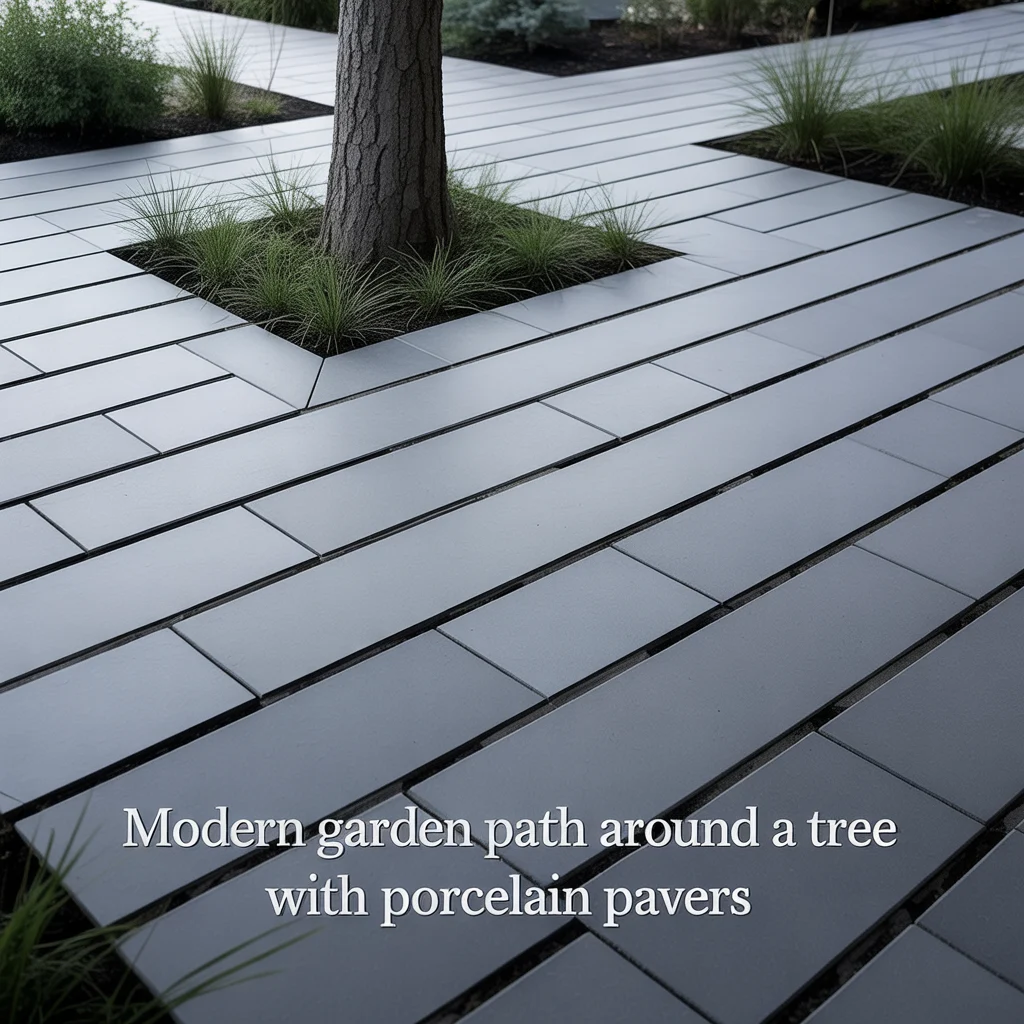
A modern garden path around a tree with porcelain pavers uses large-format porcelain slabs laid in a curved or angular route around the tree trunk, creating a contemporary path design that suits urban gardens, rear extensions, and outdoor living spaces where a sleek, low-maintenance path material is consistent with the modern character of the wider garden design. I specified this path for a contemporary residential garden project where a single multi-stem Betula pendula stood at the corner of a new outdoor dining terrace, laying a 24-by-48-inch porcelain path in charcoal grey that curved around the tree at a 3-foot clearance radius before continuing to the garden boundary.
Cutting Porcelain Pavers for a Curved Tree Path
Porcelain pavers on a curved garden path around a tree require cutting to the curved edge profile using a diamond-disc angle grinder or a wet-cut tile saw, both of which produce the clean, chip-free cut edge that porcelain demands. A wet-cut tile saw produces the most accurate and clean cut for a curved porcelain path around a tree because the continuous water cooling prevents the heat buildup that causes micro-fractures in the porcelain edge when cut dry with an angle grinder. I cut all curved porcelain paver edges on a wet tile saw hired at $65 per day, which allows the full batch of curved edge pieces for a 20-foot tree path to be cut in a single hire session.
Porcelain Colors for a Modern Tree Path
Charcoal grey, warm sand, and slate effect are three porcelain colors suited to a modern garden path around a tree. Charcoal grey in a 600mm by 600mm or 600mm by 1200mm format produces the strongest visual contrast with tree bark and surrounding green planting, creating a bold contemporary path that suits a modern garden design with dark metal furniture and rendered walls. Warm sand porcelain in a stone-effect finish produces a softer surface tone that bridges contemporary and traditional garden styles and suits a modern path around a tree in a garden with mixed planting and natural material boundary features. Slate effect porcelain in blue-grey tones suits a contemporary tree path in a coastal or urban garden where the cooler color coordinates with rendered, metal, or timber boundary materials.
Simple Garden Path Around a Tree Using Timber Rounds
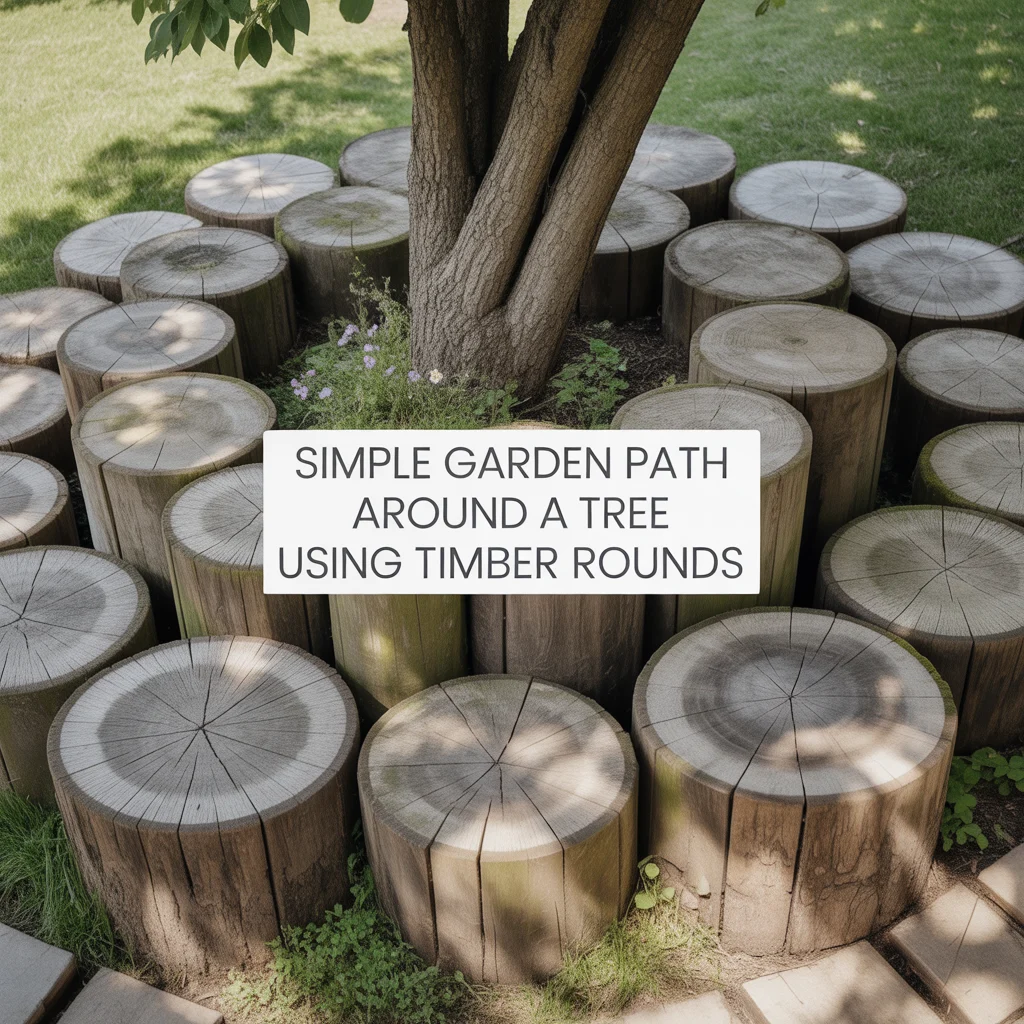
A simple garden path around a tree using timber rounds places cross-section slices of tree trunks as individual stepping elements in a curved or circular route around a central tree, creating a naturalistic path that suits woodland gardens, informal spaces, and gardens where a cheap garden path idea using natural materials is preferred over manufactured paving products. I created this path around a hazel tree in my woodland garden section using seven timber rounds of 12 to 18-inch diameter cut from a felled ash tree, set in a curved route at 12-inch intervals and bedded in 2 inches of sharp sand over a compacted soil base. The total material cost was $0 because I used wood from my own garden.
Treating Timber Rounds for a Garden Path Around a Tree
Timber rounds for a garden path around a tree require treatment to extend their outdoor lifespan from 2 to 3 years untreated to 8 to 12 years with appropriate preparation. The treatment process involves applying two coats of exterior timber preservative rated for ground contact to all surfaces of each round, paying particular attention to the end grain surfaces on the top and bottom faces where moisture penetration is fastest. I treat all timber rounds with a copper-based ground contact preservative at $18 per liter, applying the first coat and allowing 24-hour penetration before applying the second coat on the following day. Rounds cut from naturally durable timber species including oak, sweet chestnut, and larch require only one coat of preservative rather than two because the natural timber oils already provide a base level of decay resistance.
Timber Species Best Suited to a Tree Path Round
Oak, larch, and sweet chestnut are three timber species best suited to a garden path around a tree using timber rounds. Oak produces the most durable rounds with a natural lifespan of 15 to 20 years in ground contact without any preservative treatment, making it the best choice for a permanent tree path where replacing rounds every few years is undesirable. Larch produces rounds with a natural lifespan of 8 to 12 years in ground contact and suits a path where medium-term durability at lower cost than oak is the priority. Sweet chestnut produces rounds with a natural lifespan of 10 to 15 years and provides a mid-level durability option that suits most domestic garden paths around a tree.
Garden Path Around a Tree With a Circular Bench
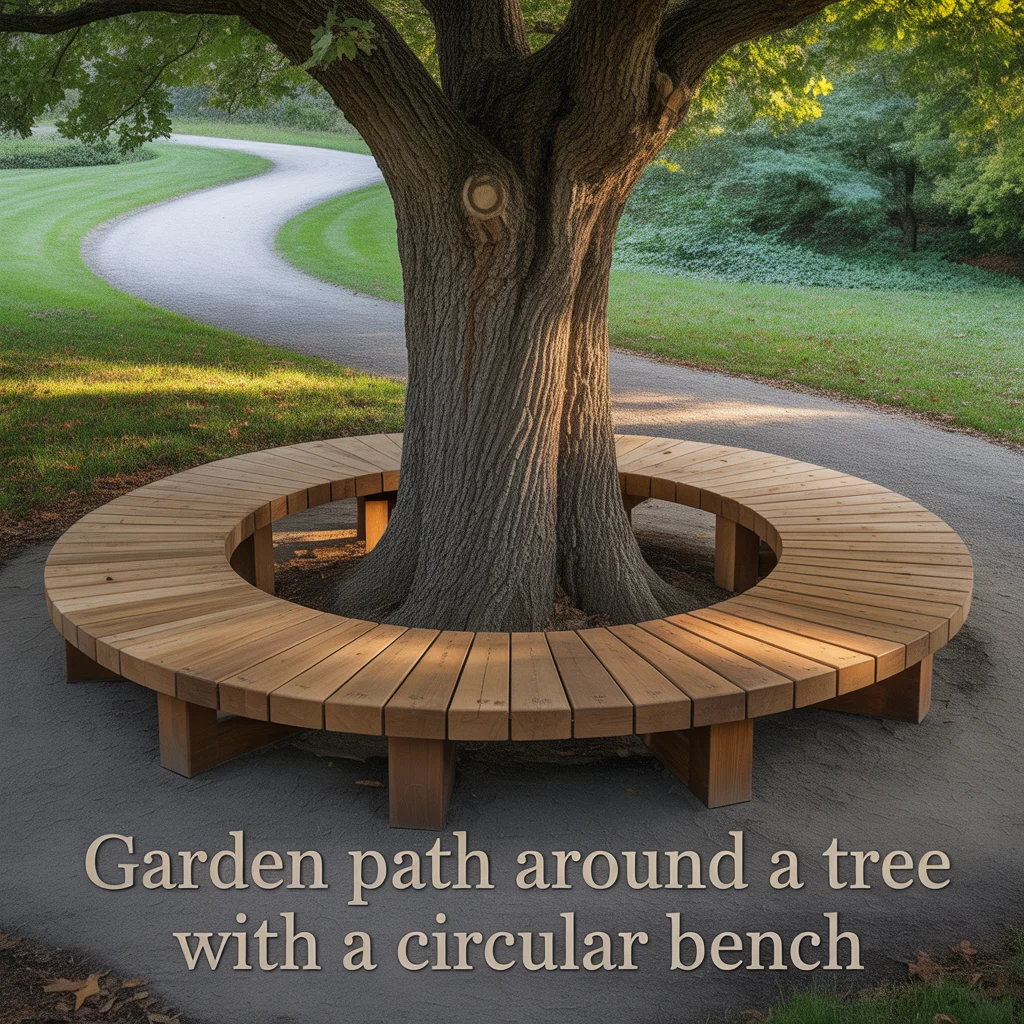
A garden path around a tree with a circular bench combines a curved path approaching and departing the tree with a full or partial circular bench fitted around the trunk, creating a tree feature that functions as both a destination on the garden path and a usable seating point within the garden layout. I specified a semi-circular hardwood bench around a mature oak tree at a garden project, with a York stone path approaching from the north and a gravel path continuing from the south, and the combination of the bench, the paths, and the tree produced a complete garden feature that became the primary outdoor sitting area of the entire 60-foot garden.
Circular Bench Dimensions for a Tree Path Feature
A circular bench fitted around a tree trunk measures most effectively at an inner diameter of 3 to 4 feet larger than the trunk diameter, which provides comfortable leg clearance between the bench seat front edge and the trunk surface while allowing future trunk growth over a 10 to 15-year period without the bench constricting the bark. The bench seat height of 17 to 18 inches suits adult comfortable seating at standard garden furniture dimensions. I specify an inner diameter of trunk diameter plus 36 inches on all circular tree bench projects, which produces a consistent 18-inch clearance between the trunk and the inside bench face that accommodates a decade of trunk growth in all but the most vigorous tree species. For the ground surface surrounding a circular bench of this type, bark chip provides the most practical and visually appropriate material under a tree canopy, and anyone planning this combination will find detailed guidance on chip sizes, membrane specifications, and edging options in these garden paths with bark mulch under tree canopies, which cover everything from fine decorative bark and pine chip to free composted wood chip and log roll edging designs suited to shaded garden positions.
Materials for a Circular Tree Bench on a Garden Path
Hardwood timber, painted softwood, and powder-coated steel are three materials suited to a circular bench on a garden path around a tree. Hardwood timber in oak, iroko, or teak produces the most naturally weathering bench surface and suits a garden where the warm wood tone of the bench coordinates with the tree bark above it, costing $280 to $600 for a complete circular bench around a standard garden tree. Painted softwood in exterior grade produces a less expensive circular bench at $120 to $280 in materials and suits a painted garden design where the bench color is chosen to coordinate with surrounding fence, gate, or furniture finishes. Powder-coated steel in black or anthracite produces the most durable and weather-resistant circular bench at $350 to $800 from specialist garden furniture suppliers.
Cheap Garden Path Around a Tree Using Recycled Materials
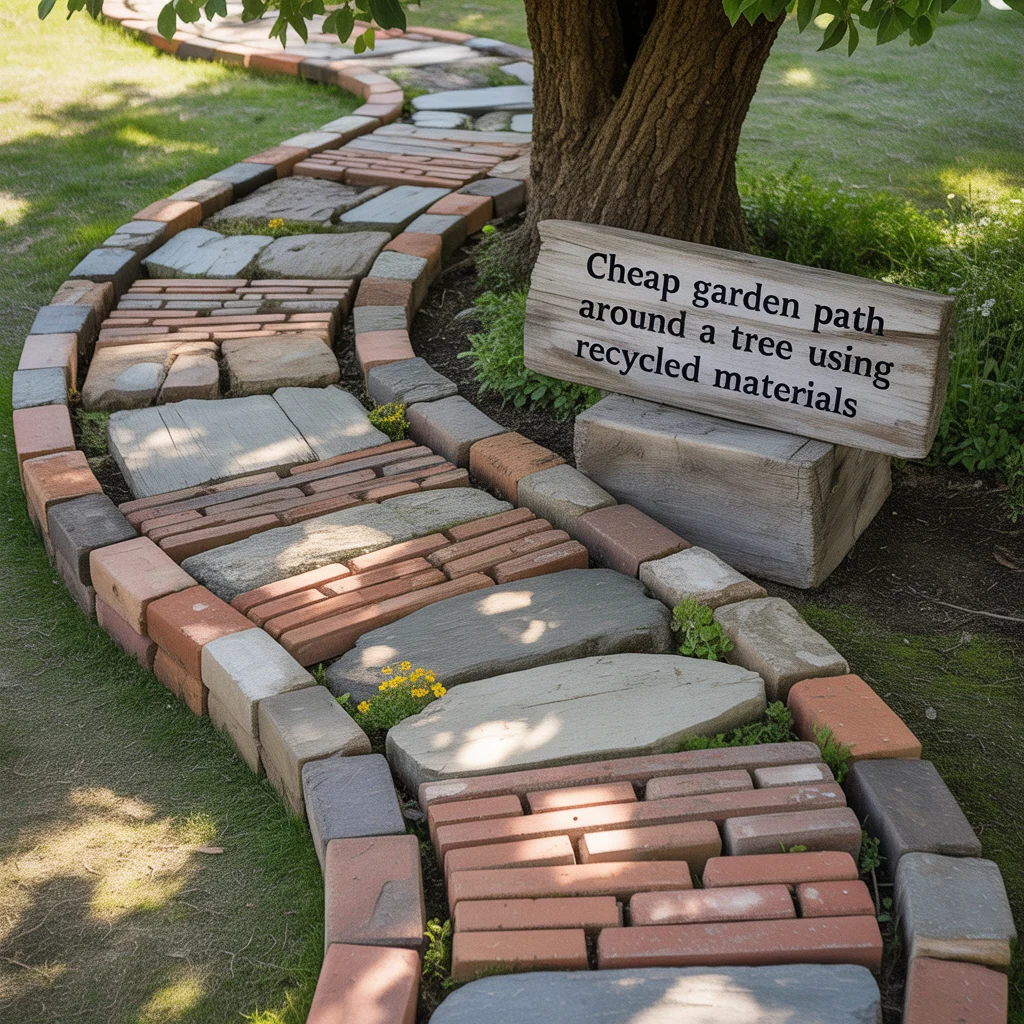
A cheap garden path around a tree using recycled materials produces a circular or curved path from reclaimed bricks, salvaged stone, or recycled concrete pieces sourced at zero or very low cost, creating a complete garden path and tree feature for under $50 in total material expenditure. I designed a circular path around a pear tree using 180 reclaimed house bricks sourced free from a neighbor’s demolition skip, laying them in a herringbone pattern on a sharp sand bed over a compacted soil base. The path cost $14 in jointing sand and took one day to complete, producing a result that several visitors assumed was a professionally installed feature.
Free and Low-Cost Materials for a Tree Path
Reclaimed bricks, salvaged stone, and free wood chip are three zero or low-cost materials suited to a cheap garden path around a tree. Reclaimed bricks are available free or at $0.20 to $0.50 each from demolition sites, online marketplace listings, and neighborhood skip clearances, and suit a circular or curved path around any style of garden tree. Salvaged stone including broken paving flags, random rubble stone, and old coping stones produces an irregular, rustic path surface around a tree and is available free from garden clearance listings and reclamation skips. Free wood chip from local tree surgeons, councils, and the online Chip Drop service in the United States provides a zero-cost path surface material for a bark mulch ring around a tree that also benefits the tree’s root zone.
Layout Options for a Recycled Material Tree Path
A full circular ring, a curved approach path with a circular terminus, and a radial stepping path with a central mulch ring are three layout options for a cheap garden path around a tree using recycled materials. A full circular ring uses recycled bricks or stone to create a complete path circle around the tree at a fixed radius, requiring the most material of the three options but producing the most formally organized tree feature. A curved approach path with a circular terminus uses fewer materials by limiting the paved area to the approach route and a small circular area on one side of the tree rather than a complete ring. A radial stepping path with a central mulch ring uses the fewest materials of the three options and suits a very tight budget where minimizing material cost is the primary constraint.
Garden Path Around a Tree With Fern and Shade Planting
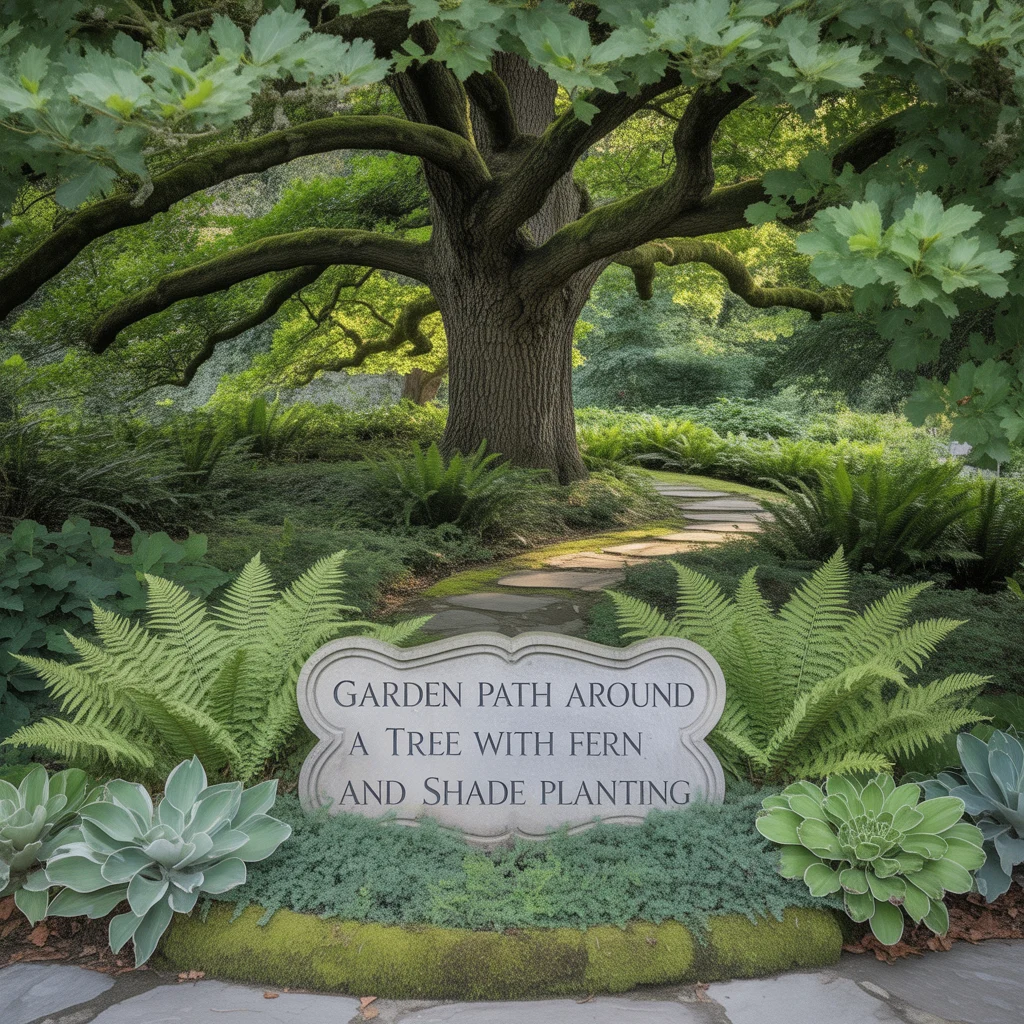
A garden path around a tree with shade planting uses ferns, hostas, astilbes, and other shade-tolerant perennials planted in the area between the tree trunk and the surrounding path to create a complete garden feature that combines the path, the tree, and a planted understorey into a single unified design. I planted a shade garden around the base of a mature beech tree on a residential project, surrounding the trunk with a 4-foot radius of Dryopteris filix-mas ferns, Hosta sieboldiana, and Astilbe chinensis, and laying a curved stepping stone path through the planting at 5-foot radius from the trunk. The combination of the path, the planted understorey, and the beech canopy above produced a layered garden feature of real visual depth.
Shade-Tolerant Plants for a Tree Path Planting Scheme
Dryopteris filix-mas, Hosta sieboldiana, and Astilbe chinensis are three shade-tolerant plants suited to the planting area around a garden path around a tree. Dryopteris filix-mas, the male fern, produces arching fronds of 3 to 4 feet in dry to moist shade and tolerates the competitive root conditions common under mature deciduous trees better than most ornamental ferns. Hosta sieboldiana produces large blue-green leaves of 12 to 18 inches width that provide a bold, architectural ground-level presence around the tree trunk base. Astilbe chinensis produces upright flower plumes of 18 to 24 inches in pink, red, and white from July to September and tolerates the moist, shaded conditions typically found around a tree base in a garden path setting.
Mulching the Planting Area on a Tree Path
The planting area around a garden path around a tree benefits from a 2-inch depth of composted bark or leaf mould mulch applied to the soil surface between the planted specimens each spring, which suppresses weed growth, retains soil moisture in the dry conditions common under a dense tree canopy, and gradually improves the soil structure as the organic material breaks down. I apply composted bark mulch to all tree base planting areas on garden path projects in March before the new growth begins, which gives the mulch time to settle before the fern and hosta growth covers the mulched surface. The mulch must be kept 3 inches clear of the stem bases of all planted specimens to prevent crown rot at the plant base.
Garden Path Around a Tree Through Grass in a Lawn
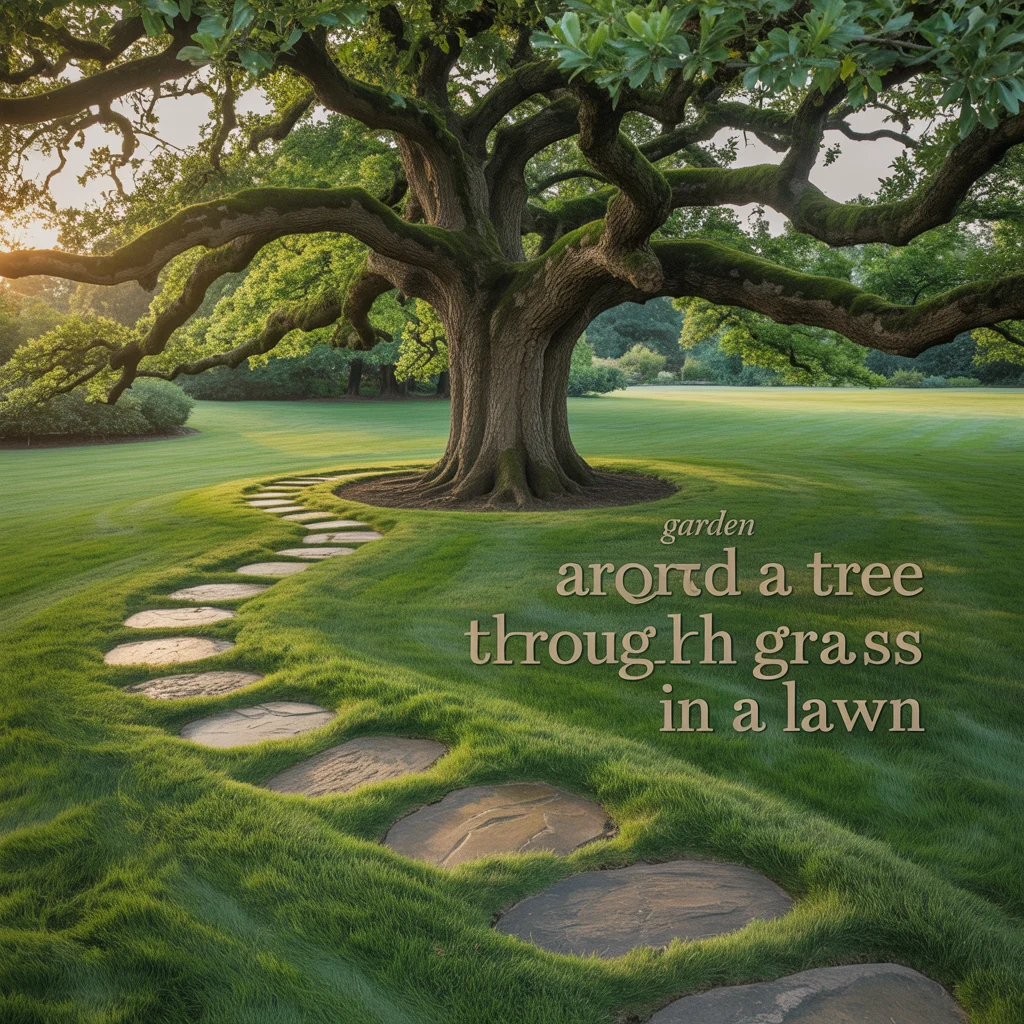
A garden path through grass around a tree in a lawn creates a defined route across the lawn surface that curves around an existing tree without removing the surrounding turf, using flush-set pavers or stepping stones that allow the lawn mower to pass directly over the path surface without any manual edge trimming. I laid this design as a small garden path around a tree in a domestic back lawn, setting six 24-by-24-inch concrete pavers flush with the turf level in a curved route from the patio edge to the tree and continuing around the trunk to a garden bench on the opposite side. The path required no edging maintenance because the flush-set stones sat at mower height throughout the growing season.
Flush Paver Setting for a Lawn Tree Path
Flush pavers on a garden path through grass around a tree are set 5mm above the surrounding turf level at installation to account for grass growth after the pavers are placed, which produces a flush surface level within 4 to 6 weeks of installation. Setting pavers exactly flush at installation typically results in the pavers sitting 5 to 10mm below the turf level after one growing season as the grass thickens, creating a collection point for standing water and a trip hazard at the path edge. I excavate to a depth of stone thickness plus 25mm for the sand bed, which positions the stone surface at the correct 5mm above-turf height when the sand is compacted and the stone is seated.
Small Garden Path Ideas Through Grass Around a Tree
A single curved stepping stone row, a double stepping stone path, and a flush concrete slab path are three small garden path ideas through grass around a tree that suit compact domestic lawn settings. A single curved stepping stone row uses one stone at each step position following the curve around the tree, producing the most economical path in terms of material cost and lawn disturbance. A double stepping stone path uses two parallel stones at each step position to create a wider path suited to two people walking side by side around the tree. A flush concrete slab path provides the most solid and all-weather surface through the lawn around a tree and suits a path used as a primary access route rather than an occasional decorative walking route.
Garden Path Around a Tree With Annual Flower Planting
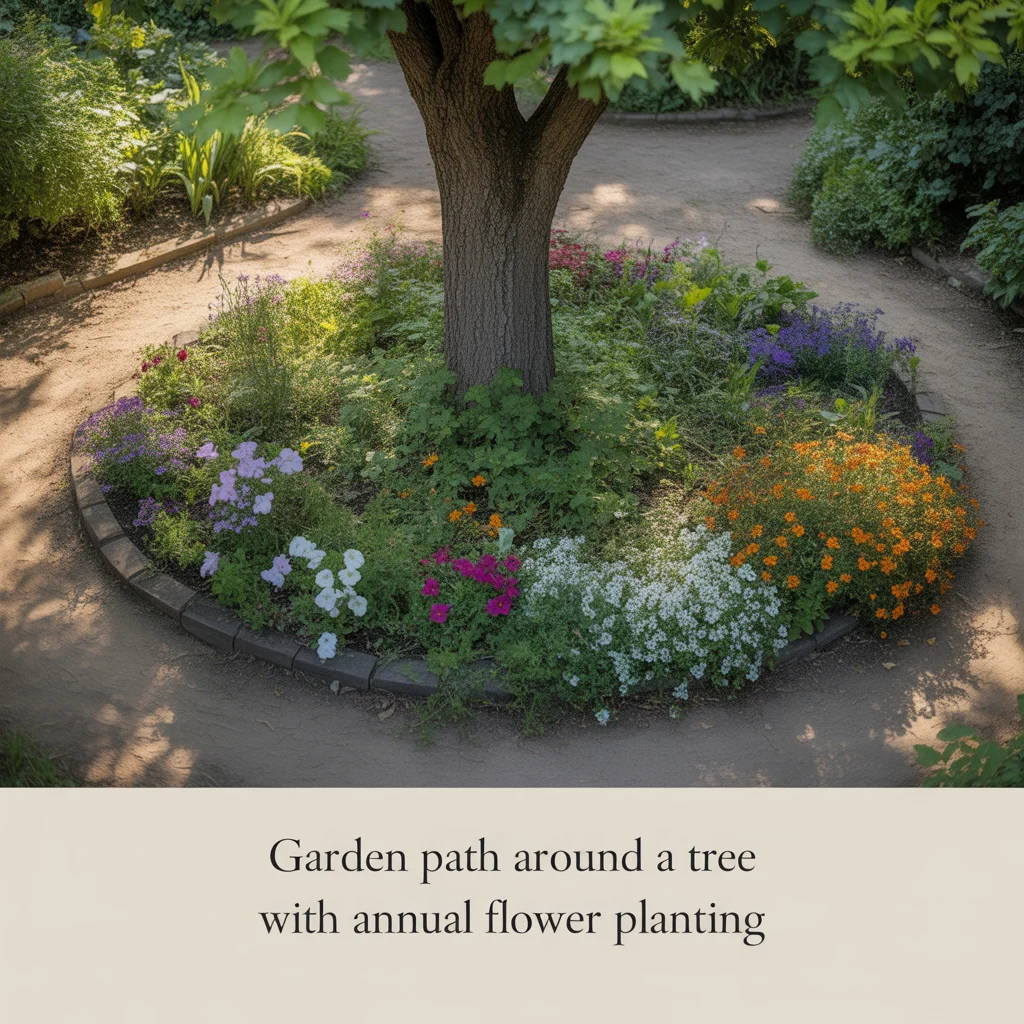
A garden path around a tree with annual flower planting uses a ring of annual bedding plants between the tree trunk and the surrounding path to create a seasonally changing colour display that transforms the tree base into a formal decorative feature within the garden path design. I planted a ring of Impatiens walleriana in deep pink and white around the base of a cherry tree on a residential project, contained between the tree trunk and a curved brick edging at 30-inch radius, and the annual planting produced a continuous colour display from May through September that made the cherry tree the most visually active feature of the garden throughout the main growing season.
Annual Plants Suited to a Tree Path Planting Ring
Impatiens walleriana, Begonia semperflorens, and Nicotiana sylvestris are three annual plants suited to a colour planting ring on a garden path around a tree. Impatiens walleriana tolerates partial shade better than almost any other annual bedding plant, producing continuous flowers in pink, red, white, and coral from May through October in the dry, shaded conditions at the base of a mature deciduous tree. Begonia semperflorens produces compact, mound-forming plants of 8 to 10 inches height in a continuous flower display from June through October, and tolerates the root competition at a tree base better than taller, more vigorous annual species. Nicotiana sylvestris produces tall white trumpet flowers from June to September with a strong evening fragrance that makes the tree path feature noticeable at dusk.
Edging Options for an Annual Planting Ring on a Tree Path
A brick soldier course, steel lawn edging, and woven willow edging are three edging options suited to defining the annual planting ring on a garden path around a tree. A brick soldier course in red or blue engineering bricks produces the most defined and formal planting ring edge, suiting a period property or formal garden where a precise, structured edge separates the path from the planting. Steel lawn edging at 100mm depth creates a sharp, modern edge at a cost of $3 to $5 per linear foot, suiting a contemporary garden path around a tree. Woven willow edging at 150mm height produces a natural, rustic border that suits a cottage or informal garden path around a tree where the organic character of the edging coordinates with the tree and planting above it.
Garden Path Around a Tree With Lighting
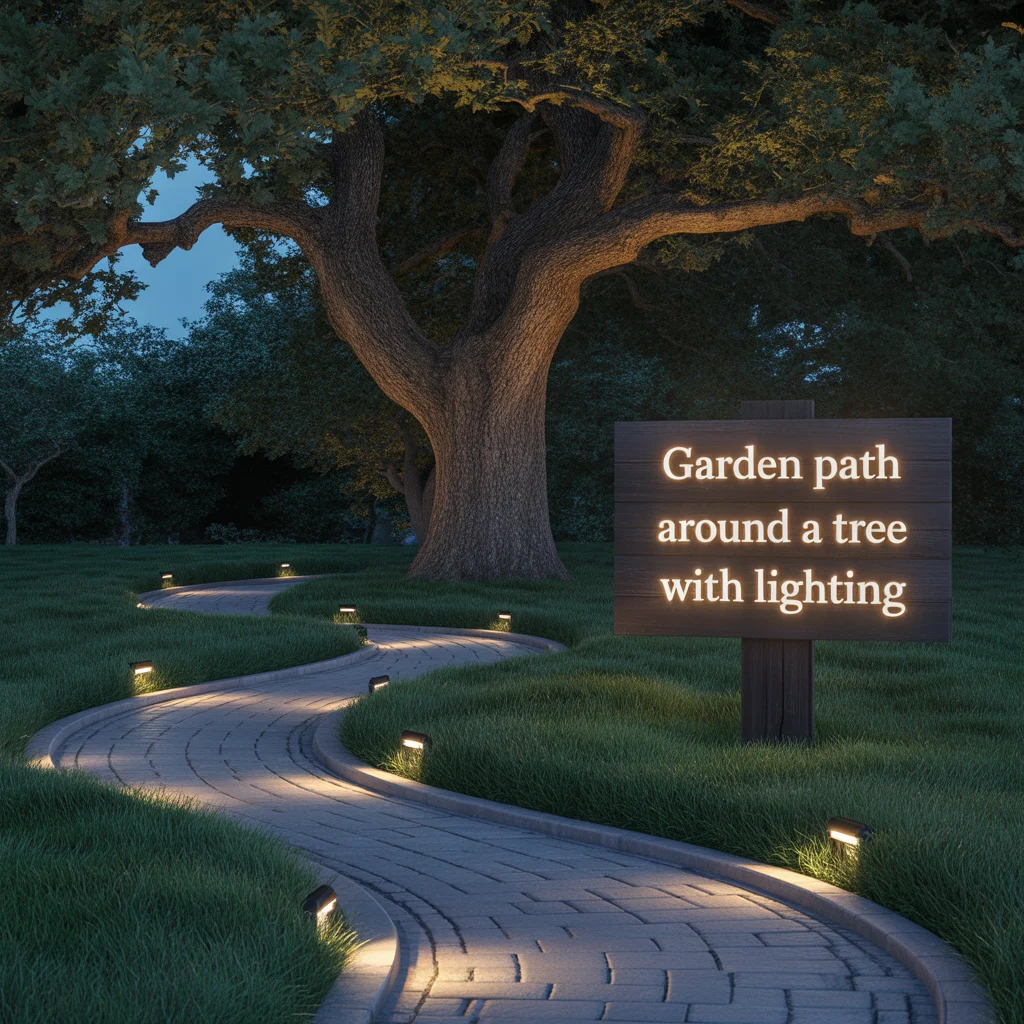
A garden path around a tree with lighting uses ground-recessed uplighters positioned at the base of the tree trunk and alongside the curved path to illuminate the tree from below after dark, creating a dramatic nighttime feature that makes the garden path around the tree as attractive in the evening as it is during the day. I installed four ground-recessed LED uplighters at 90-degree spacing around the base of a silver birch tree on a residential project, with two additional LED spike lights at 3-foot intervals along the curved path leading to the tree, and the combination of the upward light through the white birch bark and the path edge lighting produced a garden feature after dark that the homeowner described as more impressive than the daytime version.
Uplighter Positioning Around a Tree on a Garden Path
Ground uplighters around a tree on a garden path are positioned at a distance of 18 to 24 inches from the trunk center and angled at 60 to 75 degrees upward toward the main lower branches to produce effective lower canopy illumination. Placing the uplighters too close to the trunk at less than 12 inches from the base directs the light straight up the trunk surface without spreading into the lower branches, producing a bright trunk column rather than the broader canopy illumination effect. I position uplighters at 20 inches from the trunk center on all garden path tree lighting projects and find this distance produces the most effective branch and canopy illumination on trees with first branching heights between 4 and 8 feet.
Path Lighting Options for a Curved Tree Path
Solar spike lights, low-voltage LED pathway lights, and ground-recessed path lights are three lighting options suited to a curved garden path around a tree. Solar spike lights at 3-foot alternating intervals cost $8 to $25 per unit and require no wiring, suiting a curved tree path where the installation of a mains cable would disturb the tree root zone. Low-voltage 12-volt LED pathway lights at 3 to 4-foot spacing produce more consistent and controllable illumination than solar lights and cost $25 to $60 per unit plus transformer cost. Ground-recessed path lights set flush into the curved path surface produce the most refined and professional lighting result for a garden path around a tree and suit a formal or contemporary garden where the highest-quality lighting specification is required.
Garden Path Around a Tree on a Sloped Garden
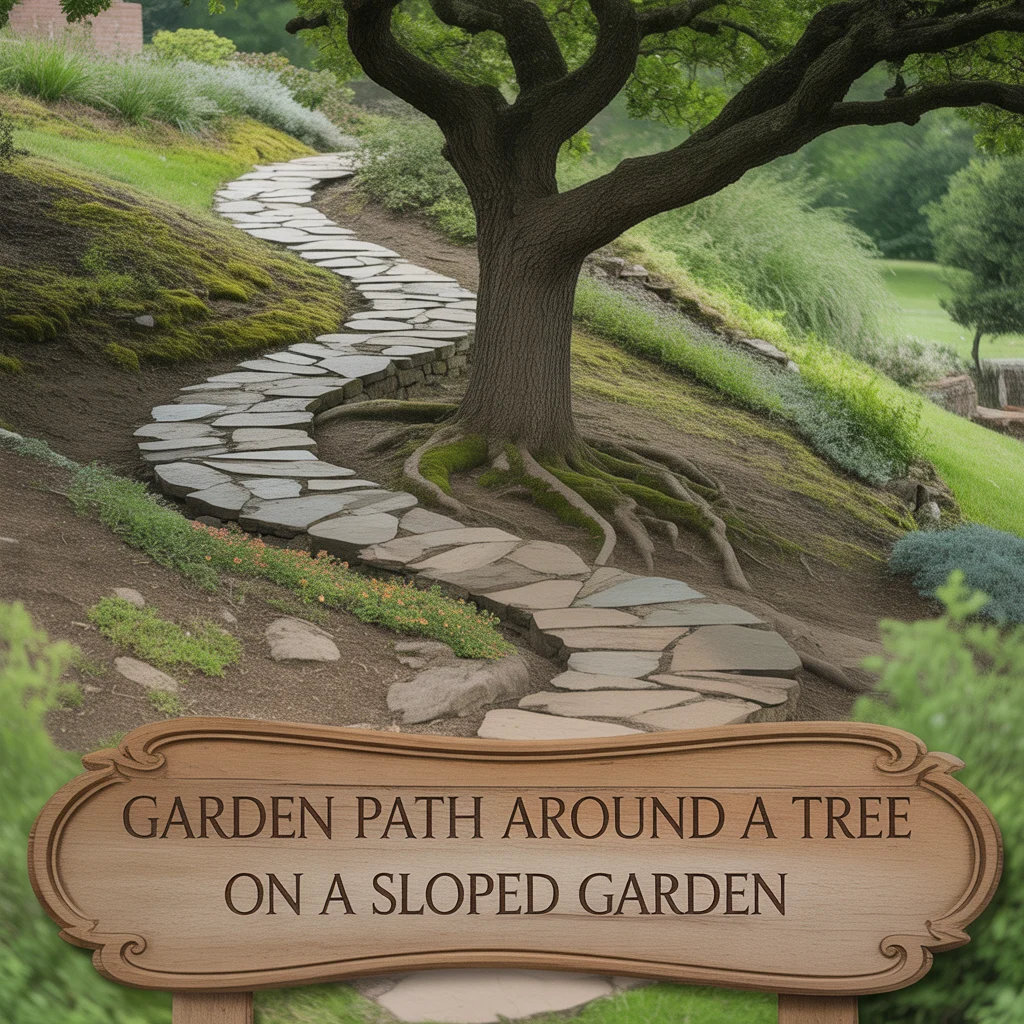
A garden path around a tree on a sloped garden uses a combination of a level circular pad around the tree trunk and a gently graded curved approach path to create a tree feature that manages the slope while incorporating the tree as a natural resting point on the path route. I designed a sloped garden tree path at a property with a 1-in-8 gradient across the rear garden, creating a level circular area of 6-foot diameter around a mature apple tree using a low retaining wall of two brick courses on the downhill side to produce a flat paved surface at a consistent level regardless of the surrounding slope. The circular level area around the tree became the primary seating point in the sloped garden.
Retaining Wall Options for a Tree Path on a Slope
Brick retaining walls, sleeper retaining walls, and natural stone dry-stone walls are three retaining wall options suited to a garden path around a tree on a sloped site. A brick retaining wall of two to three courses provides 150 to 225mm of level change, suiting a gentle slope of 1 in 12 or less where the required level difference across the circular tree area is within this range. A sleeper retaining wall using one 200mm-deep sleeper on edge provides a 200mm level change and suits a steeper slope of 1 in 8 to 1 in 6 around the tree. A dry-stone wall of 200 to 400mm height suits an informal garden path around a tree on a slope where the natural stone character of the retaining element coordinates with the organic setting of the tree.
Drainage for a Level Tree Area on a Sloped Garden Path
A level circular area around a tree on a sloped garden path requires a drainage channel or permeable sub-base to prevent water pooling against the retaining wall and trunk base after rain. A French drain of 4-inch perforated pipe laid at the base of the retaining wall on the uphill side and running to a soakaway collects and redirects the water that would otherwise pond against the wall. I install a French drain on all sloped garden tree path projects where the level circular area is 6 feet or more in diameter, because areas of this size collect sufficient rainfall in heavy rain events to require active drainage management. Smaller tree path circular areas of less than 4 feet diameter drain adequately through a permeable gravel sub-base without any drainage pipe.
Garden Path Around a Fruit Tree With Herb Planting
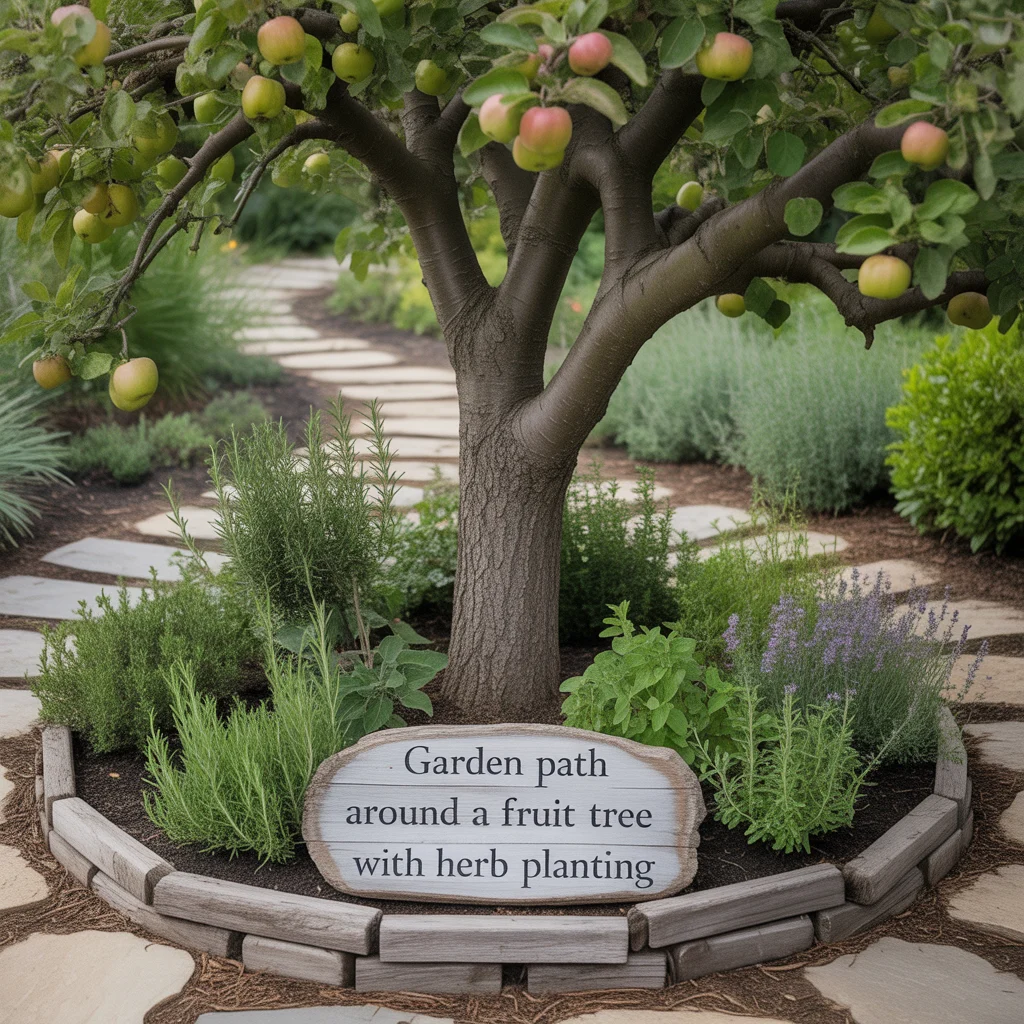
A garden path around a fruit tree with herb planting combines a practical productive garden design with a decorative circular path feature, using a ring of culinary herbs planted between the fruit tree trunk and the surrounding path to create a kitchen garden focal point that is both productive and visually organized. I planted a ring of lavender, rosemary, thyme, and chives in a 30-inch-wide band around the base of my apple tree at 24-inch radius, edged with a reclaimed brick soldier course and surrounded by a 2-foot-wide gravel path at 54-inch radius from the trunk. The combination of the herb ring and the gravel path produced the most deliberately designed section of my kitchen garden.
Herbs That Thrive Around a Fruit Tree Path
Lavender, rosemary, thyme, and chives are four herbs suited to planting around a garden path around a fruit tree. Lavender tolerates the partial shade of a fruit tree canopy and produces a beneficial companion planting effect by attracting pollinators to the fruit tree during the spring flowering period, improving fruit set through increased pollination visits. Rosemary grows well in the dry, free-draining conditions common at the base of a mature fruit tree and produces blue flowers from March to May that attract early-season pollinators to the area around the tree. Thyme stays below 6 inches in height and suits the inner planting ring at the base of the fruit tree where a low-growing herb that does not obstruct the tree’s lower branches is required.
Gravel Path Surfaces for a Fruit Tree Herb Garden
Golden gravel, pea gravel, and decomposed granite are three path surface materials suited to the circular gravel path around a fruit tree herb garden. Golden gravel at 14mm chip size produces a warm surface color that complements the bark tones of apple, pear, and cherry fruit trees and suits a kitchen garden setting where the path material coordinates with the productive character of the space. Pea gravel at 10mm produces a smoother, more comfortable surface for kneeling and crouching during herb harvesting around the tree base and costs $2 to $3 per square foot. Decomposed granite compacts to a firm, stable surface that suits a fruit tree herb garden path used frequently during the growing season and costs $1.50 to $3.00 per square foot.
Garden Path Around a Tree With Mosaic Detail
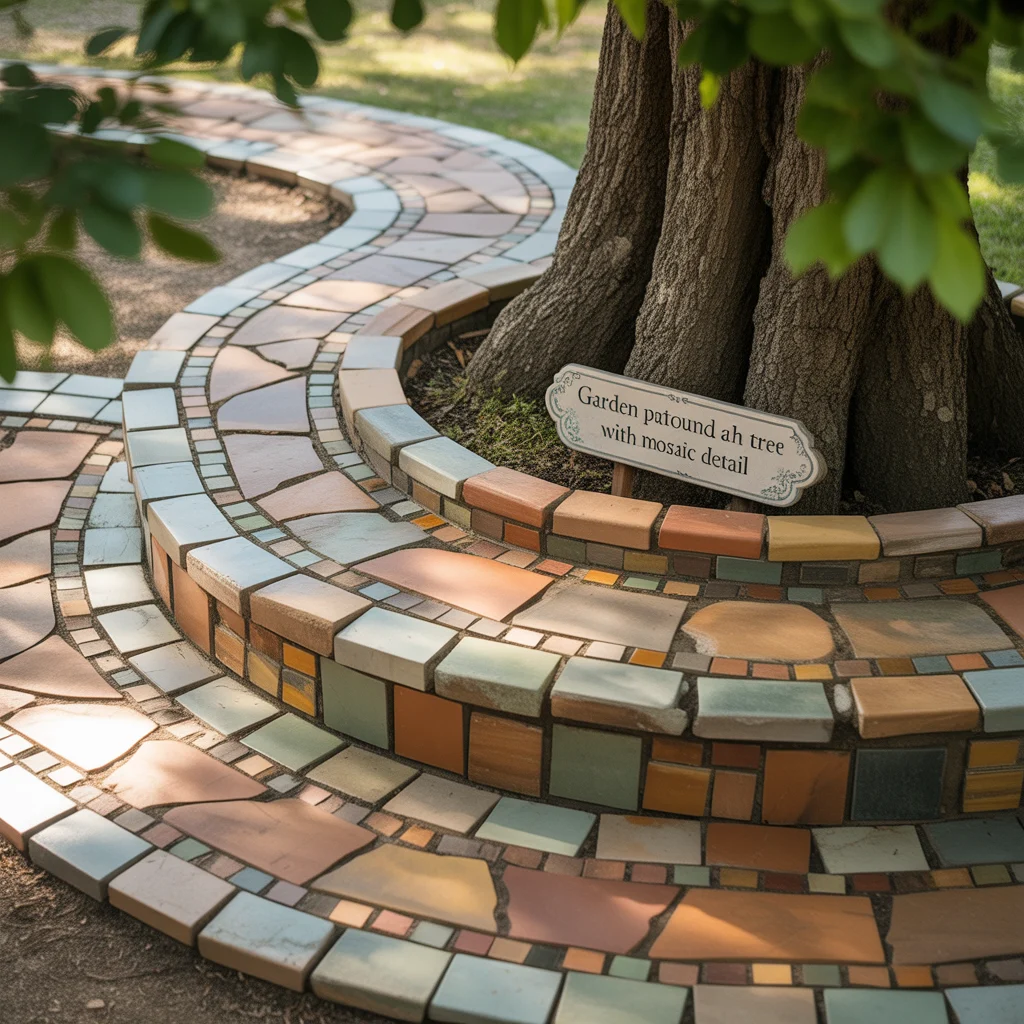
A garden path around a tree with mosaic detail uses small ceramic, glass, or stone mosaic tiles set in a decorative pattern in the path surface or around the tree collar area to create a hand-crafted decorative feature that gives the tree path a unique, artistic character. I saw this design used at a community garden where a circular mosaic pattern using blue and green glass tiles had been laid in a 6-foot-diameter circle around a mature fig tree, with the tree trunk growing through a central opening in the mosaic and a gravel path continuing outward from the mosaic edge. The combination of the fig tree canopy, the circular mosaic surface, and the surrounding garden planting produced one of the most visually distinctive garden features I have seen in a domestic or community garden setting.
Mosaic Materials for a Tree Path Surround
Glass mosaic tiles, ceramic mosaic tiles, and natural stone mosaic pieces are three materials suited to a mosaic detail on a garden path around a tree. Glass mosaic tiles in cobalt blue, turquoise, and amber produce the most reflective, jewel-like surface of the three options and cost $8 to $18 per square foot installed on a circular path surface. Ceramic mosaic tiles cost $4 to $10 per square foot and are more frost-resistant than glass, making them better suited to an exposed garden path around a tree in a climate that experiences temperatures below 0 degrees Celsius in winter. Natural stone mosaic pieces in marble, slate, or limestone cost $12 to $25 per square foot and produce a more muted, organic surface suited to a naturalistic garden path around a tree.
Setting Mosaic Tiles on a Garden Path Around a Tree
Mosaic tiles on a garden path around a tree are set in a 10mm layer of exterior grey flexible tile adhesive applied to a solid concrete or porcelain base, with each tile pressed firmly into the adhesive and leveled to a consistent finished surface using a rubber float. The flexible adhesive accommodates the slight thermal movement of an outdoor path surface without cracking the tile adhesive bond during freeze-thaw cycles. I grout the completed mosaic section using an exterior flexible tile grout in a contrasting or coordinating color applied with a rubber float after the adhesive has cured for 24 hours, wiping the tile faces clean with a damp sponge before the grout sets on the tile surface.
Garden Path Around a Tree With Seasonal Bulb Planting
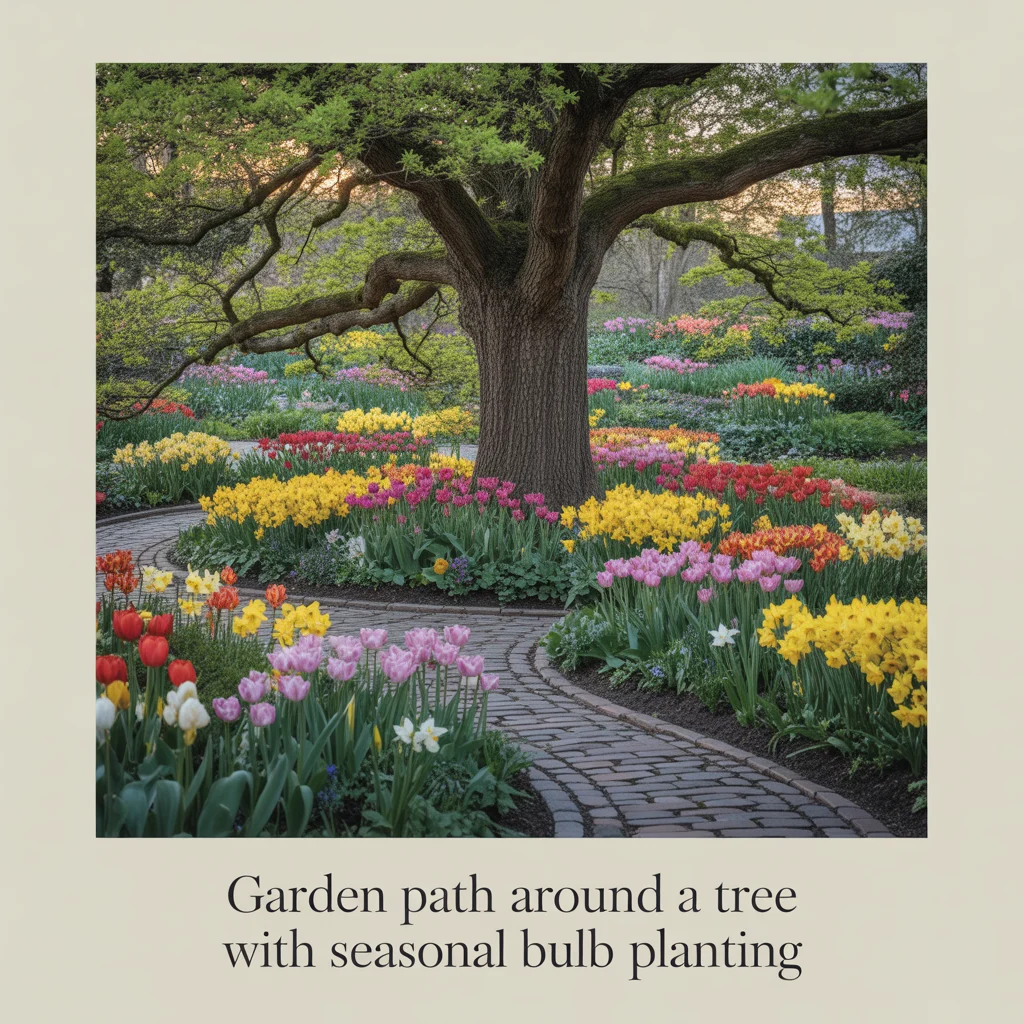
A garden path around a tree with seasonal bulb planting uses a ring of spring bulbs planted in the soil area between the tree trunk and the surrounding path to create a seasonal colour display in February through May when the tree is still bare and the garden needs early-season interest most. I planted 80 Narcissus Tete-a-Tete, 60 Muscari armeniacum, and 40 Tulipa Queen of Night bulbs in a 30-inch-wide planting ring around my apple tree in October, and the spring display in the following March and April was the most concentrated seasonal colour in my entire garden, produced entirely from a $32 bulb investment the previous autumn.
Spring Bulb Combinations for a Tree Path Planting Ring
Narcissus Tete-a-Tete, Muscari armeniacum, and Tulipa Purissima are three spring bulbs suited to a planting ring on a garden path around a tree. Narcissus Tete-a-Tete produces small yellow flowers on 6-inch stems from February to April, providing the earliest seasonal colour of the three species and appearing before the deciduous tree above produces any leaf growth. Muscari armeniacum produces dense spikes of deep blue flowers from March to April at 6 to 8 inches height, providing the strongest blue colour available in a spring bulb planting ring. Tulipa Purissima produces pure white flowers on 14-inch stems from April to May and suits a planting ring where a pale colour is needed to complement the fresh green foliage emerging on the tree above during the late tulip flowering period.
Bulb Planting Depths for a Tree Path Planting Ring
Spring bulbs planted in a ring on a garden path around a tree are planted at depths specific to each bulb size: narcissus at 6 inches depth, muscari at 3 inches depth, and tulips at 8 inches depth, measured from the base of the bulb to the soil surface. Planting deeper than the recommended depth reduces flowering in the first season because the shoot must travel further through the soil before emerging, consuming more stored energy from the bulb before the plant can begin photosynthesising. I use a bulb planting auger fitted to a cordless drill for planting in the compacted soil common at tree bases, which reduces the planting time per bulb from 2 to 3 minutes with a hand trowel to 30 to 45 seconds per hole including the depth check.
Garden Path Around a Tree Using Recycled Granite Setts
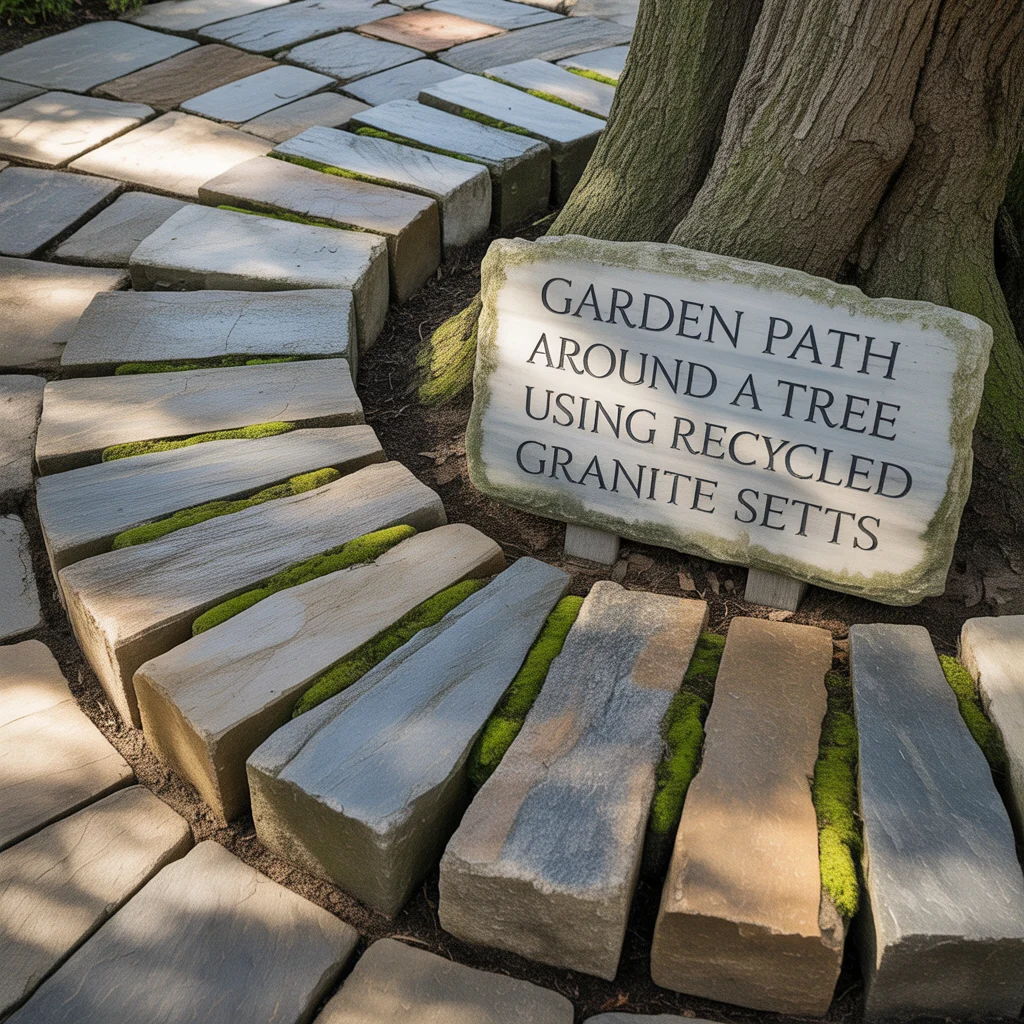
A garden path around a tree using recycled granite setts uses salvaged or reclaimed granite paving cubes at 100mm by 100mm to create a curved or circular path that suits period properties, cobbled courtyard settings, and urban gardens where the character of the granite material coordinates with stone walls, brick buildings, or heritage garden features around the tree. I sourced 300 reclaimed granite setts at $0.90 each from a local reclamation yard for a circular tree path project, laying them in a radial fan pattern around a mature bay laurel tree at 3-foot radius, and the combination of the dark grey granite setts and the dense evergreen canopy of the bay above produced a formal, period-appropriate tree feature.
Laying Granite Setts in a Curved Tree Path
Granite setts on a curved garden path around a tree are laid in a radial fan pattern with each sett row pointing toward the tree trunk center, producing a pattern where the joint widths fan outward from 8mm at the inner path edge to 14mm at the outer edge to accommodate the increasing circumference of each successive ring. I mark radial layout lines from the trunk center outward using a chalk string line at 30-degree intervals before placing any setts, which establishes the radial joint positions across the full path width before the first sett is laid. Laying the first complete inner ring of setts against the tree collar edging before starting the outer rings establishes the correct joint spacing for all subsequent rings.
Jointing Granite Sett Tree Paths
Kiln-dried sand jointing, wet mortar pointing, and resin jointing compound are three jointing methods suited to granite setts on a curved garden path around a tree. Kiln-dried sand swept into the joints suits a granite sett tree path laid on a sharp sand bed without a concrete base, allowing slight individual sett movement that accommodates tree root activity beneath the path. Wet mortar pointing with a 4:1 sand-to-cement mix suits a granite sett tree path on a concrete base where individual sett movement is not expected. Resin jointing compound produces the most weed-resistant and maintenance-free joint of the three options and suits a granite sett tree path where long-term low maintenance is the primary requirement.
Wildflower Meadow Path Around a Tree
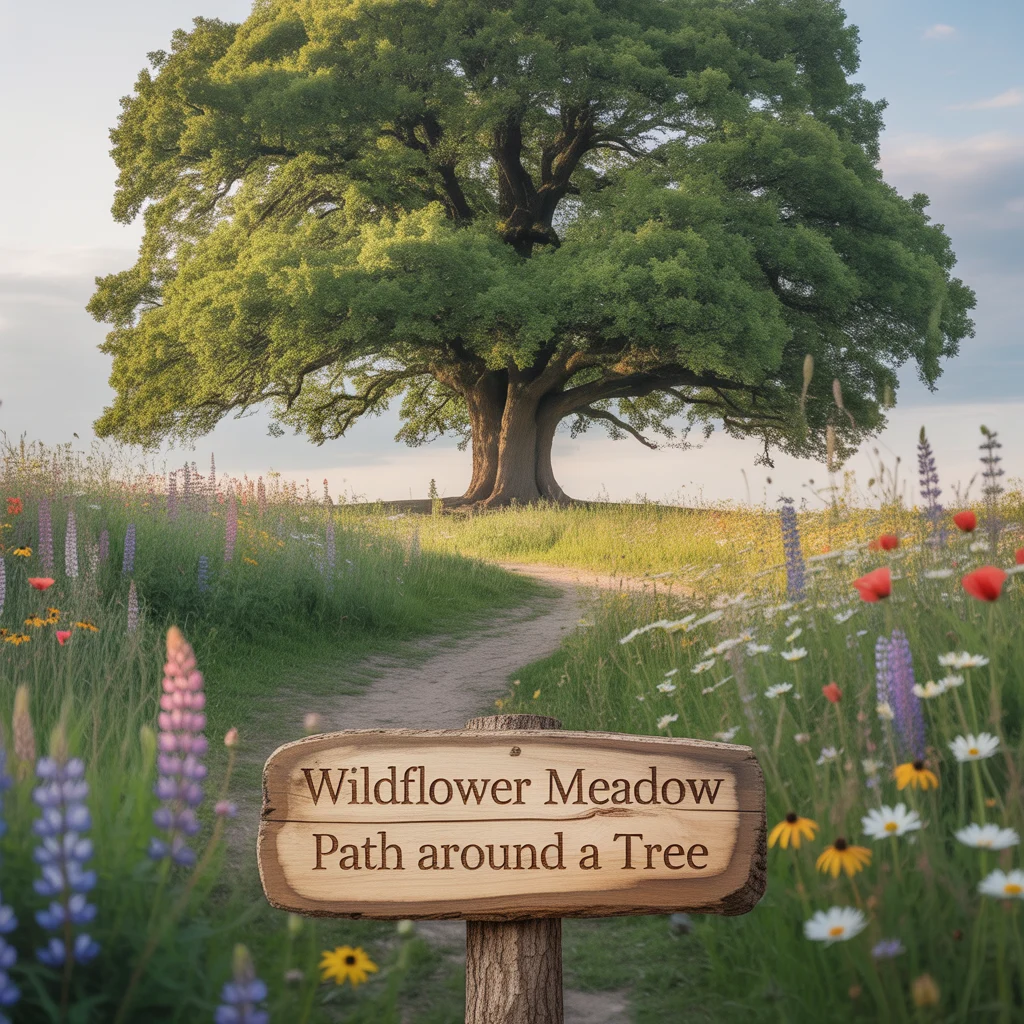
A wildflower meadow path around a tree uses a mown grass strip maintained at short height in a curved or circular route around a tree within a wildflower meadow area, creating a defined walking route through the meadow that makes the tree an organized focal point within the naturalistic planting. I created this design by converting a 15-foot-diameter section of lawn around my pear tree into a wildflower meadow, maintaining only a 2-foot-wide mown circular path at 5-foot radius from the trunk. The contrast between the short mown path strip and the 24-inch-tall wildflower growth on both sides of the path defined the circular route clearly without any hard landscaping material at a total cost of $12 in wildflower seed.
Wildflower Species for a Tree Path Meadow
Ox-eye daisy, field scabious, and common knapweed are three wildflower species suited to a meadow path around a tree. Ox-eye daisy, Leucanthemum vulgare, produces white flowers with yellow centers from May to July at 24 to 30 inches height, providing the most visible and abundant flower display of the three species in the area surrounding the mown tree path. Field scabious, Knautia arvensis, produces lilac-blue pincushion flowers from July to September at 24 to 36 inches height, extending the flowering season of the meadow path beyond the ox-eye daisy period. Common knapweed, Centaurea nigra, produces purple thistle-like flowers from July to September and tolerates the drier soil conditions common at the base of a mature deciduous tree better than most wildflower species.
Mowing Schedule for a Wildflower Tree Path
A mown grass path around a tree within a wildflower meadow requires the path strip to be cut at 25 to 30mm height every 7 to 10 days during the growing season from April to September, which maintains the contrast between the short path strip and the tall meadow growth on both sides. The surrounding wildflower meadow area requires only one cut per year in September or October after the last seed heads have ripened and shed their seed for the following season. I cut the circular mown path strip first each time before mowing any other section of lawn, using the mower’s highest wheel setting across the meadow path width to maintain the 25 to 30mm cutting height consistently throughout the growing season.
Garden Path Around a Tree With Pergola Framing
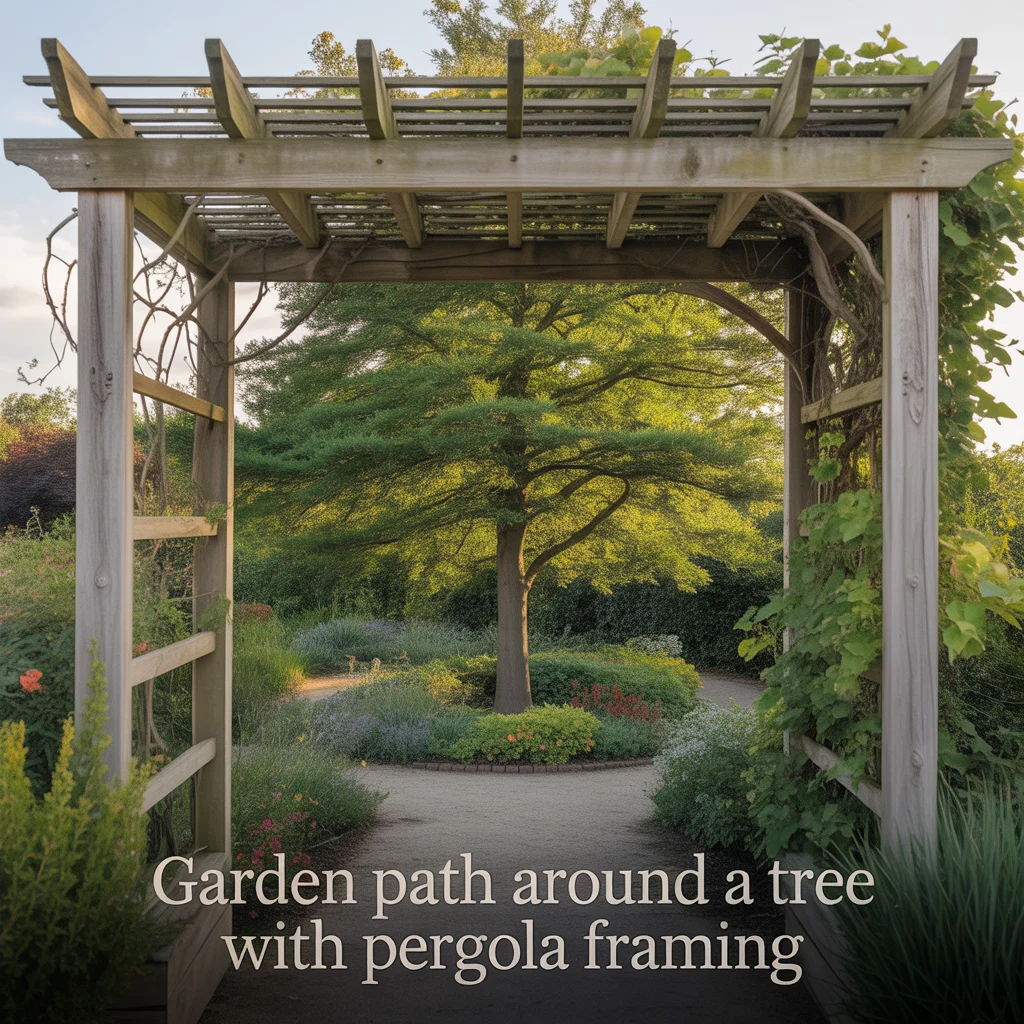
A garden path around a tree with a formal clipped hedge surround uses a low clipped evergreen hedge planted in a circle around the tree at the outer edge of the circular path, creating a formal enclosed tree feature where the hedge, the path, and the tree form three concentric design elements organized around the tree trunk as the central point. I designed this feature for a formal walled garden where a standard-trained Prunus lusitanica stood at the center of a circular clipped box hedge of 8-foot diameter, with a 3-foot-wide York stone path between the tree collar and the inner face of the hedge. The three-element composition of trunk, path, and hedge produced the most formally resolved tree feature in the garden.
Hedging Plants for a Circular Tree Path Surround
Box, Ilex crenata, and Euonymus japonicus are three hedging plants suited to a formal circular surround on a garden path around a tree. Box, Buxus sempervirens, produces the finest-textured clipped surface of any low hedging plant and suits a formal circular tree path design where the precision of the clipped edge reinforces the geometric intention of the layout. Ilex crenata produces a similar fine-textured dark green surface to box and resists box blight, making it the practical alternative for formal circular tree path surrounds in gardens where box blight is established. Euonymus japonicus clips to a formal edge at 18 to 24 inches height and suits a circular tree path hedge in a coastal garden where box and ilex struggle in exposed salt-wind conditions.
Clipping Schedule for a Circular Hedge on a Tree Path
A circular evergreen hedge on a garden path around a tree requires clipping twice a year to maintain a precise, tight surface that reinforces the formal character of the tree feature. The first clip takes place in late May after the first flush of new growth has extended beyond the intended profile, using electric hedge shears on the flat top surface and a straight edge board as a cutting guide on the vertical faces of the circular hedge. The second clip takes place in late August after the second growth flush. I clip the circular hedge in two sessions each year using a 45-minute per session schedule for a standard 8-foot-diameter circle, which keeps the hedge surface tight enough throughout the growing season to maintain the formal visual quality of the garden path around the tree.Garden Path Around a Tree With a Formal Clipped Hedge Surround
Garden Path Around a Tree With a Formal Clipped Hedge Surround
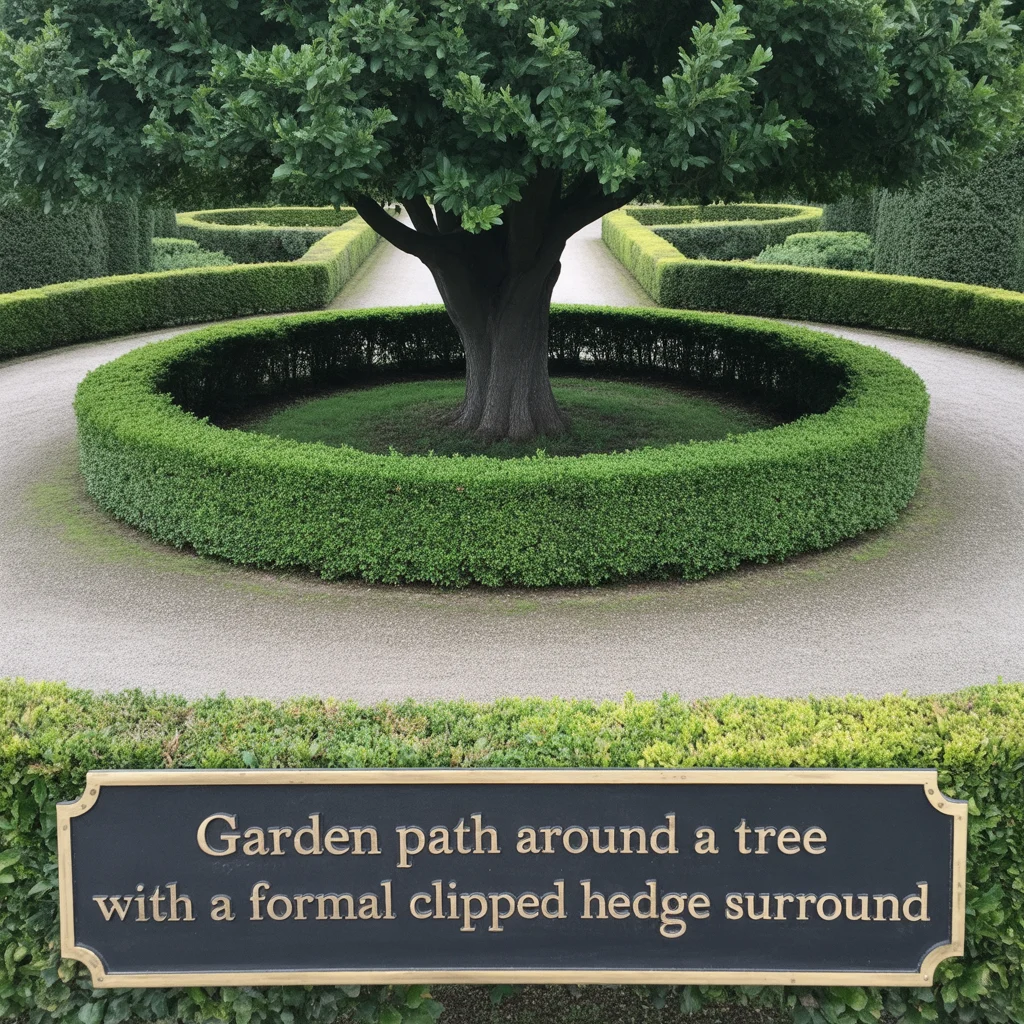
A garden path around a tree with pergola framing uses a timber or steel pergola structure positioned at the entrance to the tree feature to create a formal framed approach to the tree, making the tree the visual destination at the end of the pergola path rather than simply a feature encountered on the route. I designed a pergola path approach to a large Magnolia grandiflora tree at a formal garden project, using a 20-foot cedar pergola path planted with Rosa New Dawn ending at a circular gravel area around the tree trunk. The pergola created a deliberate axis that directed the eye toward the magnolia as the organizing focal point of the rear garden from the house terrace at the opposite end of the pergola.
Pergola Proportions for a Tree Path Approach
A pergola on a garden path approaching a tree measures most effectively when its internal height of 7 to 8 feet and its width of 4 to 5 feet create a viewing cone that focuses on the tree at the path terminus from the pergola entrance. A pergola height below 6.5 feet feels oppressive as a garden path entrance structure and restricts the vertical visual connection between the path and the tree canopy above the circular area at the pergola’s end. A pergola width above 6 feet starts to widen the internal space to a point where the focus on the tree at the far end is diluted by the broad internal volume of the structure, reducing the focal effect on the tree that makes this design work.
Climbing Plants for a Pergola Tree Path
Rosa New Dawn, Wisteria sinensis, and Clematis montana are three climbing plants suited to a pergola on a garden path approaching a tree. Rosa New Dawn produces pale pink flowers from June to October on a vigorous plant growing to 20 feet, covering a standard pergola fully within three seasons and providing a flowering overhead canopy on the path approach to the tree. Wisteria sinensis produces hanging lilac flower racemes in May before the leaves develop, creating a spectacular flowering canopy on the pergola path at the same time as many ornamental trees are in flower in the surrounding garden. Clematis montana produces a mass of white or pink flowers in April and May, covering the pergola structure rapidly within two seasons.
Related
best ground cover plants for paths around a tree
stepping stone ideas for curved paths around trees
zone 4 woodland garden ideas with tree path designs
Frequently Asked Questions
How do you build a garden path around a tree without damaging the roots?
A garden path around a tree is built without damaging the roots by using a permeable sub-base of 4 inches of clean angular aggregate, positioning all hard path materials at a minimum radius of 3 feet from the trunk base, and avoiding any excavation deeper than 4 inches within 10 feet of a mature tree trunk. Permeable aggregate sub-bases maintain soil drainage and gas exchange through the void spaces in the aggregate, preventing the root suffocation that a compacted hardcore or concrete sub-base causes. I specify a permeable aggregate sub-base on every garden path around a tree project and include a tree root protection zone calculation based on the trunk diameter to determine the minimum path clearance for each specific tree.
What is the cheapest garden path idea around a tree?
A bark mulch ring path around a tree is the cheapest garden path idea, costing $0 when free wood chip from a local tree surgeon or council is used, or $25 to $40 when purchased bark chip is the material. A mown grass circular path through an existing lawn costs nothing beyond the fuel or electricity for the lawn mower. A recycled brick path using reclaimed bricks from a demolition skip or online marketplace costs $14 to $30 for the jointing sand alone when the bricks are sourced free. I have completed all three of these cheap garden path ideas around trees in my own and clients’ gardens and found each one produces a satisfying result relative to its zero or near-zero material cost.
What path materials work best around a tree with surface roots?
Bark mulch, gravel on a permeable membrane, and loose-laid stepping stones are the three path materials that work best around a tree with surface roots because all three accommodate root growth and movement beneath the path surface without cracking, lifting, or becoming a trip hazard as the roots develop over time. Rigid paving materials including mortar-bedded bricks, concrete, and porcelain on a compacted sub-base crack and lift within 3 to 5 years when surface roots grow beneath them, requiring complete reinstallation. I always recommend loose-laid or flexible path materials within 6 feet of a mature tree trunk and reserve rigid paving for path sections beyond this distance where root activity is less likely to affect the path surface.
How far from a tree trunk should a garden path be?
A garden path around a tree should maintain a minimum clearance of 3 feet from the outer edge of the trunk base, which provides adequate space for trunk growth over a 10 to 15-year period and avoids the dense surface root zone immediately surrounding the base. For very large trees including mature oak, beech, and lime, a minimum clearance of 5 feet is recommended to accommodate the larger trunk diameter and more extensive surface root system of these species. I calculate the recommended clearance for each tree individually using a formula of trunk diameter in inches multiplied by 1.5 to give the minimum clearance radius in inches, which produces a proportionally appropriate clearance for trees of different sizes.
Can I lay a circular path around an established tree?
A circular path around an established tree is installed successfully when a permeable sub-base is used, excavation depth is limited to 4 inches, and the path inner edge maintains a minimum 3-foot clearance from the trunk. Established trees with trunks above 6 inches in diameter have developed root systems extending 2 to 3 times the canopy radius from the trunk center, which means any path within the canopy drip line area encounters established roots during excavation. I always conduct a visual root survey before excavating any circular path project around an established tree, probing the soil at 12-inch intervals along the intended path route to identify major roots above 1 inch in diameter that require routing around rather than cutting through during the sub-base preparation.