
Pergola Bench Swing Ideas for an Outdoor Retreat

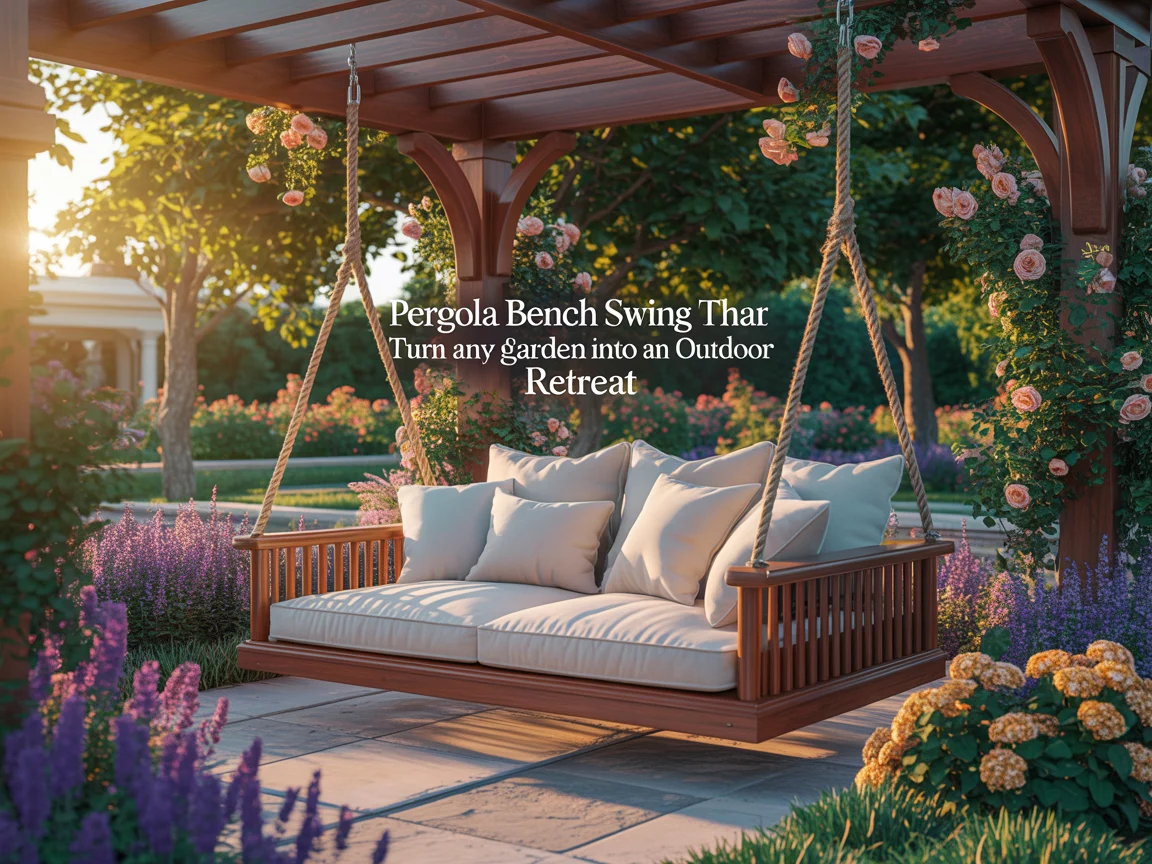
I built my first pergola bench swing on a long weekend using four 4-by-4-inch pressure-treated posts, two 2-by-8-inch overhead beams, four 3-foot lengths of 12mm galvanized chain, and a reclaimed oak plank bench seat. The whole structure cost $145 in materials and took two days including the concrete footings. When I sat in it for the first time that Sunday evening, my feet barely touching the ground and the bench swaying gently from the chain suspension, I understood immediately why pergola bench swings appear in virtually every aspirational garden photograph on Pinterest and Instagram. The combination of the overhead structure, the suspended seat, and the gentle swinging motion produces an outdoor experience that no static bench or garden chair can replicate.
A pergola bench swing combines a post-and-beam overhead garden structure with a suspended swinging bench seat hanging from the pergola crossbeams on chains, ropes, or steel hangers, creating a premium outdoor relaxation feature that provides physical shade from overhead coverage, a gentle swinging motion from the suspended seat, and the architectural presence of a defined garden structure as a single integrated outdoor living element. The pergola gives the swing a permanent, designed home in the garden, and the swing gives the pergola its primary human function beyond climbing plant support.
Since that first weekend build, I have designed, built, and studied pergola bench swings across many different styles, materials, and garden settings. I have seen wooden pergola bench swing designs built for under $200 produce results equal to purchased units costing $1,200, and I have also seen complex pergola with swings and fire pit combinations create complete outdoor entertaining destinations.
In this article, I am sharing 20 pergola bench swing ideas that I have either built myself or researched thoroughly enough to recommend with complete confidence.
Classic Cedar Wood Pergola Bench Swing
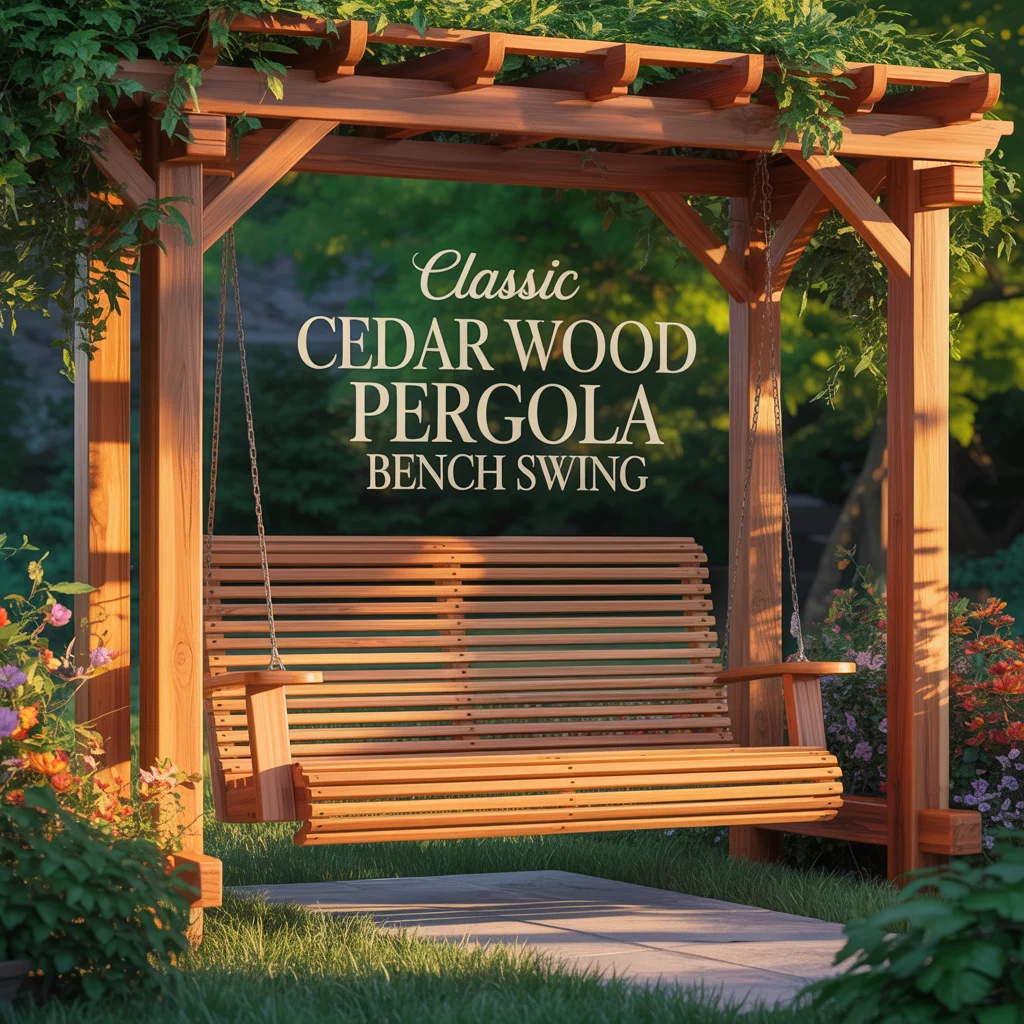
A classic cedar wood pergola bench swing uses Western red cedar for both the pergola post-and-beam structure and the suspended bench seat, creating a unified natural timber outdoor feature where the warm reddish-brown color and the aromatic fragrance of cedar provides a premium natural material experience alongside the functional swinging bench. Cedar is the most widely used timber for pergola bench swing construction in North American gardens because the natural oil content of the heartwood provides inherent rot resistance that eliminates the need for chemical preservative treatment on the overhead structure, the suspension hardware mounting points, and the bench seat surface.
Cedar Pergola Bench Swing Dimensions
A cedar pergola bench swing reads most effectively when the overhead beam height sits at 8 to 9 feet above the ground surface, providing enough vertical clearance for the suspended bench to swing freely without the seated occupant’s feet dragging on the ground below. The standard bench seat height when at rest is 18 inches above the ground, which requires a chain or rope suspension length of 66 to 78 inches from the beam face to the bench seat top face on an 8-foot ceiling pergola. I design all pergola bench swings with a minimum 12-inch clearance between the suspended bench seat and the pergola upright posts on both sides, which provides comfortable swinging range without the bench contacting the posts.
Cedar Pergola Bench Swing Post Sizing
4-by-4-inch cedar posts, 6-by-6-inch cedar posts, and 4-by-6-inch cedar posts are three post sizes suited to a cedar pergola bench swing structure. 4-by-4-inch posts suit a single-swing pergola with a beam span of 8 feet or less and a maximum single occupant load of 120kg per swing position. 6-by-6-inch posts provide greater structural stiffness suited to a wider pergola span of 10 to 14 feet carrying two swing positions or a heavier-loaded single position of up to 200kg. 4-by-6-inch posts provide an intermediate option suited to a single-swing pergola of 8 to 10-foot span where the additional post thickness in the beam direction resists the forward-backward rocking force transmitted from the swinging bench seat to the post base during use.
Wooden Pergola Bench Swing With Climbing Roses
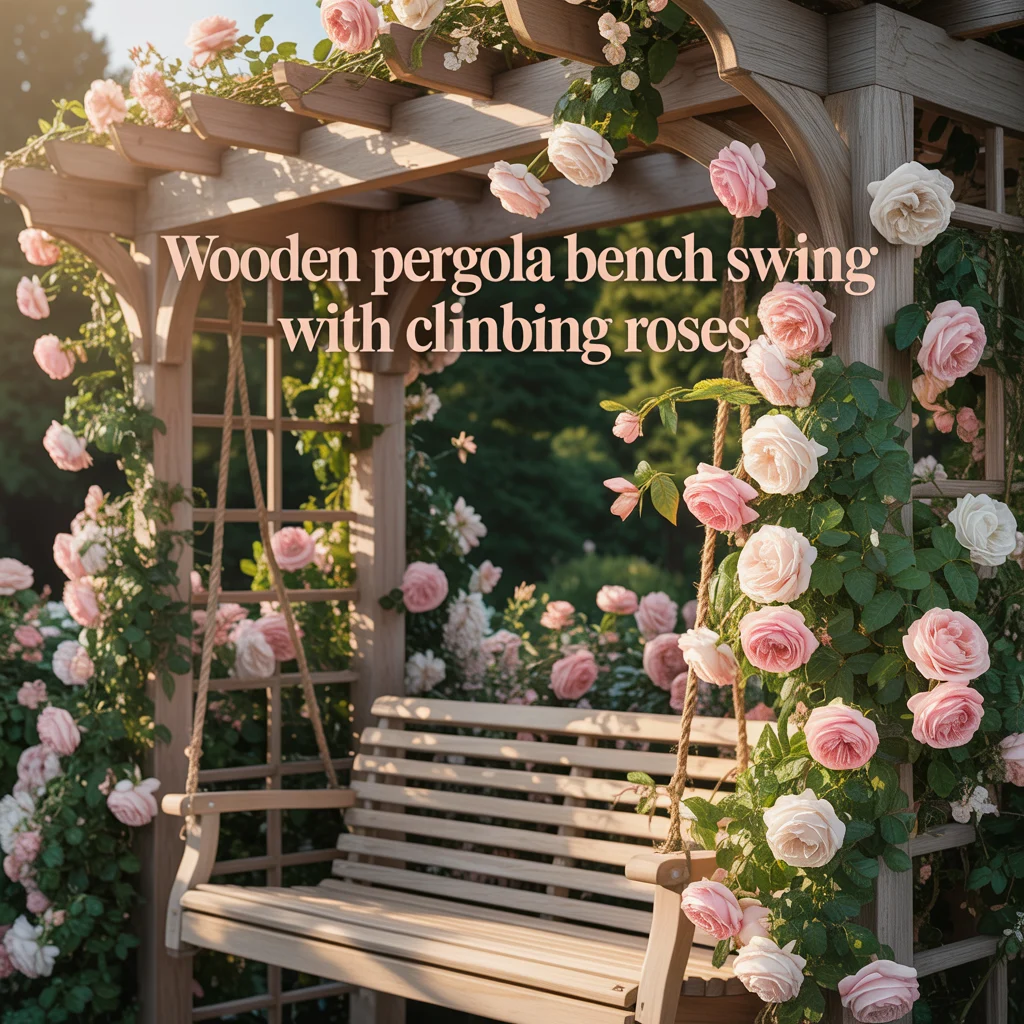
A wooden pergola bench swing with climbing roses trains Rosa or Clematis montana over the pergola overhead frame to create a flowering canopy above the suspended bench seat, producing a garden feature where the swinging bench experience is enhanced by overhead flower color, fragrance at seated face level, and the dappled shade of the climbing plant coverage during the summer flowering season. I planted Rosa Zephirine Drouhin on the two rear posts of a cedar pergola bench swing at a residential project, and the thornless climbing rose covered the rear crossbeam within two growing seasons, producing a fragrant pink flower canopy above the swing bench seat from June to September that made the swinging bench experience genuinely multi-sensory.
Climbing Plants for a Pergola Bench Swing
Rosa Zephirine Drouhin, Clematis montana Rubens, and Wisteria sinensis are three climbing plants suited to a wooden pergola bench swing overhead frame. Rosa Zephirine Drouhin is the best rose for a pergola bench swing because it is completely thornless, eliminating the risk of thorned canes catching the swing chains or the seated user’s hair and clothing during active swinging use. Clematis montana Rubens produces a mass of small pink flowers in May at an extremely vigorous growth rate that covers a pergola bench swing frame within two growing seasons, providing the fastest overhead plant coverage of any climbing species suited to a pergola swing structure. Wisteria sinensis produces the most spectacular flower display of any pergola climbing plant in May.
Training Climbing Plants on a Pergola Bench Swing
Climbing plants on a pergola bench swing are trained away from the swing chains and suspension hardware positions to prevent vine stems from twisting around the chains and restricting the free swinging movement of the bench seat. I tie all climbing plant stems to the pergola posts and crossbeams using soft garden twine in a figure-of-eight knot that allows slight stem movement, directing growth away from the chain positions and toward the solid overhead frame members where the stems can ramble without affecting the mechanical function of the bench swing suspension. Chain positions are kept clear of plant growth by checking and redirecting stems monthly during the active growing season from April through September.
Modern Metal Frame Pergola Bench Swing

A modern metal frame pergola bench swing uses a powder-coated steel or aluminium structural frame in black or anthracite grey with horizontal steel rod or tube crossbeams to create a contemporary outdoor swing feature suited to modern architecture, urban garden spaces, and designed outdoor living areas where the clean geometric lines of a metal pergola frame provide a stronger architectural presence than an equivalent timber structure. I designed a modern metal pergola bench swing for a contemporary residential garden using 50mm square hollow steel section in RAL 9005 black powder coat for the four posts and overhead beams, suspending a slatted iroko bench on 12mm black powder-coated steel chain, and the completed metal pergola bench swing suited the modern garden character far more precisely than any timber alternative.
Steel Section Sizes for a Modern Pergola Bench Swing
50mm square hollow section, 60mm square hollow section, and 75mm by 50mm rectangular hollow section are three steel sizes suited to a modern metal frame pergola bench swing. 50mm square hollow section at 3mm wall thickness provides adequate structural rigidity for a single-swing pergola of 8-foot span and suits a residential garden installation with maximum single occupant load of 150kg. 60mm square hollow section at 3mm wall thickness provides greater rigidity suited to a wider pergola of 10 to 12-foot span or a double-swing pergola carrying two bench seats simultaneously. 75mm by 50mm rectangular hollow section with the 75mm dimension in the vertical direction provides the optimum structural efficiency for the overhead beam position where the bending load from the suspended swing acts in the vertical plane.
Powder Coat Finishes for a Modern Pergola Swing Frame
RAL 9005 black, RAL 7016 anthracite grey, and RAL 6009 fir green are three powder coat colors suited to a modern metal pergola bench swing frame. RAL 9005 black provides the strongest visual contrast against any garden background including green planting, pale stone, and light render, making the metal pergola bench swing frame clearly readable as a designed architectural element rather than a utilitarian structure. RAL 7016 anthracite grey provides a softer, less stark frame color that suits a modern garden where the pergola bench swing shares visual space with other metal elements including furniture, edging, and gate hardware in matching grey tones. RAL 6009 fir green suits a pergola bench swing in a planted garden setting where the dark green frame color recedes into the surrounding foliage.
Pergola Bench Swing Plans for DIY Construction
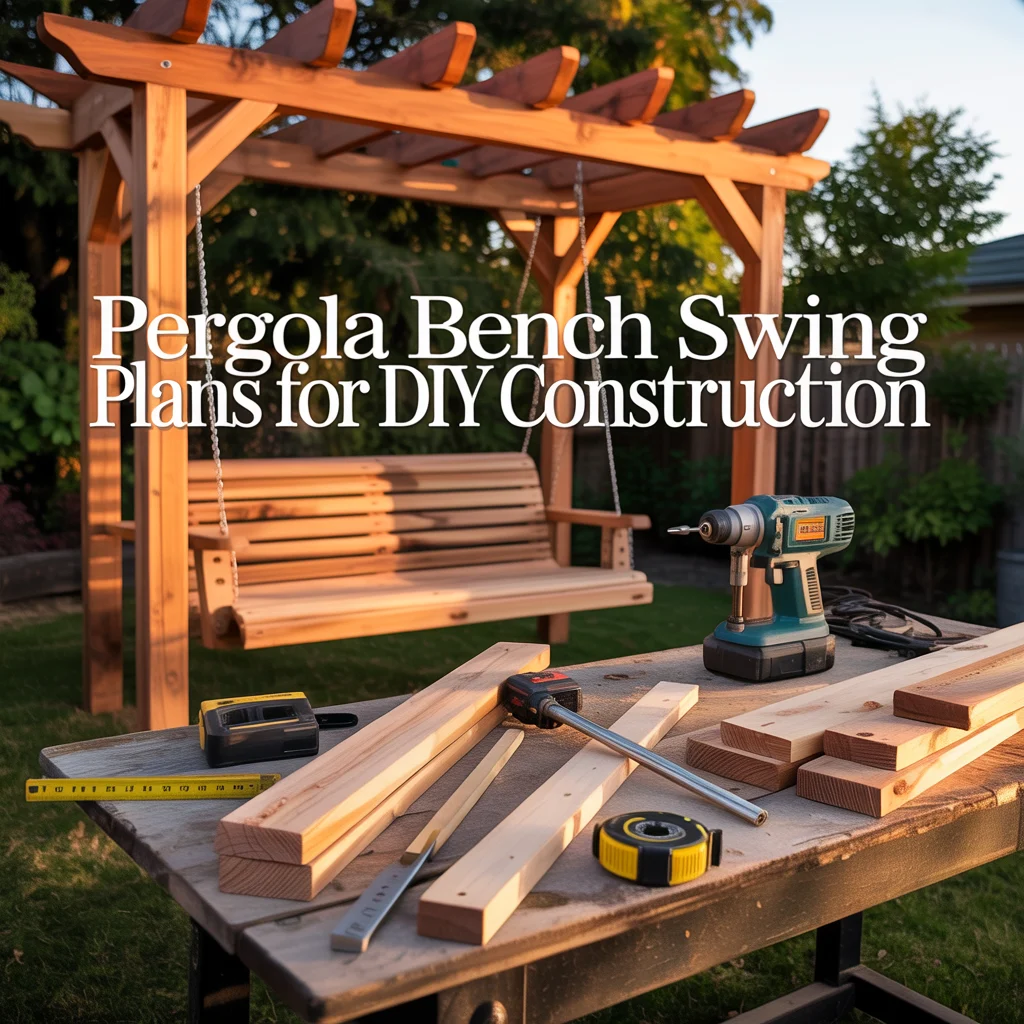
A pergola bench swing built from a DIY plan uses a scaled technical drawing specifying post size, beam dimensions, suspension hardware specification, bench seat construction, and concrete footing requirements to guide a homeowner through the complete pergola bench swing construction process from site preparation to final swing installation. I have built four pergola bench swings from self-developed plans and found that the most important planning decision before any material purchase is the concrete footing depth, which varies between 24 and 36 inches depending on the soil type, frost depth, and total swing load at the installation site.
Free DIY Pergola Bench Swing Plan Dimensions
A free DIY pergola bench swing plan for a standard single-seat residential installation specifies four primary dimensions: post height above grade of 8 feet, beam span of 8 feet between post centers, beam projection beyond post face of 12 inches on both ends, and footing depth of 24 to 36 inches below grade. The bench seat measures 48 to 54 inches in length, 18 to 20 inches in width, and 18 inches in height from the ground when suspended at rest on chains of 66 to 72-inch length from the overhead beam soffit to the bench seat top face. I publish complete free pergola bench swing plans including a cut list, materials list, and step-by-step assembly sequence available to any homeowner planning a weekend pergola bench swing build.
Tools Required for a DIY Pergola Bench Swing Build
A post hole digger, circular saw, drill and driver, spirit level, and adjustable wrench are five tools required for a standard DIY wooden pergola bench swing construction. A post hole digger of 8-inch diameter digs the four corner footings to 24 to 36-inch depth for setting the pergola posts in concrete, and costs $25 to $45 per day from a tool hire center for a powered auger version that significantly reduces the manual effort of the footing excavation on clay or compacted soil sites. A circular saw cuts all the post, beam, and bench seat timber sections to the required plan dimensions. A drill and driver drives all screws and pilots all bolt holes throughout the pergola bench swing construction.
Pergola Bench Swing With Fire Pit
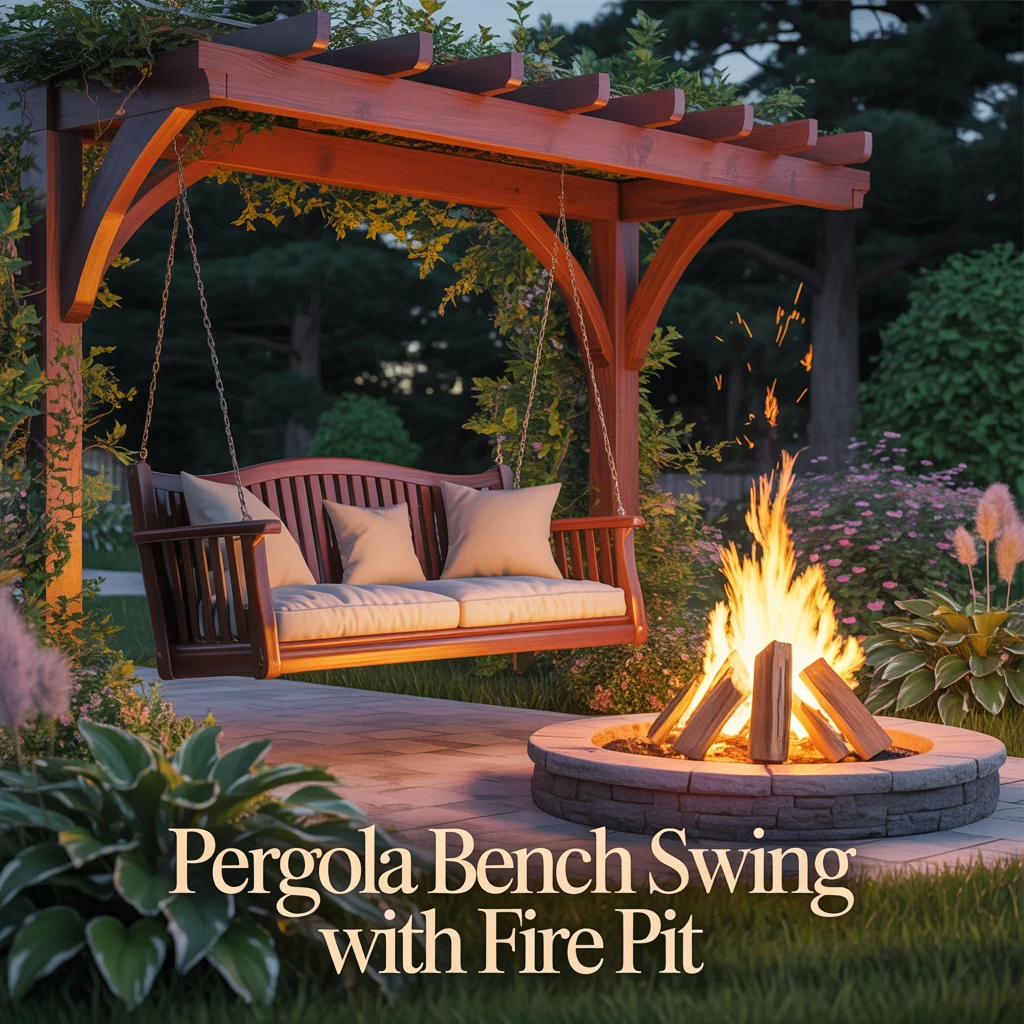
A pergola with swings and fire pit combines a pergola bench swing structure with a central fire feature to create a complete outdoor entertaining destination where the swinging bench seats surround a fire pit within the pergola structure, providing both the gentle swinging relaxation of the bench seat and the warmth, light, and social focus of an open fire in the same designed outdoor space. I designed a pergola with swings and fire pit at a residential project using a 12-by-12-foot timber pergola structure with two swing bench seats suspended from the overhead beams on opposite sides and a 24-inch cast iron fire bowl on a compacted gravel pad at the structure’s center, and the completed feature became the primary outdoor entertaining destination at the property throughout the year.
Fire Pit Safety Clearances for a Pergola Bench Swing
A fire pit within a pergola bench swing structure requires a minimum horizontal clearance of 7 feet between the fire bowl rim and any combustible overhead structural element, and a minimum vertical clearance of 8 feet between the fire bowl rim and the overhead beam soffit. These clearances comply with National Fire Protection Association guidance for outdoor fire features beneath overhead structures. I position all fire pits in pergola swing structures at the exact center of the plan footprint, which maximizes the clearance between the fire feature and the four surrounding posts and the two overhead beams in all directions simultaneously.
Pergola with Swings and Fire Pit Design Configurations
A rectangular pergola with two opposing swings and a central fire pit, a square pergola with four swings and a central fire pit, and an L-shaped pergola with one swing section and one fire pit section are three configurations suited to a pergola with swings and fire pit design. A rectangular 12-by-10-foot pergola with two opposing swings of 54-inch length on the 12-foot span sides and a 24-inch fire bowl at the center provides seating for 4 adults in the swing positions with adequate clearance for the fire feature between the swing bench seats in the at-rest position. A square 14-by-14-foot pergola with four swing positions, one on each 14-foot span side, provides the maximum swing seat capacity around a central fire pit in a single pergola structure. Further ideas for composing this kind of seating feature into a charming overall garden setting are covered in these charming garden bench ideas including pergola swing designs.
Pergola Bench Swing With Rope Suspension

A pergola bench swing with rope suspension uses natural fiber or synthetic rope rather than chain as the bench seat hanging element, creating a swing with a softer, more organic aesthetic suited to rustic, coastal, and naturalistic garden styles where the visual character of chain would be inconsistent with the surrounding garden design. I built a rope-suspended pergola bench swing using 16mm natural manila rope on a cedar pergola frame at a coastal property, and the combination of the cedar posts, the natural rope suspension, and a reclaimed oak bench seat produced a pergola swing aesthetic that suited the informal coastal garden character of the property more authentically than any chain-suspended alternative.
Rope Types for a Pergola Bench Swing Suspension
Natural manila rope, synthetic polypropylene rope, and braided nylon rope are three rope types suited to a pergola bench swing suspension. Natural manila rope at 16mm diameter provides the most aesthetically appropriate suspension material for a rustic or coastal pergola bench swing, with a warm golden-brown color and a natural fiber texture that suits timber pergola frames and naturalistic garden settings, at a tensile strength of 1,800 to 2,200kg for 16mm diameter that provides adequate safety factor for a two-person pergola swing bench load of 200kg. Synthetic polypropylene rope at 16mm diameter provides comparable strength to manila at lower material cost but with a less attractive synthetic appearance suited to a utilitarian rather than aesthetic suspension requirement.
Rope Knotting for a Pergola Bench Swing
Four rope knot techniques are used in pergola bench swing construction: the bowline knot for creating a fixed loop at the beam attachment point, the cleat hitch for securing rope to a crossbar, the figure-of-eight knot for creating stopper knots beneath drilled bench holes, and the reef knot for joining two rope ends securely. I use a bowline knot at all overhead beam attachment points on rope-suspended pergola bench swings because the bowline creates a strong, non-jamming loop that maintains its shape under load and can be untied easily for height adjustment, unlike the clove hitch which jams under sustained load making subsequent height adjustment difficult without cutting the rope.
Small Pergola Bench Swing for Compact Gardens
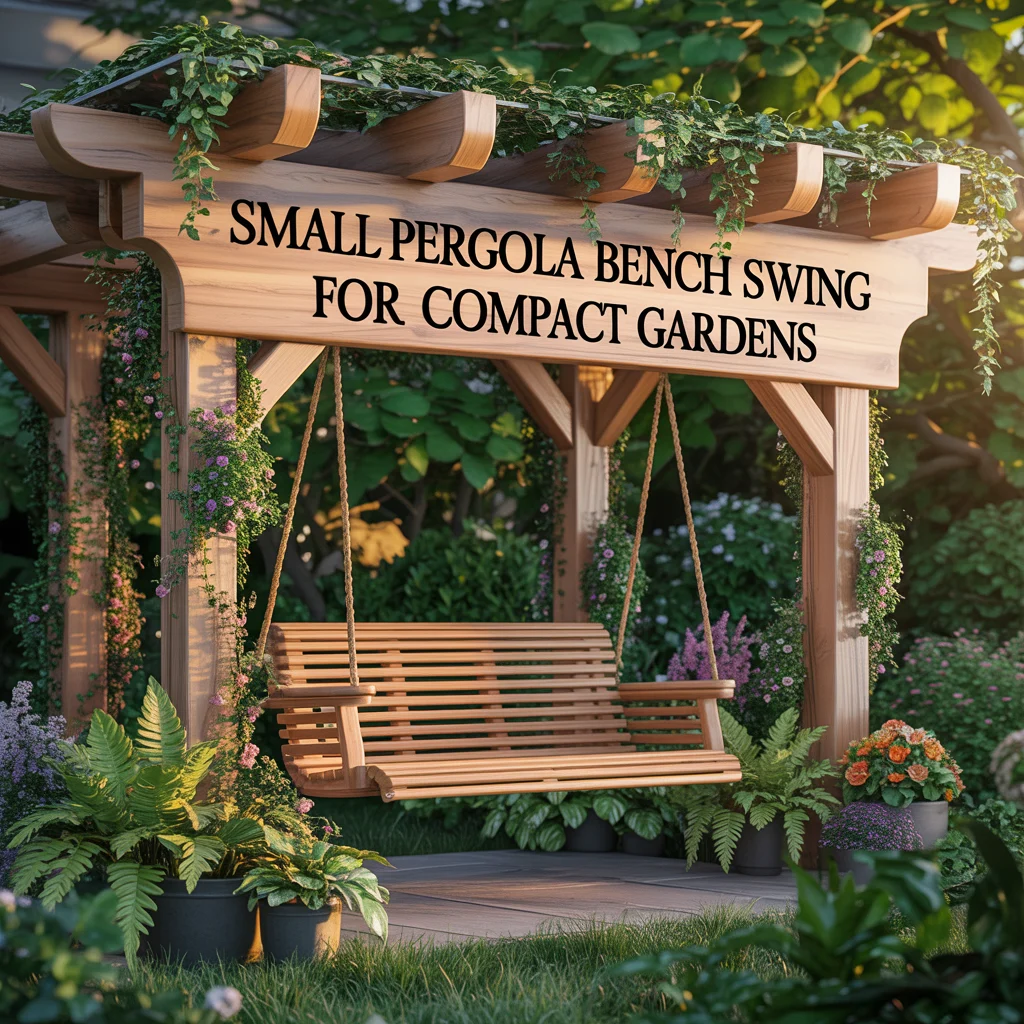
A small pergola bench swing for a compact garden uses a reduced footprint structure of 6-by-6 to 8-by-8 feet rather than the standard 10-by-12-foot full-size pergola, scaled to suit gardens with limited available space while maintaining all the functional and aesthetic qualities of a full-size pergola bench swing feature. I designed a small pergola bench swing for an urban back garden measuring 18 by 14 feet, using a 6-by-6-foot cedar structure with a single 48-inch bench swing on the rear crossbeam, and the compact pergola bench swing produced a premium outdoor feature in the small garden without occupying disproportionate floor area relative to the available outdoor space.
Small Pergola Bench Swing Post Spacing
A 6-foot post center-to-center spacing produces the smallest practical pergola bench swing that accommodates a standard 48-inch bench seat with adequate swing clearance on both sides. The 48-inch bench on a 6-foot span leaves 6 inches of chain and side clearance on each bench end, which is the minimum acceptable for safe swinging without the bench ends contacting the inner post faces during a full 12-inch forward swing arc. A 7-foot post spacing provides 54-inch bench capacity with 9 inches of side clearance, suiting a small pergola bench swing where the additional 12 inches of bench length allows two smaller adults or one adult and one child to use the swing simultaneously.
Materials for a Small DIY Pergola Bench Swing
Pressure-treated 4-by-4-inch posts, 2-by-8-inch overhead beams, and 2-by-6-inch bench seat boards are three material specifications suited to a small DIY pergola bench swing. Pressure-treated 4-by-4-inch posts at 10-foot length provide the correct 8-foot above-grade post height with 24-inch in-ground footing depth for a small pergola swing structure at $18 to $28 each. 2-by-8-inch overhead beams at the 6 to 8-foot span of a small pergola bench swing carry the suspended swing load with adequate structural safety factor at $2.50 to $4.00 per linear foot. 2-by-6-inch bench seat boards provide a comfortable, smooth seating surface for the suspended bench at $1.80 to $3.00 per linear foot.
Pergola Bench Swing Costco and Retail Purchase Guide
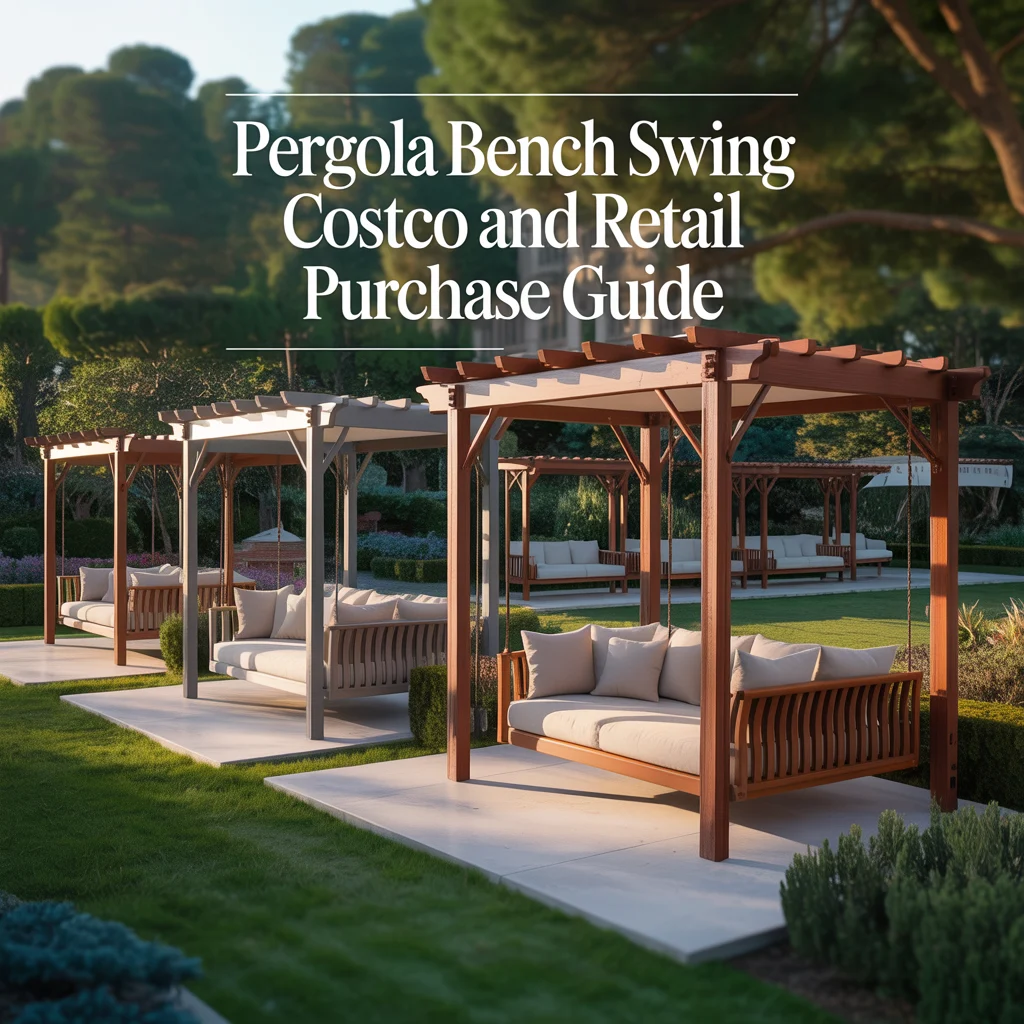
A pergola bench swing from Costco or other large garden furniture retailers provides a pre-engineered, complete swing package with all structural components, hardware, and assembly instructions included in a single purchase, eliminating the design and material sourcing stages required for a DIY pergola bench swing build. Costco pergola bench swings are seasonal products stocked from March through August in most North American locations and represent some of the best-value pre-packaged pergola swing options available to homeowners who prefer a complete kit purchase over individual component sourcing and custom design.
What Comes in a Retail Pergola Bench Swing Package
A standard retail pergola bench swing package includes four pre-cut structural posts, two to four overhead beams, all required metal post bases or footing hardware, suspension chains or ropes with safety-rated connecting hardware, a pre-assembled or flat-packed bench seat, and a step-by-step illustrated assembly manual. Most retail pergola bench swing packages do not include concrete for the footings, stain or sealant for the timber, and any tools required for assembly, all of which require separate purchase before installation can begin. I always check the complete contents list of any retail pergola bench swing package against a standard DIY material list before purchase to identify any missing components that would require additional sourcing before the assembly day.
Pergola Bench Swing Costco vs DIY Cost Comparison
A Costco or equivalent retail pergola bench swing costs $350 to $900 for a complete pre-engineered package depending on size, material quality, and included accessories. An equivalent DIY cedar pergola bench swing using individually sourced lumber, hardware, and bench materials costs $150 to $350 in materials for a comparable single-swing structure of equivalent size. The DIY option saves $200 to $550 in direct material cost but requires 8 to 16 hours of design, material sourcing, and construction time that has a real labor value of $120 to $320 at typical DIY project labor rates. The retail package provides engineering certification, guaranteed component compatibility, and a single-source purchase experience that the DIY approach cannot replicate.
Pergola Bench Swing Design With Curtains
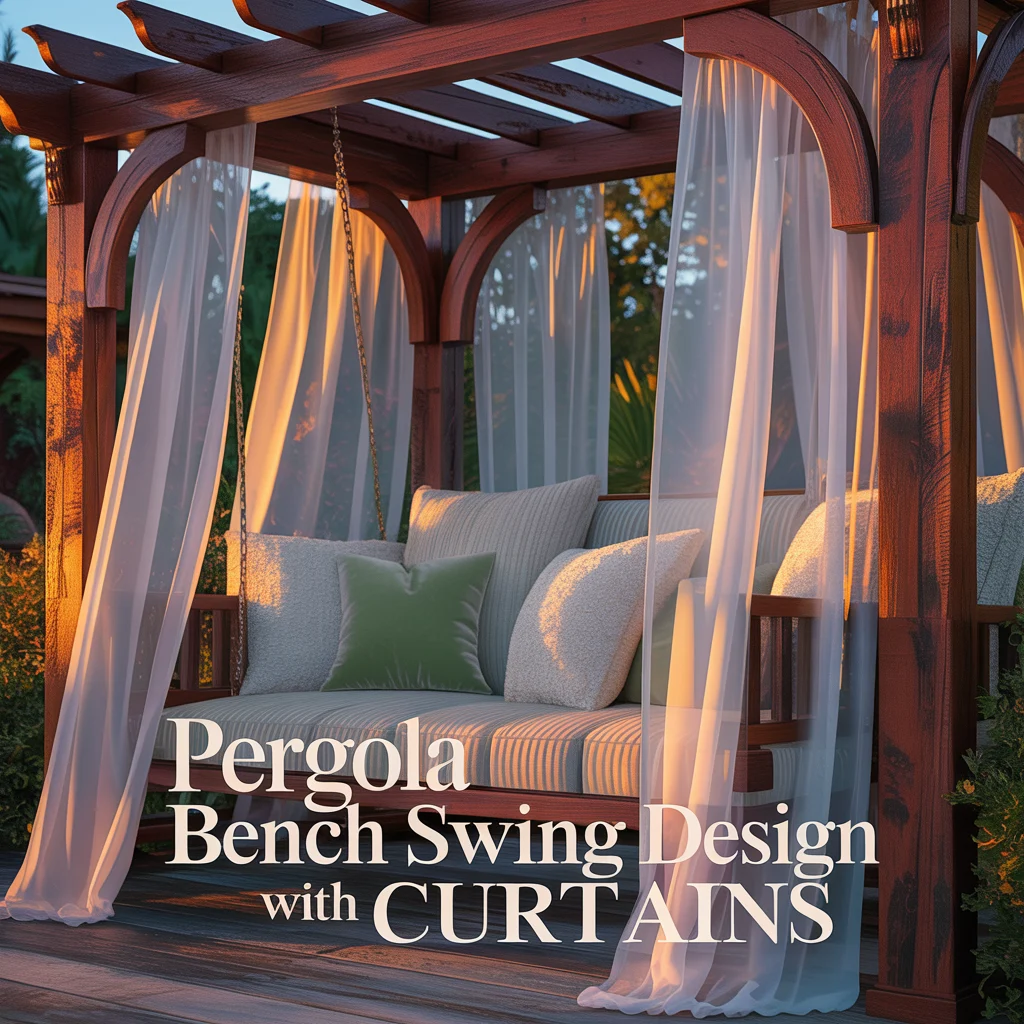
A pergola bench swing with curtains uses outdoor-rated fabric panels hung from the pergola beam on curtain rings or tension rods to create adjustable privacy screening and shade on one or both sides of the swing seat, transforming the open pergola structure into a semi-enclosed outdoor room that can be opened fully for maximum garden view or drawn closed for shaded, private swinging relaxation. I added three panels of outdoor Sunbrella fabric in a pale sage green to the front face of a cedar pergola bench swing at a residential project, and the curtain panels transformed the open pergola into an enclosed outdoor retreat that the homeowner used for afternoon reading sessions throughout the summer months.
Outdoor Curtain Fabrics for a Pergola Bench Swing
Sunbrella acrylic fabric, polyester outdoor canvas, and HDPE shade fabric are three outdoor curtain materials suited to a pergola bench swing. Sunbrella acrylic fabric provides the most durable and UV-stable outdoor curtain material rated for continuous outdoor exposure, with a fade-resistant guarantee of 5 years at a cost of $12 to $25 per linear yard in standard 54-inch curtain widths. Polyester outdoor canvas provides a cost-effective alternative at $6 to $14 per linear yard with moderate UV stability suited to a curtain that is stored indoors during winter rather than left on the pergola bench swing frame throughout the year. HDPE shade fabric at $4 to $8 per linear yard provides the most affordable curtain option with good UV filtering at 85 to 95% shade density.
Curtain Hardware for a Pergola Bench Swing
A stainless steel tension rod, a galvanized curtain wire with tensioners, and a steel curtain track with sliding rings are three curtain hanging systems suited to a pergola bench swing. A stainless steel tension rod of 5/8-inch diameter span-mounted between the pergola posts at 7-foot height provides a simple, tool-free curtain installation with infinite lateral adjustment of the curtain panel position on the rod. A galvanized curtain wire of 2mm diameter tensioned between eye bolts at both post faces provides a neater, lower-profile curtain suspension than a solid rod and suits longer spans between posts of 10 to 14 feet where a solid tension rod would deflect under the curtain weight. A steel curtain track provides the smoothest sliding action for frequently operated pergola bench swing curtains.
Pergola Bench Swing With Cushions and Accessories

A pergola bench swing with cushions and accessories uses outdoor-rated seat cushions, weather-resistant throw pillows, a side table, and optional accessory lighting to furnish the suspended bench seat as a comfortable, styled outdoor relaxation destination rather than a purely functional swinging seat. I styled a cedar pergola bench swing with a 4-inch-thick Sunbrella seat cushion in a navy blue botanical print, three coordinating throw pillows, a small teak side table hung on a side chain from the beam, and four solar fairy lights woven through the overhead lattice, and the styled pergola bench swing produced a completely different social and visual experience from the same unfurnished structure.
Outdoor Cushion Specification for a Pergola Bench Swing
A 4-inch-thick outdoor foam cushion, a 6-inch quilted outdoor cushion, and a custom-filled outdoor cushion are three cushion options suited to a pergola bench swing. A 4-inch outdoor foam cushion using a high-density polyurethane foam core of 1.8 to 2.0 lbs density provides the minimum comfortable seat thickness for extended swinging sessions and costs $35 to $75 for a standard 48-inch bench cushion in an outdoor Sunbrella cover. A 6-inch quilted outdoor cushion using a premium foam core with a quilted top provides a more luxurious seating experience suited to a pergola bench swing used as a primary outdoor relaxation destination, costing $65 to $140 for the same 48-inch bench length. Custom-filled cushions with outdoor-rated recycled polyester fill cost $45 to $95.
Side Table Options for a Pergola Bench Swing
A swing-mounted side table on its own support chain, a small folding teak table, and a built-in armrest with cup holder are three side table options suited to a pergola bench swing. A swing-mounted side table uses a secondary chain or rope attachment to the overhead beam to suspend a small table surface of 12 by 18 inches at the correct height relative to the bench seat, allowing the table to swing with the bench rather than remaining static while the seat moves. A small folding teak table of 16-inch diameter and 20-inch height placed on the ground beside the at-rest bench position provides a stable, non-swinging surface for drinks and books that suits a pergola bench swing used at a gentle slow swing rather than active vigorous swinging.
Pergola Bench Swing Ideas for a Backyard Entertainment Area

A pergola bench swing as a backyard entertainment area feature uses the swing structure as the central organizing element of an outdoor living zone that includes additional seating, a fire feature, ambient lighting, and outdoor cooking facilities arranged around the pergola bench swing as the primary destination. I designed a backyard entertainment area at a residential project using a 12-by-10-foot timber pergola bench swing at the center, flanked by two freestanding Adirondack chairs on a compacted gravel surface, with a 30-inch fire bowl at 8-foot clearance from the swing position and four low-voltage LED bollard lights defining the perimeter of the entertainment area, and the integrated outdoor room produced the most used outdoor space on the full property.
Layout Planning for a Pergola Swing Entertainment Area
A seating circle layout, a linear arrangement, and a corner-anchored layout are three spatial configurations for a pergola bench swing entertainment area. A seating circle layout positions the pergola bench swing at one arc of a circular outdoor seating area with additional chairs completing the circle on the remaining arcs, creating a social gathering space where all seated users face the center of the circle. A linear arrangement positions the pergola bench swing at one end of a defined path or deck with a fire pit at the midpoint and additional seating at the far end, creating a sequential entertainment destination that users move between during an outdoor session. A corner-anchored layout places the pergola swing in one corner of the entertainment area.
Surface Materials for a Pergola Swing Entertainment Area
Compacted gravel, composite decking, and a concrete pad with decorative aggregate finish are three surface materials suited to a pergola bench swing entertainment area. Compacted gravel at 3-inch depth on a weed membrane within a defined timber or steel edging border provides a level, well-drained, comfortable surface for the full pergola swing entertainment area at $3 to $6 per square foot, suiting a large entertainment area where the material cost of a continuous hard surface would be prohibitive. Composite decking provides a smooth, splinter-free, maintenance-free surface at $8 to $18 per square foot and suits a pergola bench swing entertainment area adjoining or adjacent to the house where the deck surface connects the interior living space to the outdoor swing destination.4
Pergola Bench Swing Lighting Ideas
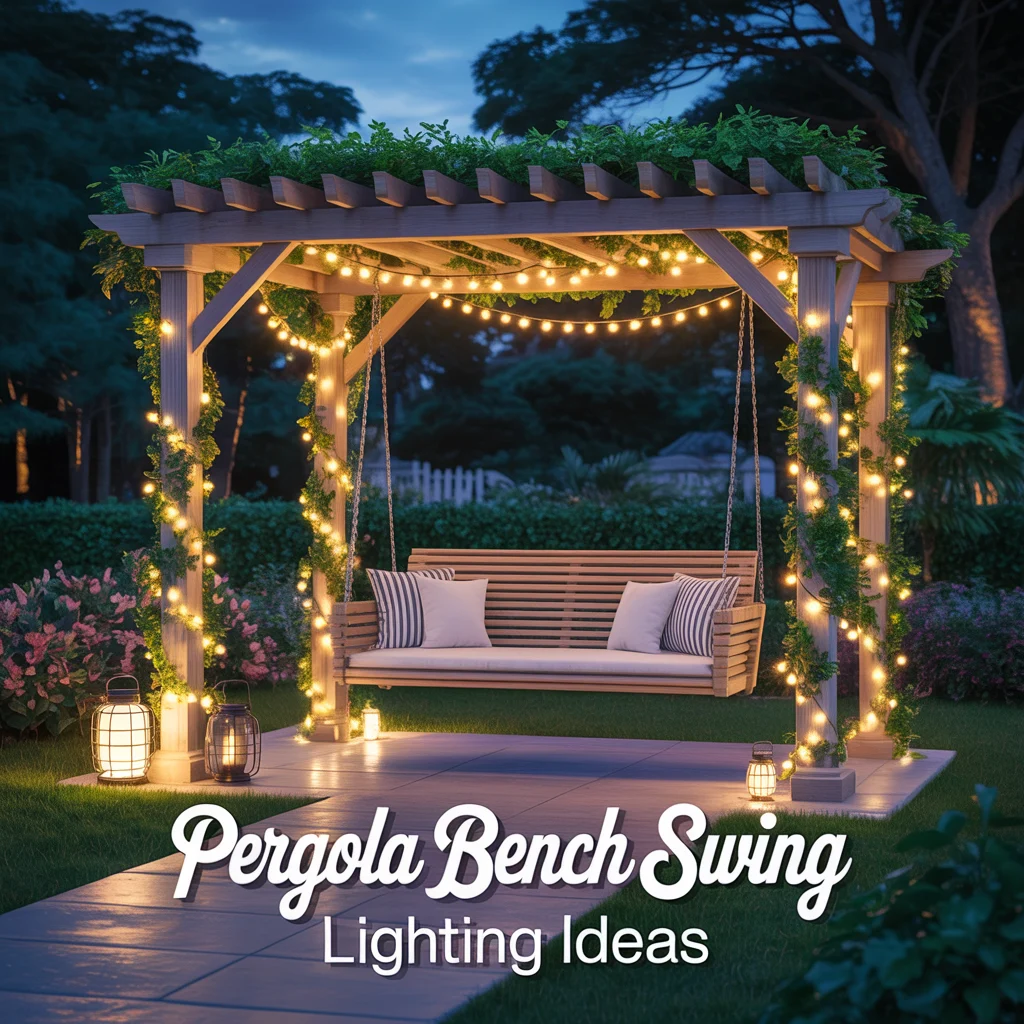
A pergola bench swing with integrated lighting uses solar fairy lights, low-voltage LED string lights, or recessed LED spotlights within the pergola structure to illuminate the swing area after dark, creating an outdoor feature that is as visually appealing and practically usable in the evening hours as during daylight. I fitted LED warm white string lights at 2700K along all four pergola beams of a cedar bench swing installation, and the after-dark pergola swing produced a garden feature that the homeowner described as more atmospheric and inviting than the daytime version, extending the active use season of the pergola bench swing from a daylight-only summer feature into a year-round evening destination.
String Light Installation on a Pergola Bench Swing
Solar powered LED string lights, mains-powered low-voltage LED string lights, and USB-rechargeable string lights are three string light types suited to a pergola bench swing. Solar powered LED string lights at $15 to $35 per 10-meter run require no wiring and suit a pergola bench swing positioned in a location receiving 4 or more hours of direct sun on the solar panel per day. Mains-powered low-voltage LED string lights at $20 to $50 per 10-meter run provide the most reliable and consistent illumination for a pergola bench swing used frequently in the evening, with power supplied through a ground-level conduit cable from the nearest outdoor electrical outlet. I mount solar panels for all solar string light installations on a south-facing post face at 60 to 70 degrees from horizontal to maximize charging time even in partially shaded garden positions.
Spotlighting a Pergola Bench Swing
A directional LED spike spotlight aimed at the pergola frame, recessed LED downlights in the overhead beam, and uplighters at the post bases are three spotlighting approaches suited to a pergola bench swing. A directional LED spike spotlight of $25 to $55 placed 6 to 8 feet from the pergola and aimed at 30 degrees toward the overhead beam creates a dramatic lit pergola effect after dark that makes the swing structure the visual focal point of the garden. Recessed LED downlights of 2700K color temperature installed in pre-drilled holes in the pergola beams directly above the bench seat provide functional illumination of the swing seating area at a cost of $15 to $35 per fitting plus installation labor for the cable routing through the pergola timber.
Pergola Bench Swing Safety Requirements
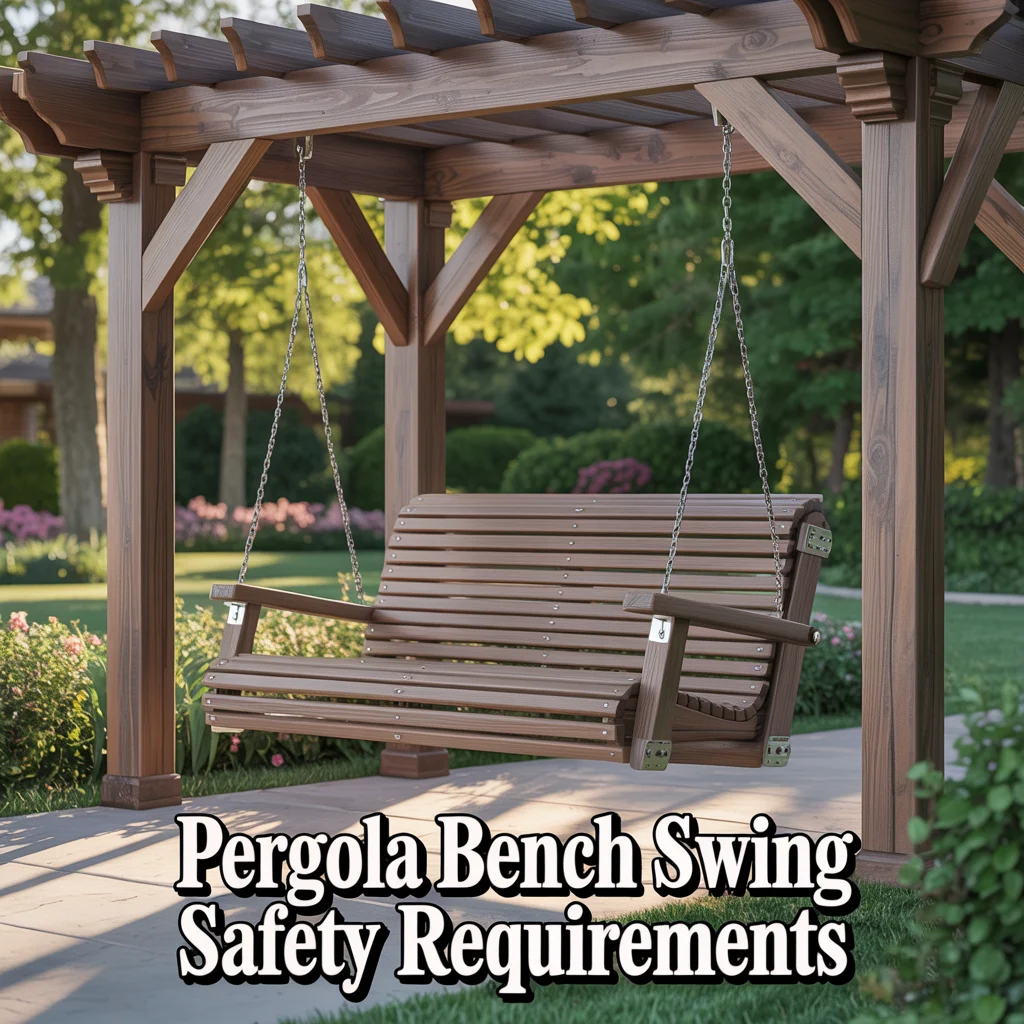
A pergola bench swing must meet specific structural, hardware, and installation safety requirements to provide reliable, safe use for all intended occupants over the full service life of the structure, because a suspended bench swing carries dynamic loading from occupant movement that significantly exceeds the static weight of the occupants and creates forces at the overhead beam connection points that must be correctly rated and maintained throughout the swing’s service life.
Load Rating for a Pergola Bench Swing
A residential pergola bench swing structure is designed to carry a minimum dynamic load of 600kg at the overhead beam suspension points, which provides an adequate safety factor for a two-person swing bench with a combined static occupant weight of 200kg when the dynamic load factor of 3.0 is applied to account for the impact and acceleration forces generated during normal swinging use. The suspension hardware including eye bolts, S-hooks, quick links, and chain or rope must all be individually rated to a minimum 600kg working load limit at each connection point in the suspension chain from beam to bench. I specify hardware with a safety factor of 4:1 over the minimum design load for all pergola bench swing installations, which provides a minimum hardware working load limit of 600kg for a two-person residential swing design.
Annual Inspection Checklist for a Pergola Bench Swing
Post base conditions, overhead beam to post connections, suspension hardware, bench seat structural integrity, and concrete footing exposure are five elements requiring annual inspection on a pergola bench swing. Post base conditions are checked by probing the timber at ground level with a sharp tool to detect any soft spots indicating rot at the most moisture-vulnerable point of the pergola structure. Overhead beam to post connections are checked by applying a lateral racking force to the top of each post and confirming no movement occurs at the bolted connection between the beam and the post. Suspension hardware is checked for rust, cracks, deformation, and thread engagement at every connecting link in the chain from the beam eye bolt to the bench seat fixing point.
Painted Pergola Bench Swing Ideas

A painted pergola bench swing uses exterior wood paint applied to the full timber structure and bench seat in a heritage or contemporary color to create a pergola swing that functions as a deliberate color statement in the garden rather than relying on the natural timber tone as the primary visual element. I painted a pressure-treated softwood pergola bench swing in Farrow and Ball Hague Blue exterior paint at a residential project, and the deep blue painted structure surrounded by white Rosa Blush climbing roses produced a pergola bench swing of greater visual impact than any natural timber swing I have installed in a comparable garden position.
Heritage Paint Colors for a Pergola Bench Swing
Farrow and Ball Hague Blue, Farrow and Ball Mizzle, and Farrow and Ball Pigeon are three heritage paint colors suited to a painted pergola bench swing. Hague Blue in a deep blue-green tone provides the most dramatically colored pergola bench swing finish and suits a garden where a bold statement structure is the intended design outcome. Mizzle in a muted grey-green tone provides the most naturally garden-appropriate pergola swing color because the grey-green coordinates with foliage, aged timber, and stone materials without creating a strong color contrast that might overpower the surrounding planting. Pigeon in a soft mid-grey provides a contemporary neutral color that suits a modern pergola bench swing in a garden where color is provided by the surrounding planting rather than the structure itself.
Exterior Paint Types for a Pergola Bench Swing
Microporous exterior wood paint, oil-based exterior paint, and exterior masonry paint applied to treated timber are three paint types suited to a pergola bench swing. Microporous exterior wood paint allows moisture vapor to pass through the paint film, preventing the blistering and peeling that occurs when moisture trapped beneath a conventional paint film expands during temperature cycling on a permanently outdoor pergola structure. Oil-based exterior paint provides the most durable and water-resistant film of any exterior paint type for a pergola bench swing, with a 5 to 7-year repainting interval compared to 3 to 5 years for water-based exterior products. I specify microporous water-based exterior paint on all cedar and pressure-treated softwood pergola bench swing structures as the best combination of durability, breathability, and practical ease of application.
Pergola Bench Swing for a Garden With Children
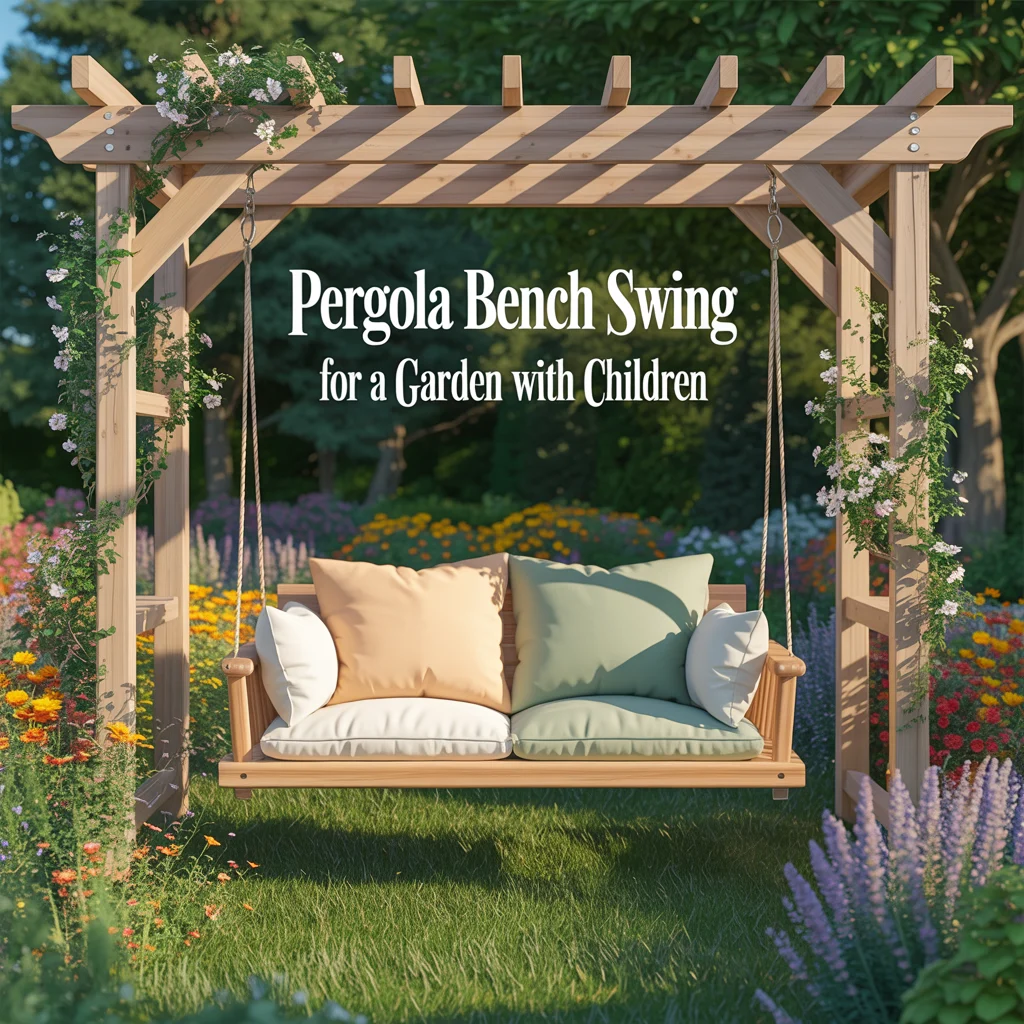
A pergola bench swing for a family garden with children uses child-appropriate structural specifications, non-toxic surface finishes, rounded or chamfered edge details on all timber components, and load ratings that account for the higher dynamic forces generated by children’s active swinging compared to the moderate oscillation of adult relaxation swinging on the same structure. I designed a family pergola bench swing at a residential project with three children aged 4 to 10, specifying a 6-by-6-inch post structure rather than the standard 4-by-4-inch for additional rigidity under high-force child swinging, using 16mm galvanized chain rather than 12mm, and fitting rubber bumper strips to the inner post faces at swing clearance height.
Child Safety Features for a Pergola Bench Swing
Rubber bumper strips on inner post faces, a swing seat with safety sides or armrests, rope suspension with no accessible loops, and a resilient impact surface below the swing are four child safety features suited to a family pergola bench swing. Rubber bumper strips of 50mm by 25mm closed-cell foam fixed to the inner post face at the swing arc height provide a cushioned contact surface if the bench seat or occupant contacts the post during active swinging. A swing bench seat with 6-inch armrest sides on both ends prevents younger children from sliding off the bench seat during vigorous swinging and provides a gripping point for children who need manual support during the swinging motion.
Impact Surface for a Children’s Pergola Bench Swing
Play bark chip, rubber mulch, and poured-in-place rubber are three impact surface materials suited to a children’s pergola bench swing ground surface. Play bark chip at 9-inch depth on a permeable membrane provides EN1177-compliant impact attenuation for a swing seat at 6-foot maximum height above the ground surface at a material cost of $4 to $7 per square foot for a standard 10-by-12-foot swing zone. Rubber mulch at 6-inch depth provides longer-lasting impact attenuation than bark chip with a 10-year service life before replacement, at $8 to $14 per square foot. Poured-in-place rubber provides the most permanent and professionally finished impact surface for a family pergola bench swing at $18 to $30 per square foot installed.
Pergola Bench Swing With Privacy Screen

A pergola bench swing with a privacy screen uses lattice panels, bamboo screening, planted hedging, or fabric panels on one or more sides of the pergola structure to create a screened outdoor seating destination that provides visual privacy from adjacent properties, public viewpoints, or other areas of the garden. I added two 4-by-8-foot cedar lattice panels to the rear and one side of a cedar pergola bench swing at a residential project, planting Clematis montana on the rear panel and leaving the front and remaining side open, and the screened pergola swing produced a genuinely private outdoor retreat that the homeowner used for telephone calls, reading, and quiet relaxation throughout the garden season.
Privacy Screen Materials for a Pergola Bench Swing
Cedar lattice panels, bamboo fence panels, and planted hedging are three privacy screen materials suited to a pergola bench swing. Cedar lattice panels at 4 by 8 feet cost $25 to $55 each and provide an immediately installed privacy screen that suits a pergola bench swing where a permanent decorative screen is the design intention. Bamboo fence panels at 6 by 4 feet cost $15 to $35 each and provide the most cost-effective natural privacy screen for a pergola bench swing in a garden where the organic character of bamboo coordinates with the surrounding planting. Planted hedging of Taxus baccata or Buxus sempervirens provides the most permanent and naturalistic privacy screen for a pergola bench swing at 4 to 8 years establishment time before full screening height is achieved.
Lattice Panel Attachment for a Pergola Bench Swing
Cedar lattice panels are attached to a pergola bench swing frame by resting the panel base on a 2-by-2-inch timber ledger fixed to the inner post face at ground level and securing the panel top face to the overhead beam soffit using 2-by-2-inch timber nailers on both panel faces at the beam connection point. The ledger and nailer system holds the lattice panel rigidly in its vertical position without requiring any screws through the decorative lattice surface that would split the thin lattice strips. I complete the lattice panel installation on a pergola bench swing before fitting the bench seat and suspension hardware to maintain clear access to the post faces and beam connections during the panel attachment process.
Teak Pergola Bench Swing
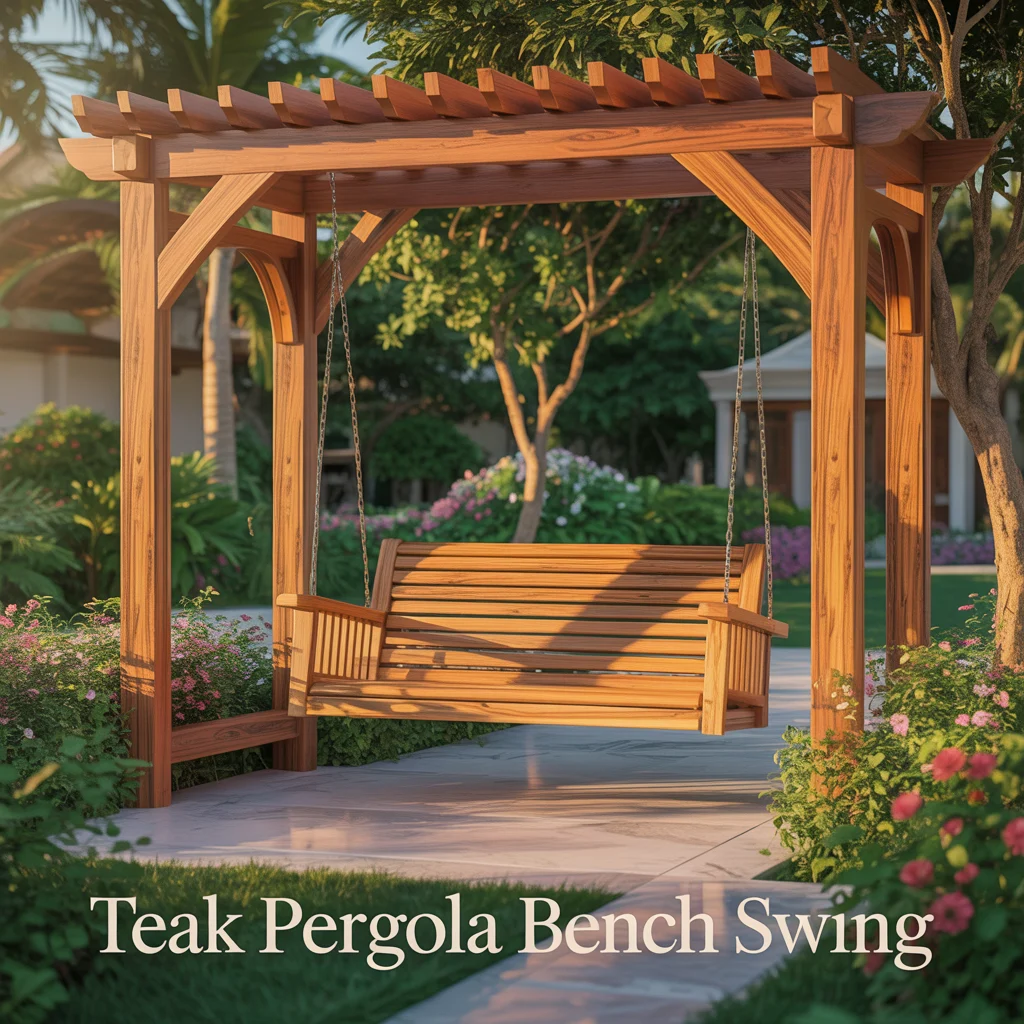
A teak pergola bench swing uses Tectona grandis teak timber for both the structural pergola frame and the suspended bench seat to create the most premium natural material outdoor swing feature available, combining the natural weather resistance and silver-grey weathering patina of teak with the classic swinging bench seat experience. I specified a teak pergola bench swing for a coastal residential property where the salt-laden air and high humidity required a timber with the natural corrosion and moisture resistance to perform without annual surface treatment in a permanently exposed outdoor position, and teak was the only timber that provided the required performance specification at the coastal site conditions. A broader range of swing and seat styles for this kind of outdoor feature is covered in these outdoor garden bench ideas with swing-style seating.
Teak Pergola Bench Swing Construction Specifications
Teak pergola bench swing construction uses 4-by-4-inch or 6-by-6-inch teak post sections at post centers of 8 to 12 feet, connected by 2-by-8-inch teak overhead beams using 12mm stainless steel through-bolts at each beam-to-post connection point. All structural fixings on a teak pergola bench swing use grade 316 stainless steel hardware throughout because standard galvanized steel fixings react with the natural tannins in teak to produce black staining around each fixing point that permanently discolors the timber surface. The suspended bench seat uses 2-by-6-inch teak boards at 10mm gap spacing across a 48-inch bench width, connected to the suspension system using 316 stainless steel chain, stainless steel eye bolts, and stainless steel quick links at all four connection points.
Teak Pergola Bench Swing Price Comparison
A teak pergola bench swing costs significantly more than equivalent cedar or pressure-treated softwood designs at every scale and specification level. Materials for a DIY teak pergola bench swing of standard single-seat residential size cost $450 to $850 compared to $145 to $280 for an equivalent cedar design and $95 to $180 for pressure-treated softwood, representing a 3 to 5 times material cost premium over the most affordable DIY alternatives. The teak premium reflects the timber’s 25 to 40-year outdoor service life without surface treatment, which produces a total cost per year of use that compares favorably with cedar at 15 to 20 years and pressure-treated softwood at 10 to 15 years when the full service life cost of each material is calculated rather than the initial purchase cost alone.
Pergola Bench Swing With Shade Sail
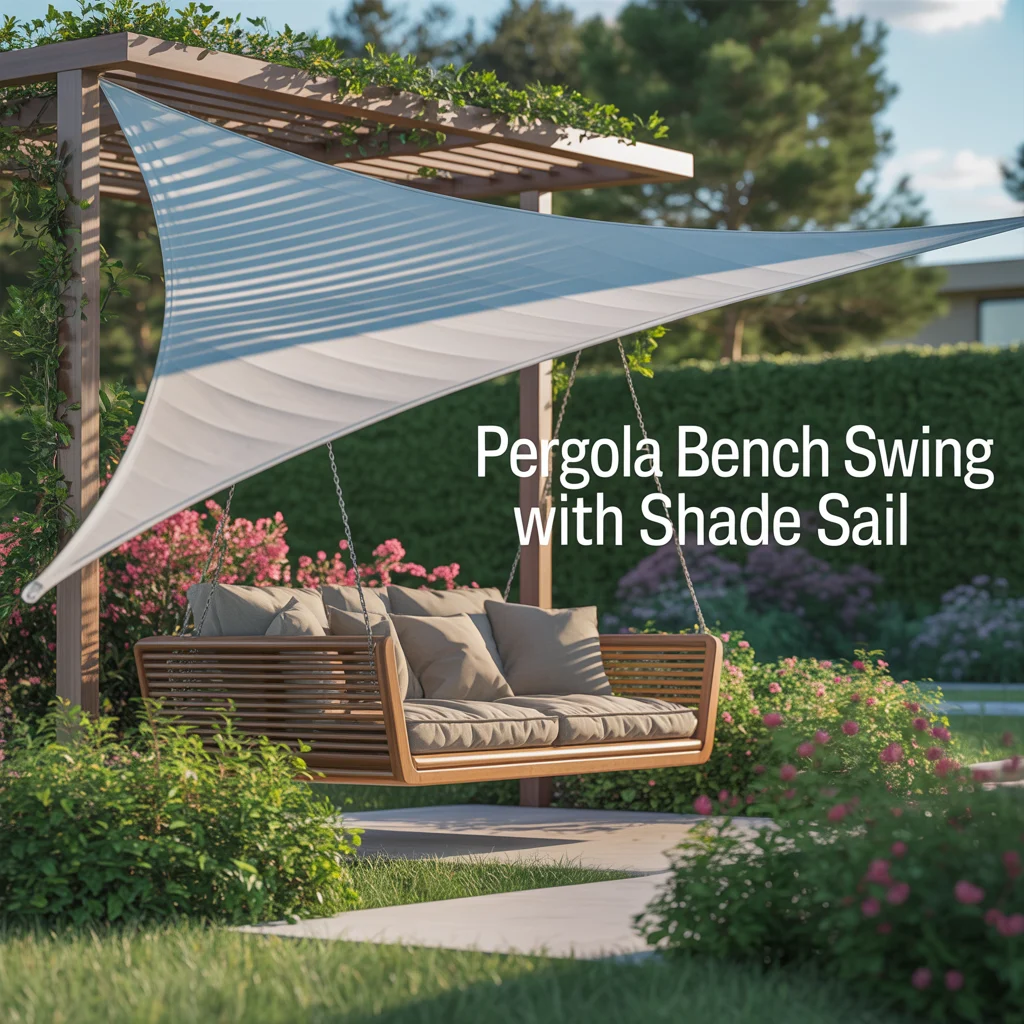
A pergola bench swing with a shade sail uses a tensioned triangular or square fabric panel attached to the overhead beam and to two external anchor points beyond the pergola structure to provide additional shade coverage over the bench seat beyond the partial shade provided by the pergola beam framework alone. I fitted a 10-by-10-foot square HDPE shade sail to a cedar pergola bench swing at a south-facing garden position where the overhead beam lattice provided inadequate shade during the peak midday sun hours of July and August, and the shade sail reduced the solar radiation reaching the bench seat surface by 85 to 92% while maintaining the open, airy character of the pergola structure below the sail.
Shade Sail Materials for a Pergola Bench Swing
High-density polyethylene HDPE shade fabric, acrylic shade sail fabric, and waterproof PVC shade sail fabric are three materials suited to a shade sail over a pergola bench swing. HDPE shade fabric provides 85 to 95% UV protection in a breathable woven construction that allows air movement through the fabric while blocking the majority of direct solar radiation reaching the bench seat, at a cost of $45 to $120 for a standard 10-by-10-foot sail in a commercial grade UV-stabilized product. Acrylic shade sail fabric provides comparable UV protection with a denser weave construction that provides some water resistance in light rain at $65 to $150 for the same size. PVC shade sail fabric provides full waterproofing but blocks air movement through the fabric.
Tensioning a Shade Sail Over a Pergola Bench Swing
A shade sail over a pergola bench swing is tensioned by attaching two sail corners to stainless steel D-rings fixed to the overhead beam at the attachment points, with the remaining two corners connected to stainless steel eye bolts in external timber posts or masonry anchor points positioned 8 to 10 feet from the pergola structure on the sun-facing side. The sail requires tension of 20 to 30kg on each attachment point to produce a taut surface that resists wind uplift without flapping, achieved by tightening the stainless steel tensioning ratchets at each corner until the sail surface shows no visible sag or wrinkle in calm wind conditions.
Rustic Pergola Bench Swing With Log Construction
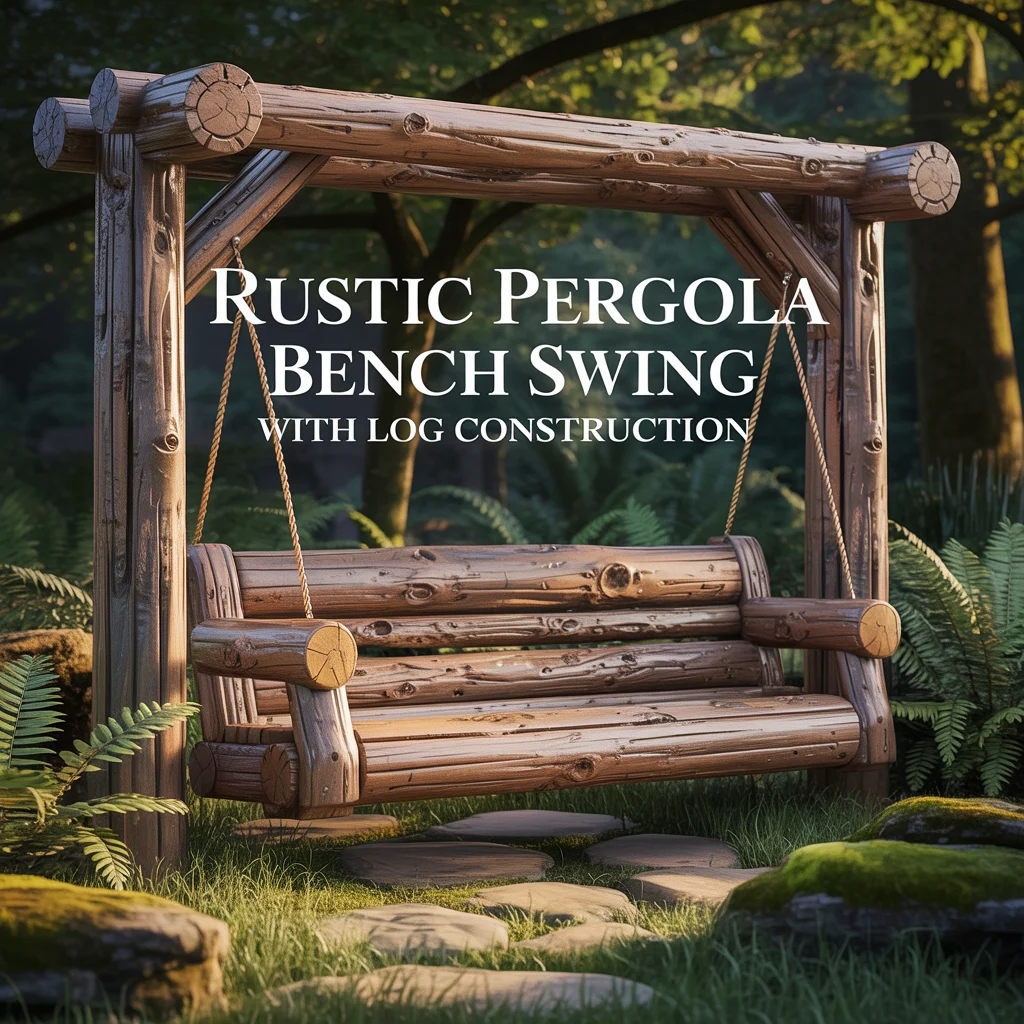
A rustic pergola bench swing with log construction uses naturally rounded or hand-hewn log sections as the structural posts and overhead beams rather than sawn dimensional timber, creating a swing structure with the most naturalistic, forest-floor aesthetic of any pergola bench swing design. I built a rustic log pergola bench swing for a woodland garden property using four 8-foot cedar log sections of 5 to 6-inch average diameter as the corner posts and two 10-foot hand-peeled cedar logs as the overhead beams, and the completed rustic log swing produced a garden feature that looked as though it belonged in the surrounding mature tree canopy in a way that no sawn timber structure could have achieved in the same woodland garden setting.
Log Selection for a Rustic Pergola Bench Swing
Straight-grained logs, slightly curved logs for character, and hand-peeled green logs are three log selection approaches suited to a rustic pergola bench swing. Straight-grained logs of 4 to 6-inch average diameter provide the most structurally reliable post material for a rustic pergola bench swing because the consistent fiber direction of a straight log provides predictable strength and stiffness that the variable grain of a curved log cannot reliably match. Slightly curved logs of consistent curvature add a deliberate organic character to the rustic pergola swing frame and suit a woodland or naturalistic garden setting where the perfect geometric precision of sawn timber would look inconsistent with the surrounding landscape character.
Peeling and Treating Logs for a Rustic Pergola Swing
Green freshly felled logs used for a rustic pergola bench swing require bark removal within 4 to 6 weeks of felling before the cambium layer beneath the bark begins to harbor beetle larvae and fungal growth that accelerates timber decay from the outside inward. I peel all green logs for rustic pergola swing projects using a draw knife, removing the full bark and cambium layer to reveal the clean cream-colored sapwood beneath, then applying a penetrating boron-based wood preservative solution to all exposed sapwood surfaces before the logs are assembled into the pergola frame. The boron treatment protects the sapwood against the insect and fungal attack that the bark removal exposes.
Year-Round Pergola Bench Swing Maintenance Plan
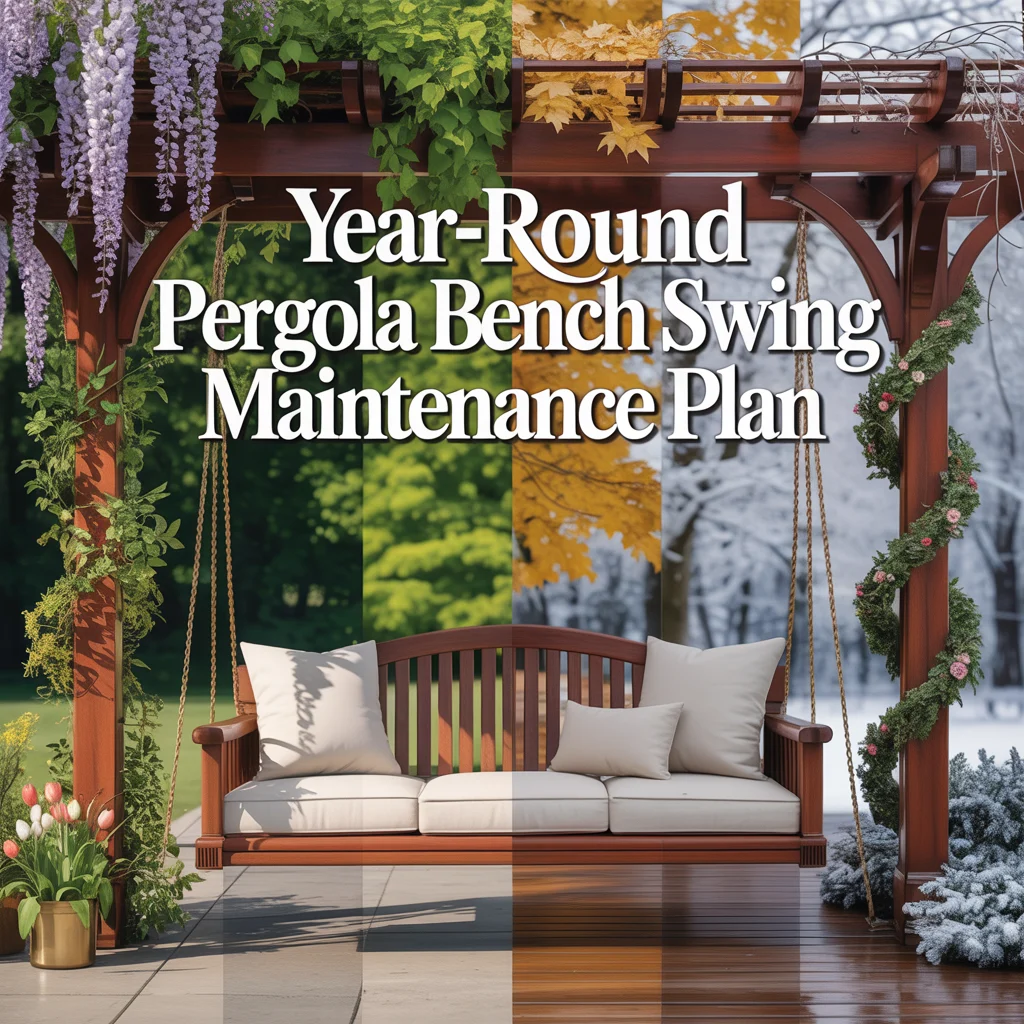
A year-round maintenance plan for a pergola bench swing addresses the seasonal demands that different weather conditions place on the timber structure, metal hardware, rope or chain suspension, and bench seat surface of a permanently outdoor swing installation, maintaining the structural safety and visual appearance of the feature throughout all four seasons of outdoor exposure. I follow a four-season maintenance plan on all pergola bench swings I install and manage, and find the plan prevents the cumulative structural deterioration that occurs on unmanaged swing structures and maintains the structural safety certification of the swing for the full service life of the installation.
Spring Pergola Bench Swing Maintenance
Full structural inspection, hardware checking, surface treatment, and suspension system load testing are four spring maintenance tasks completed in March or April on a pergola bench swing. Full structural inspection checks all post bases, beam connections, overhead member integrity, and footing exposure conditions for any winter deterioration. Hardware checking examines all chain links, eye bolts, quick links, and connection points for rust, deformation, thread engagement, and working load limit compliance. Surface treatment applies one coat of appropriate exterior finish to any bare, weathered, or cracked timber surfaces identified during the structural inspection. Suspension system load testing applies a controlled load of 300kg to each swing position using weighted bags to confirm the suspension system performs within its rated load capacity before the main swing use season begins.
Autumn and Winter Pergola Bench Swing Preparation
Cushion removal, chain lubrication, structural timber treatment, and storm damage inspection are four autumn and winter preparation tasks completed between October and February on a pergola bench swing. Cushion removal in October stores all seat cushions, throw pillows, and fabric accessories indoors for the winter period, which extends the service life of outdoor cushion materials by preventing the frost damage that outdoor-rated fabrics can sustain during prolonged freezing wet conditions. Chain lubrication applies a penetrating rust inhibitor spray to all steel chain, hardware, and suspension components in October before the first frost, which prevents surface rust from developing during the winter period and maintains the free movement of all connecting links throughout the cold season.
Related
best garden paths with lighting near a pergola swing area
how to add a pergola bench swing to a garden path design
library garden bench ideas for a quiet pergola swing corner
Frequently Asked Questions
How do I build a pergola bench swing?
A pergola bench swing is built in six steps: excavate four corner footings at 24 to 36-inch depth, set 4-by-4-inch posts in concrete footings at 8-foot center-to-center spacing, install 2-by-8-inch overhead beams bolted to the post tops, fit eye bolts to the beam soffit at the suspension points, hang 12mm chain from the eye bolts to the bench seat S-hooks, and attach the pre-built bench seat to the chain suspension. Total construction time for a standard single-swing pergola bench swing is 8 to 12 hours including concrete curing time of 24 hours before loading the structure. Material cost for a pressure-treated softwood pergola bench swing ranges from $95 to $180 and for a cedar pergola bench swing from $145 to $280.
What is the best wood for a pergola bench swing?
Western red cedar is the best wood for a pergola bench swing because it provides natural rot resistance without chemical treatment, dimensional stability in outdoor conditions that prevents the cracking and splitting that occurs in pressure-treated softwood during temperature cycling, and a natural aromatic fragrance that adds a sensory quality to the swing experience. Teak provides superior long-term weather resistance at a significantly higher material cost suited to a coastal or permanently exposed swing position. Pressure-treated softwood provides the most affordable pergola bench swing material at the lowest initial cost with adequate 10 to 15-year performance in a residential garden installation.
How much weight can a pergola bench swing hold?
A correctly designed and constructed residential pergola bench swing holds a minimum of 200kg static load on the bench seat, which corresponds to two adults of average weight using the swing simultaneously. The dynamic load factor of 3.0 applied during active swinging means the structural hardware must be rated to a minimum 600kg working load limit at every connection point from the beam eye bolt to the bench seat fixing. I specify hardware with a 4:1 safety factor over the minimum design load on all pergola bench swing installations, requiring individual hardware working load limit ratings of 800kg minimum at each suspension connection point for a two-person residential swing design.
Can I attach a swing to an existing pergola?
A swing is attached to an existing pergola when the overhead beam cross-section is a minimum 2-by-8-inch solid timber and the beam-to-post connections use through-bolts of minimum 10mm diameter rather than screws or nails. The existing pergola beams must be inspected for rot, insect damage, and structural cracking before any swing attachment hardware is installed, because a swing creates dynamic loading at the attachment point that exceeds the static design loads of most standard pergola structures. I assess every existing pergola structure individually before recommending swing attachment, and specify structural reinforcement of the beam-to-post connections in approximately 40% of existing pergolas assessed for retrofit swing installation due to inadequate original connection hardware. Anyone planning a walkway that leads toward this kind of seating destination will find further layout ideas in these garden paths with pergolas leading to a bench swing.
What is the standard height for a pergola bench swing?
A pergola bench swing sits most effectively when the overhead beam soffit is at 8 to 9 feet above the ground, which provides a suspension chain length of 66 to 78 inches and a bench seat rest height of 18 inches above the ground. A beam height below 7.5 feet produces a chain length that places the bench seat too close to the ground for comfortable adult swinging without the occupant’s feet dragging. A beam height above 10 feet produces a chain length that creates an excessively slow swing period and a very high swing arc amplitude that may feel unsafe to occupants who prefer a gentle oscillation rather than a wide swinging range during normal use of the pergola bench swing.