
20 Garden Paths With Lighting for a Stunning Night Garden

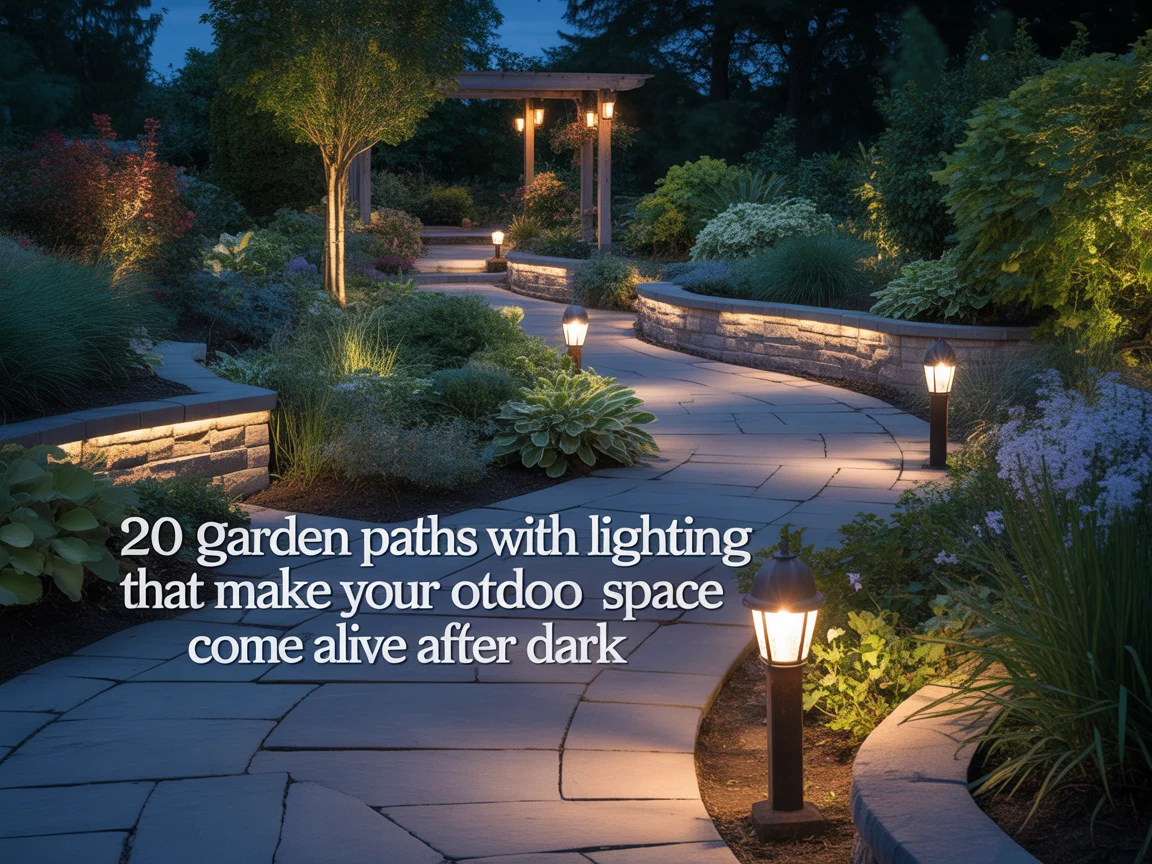
I installed my first garden path lighting on a whim one October evening after tripping over a raised paving edge in the dark for the third time that week. I ordered six solar spike lights online, pushed them into the soil along both sides of my front path, and switched them on at dusk. The path I had walked past every day without giving it a second thought suddenly looked like something from a hotel garden. My wife came outside just to stand and look at it. That was four years ago and I have been studying outdoor path lighting seriously ever since.
Garden paths with lighting combine a walkable outdoor surface with a planned illumination system that serves both a practical safety function and a decorative atmospheric function, making the path usable and visually appealing after dark as well as during daylight hours. The lighting gives the path a nighttime presence that transforms the entire garden after sunset, and the path gives the lighting a defined structure that makes the fixtures look placed with intention rather than scattered randomly.
Since that first set of solar lights, I have installed, tested, and studied many lighting designs for garden paths across different styles, budgets, and technical setups. In this article, I am sharing 20 garden paths with lighting that I have either installed myself or studied closely enough to recommend with complete confidence.
Solar Spike Lights Along a Gravel Garden Path
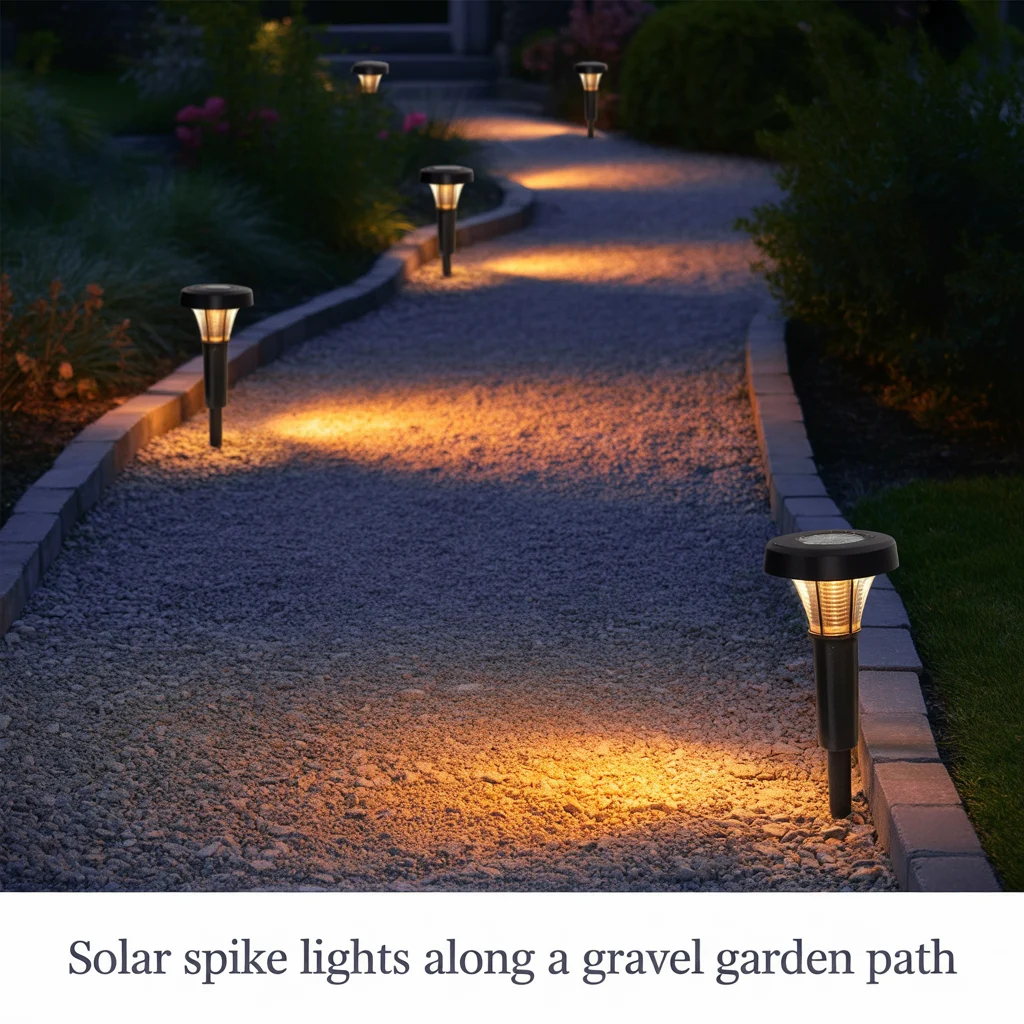
Solar spike lights along a gravel garden path are the most accessible starting point for any homeowner wanting to add lighting to a garden path without any electrical installation work or ongoing running costs. I use solar spike lights on three separate garden paths and find them the fastest lighting upgrade available, requiring no tools, no wiring, and no expertise to install. A set of eight solar spike lights placed at 3-foot intervals on both sides of a 12-foot gravel path costs between $25 and $80 depending on the product quality and light output, and the entire installation takes under 20 minutes.
How Solar Spike Lights Work on a Garden Path
Solar spike lights contain a small photovoltaic panel on the top face of the unit that charges an internal rechargeable battery during daylight hours and powers an LED bulb automatically at dusk through a built-in light sensor. The LED output of a standard solar spike light ranges from 5 to 20 lumens, which is sufficient to define the path edge clearly after dark without producing enough light to read by. I measured the light output of four different solar spike light models on my gravel path and found that units rated at 15 lumens or above produced a clear, visible path definition from 20 feet away, while units below 10 lumens were visible only from within 8 feet.
Solar Spike Light Spacing for a Gravel Path
Solar spike lights on a gravel garden path produce the most effective illumination pattern when spaced at 3 to 4 feet apart on alternating sides of the path, creating an offset pattern that lights both edges without placing fixtures directly opposite each other. Placing fixtures directly opposite each other at equal spacing creates a formal, symmetrical lighting pattern that suits a formal garden path but can look overly regimented on an informal gravel path. I use alternating 3-foot spacing on all my gravel paths and find the resulting offset light pattern produces a more natural-looking illumination that suits the informal character of a gravel path surface better than a symmetrical opposite placement. For anyone wanting to take path lighting further with an overhead structural element, these garden paths with pergolas and overhead lighting cover LED strip lighting fixed to pergola crossbeams, solar and mains-powered options for covered walkways, and complete design combinations that extend the atmosphere of a lit garden path into the evening hours throughout the full length of a covered outdoor corridor.
Recessed LED Step Lights on a Raised Path
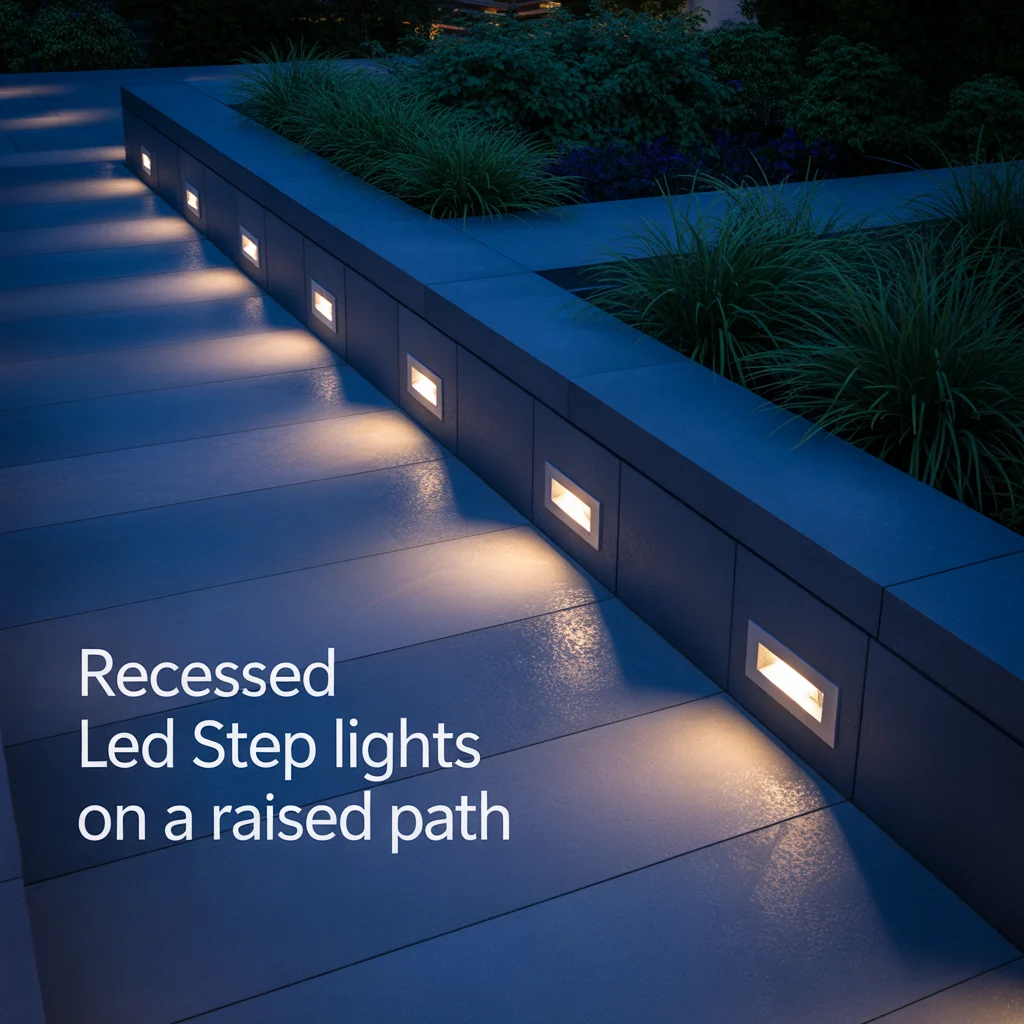
Recessed LED step lights set into the risers of a raised or stepped garden path produce a flush, architectural lighting effect where the light source is completely hidden within the step face and the illumination appears as a horizontal band of light across the full width of each tread. I installed recessed LED step lights on a four-step brick path entrance at a residential project and the effect after dark was a precise sequence of four horizontal light bands that made the steps completely safe to use at night while producing an appearance of deliberate architectural lighting design. Each fitting cost $18 to $35 and required a mains 12-volt transformer and armored cable installation.
Recessed Step Light Installation Requirements
Recessed LED step lights require a 60mm diameter or 68mm diameter circular recess cut into the step riser face using a hole saw, a 12-volt mains transformer located in a weatherproof enclosure at a maximum distance of 30 meters from the most distant fitting, and armored outdoor cable rated to IP68 running between each fitting and the transformer. The total installation cost for a four-step path entrance with mains-powered recessed step lights, including a qualified electrician’s labor for the cable run and transformer connection, ranges from $280 to $480. I find this the most professional-looking lighting result available for a stepped garden path and the one most frequently described as looking like a designed feature rather than a lighting addition.
LED Color Temperatures for Recessed Step Lights
Warm white at 2700K, neutral white at 4000K, and cool white at 6000K are three color temperature options for recessed LED step lights on a garden path. Warm white at 2700K produces an amber-toned light that suits traditional brick, sandstone, and timber step materials and creates a welcoming atmospheric effect on a residential garden path. Neutral white at 4000K produces a clean, crisp light that suits contemporary concrete and porcelain step materials and is the color temperature I use most frequently on modern garden path lighting projects. Cool white at 6000K produces a blue-toned light that suits a very contemporary or industrial garden path design but can feel clinical in a domestic residential setting.
Bollard Lights Along a Formal Garden Path
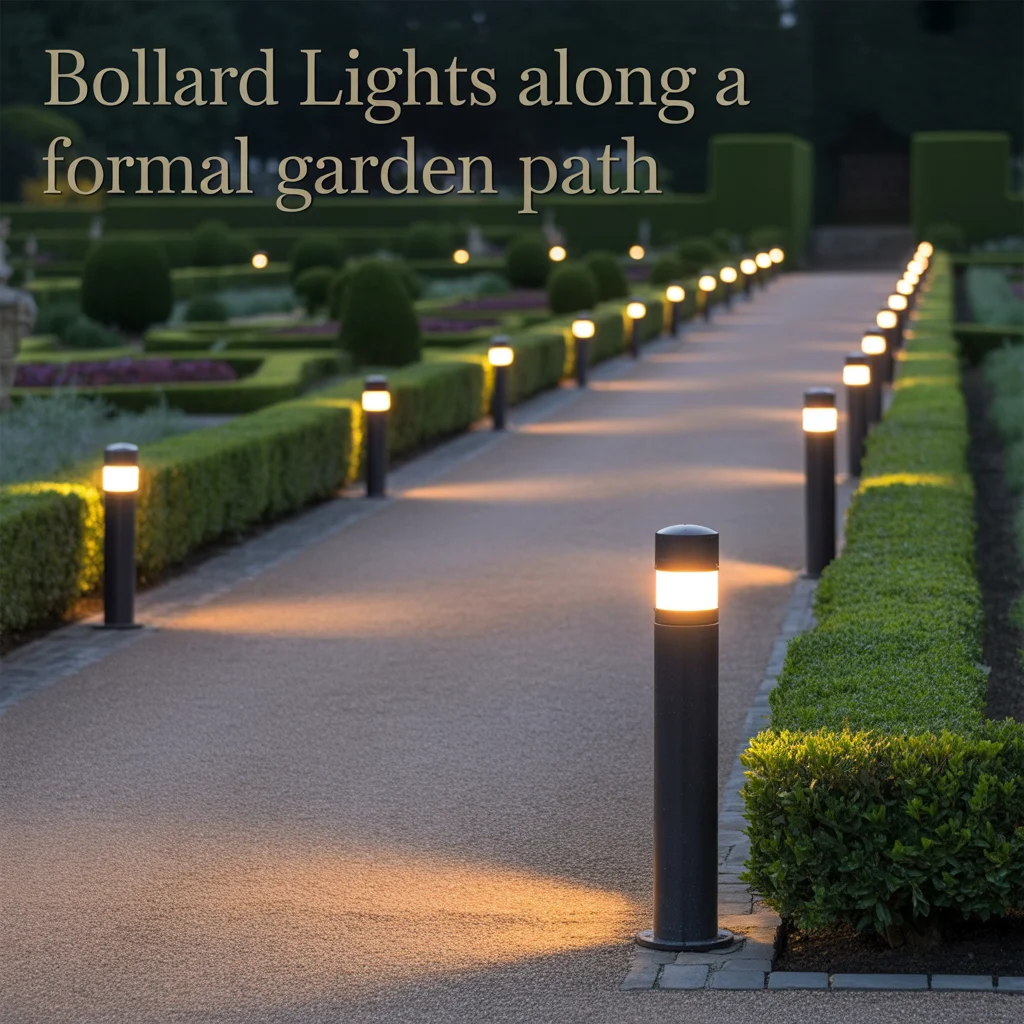
Bollard lights along a formal garden path use freestanding post-mounted light fixtures of 400 to 900mm height placed at regular intervals along one or both sides of the path to produce a defined corridor of downward-directed light that suits formal, symmetrical, and contemporary garden path designs. I studied bollard lighting on a formal paved path at a contemporary residential property where six 600mm-tall stainless steel bollard lights were placed at 6-foot intervals along one side of a 35-foot York stone path, and the sequence of evenly spaced light pools on the path surface produced one of the cleanest and most precise formal garden path lighting designs I have seen.
Bollard Light Heights for a Garden Path
Bollard lights for a garden path are available in three standard height categories: low bollards of 300 to 400mm, medium bollards of 500 to 600mm, and tall bollards of 700 to 900mm. Low bollards of 300 to 400mm produce a ground-level lighting effect that suits an informal or cottage garden path where the low position of the light creates an intimate, close-to-ground illumination. Medium bollards of 500 to 600mm are the most widely used height for a formal garden path because the light source sits at a height that illuminates both the path surface and the lower stems of adjacent border planting simultaneously. Tall bollards of 700 to 900mm suit a wide formal path of 5 feet or more where the greater fixture height is needed to spread light across the full path width from a single row of fittings on one side.
Bollard Light Materials for an Outdoor Garden Path
Stainless steel, powder-coated aluminium, and weathered cor-ten steel are three materials used in bollard lights for a garden path with lighting. Stainless steel bollards in a brushed finish cost $60 to $180 per unit and suit a contemporary or modern formal path design where the metal surface ages well without rust or surface degradation. Powder-coated aluminium bollards cost $40 to $120 per unit and are available in a wide range of RAL colors including anthracite grey, black, and white, which suit different garden path styles and surrounding materials. Cor-ten steel bollards develop an orange-brown rust patina within 6 to 12 months and cost $80 to $200 per unit, suiting a contemporary or industrial garden path design where the warm rust tone complements natural stone or timber path materials.
String Fairy Lights Over a Pergola Garden Path
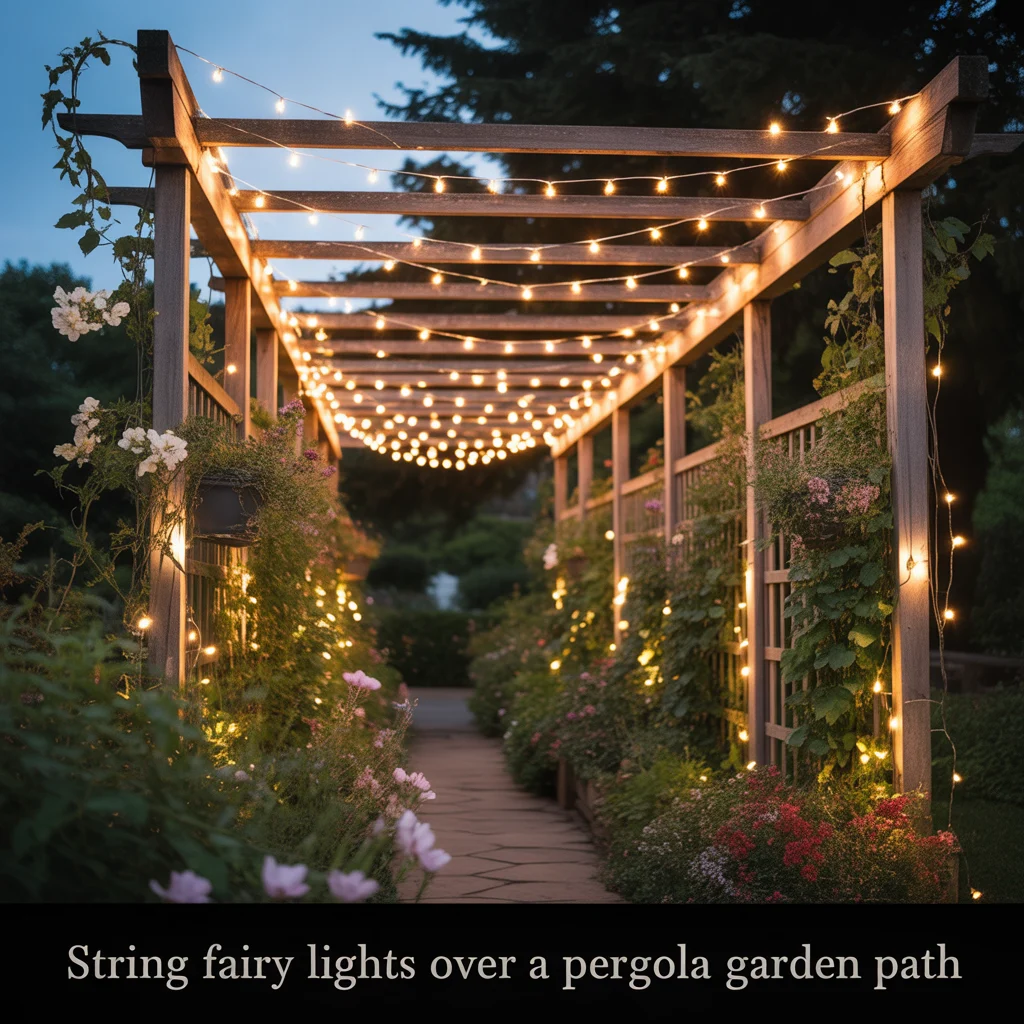
String fairy lights suspended overhead along a pergola garden path create the most atmospheric and photographically distinctive version of garden paths with lighting, producing a warm overhead canopy of small light points that transforms a timber pergola walkway into a usable outdoor living space after dark. I fitted a 40-meter run of warm white LED string fairy lights along the crossbeams of a 20-foot cedar pergola path last summer, draping the string in gentle catenary curves between each beam, and the result after dark was a path that my family used as an outdoor dining and gathering space on warm evenings from June through to September, which had never happened before the lighting was installed.
String Light Types for a Pergola Garden Path
Copper wire micro fairy lights, outdoor rubber cable string lights, and solar-powered string lights are three string light types suited to a pergola garden path. Copper wire micro fairy lights produce the most delicate and fine light point appearance and cost $15 to $40 for a 20-meter length, but require shelter from direct rain because the thin copper wire corrodes in exposed outdoor conditions over time. Outdoor rubber cable string lights use a weatherproof rubber-insulated cable rated to IP44 or IP65 and cost $25 to $80 for a 10-meter length, making them the most durable option for a permanent pergola path lighting installation. Solar-powered string lights cost $20 to $60 and require no mains wiring, but need the solar panel positioned on a surface receiving 4 or more hours of direct sunlight per day.
How to Fix String Lights to a Pergola Path
String lights on a pergola garden path are fixed to the crossbeam undersides using stainless steel screw hooks at 12-inch intervals along each beam, with the string draped between hooks in a catenary curve of 6 to 10 inches sag depth between fixing points. I fix the string at each hook with a simple loop of the cable rather than knotting it, which allows the string position to be adjusted easily when bulbs need replacing or when the catenary depth needs correcting after the cable stretches slightly in warm weather. The screw hooks cost $8 for a pack of 50, which is sufficient for a standard 20-foot pergola path with crossbeams at 4-foot intervals.
Ground-Recessed Uplighters Along a Stone Path
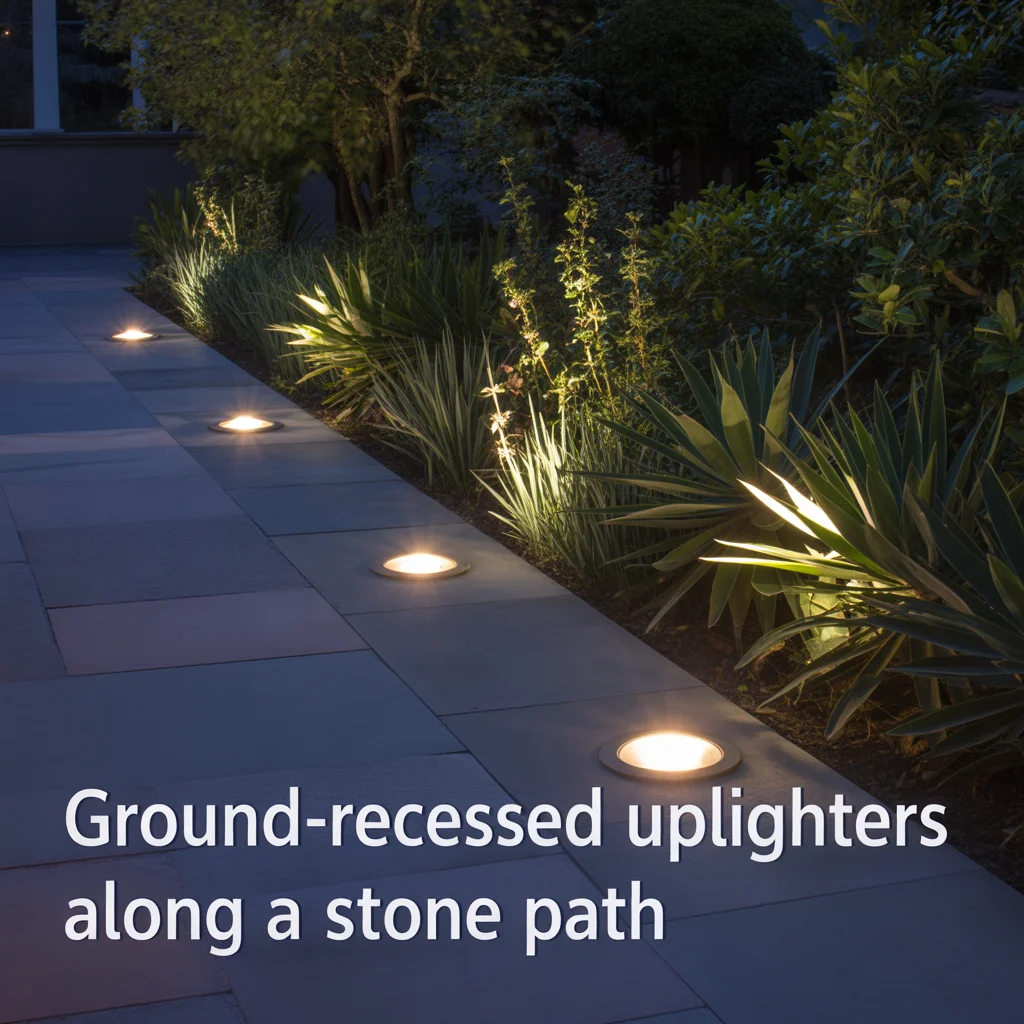
Ground-recessed uplighters set into the soil or path edging alongside a stone garden path direct light upward through the adjacent planting and onto the path surface from below, producing a dramatic low-angle illumination effect that highlights plant stems, leaf textures, and the surface texture of the stone path simultaneously. I installed four ground-recessed LED uplighters at 5-foot intervals alongside a York stone path edged with ornamental grasses, and the upward light through the Miscanthus sinensis clumps at night produced a silhouette effect on the garden wall behind that made the path border planting look completely different from its daytime appearance.
Ground-Recessed Uplighter Installation for a Garden Path
Ground-recessed uplighters for a garden path require an excavated housing pocket of the correct diameter for the chosen fitting, typically 100 to 120mm, dug to a depth of 150mm, with armored 12-volt or 240-volt cable run in a cable conduit beneath the path or path edging to a weatherproof transformer or junction box. I install all mains-voltage ground-recessed uplighters using a qualified electrician for the cable run and connection, which adds $150 to $300 to the material cost of the fittings depending on the path length and cable run distance. The fittings themselves cost $25 to $80 each for a 12-volt LED version rated to IP67, which is the minimum ingress protection rating needed for a fitting set in moist garden soil.
Plants That Respond Best to Uplighting on a Garden Path
Miscanthus sinensis, Phormium tenax, and Betula pendula are three plants that respond most effectively to uplighting alongside a garden path. Miscanthus sinensis produces tall, arching grass plumes of 5 to 6 feet that create a dramatic silhouette when lit from below, with the light passing through the translucent seed heads and casting a feathered shadow pattern on walls or fences behind the path. Phormium tenax produces stiff, sword-shaped leaves of 4 to 5 feet that cast precise, architectural shadow lines when uplit, suiting a modern or formal garden path lighting design. Betula pendula, silver birch, produces a distinctive white bark surface that reflects upward light far more effectively than any other tree bark, creating a glowing column effect alongside a garden path at night.
Lantern Post Lights on a Brick Garden Path
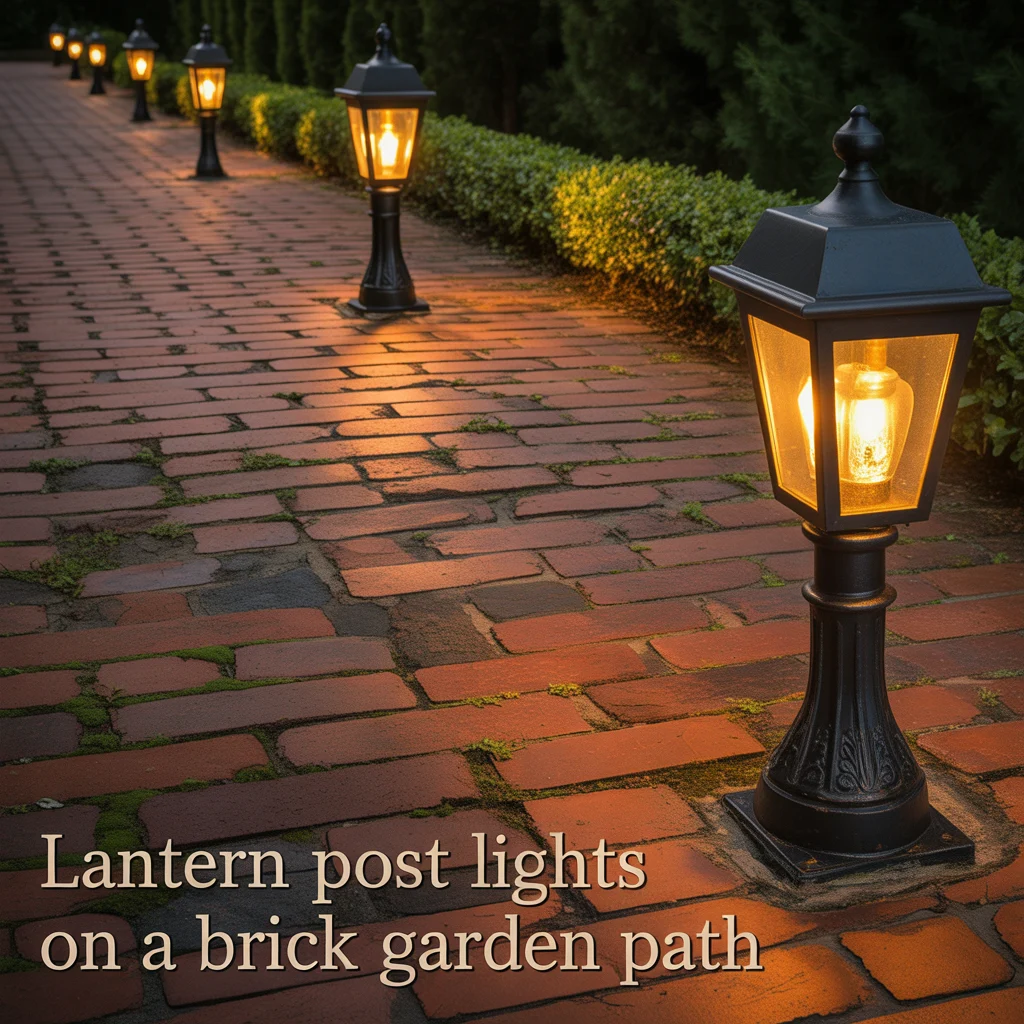
Lantern post lights on a brick garden path use traditional-style freestanding post-mounted lanterns to create a warm, period-appropriate lighting scheme that suits cottage, Victorian, and traditional garden path designs where contemporary bollard or recessed lighting would look out of place. I helped install a pair of black cast-iron lantern post lights at the entrance to a 25-foot brick path at a Victorian terrace property, and the warm yellow-toned light from the 2700K LED bulbs inside the lantern housings produced an entrance that looked entirely consistent with the period character of the property from the street. Each lantern post cost $85 and required a mains cable connection by an electrician.
Lantern Post Heights for a Brick Garden Path
Lantern post lights for a brick garden path are most effective at heights of 1200mm to 1800mm, which positions the light source high enough to spread illumination across a reasonable width of path surface while keeping the lantern at a visually comfortable scale relative to the garden boundary and planting around it. Posts taller than 1800mm start to look like street lighting in a domestic garden setting and suit only very large or formal garden path entrances. I use 1200mm lantern posts on standard residential brick paths and find the height produces a light spread of approximately 8 feet in diameter on the path surface from a 4-watt LED bulb at 400 lumens.
Lantern Housing Styles for a Traditional Garden Path
Black cast-iron lanterns, antique brass lanterns, and painted steel coach lanterns are three housing styles suited to a traditional brick garden path with lighting. Black cast-iron lanterns are the most widely used style on traditional brick paths because the dark metal complements the warm red-orange of the brick and suits both Victorian and cottage garden aesthetics. Antique brass lanterns produce a warmer, more decorative appearance and suit a formal traditional garden path where the lantern is visible from the house and intended to be a noticeable decorative feature. Painted steel coach lanterns in black or dark green are a less expensive alternative at $45 to $90 per unit and suit a brick path where the budget does not extend to cast-iron fittings.
LED Strip Lighting Beneath Path Edging
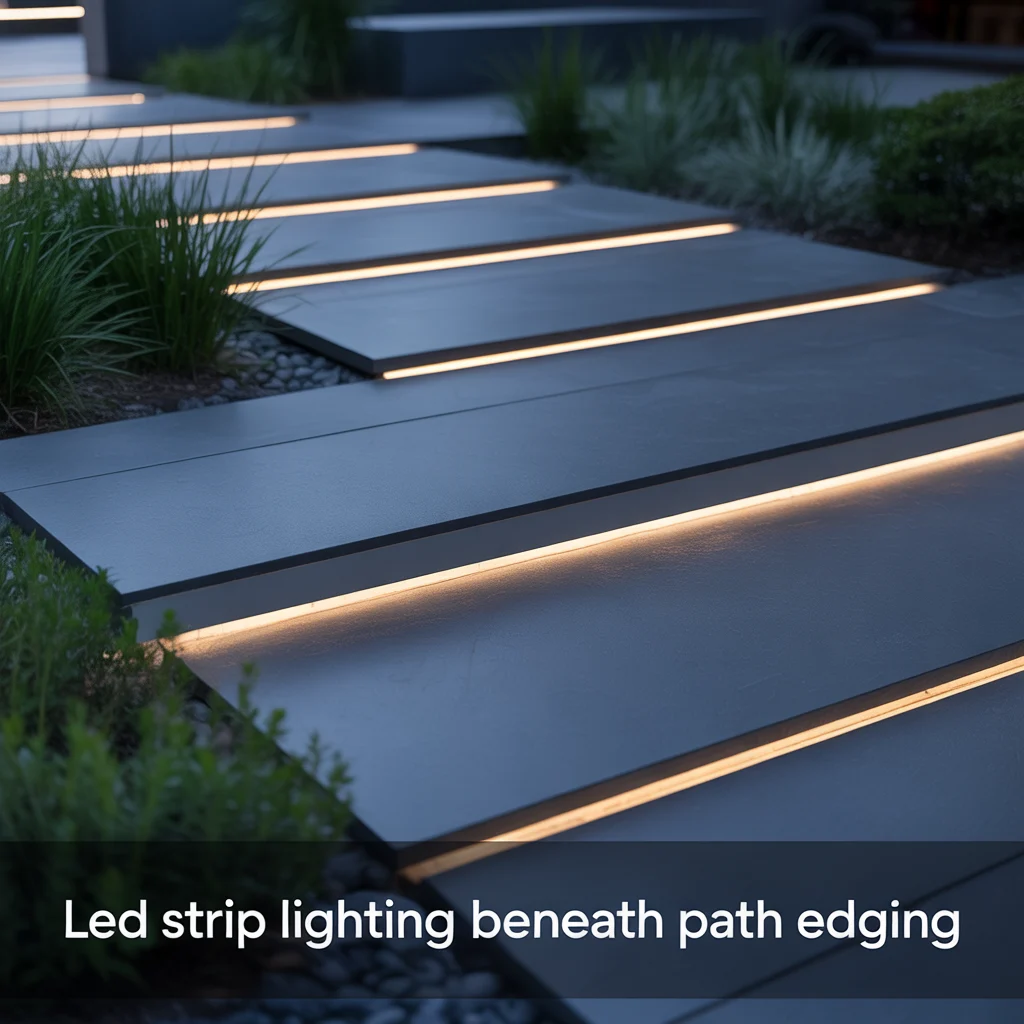
LED strip lighting fixed beneath the overhang of raised path edging or along the inner face of path retaining boards produces a soft, diffused band of light at path surface level that illuminates the walkway from a hidden source, creating a floating path effect where the light appears to come from the path surface itself rather than from a visible fixture. I tested this technique on a raised timber-edged path by fixing a 12-volt LED strip to the inner face of the timber edging board, 20mm above the path surface, and the resulting band of warm white light along the full path length produced an effect that looked far more expensive than the $35 LED strip cost suggested.
LED Strip Specifications for a Garden Path
A 12-volt LED strip for a garden path requires an IP65 or IP67 waterproof rating, a minimum output of 400 lumens per meter for effective path illumination, and a warm white color temperature of 2700K to 3000K for an atmospheric result. LED strips below IP65 rating are not suitable for outdoor path use because moisture penetration causes the strip to fail within one to two seasons in typical outdoor conditions. I use IP67 rated LED strips on all outdoor path installations and find they survive direct water exposure during rain without any degradation in light output or electrical performance after three years of continuous seasonal use.
Power Supplies for LED Strip Path Lighting
A 12-volt transformer, a mains socket with a weatherproof outdoor adapter, and a solar-powered LED strip driver are three power supply options for LED strip lighting on a garden path. A 12-volt transformer installed in a weatherproof enclosure within 10 meters of the strip provides the most stable power supply and suits a permanent LED strip installation on a garden path with mains power available nearby. A mains socket with a weatherproof outdoor adapter costs $25 to $45 to install and allows the LED strip to be plugged in directly without a separate transformer, suiting a temporary or seasonal path lighting installation. A solar-powered LED strip driver works with strips up to 5 meters in length on paths receiving direct sunlight on the solar panel for 4 or more hours per day.
Garden Path Lighting With Smart Controls
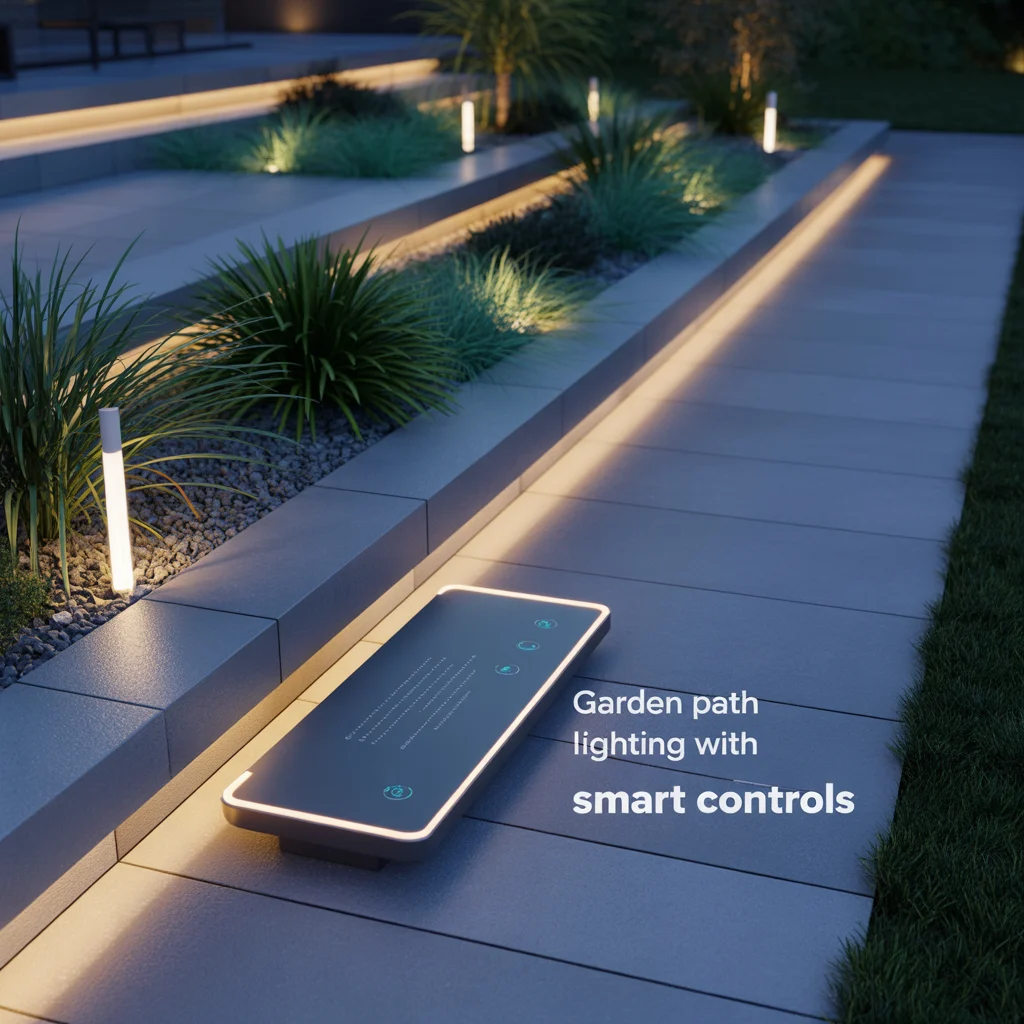
Garden path lighting with smart controls uses Wi-Fi or Bluetooth connected outdoor light fittings operated through a smartphone app or a voice assistant to allow the homeowner to adjust the path lighting schedule, brightness, and color temperature remotely without visiting the garden. I installed a smart outdoor lighting system on my front garden path two years ago using four smart Wi-Fi connected LED spike lights connected to a weatherproof outdoor smart plug, and the ability to set the lighting to turn on automatically at sunset and off at 11pm, without any manual intervention, was the single most practically useful feature of the entire installation.
Smart Lighting Systems Compatible With Garden Paths
Philips Hue Outdoor, Ring Smart Lighting, and Lutron Caséta Outdoor are three smart lighting systems compatible with garden path installations. Philips Hue Outdoor produces a full range of path-compatible fittings including spike lights, bollards, and ground recessed uplighters that connect to the Philips Hue Bridge and allow color temperature adjustment between 2200K and 6500K through the Hue app. Ring Smart Lighting produces solar-powered smart path lights that connect to the Ring network and integrate with Ring security cameras, allowing path lighting to activate automatically when motion is detected on the path. Lutron Caséta Outdoor produces a wired smart dimming system that suits a permanent mains-powered garden path lighting installation where dimming control is required.
Smart Lighting Features Most Useful for a Garden Path
Sunset automation, motion activation, and dimming schedules are three smart lighting features that provide the most practical benefit on a garden path. Sunset automation turns path lighting on automatically at the correct local sunset time each day without requiring any manual adjustment as the seasons change, which I find eliminates the most common problem with manual path lighting timers, which require resetting every two weeks during spring and autumn as the sunset time shifts significantly. Motion activation suits a garden path used infrequently during evening hours, where keeping the lights on all night produces unnecessary energy consumption and reduces LED bulb lifespan without providing any additional practical benefit.
Copper Lantern Stake Lights on a Cottage Path
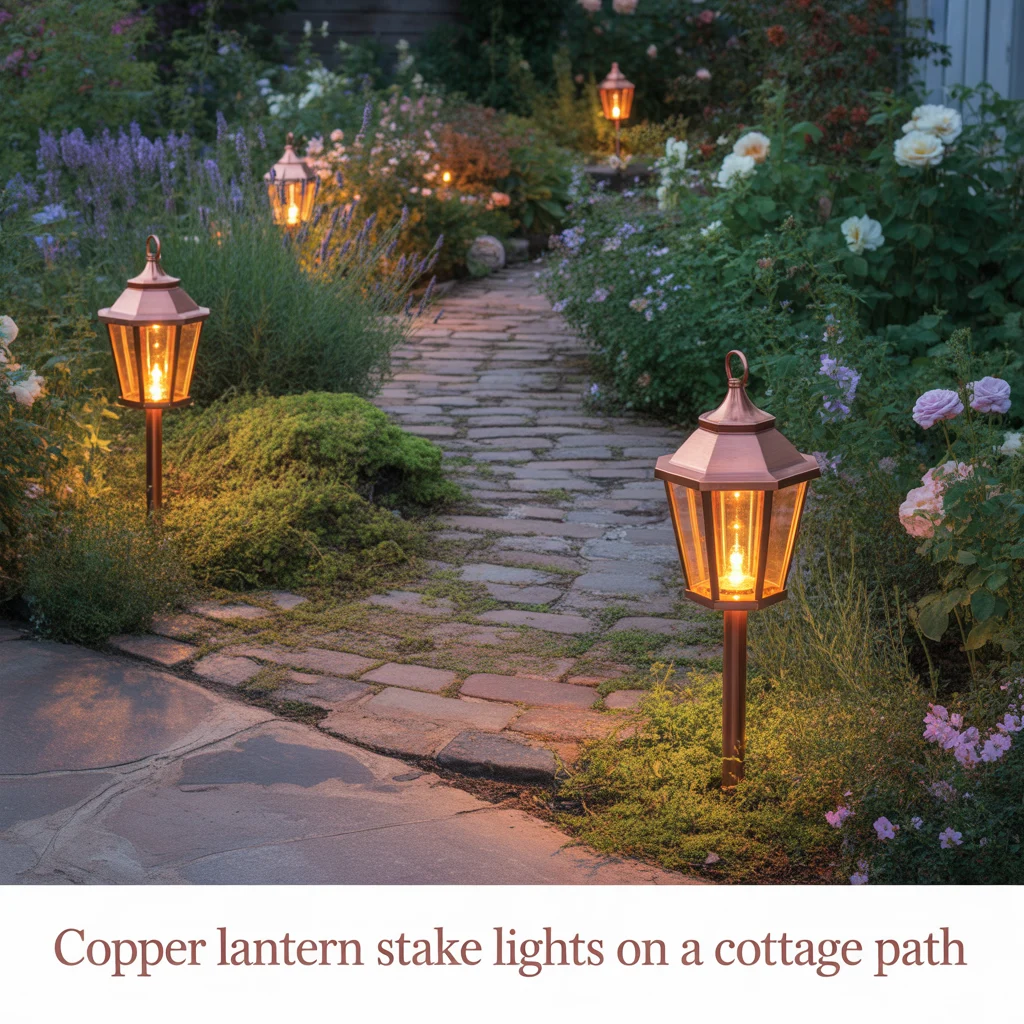
Copper lantern stake lights on a cottage garden path use decorative stake-mounted lantern housings with a warm filament-effect LED bulb to create a traditional, handcrafted lighting appearance on an informal garden path through a cottage-style planting scheme. I fitted eight copper stake lanterns along a 20-foot winding gravel path through a cottage border planting of lavender, salvia, and geranium, and the warm amber light from the filament-effect bulbs at dusk produced an appearance that suited the relaxed, informal character of the cottage path far better than a more technically precise LED lighting solution would have done. The eight lanterns cost $65 as a set.
Filament LED Bulbs for Outdoor Lantern Stake Lights
Filament LED bulbs, also called Edison bulbs, produce a warm amber glow at 2200K to 2400K by using a visible LED filament arranged to resemble the glowing wire of a traditional incandescent bulb, providing the aesthetic appearance of an old-style lantern while consuming only 2 to 4 watts of power. I replaced the standard LED bulbs in my copper stake lanterns with filament LED equivalents costing $4 each and found the color temperature change from 3000K to 2200K significantly improved the visual warmth of the path lighting, making the cottage planting on both sides of the path look more naturally lit than the cooler standard LED produced.
Maintaining Copper Stake Lanterns on a Garden Path
Copper stake lanterns on a garden path develop a natural verdigris patina within 12 to 24 months of outdoor exposure as the copper surface oxidizes, changing color from bright orange-brown to a muted green-grey. The patina is a natural surface development that protects the copper from further corrosion and suits a cottage garden path where the aged appearance of the lanterns coordinates with the informal character of the surrounding planting. I clean the glass panels of my copper stake lanterns with a damp cloth twice a year in spring and autumn to remove algae growth that accumulates on the glass surface and reduces the light output of the bulb inside, which takes approximately 5 minutes per lantern.
Garden Path With Motion-Sensor Security Lighting
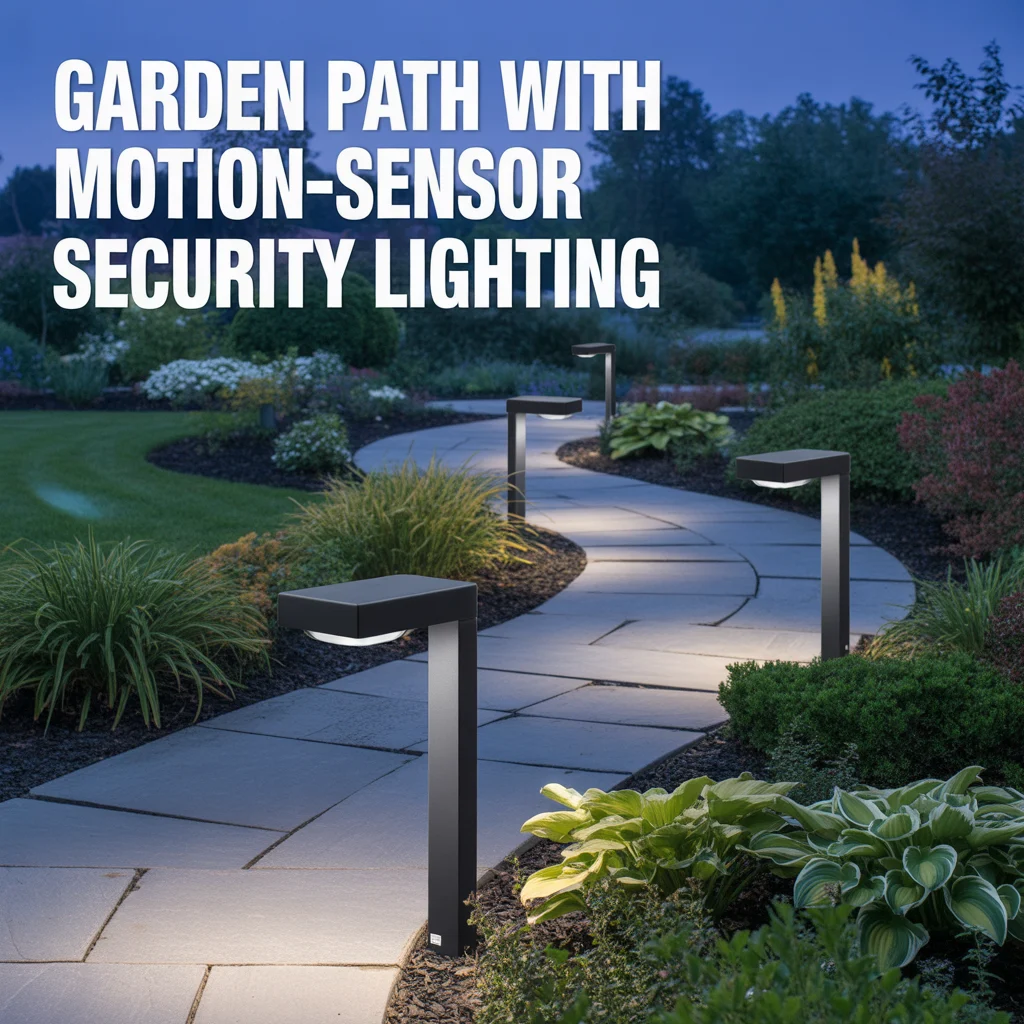
A garden path with motion-sensor security lighting uses PIR-triggered outdoor light fittings positioned to illuminate the path when movement is detected, providing both a practical safety function for path users arriving after dark and a security deterrent for unwanted access to the property. I installed two 10-watt LED PIR floodlights covering a 15-foot side path between my house and the back garden boundary after the path became unusable safely after dark in winter, and the motion-triggered lights activated reliably every time I used the path while never producing false triggers from the surrounding planting movement in normal wind conditions after I adjusted the PIR sensitivity setting to medium.
PIR Sensor Settings for a Garden Path
A PIR sensor for a garden path security light requires three settings to be adjusted correctly for reliable, accurate operation: detection range, detection angle, and sensitivity level. Detection range should be set to cover the full length of the path approach plus 3 feet beyond the path entrance, typically 6 to 10 meters for a standard garden path. Detection angle should be set to the narrowest beam width that covers the full path width, typically 90 to 120 degrees, to prevent the sensor from triggering on movement in adjacent areas outside the path. Sensitivity should be set to medium on a path surrounded by planting, because the high sensitivity setting triggers on plant movement in winds above 15mph, producing frequent false activations that make the security function less reliable.
LED Floodlight Wattages for a Path Security Light
A 10-watt LED floodlight, a 20-watt LED floodlight, and a 50-watt LED floodlight are three wattage options suited to different garden path security lighting requirements. A 10-watt LED floodlight produces approximately 800 to 1000 lumens, which is sufficient to illuminate a path of up to 20 feet in length clearly enough for safe walking and to deter casual intruders. A 20-watt LED floodlight produces 1600 to 2000 lumens and suits a longer path of 20 to 40 feet or a path in a garden with high surrounding wall or hedge shadows that absorb a significant proportion of the light output. A 50-watt floodlight produces 4000 to 5000 lumens and suits a commercial or large estate path where a wide area of ground needs illuminating from a single fixture position.
Pathway Lights With Adjustable Heads on a Modern Path
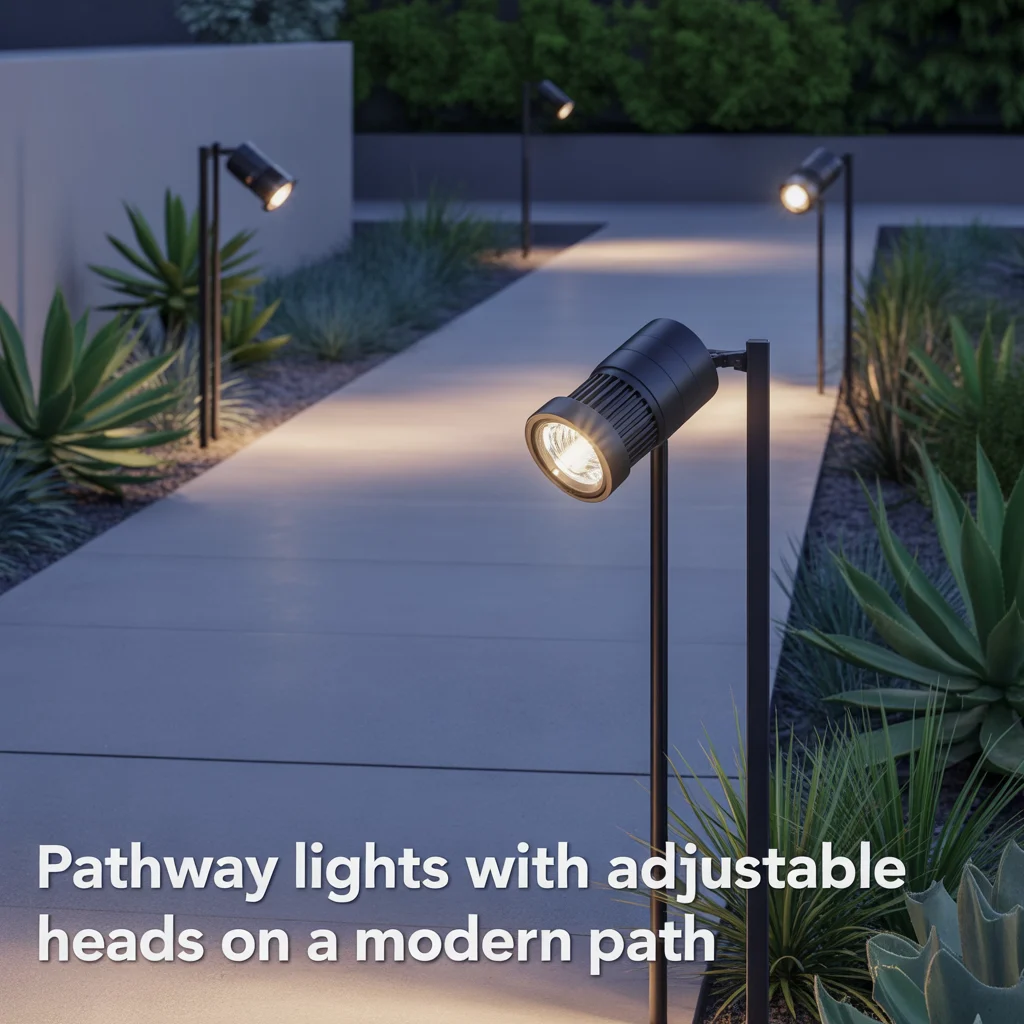
Pathway lights with adjustable heads use a spike-mounted fixture with a rotatable light head that can be angled to direct the beam precisely onto the path surface, adjacent planting, or architectural features alongside the path, allowing a single fixture type to perform multiple lighting functions depending on its head angle setting. I fitted six adjustable-head spike lights along a 24-foot porcelain slab path and directed two of the heads upward into the adjacent Phormium planting, two downward onto the path surface, and two at 45 degrees onto the rendered garden wall beside the path. The three different beam directions from a single fixture type produced a varied, layered lighting effect that looked like a professionally designed lighting scheme.
Adjustable Head Spike Light Beam Angles
Adjustable spike light heads rotate through 180 degrees on a pivot joint, allowing beam angles from directly upward at 90 degrees through horizontal at 0 degrees to directly downward at minus 90 degrees. In practice, the most useful angle settings for a garden path are 20 to 30 degrees downward for path surface illumination, 45 to 60 degrees upward for planting uplighting, and 70 to 80 degrees upward for wall washing alongside the path. I set the path surface lights at 25 degrees downward on my modern path installation and found this angle produced a clean oval light pool on the porcelain surface of approximately 3 feet in diameter from a fixture height of 400mm, which was sufficient coverage for the 4-foot-wide path from a single row of fixtures.
Adjustable Spike Light Products for a Modern Garden Path
12-volt low-voltage spike lights, solar adjustable spike lights, and mains 240-volt outdoor spike spotlights are three product types available in adjustable-head format for a modern garden path with lighting. 12-volt low-voltage spike lights cost $25 to $60 per unit and require a weatherproof 12-volt transformer, providing the most consistent and controllable light output of the three options. Solar adjustable spike lights cost $15 to $45 per unit and require no wiring, suiting a modern path where trench-laying a cable is not practical. Mains 240-volt outdoor spike spotlights cost $30 to $80 per unit and provide the highest individual light output, suiting a path where a small number of high-output fittings is preferable to a larger number of lower-output 12-volt units.
Garden Path With Colour-Changing RGB Lighting
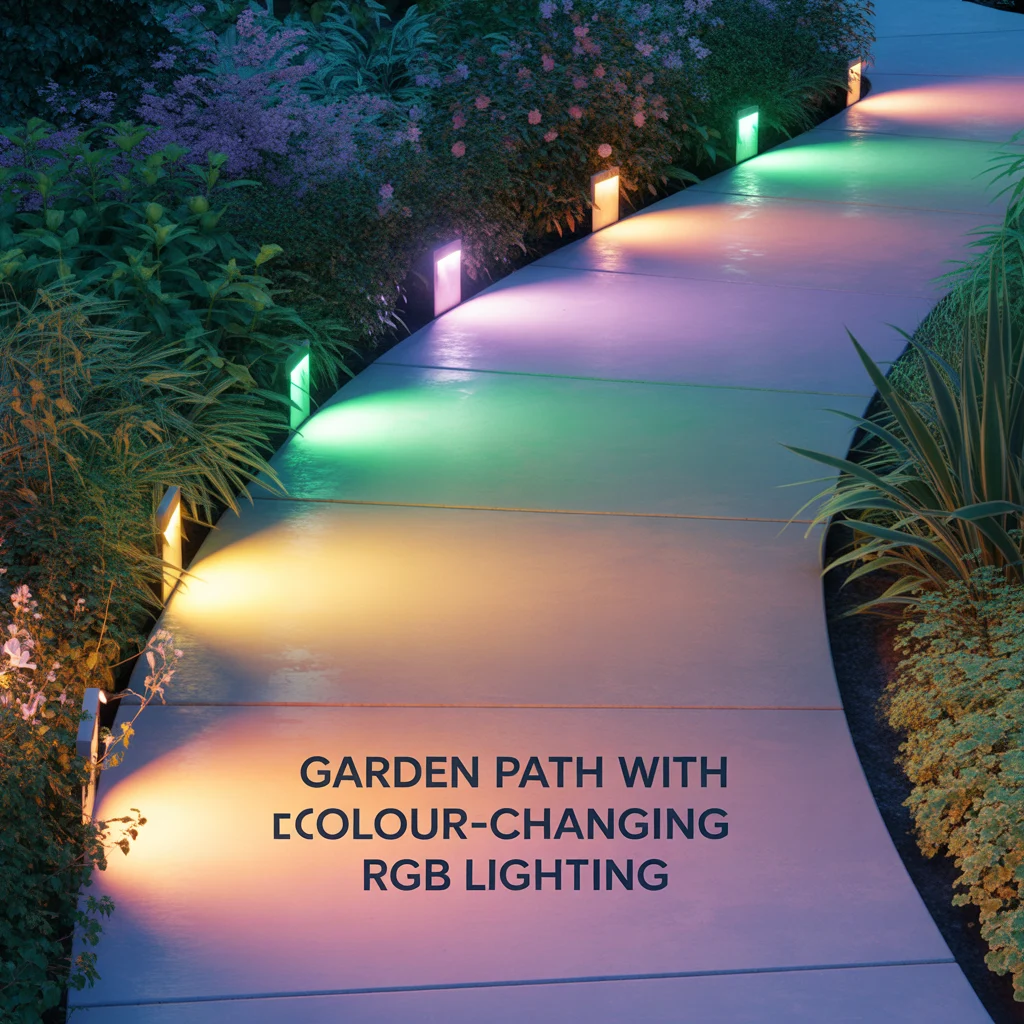
A garden path with colour-changing RGB LED lighting uses fittings containing red, green, and blue LED elements that combine to produce any colour in the visible spectrum, allowing the path lighting to change colour according to the season, occasion, or personal preference of the homeowner. I installed RGB LED spike lights on my back garden path for a garden party last summer and used the app control to set the path to a warm amber tone during the pre-dinner gathering and switch to a cooler white tone during the outdoor dining period later in the evening. The colour change took 3 seconds through the app and produced a noticeably different atmosphere on the path and in the surrounding garden.
RGB vs Tunable White Lighting for a Garden Path
RGB lighting and tunable white lighting are two colour-adjustable technologies used in garden path lighting, and they suit different homeowner requirements. RGB lighting produces any colour including red, green, blue, purple, and amber by mixing the three primary LED colours, which suits a garden path where coloured festive or event lighting is a regular requirement. Tunable white lighting adjusts only between warm white at 2700K and cool white at 6500K without producing non-white colours, which suits a garden path where the homeowner wants to adjust the atmosphere between warm evening lighting and bright task lighting without requiring coloured light at any point. I find tunable white more practical for everyday path use and RGB more suited to gardens used regularly for outdoor entertaining.
Smart App Control for RGB Garden Path Lighting
A dedicated smartphone app, Amazon Alexa voice control, and a physical remote control are three control methods for RGB LED garden path lighting systems. A smartphone app provides the most complete control, allowing individual colour selection from a full colour wheel, brightness adjustment from 1 to 100%, and automated schedule programming from a single interface. Amazon Alexa voice control suits a homeowner who has an existing Alexa ecosystem in the home and wants to control the garden path lighting using the same voice commands used for indoor lighting. A physical remote control costs no additional setup and suits a homeowner who prefers a simple, single-device control method without requiring a smartphone or smart home integration.
Winding Garden Path With Integrated Paver Lighting
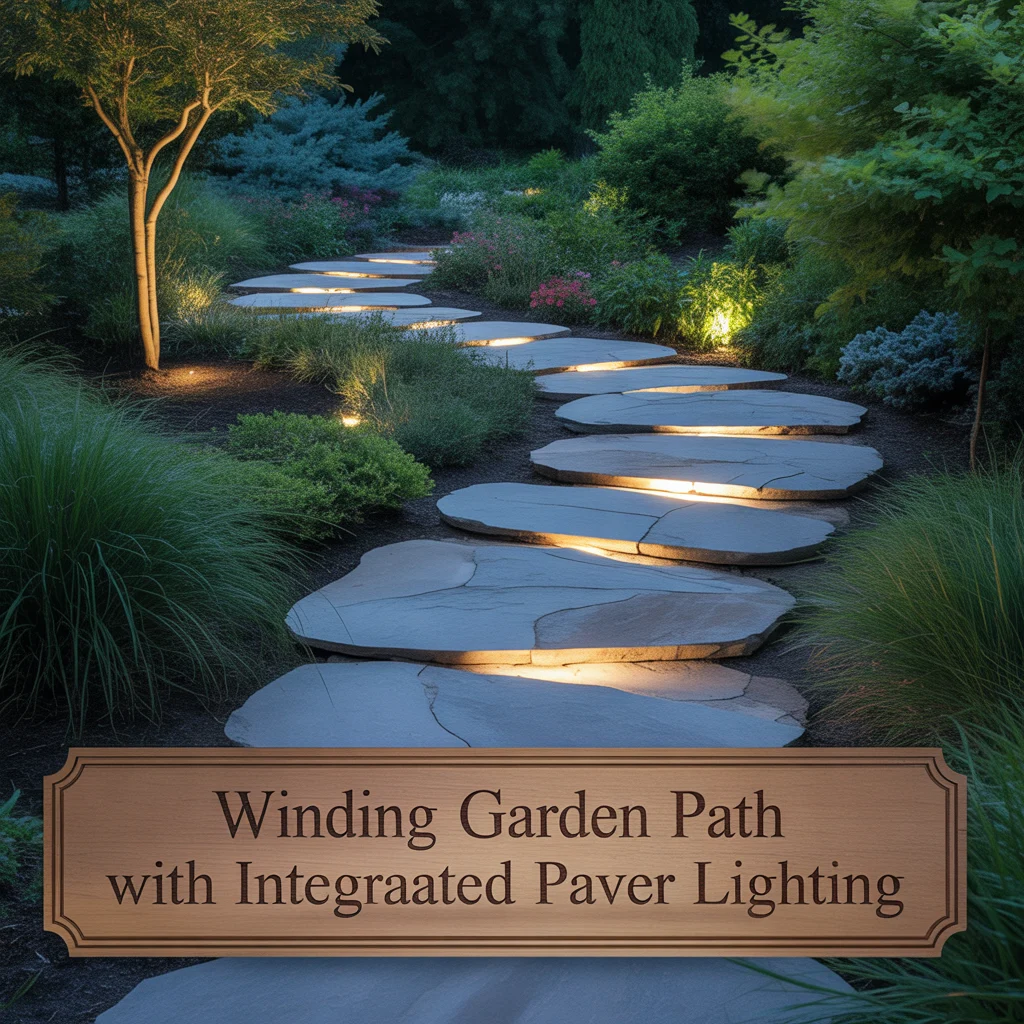
A winding garden path with integrated paver lighting uses LED light fittings set flush into individual paving stones along the path route to produce illumination that appears to come directly from the path surface itself, creating a glowing ribbon of light that follows every curve of a winding path layout after dark. I saw this design installed on a winding sandstone path at a show garden where alternating pairs of path pavers contained flush LED inserts rated to IP68, and the result at dusk was a curving line of soft warm light following the exact route of the path through the surrounding planting, which produced a garden lighting effect I had not seen matched by any surface-mounted or stake-mounted fitting type.
Integrated Paver Light Installation Process
Integrated paver lights for a garden path are installed by cutting a recess of the correct depth and diameter into an individual paving stone using a diamond-tipped core drill, setting the LED insert into the recess with a weatherproof sealant, and running the low-voltage cable from each insert beneath the adjacent path surface to a central transformer. The core drilling requires a diamond core drill bit of 80 to 100mm diameter matched to the fitting size, and the correct drill speed to prevent cracking the stone around the recess. I watched this installation process completed by a specialist lighting contractor on a project and found the drilling stage took approximately 8 minutes per stone, making the full installation of 12 integrated paver lights on a winding path a half-day task for one experienced installer.
Paving Stone Types Best Suited to Integrated Lighting
Porcelain pavers, natural granite, and dense concrete pavers are three paving stone types suited to integrated LED insert lighting on a garden path. Porcelain pavers drill cleanly with a diamond core bit because the material is dense and uniform without the natural grain variations that cause cracking in some stone types. Natural granite is the hardest and most drill-resistant option but produces the cleanest recess edge and the most durable housing for a recessed paver light fitting. Dense concrete pavers are the most affordable option and drill easily, though the softer material produces a slightly less precise recess edge than porcelain or granite. Sandstone and limestone are not recommended for integrated paver lighting because the softer stone material cracks around the recess during drilling in a significant proportion of attempts.
Japanese Garden Path With Lantern Post Lighting
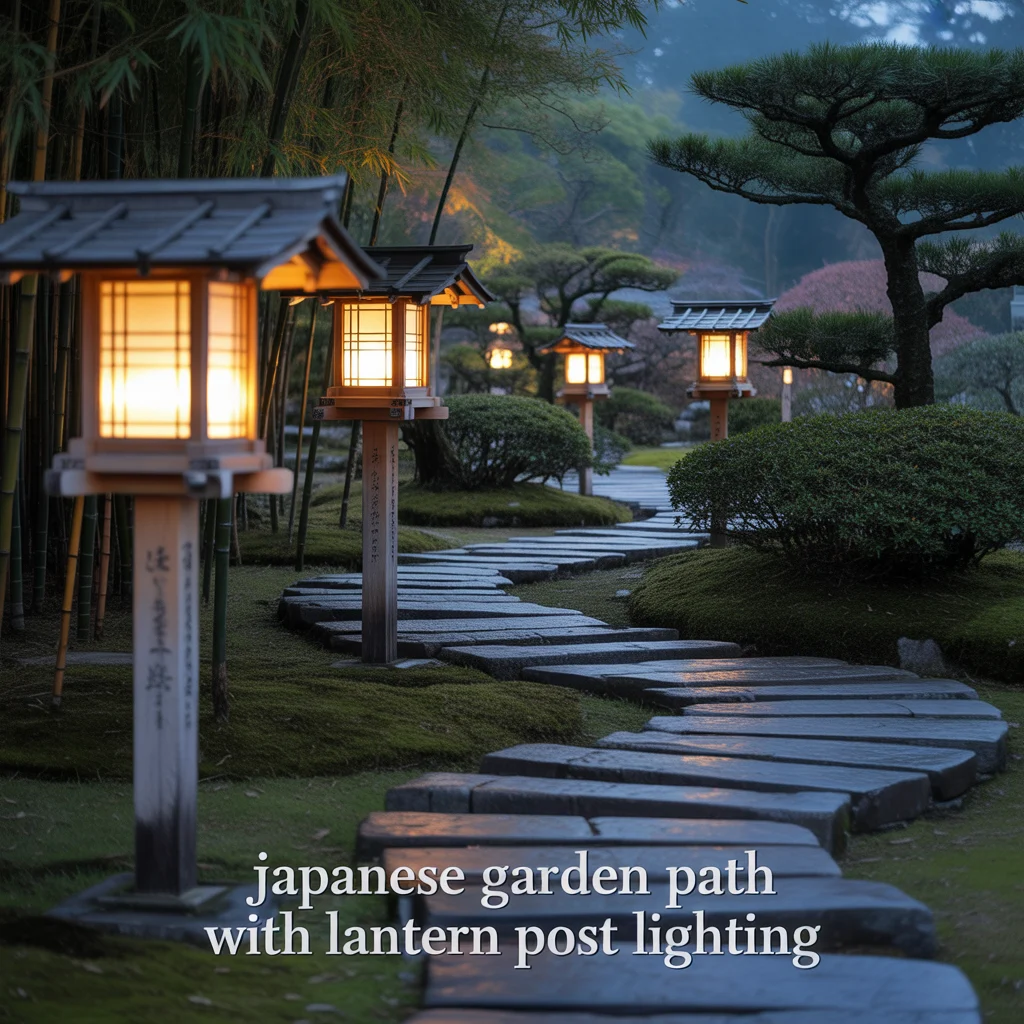
A Japanese garden path with traditional stone lantern post lighting uses granite or reconstituted stone lanterns placed at the path edge to create a period-appropriate lighting feature in a Japanese-inspired garden design. Stone lanterns in the Japanese toro style have been used to light garden paths since the 16th century, and modern versions fitted with internal LED light sources provide the authentic visual appearance of a traditional stone lantern with the practical convenience of a controlled, consistent light output. I placed two reconstituted stone toro lanterns at the entrance to a gravel and stepping stone Japanese-inspired path and the combination of the stone lantern form and the warm LED light inside suited the garden style completely.
Japanese Stone Lantern Types for a Garden Path
Yukimi lanterns, Kasuga lanterns, and Oribe lanterns are three traditional Japanese stone lantern types suited to a garden path with lighting. The Yukimi lantern, also called a snow-viewing lantern, has a wide, low profile cap and three short legs that place the light source close to the ground, suiting a low path position where the lantern sits at the path edge beside stepping stones. The Kasuga lantern is a taller, post-mounted form standing 24 to 36 inches in height that suits the edge of a formal Japanese garden path where a more upright lantern silhouette is appropriate. The Oribe lantern is a slender post-mounted form with a distinctive cross-shaped window and stands 30 to 48 inches tall, suiting a path entrance or path transition point in a Japanese garden.
LED Conversion Kits for Stone Garden Lanterns
Reconstituted stone and genuine granite Japanese garden lanterns are available with pre-installed LED light sources from specialist suppliers, or existing stone lanterns without electrical fittings can be converted using an LED candle insert powered by a rechargeable battery or a low-voltage cable concealed within the lantern post. Battery-powered LED candle inserts for stone lanterns cost $8 to $20 and provide 8 to 12 hours of continuous light from a single charge, suiting a path lantern used for regular evening lighting. Low-voltage cable-powered LED inserts require a small hole drilled in the lantern base for the cable entry and provide continuous, timer-controlled light output independent of battery condition, suiting a permanently installed path lantern. Anyone planning a lit path feature of this kind alongside a broader outdoor design will find a wide range of practical and decorative approaches in these backyard pathway ideas with evening lighting, which cover everything from solar spike layouts and ground-recessed uplighters to lantern-style fixtures and LED strip installations suited to different path surfaces and garden styles.
Garden Path With Festoon Lighting Between Posts
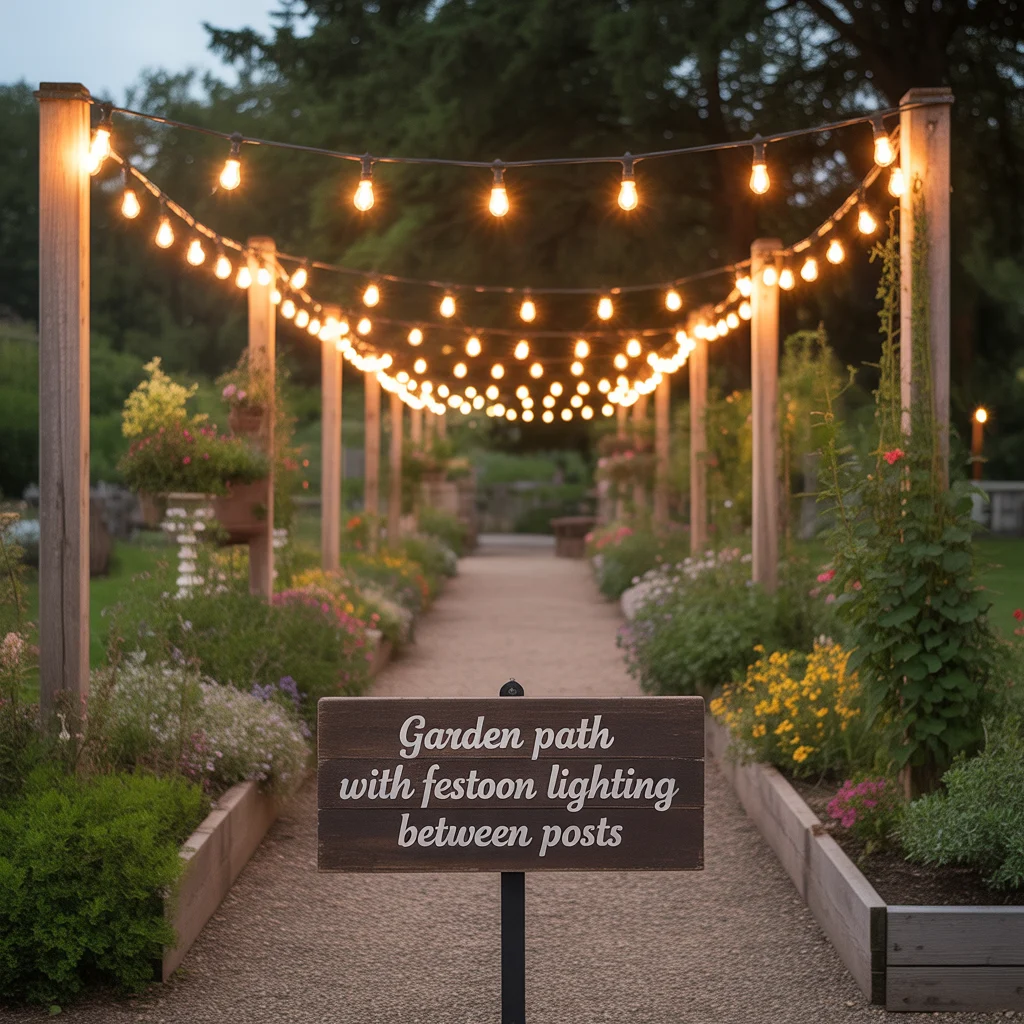
Garden path festoon lighting uses a string of larger spaced bulbs on a rubber or textile outdoor cable suspended between wooden or metal posts along the path route, creating an overhead lighting feature that suits informal entertaining spaces, kitchen garden paths, and cottage garden walkways where the visible bulb format adds a decorative overhead presence rather than simply illuminating the path below. I installed festoon lighting between six 8-foot timber posts along a 25-foot kitchen garden path using a 25-meter rubber cable festoon string with G45 globe bulbs at 50cm spacing, and the illuminated path became the primary outdoor entertaining space of the garden from June through September.
Festoon Bulb Types for an Outdoor Garden Path
G45 globe bulbs, ST64 Edison bulbs, and G95 large globe bulbs are three festoon bulb formats suited to an outdoor garden path lighting installation. G45 globe bulbs at 45mm diameter are the most commonly used format and produce a compact, evenly spaced light point that suits a path festoon string with 40 to 60cm bulb spacing. ST64 Edison bulbs produce a visible filament and an amber-toned 2200K light output that suits a cottage or kitchen garden path where a warm, traditional lighting appearance is the design intention. G95 large globe bulbs at 95mm diameter produce a larger, more dramatic light point suited to a path with fewer bulbs at wider spacing of 80 to 100cm, creating a bolder overhead lighting effect.
Post Heights and Spacing for Festoon Path Lighting
Festoon lighting posts for a garden path are set at heights of 2200 to 2800mm to provide comfortable head clearance below the cable at its lowest catenary point, which sags 200 to 400mm below the fixing height between posts. Posts set at 2400mm height with a catenary sag of 300mm produce a minimum cable clearance of 2100mm at the center of the span between posts, which is adequate for most adults to walk beneath without ducking. Post spacing of 2.4 to 3.6 meters produces a catenary curve depth of 150 to 400mm depending on the cable weight per meter, with heavier rubber cables producing more sag than lighter textile cables at the same post spacing and fixing height.
Low-Voltage Pathway Lights on a Suburban Garden Path
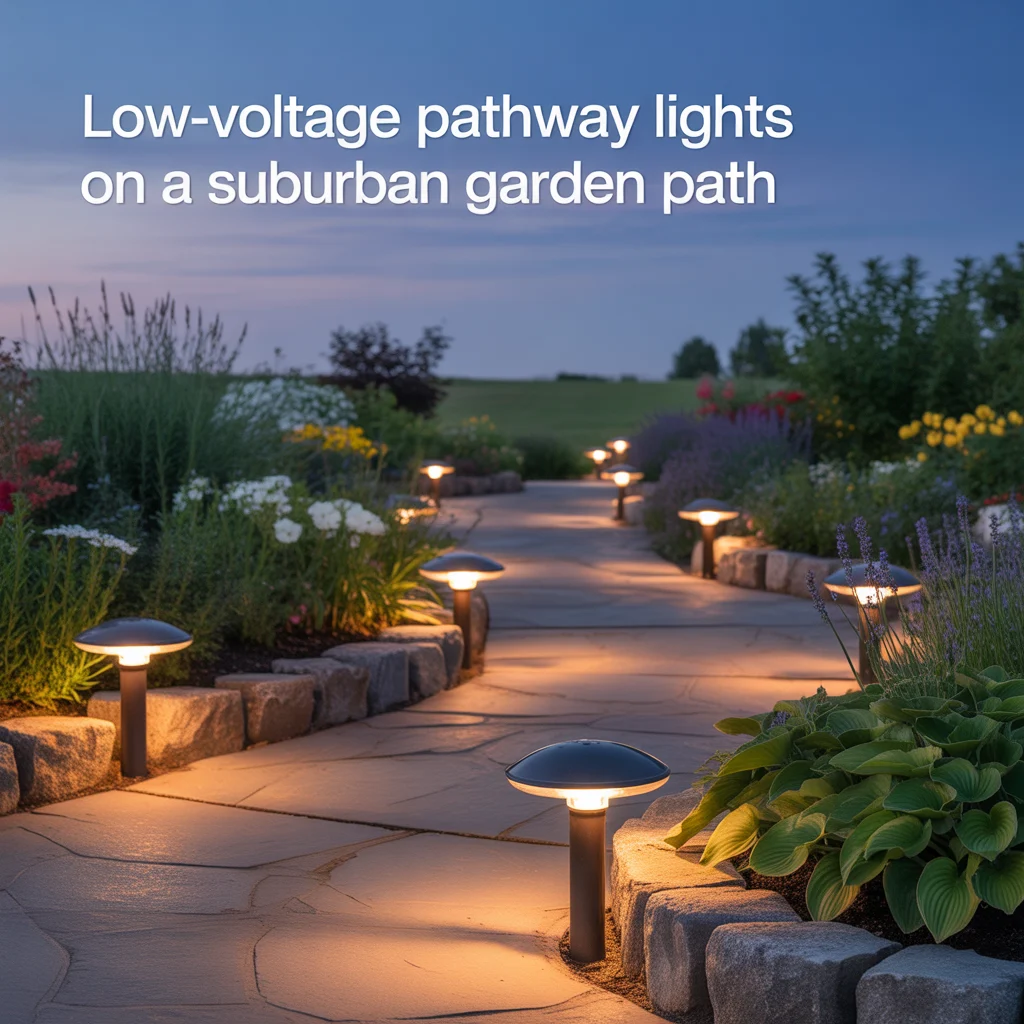
Low-voltage 12-volt pathway lights use a central transformer connected to a daisy-chain cable run to power a series of individual path light fittings from a single power source, providing a safe, energy-efficient lighting system for a suburban garden path that is significantly less expensive to install than a full mains 240-volt system while producing more reliable and consistent results than solar-only lighting. I installed an eight-light low-voltage pathway lighting system on my front garden path using a 40-watt transformer and a 10-meter cable run with individual fittings at 4-foot intervals, and the total installation cost including the transformer, cable, and eight fittings was $145 with no electrician required.
Low-Voltage Transformer Sizing for a Garden Path
A 12-volt transformer for a garden path lighting system requires a wattage capacity equal to the total combined wattage of all connected fittings plus a 20% safety margin. Eight fittings at 3 watts each total 24 watts, which requires a transformer rated at a minimum of 29 watts, making a 40-watt transformer the correct choice for an eight-light path installation. Undersizing the transformer by selecting a unit rated below the total fitting wattage causes the transformer to overheat and reduces its operational lifespan from the rated 10 to 15 years to as few as 2 to 3 years in continuous operation. I always fit a transformer with a minimum 25% headroom above the calculated total fitting wattage on all garden path lighting projects to prevent thermal stress on the unit.
Cable Burial Depth for Low-Voltage Path Lighting
Low-voltage 12-volt landscape lighting cable for a garden path requires burial at a minimum depth of 75mm below the soil surface or path sub-base to protect the cable from accidental damage during garden maintenance activities including hoeing, edging, and bulb planting. I bury all low-voltage path lighting cables in a 100mm-deep trench alongside the path edge and lay a continuous strip of yellow cable warning tape 50mm above the cable before backfilling the trench, which alerts anyone digging in that area to the presence of the cable below. The cable itself does not require conduit at 12 volts, though I fit conduit sections wherever the cable crosses a paved surface or runs beneath a path edge board for additional physical protection.
Garden Path With Uplighting on Surrounding Trees
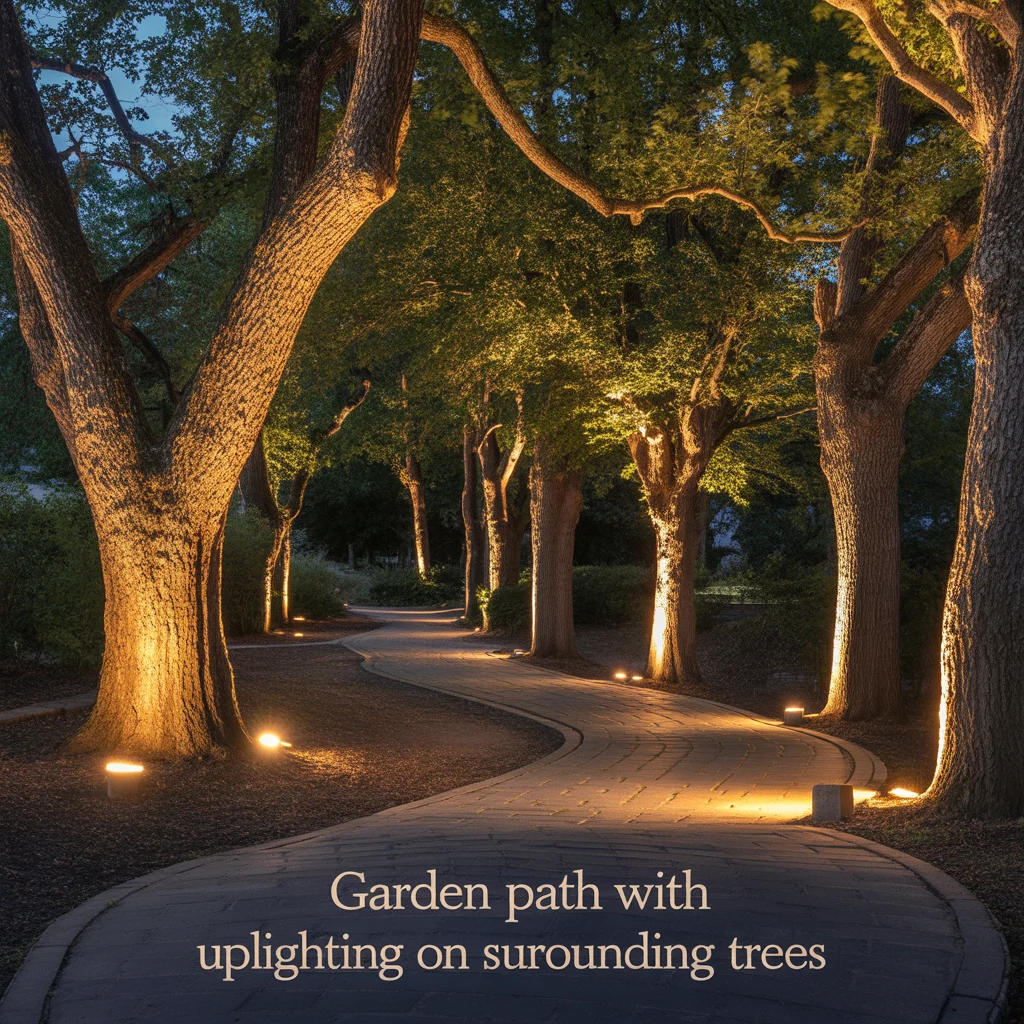
A garden path with tree uplighting places ground-recessed or surface-mounted spike spotlights at the base of trees growing alongside or adjacent to the path, directing light upward into the tree canopy to create a dramatic overhead illumination effect that makes the path appear to run through a lit woodland space rather than a dark garden. I fitted three 7-watt LED ground spike spotlights at the base of three silver birch trees growing alongside a 30-foot garden path and the upward light through the birch canopy at night produced a completely different version of the garden that I found more atmospheric than the daytime appearance. The white bark of each birch reflected the LED light across the full canopy width effectively.
Spotlight Positioning for Tree Uplighting on a Path
A ground spike spotlight for tree uplighting on a garden path is positioned at the base of the tree trunk at a distance of 300 to 600mm from the trunk center, angled upward at 60 to 75 degrees toward the main branches. Placing the spotlight too close to the trunk at less than 200mm from the base directs the light straight up the trunk without spreading into the lower branches, which produces a bright column of trunk illumination rather than the broader canopy lighting effect. I position my tree uplights at 450mm from the trunk center on all garden path tree lighting projects and find this distance produces effective lower branch illumination on trees with first branching heights of 1.5 to 3 meters.
Tree Species That Respond Best to Path Uplighting
Betula pendula, Acer palmatum, and Amelanchier lamarckii are three tree species that respond most effectively to uplighting alongside a garden path. Betula pendula produces white bark that reflects ground-level uplighting across the full trunk surface and into the canopy branches, creating the most visually dramatic tree uplighting effect available in a domestic garden setting. Acer palmatum produces finely divided leaves that glow in translucent green or red-purple when backlit by an uplighter in a path border, creating a distinctive illuminated leaf effect in summer that changes completely in autumn when the leaf color intensifies. Amelanchier lamarckii produces an open, multi-stemmed structure that allows upward light to penetrate through the full height of the tree canopy without obstruction.
Garden Path With Step Riser Lighting and Border Glow
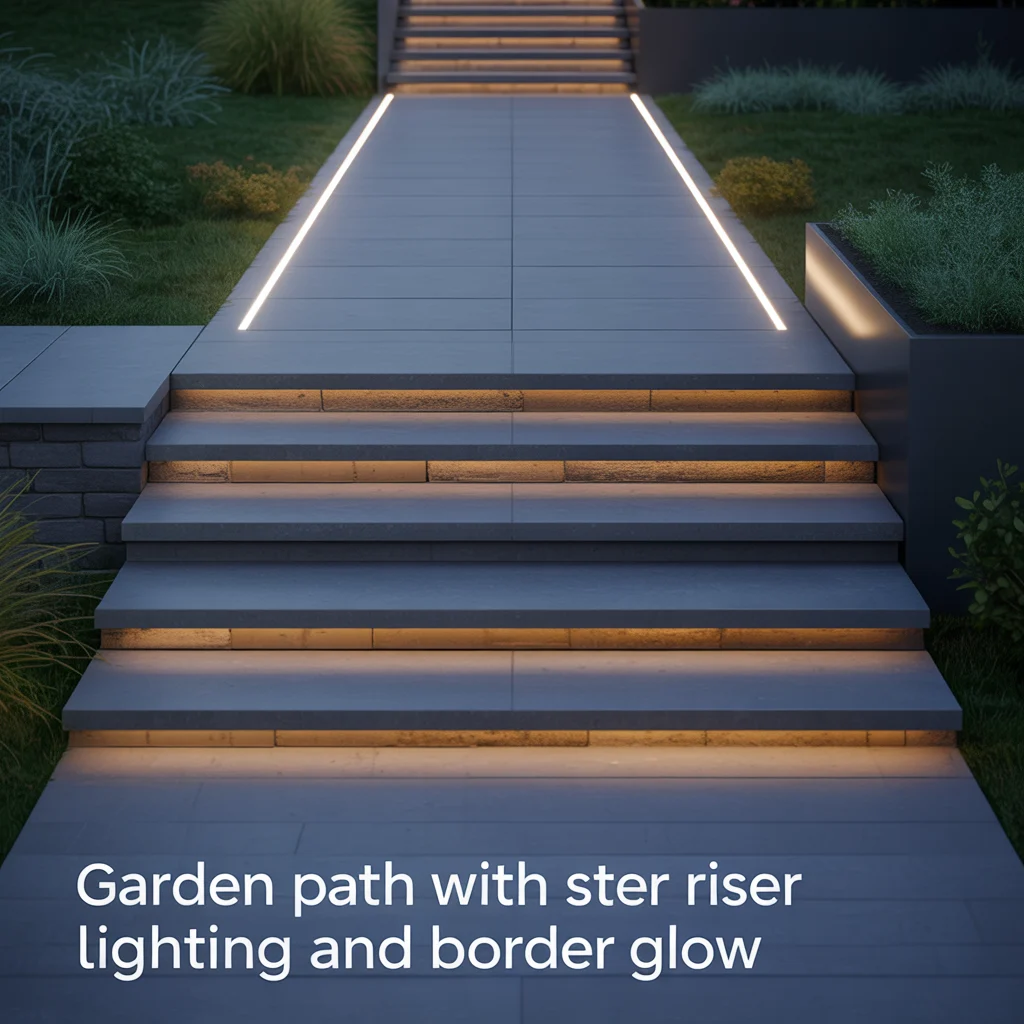
A garden path with step riser lighting combined with low border glow lighting uses two complementary lighting types simultaneously, with recessed LED inserts in the step risers providing precise horizontal light bands at the level changes and low ground-level LED border lights providing a soft ambient glow along the flat path sections between the steps. I designed and installed this combined system on a garden path at a residential project where a 35-foot path included two sets of three steps separated by 10-foot flat sections, and using both lighting types on the same path produced a more complete and professionally finished nighttime appearance than either system alone would have achieved. For anyone planning to extend a seating area into the evening hours as well, these garden paths with benches lit for nighttime use cover bench positioning alongside lit walkways, water feature bench combinations that benefit from evening illumination, and the full range of bench materials and styles suited to garden paths where both daytime comfort and after-dark atmosphere are design priorities.
Combining Two Lighting Types on a Single Garden Path
Combining step riser lights and border glow lights on a single garden path requires both systems to use the same color temperature to prevent visible mismatches between the warm light on the steps and the cool light on the flat sections. I specify 2700K warm white for both the step riser inserts and the border glow lights on all combined path lighting projects, which produces a consistent amber-toned illumination across both the vertical step faces and the horizontal path surface. Using 2700K step lights alongside 4000K border lights, which I tested on a prototype section of path, produced a jarring color shift between the step risers and the flat sections that was immediately noticeable and looked unplanned.
Border Glow Light Options for a Garden Path
Flat disc LED path lights, angled hood path lights, and mushroom-cap path lights are three border glow light formats suited to the flat sections of a garden path with combined step and border lighting. Flat disc LED path lights sit low to the ground at 80 to 120mm height and produce a wide, even downward light distribution suited to illuminating a broad path surface. Angled hood path lights at 200 to 300mm height direct a focused beam downward and forward onto the path surface and suit a narrower path where a more directed light pool is needed. Mushroom-cap path lights at 300 to 400mm height produce a 360-degree downward light distribution under a wide cap and suit a path with wide planting on both sides where edge illumination is needed rather than central path surface lighting.
Garden Path With Candlelight and Lantern Lighting
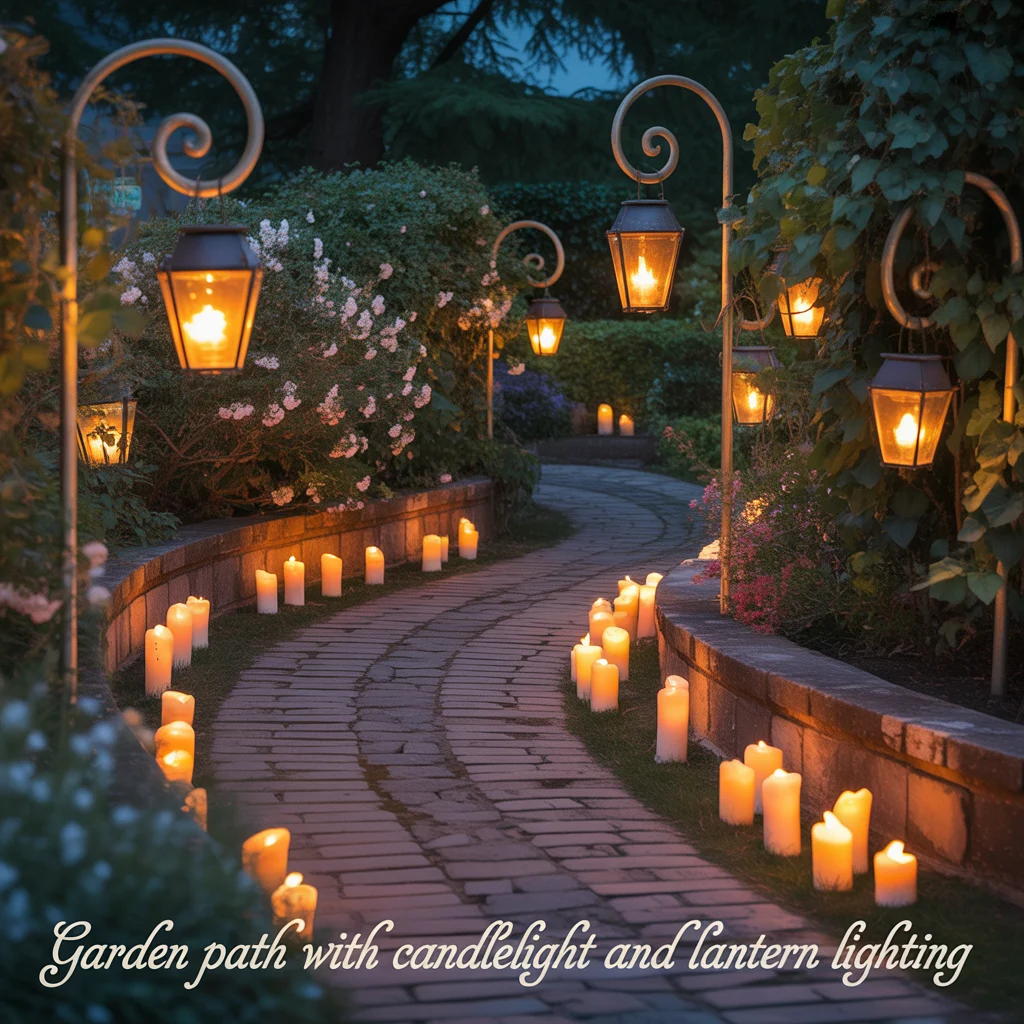
A garden path with real or LED candle lanterns placed along the path edge creates a warm, intimate lighting atmosphere suited to a garden used for outdoor dining, evening entertaining, or simply relaxing after dark in the warmer months. I used a combination of 12 hurricane glass lanterns with pillar candles at 18-inch intervals along both sides of a 16-foot paved path for an outdoor dinner party, and the candlelight on the path produced an atmospheric result that no electrical lighting system I have installed has fully replicated. The slight flicker of the candle flames, the warm 1800K color temperature, and the visible flame inside the glass lanterns created a completely different visual quality from LED lighting at the same color temperature.
Hurricane Lantern Sizes for a Garden Path
Small hurricane lanterns of 150 to 200mm height, medium lanterns of 250 to 350mm height, and large lanterns of 400 to 500mm height are three sizes suited to a garden path candlelight display. Small lanterns produce a delicate, low-level light suitable for a path used for slow evening walking rather than active navigation, and cost $8 to $20 each. Medium lanterns produce enough light to illuminate the immediate path surface on each side and cost $15 to $40 each. Large lanterns produce the most substantial candlelight effect and suit a wider path of 5 feet or more where the additional lantern height is needed to spread the candlelight across the full path width. I use medium lanterns at 300mm height on paths of 3 to 4 feet width and find the proportional relationship between lantern size and path width produces the most balanced visual result.
LED Candle Alternatives for a Permanent Path Lantern Display
Flameless LED candles with a flicker effect, rechargeable LED tea lights, and solar-powered LED lanterns are three LED alternatives to real candles in garden path lanterns. Flameless LED candles with a built-in flicker algorithm produce a convincing candle movement effect at a color temperature of 1800 to 2200K and cost $6 to $15 each, lasting 200 to 500 hours on two AA batteries. Rechargeable LED tea lights cost $3 to $8 each and charge via a USB base unit that holds 6 to 12 tea lights simultaneously, providing a convenient way to maintain a large path lantern display without replacing batteries individually. Solar-powered LED lanterns charge during the day and activate automatically at dusk, requiring no battery replacement and suiting a permanent outdoor path lantern installation.
Energy-Efficient LED Garden Path Lighting System
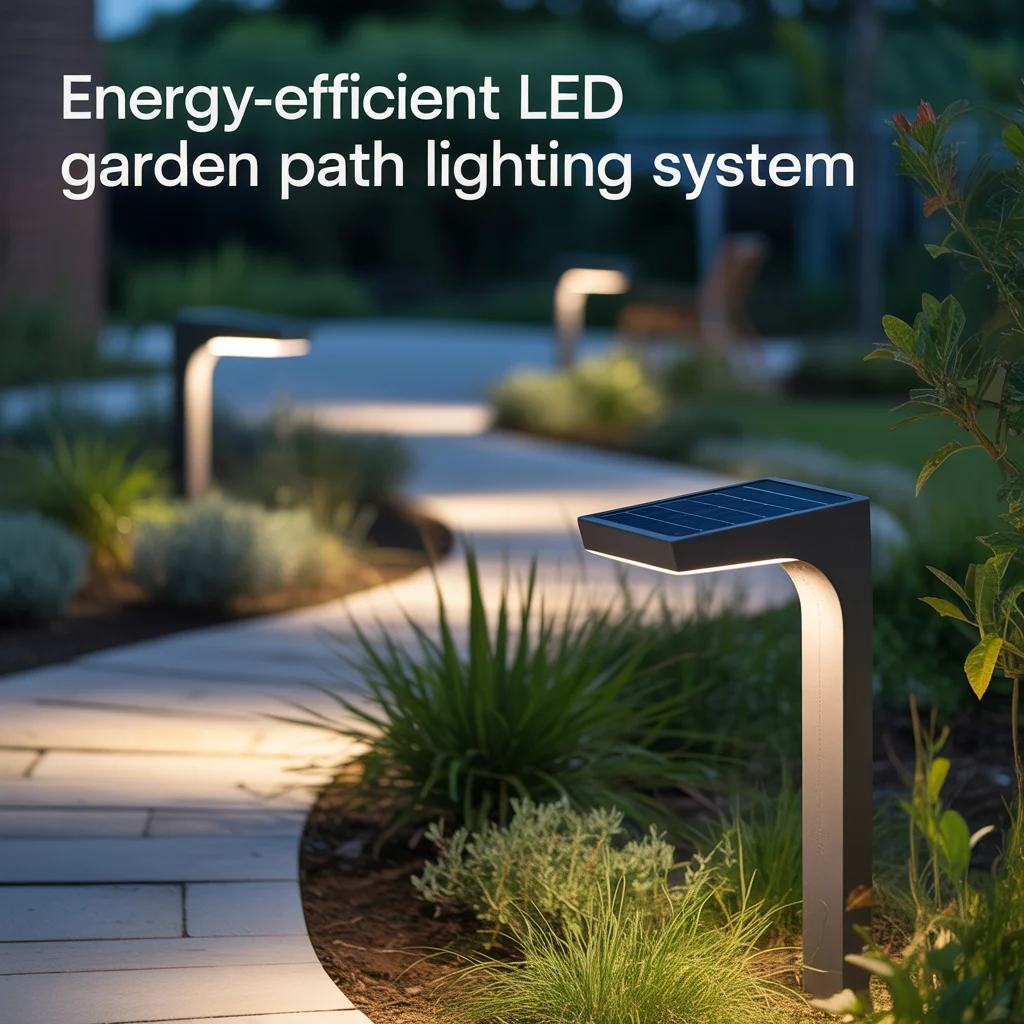
An energy-efficient LED garden path lighting system uses LED fittings throughout the path lighting installation to minimize electricity consumption while maintaining adequate illumination levels for safe and attractive path use after dark. I calculated the annual running cost of my front garden path lighting after replacing four 35-watt halogen spike lights with 3-watt LED equivalents and found the electricity cost reduced from $48 per year to $4.10 per year for the same 10 hours per day of use, representing a 91% reduction in running cost from a single path lighting upgrade that cost $32 in LED replacement fittings.
LED vs Halogen Running Costs for a Garden Path
A direct comparison between halogen and LED running costs on a garden path with lighting shows a consistent reduction in annual electricity consumption of 80 to 92% when halogen fittings are replaced with equivalent LED products. Four 35-watt halogen path lights running for 10 hours per day cost $48 per year at a UK average electricity rate of $0.34 per kWh. Four 3-watt LED path lights at the same running hours cost $4.10 per year, a saving of $43.90 per year. The LED fittings pay back their purchase cost in reduced electricity consumption within 8 to 10 months of installation at current electricity rates, after which the energy saving represents a direct annual financial benefit to the homeowner.
LED Lumen Output Requirements for a Garden Path
A garden path requires a minimum total lumen output of 100 to 200 lumens per linear meter of path length from the combined output of all fittings to produce effective illumination for safe nighttime use. A 15-foot path of 4.5 meters requires 450 to 900 lumens of total lighting output, achievable with six to eight fixtures at 100 lumens each placed at 2.5-foot intervals along the path edges. I calculate the lumen requirement for every garden path lighting project before selecting fittings and find this calculation prevents both under-lighting, where the path surface is too dark for safe navigation, and over-lighting, where excessive lumen output produces an overly bright path that loses the warm atmospheric quality that makes garden path lighting effective after dark.
best flagstone path ideas for illuminated garden walks
how to light a garden path with borders for safety
stunning stone garden path ideas for lit walkways
Frequently Asked Questions
What is the best lighting for a garden path?
Low-voltage 12-volt LED pathway lights are the best lighting for a garden path because they provide consistent, controllable illumination at a running cost of $4 to $8 per year for a standard 8 to 10 fixture installation, require no qualified electrician for the cable installation between fittings and transformer, and produce a professional result in all weather conditions throughout the year. Solar spike lights are the best option for a garden path where no mains power is available nearby and the path receives 4 or more hours of direct sunlight per day on the solar panel positions. For a step-inclusive garden path, recessed LED step riser lights provide the safest and most visually refined lighting result but require a qualified electrician for the mains cable installation.
How far apart should garden path lights be placed?
Garden path lights are placed most effectively at 3 to 4 feet apart on alternating sides of the path, which produces overlapping light pools that illuminate the full path surface without creating bright spots between dark gaps. Spacing greater than 6 feet between fixtures on the same side of the path produces visible dark sections between light pools at the typical output levels of standard solar and low-voltage path lights. Spacing less than 2 feet between fixtures produces an overly bright, clinical illumination that removes the atmospheric quality of garden path lighting. I use 3-foot alternating spacing as the standard on all garden path lighting projects and find it produces a consistent, evenly lit path surface from every fixture type I have installed.
Are solar path lights good enough for a garden path?
Transform your outdoor space after dark with 20 garden paths with lighting, featuring solar, LED, lantern, and smart lighting ideas that add beauty, safety, and ambiance.
How do I install garden path lighting without an electrician?
A 12-volt low-voltage landscape lighting system or solar spike light system installs without a qualified electrician because the 12-volt operating voltage of the fittings is below the 50-volt threshold at which UK and international wiring regulations require a qualified electrician for installation. The low-voltage transformer connects to a standard outdoor mains socket using a standard plug, and the 12-volt cable from the transformer to the individual fittings is installed by the homeowner without any electrical qualification. I installed my own 8-light low-voltage path system in 3 hours following the manufacturer’s installation guide, burying the cable at 75mm depth alongside the path edge and connecting each fitting to the cable using the supplied piercing connectors that require no wire stripping or terminal connections.
What color temperature is best for garden path lighting?
Warm white at 2700K is the best color temperature for garden path lighting because it produces an amber-toned light that suits all garden path materials including brick, stone, timber, and gravel, creates a welcoming atmospheric effect after dark, and coordinates with the appearance of candlelight and traditional lantern lighting that homeowners associate with an attractive garden environment. Neutral white at 4000K suits a contemporary or modern garden path where a cleaner, crisper light output is the design intention, but produces a less atmospheric result than warm white in a garden setting. Cool white at 6000K is not recommended for residential garden path lighting because the blue-toned output looks clinical in a domestic outdoor setting and makes natural stone and timber path materials appear grey and flat rather than warm and textured.