
16 Garden Paths With Creeping Thyme for a Fragrant Walk

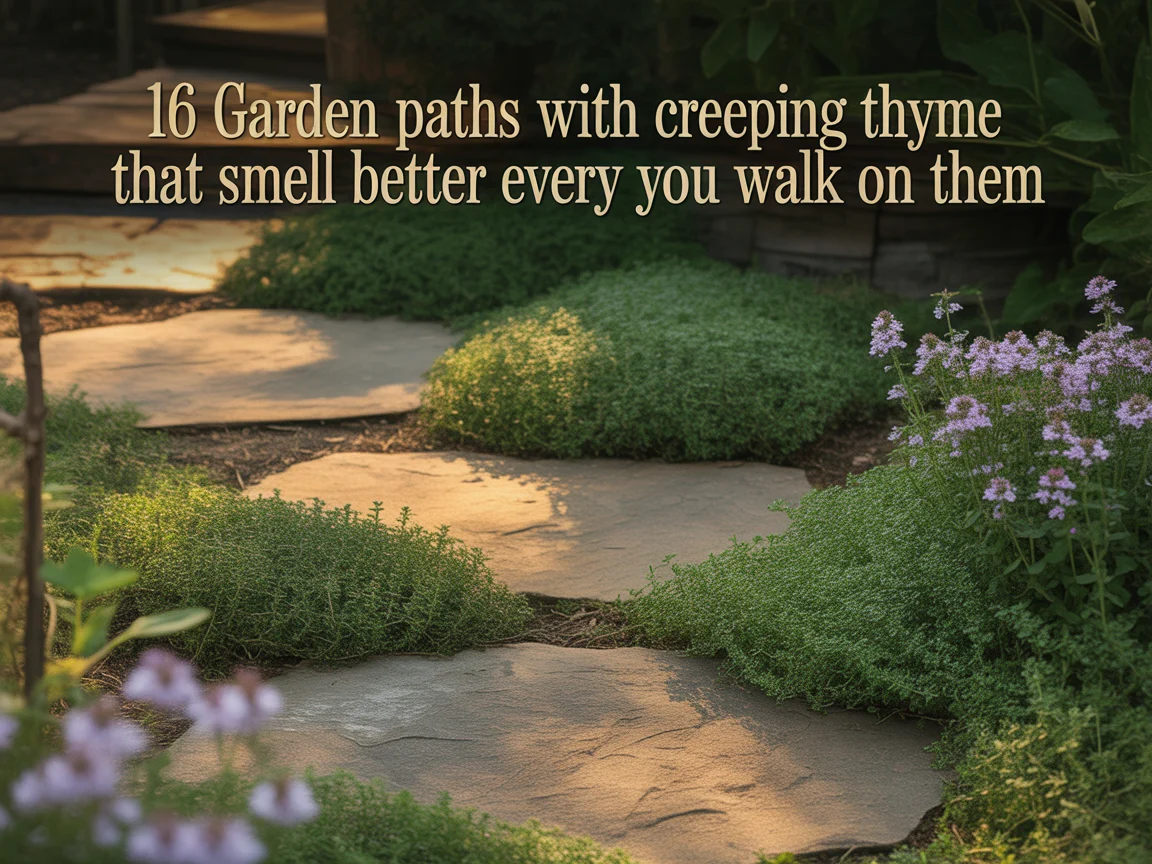
I planted creeping thyme between the stepping stones of my back garden path three years ago on a warm April afternoon, pressing small plug plants into the gaps with my fingers and watering them in with a can. By June of that same year, the gaps were covered in a dense mat of tiny leaves with small pink-purple flowers appearing across the full surface. By midsummer, every time I walked along the path I could smell warm herbs rising from the ground at foot level, which is an experience that no paving material, gravel, or bark surface has ever produced in any path I have installed before or since.
Garden paths with creeping thyme combine a stepping stone, paved, or gravel walkway surface with Thymus serpyllum or related low-growing thyme species planted in the gaps between path stones or along the path edges, creating a living surface that releases a warm herbal fragrance when lightly walked on, produces pink or purple flowers from May to July, and suppresses weeds without any chemical treatment. The thyme gives the path a sensory quality that hard landscaping alone cannot produce, and the path gives the thyme a defined structure that keeps the spreading growth organized and purposeful.
Since that April planting, I have used creeping thyme on garden paths in many different configurations, soil types, and sun exposures. I have tested multiple varieties, grown creeping thyme from seeds and plugs, and studied its performance in both full sun and partial shade positions.
In this article, I am sharing 16 garden paths with creeping thyme that I have either planted myself or researched thoroughly enough to recommend with complete confidence.
Stepping Stone Path With Creeping Thyme in the Gaps
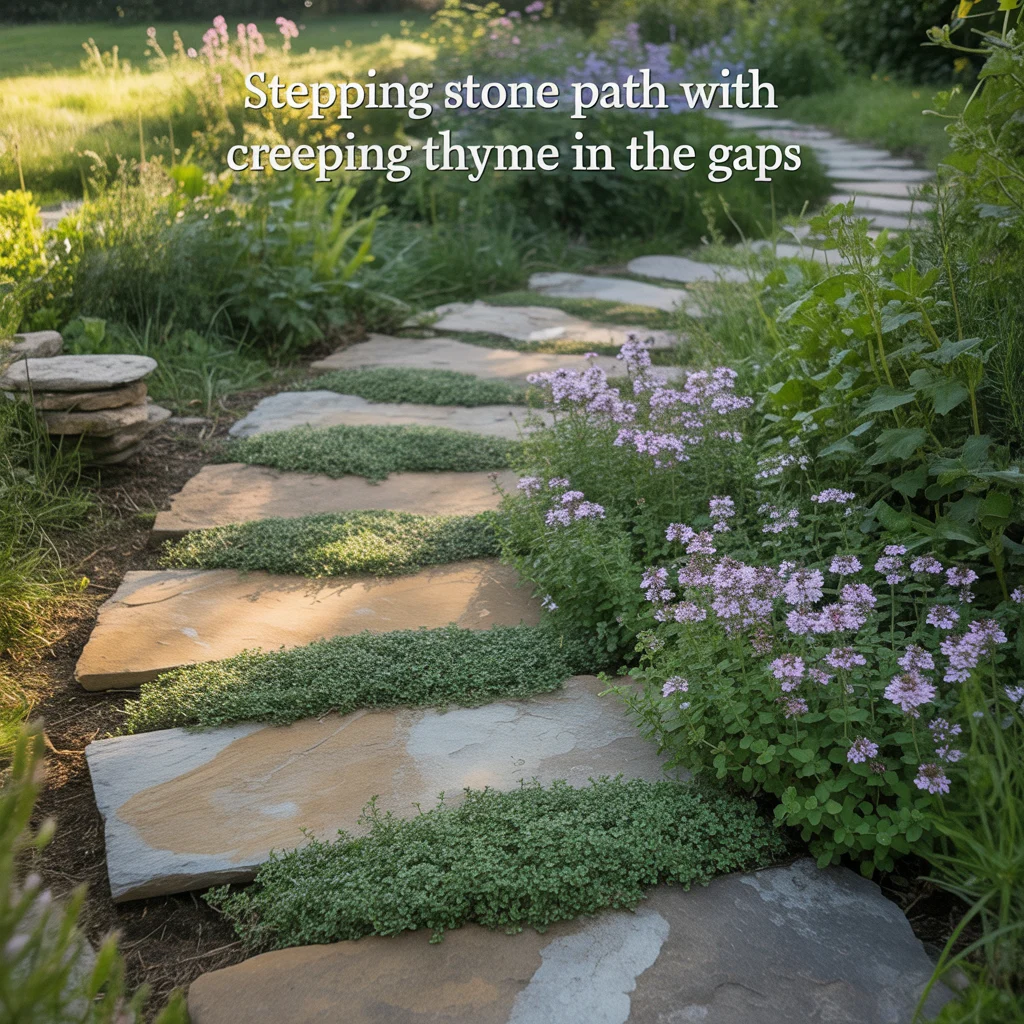
A stepping stone path with creeping thyme planted in the gaps between each stone is the most widely used and most photographed version of garden paths with creeping thyme, producing a path surface where the flat stone provides the firm foot placement and the thyme fills every surrounding gap with a living, fragrant mat. I planted Thymus serpyllum Coccineus between 20-by-20-inch sandstone stepping pads on a 15-foot path and the thyme covered the full gap area between every stone by the end of its first summer, with pink flowers appearing across the surface in June and a strong herbal fragrance released at every step throughout the summer months.
Best Creeping Thyme Varieties for Stepping Stone Gaps
Thymus serpyllum Coccineus, Thymus praecox, and Thymus polytrichus are three creeping thyme varieties suited to stepping stone gaps on a garden path. Thymus serpyllum Coccineus produces the deepest pink-red flowers of any creeping thyme variety from June to August and spreads to 18 inches per plant within one growing season, making it the fastest gap-filling variety for a stepping stone path. Thymus praecox produces slightly larger flowers in a mid-pink tone and spreads at a moderate rate suited to smaller gaps of 2 to 3 inches between closely spaced stepping stones. Thymus polytrichus stays below 1 inch in height and produces the densest, most compact mat of the three varieties, suiting the narrowest path stone gaps where a taller creeping thyme would look out of proportion.
Gap Width for Creeping Thyme Between Stepping Stones
Creeping thyme establishes most effectively in stepping stone gaps of 3 to 6 inches between each stone face, which provides enough soil surface area for the root system to anchor before the spreading stems cover the gap. Gaps below 2 inches provide insufficient soil volume for the thyme roots to establish a viable system within the first growing season, producing thin, patchy coverage. I use 4-inch gaps between my sandstone stepping pads as the standard spacing on all creeping thyme path projects, and find this width produces full gap coverage within 8 to 10 weeks of planting in April, before the first flowering flush begins in June.
Gravel Path With Creeping Thyme Planted at the Edges
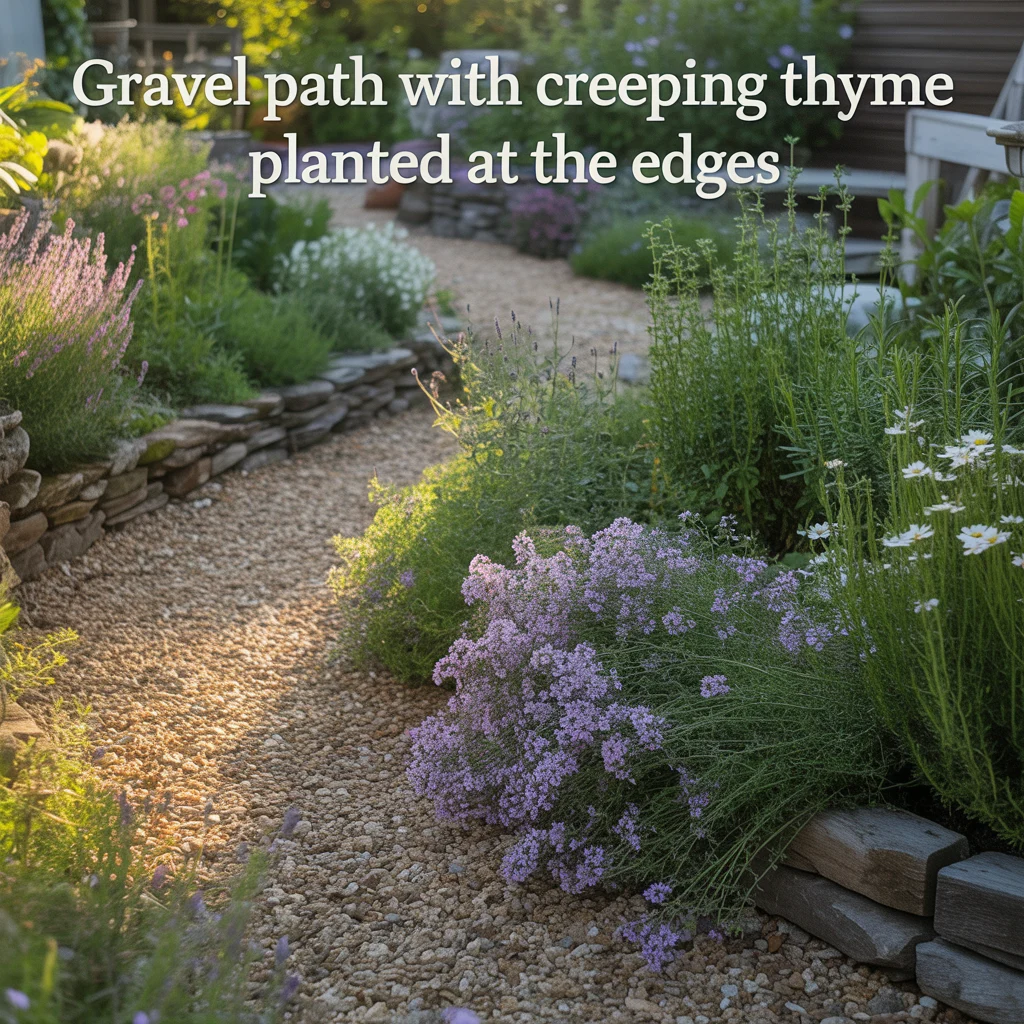
A gravel path with creeping thyme planted along both edges uses the spreading habit of Thymus serpyllum to create a living border that gradually softens the transition between the gravel path surface and the adjacent lawn or planting border by growing outward from the planted edge position onto both the gravel and the surrounding ground simultaneously. I planted Thymus serpyllum Album along both sides of a 20-foot pea gravel path at a residential project, setting plants at 12-inch spacing, and by the second growing season the thyme had spread 8 to 10 inches inward over the gravel surface and 6 to 8 inches outward into the adjacent border, creating the naturally blurred path edge that I had observed in Mediterranean herb garden photographs and wanted to replicate.
Planting Creeping Thyme at the Edge of a Gravel Path
Creeping thyme planted at the edge of a gravel path is set directly into the soil at the path boundary, with the planting hole prepared by scraping back the gravel surface to expose the soil below, digging a small hole to twice the pot depth, and pressing the root ball firmly into the hole before replacing the gravel around the plant base. I plant at 12-inch spacing for a single row along both path edges, which produces a continuous line of overlapping thyme growth along the full path length within two growing seasons. Planting into the gravel surface rather than into the soil edge reduces the plant’s establishment rate because the gravel layer insulates the soil below from rainfall penetration.
Gravel Colors That Suit Creeping Thyme Path Edges
Golden gravel, white marble chippings, and grey flint are three gravel types that create effective visual combinations with creeping thyme planted at path edges. Golden gravel at 14mm chip size produces a warm background color that complements the pink-purple thyme flowers in June and July and suits a cottage or Mediterranean garden path style. White marble chippings create the strongest contrast with the green thyme foliage and the pink flowers, producing a bold visual effect that suits a contemporary or minimalist garden path design. Grey flint gravel provides a neutral background that suits any creeping thyme variety and allows the flower color to dominate the visual appearance of the path edges during the June to August flowering period.
Brick Path With Creeping Thyme Between Brick Joints
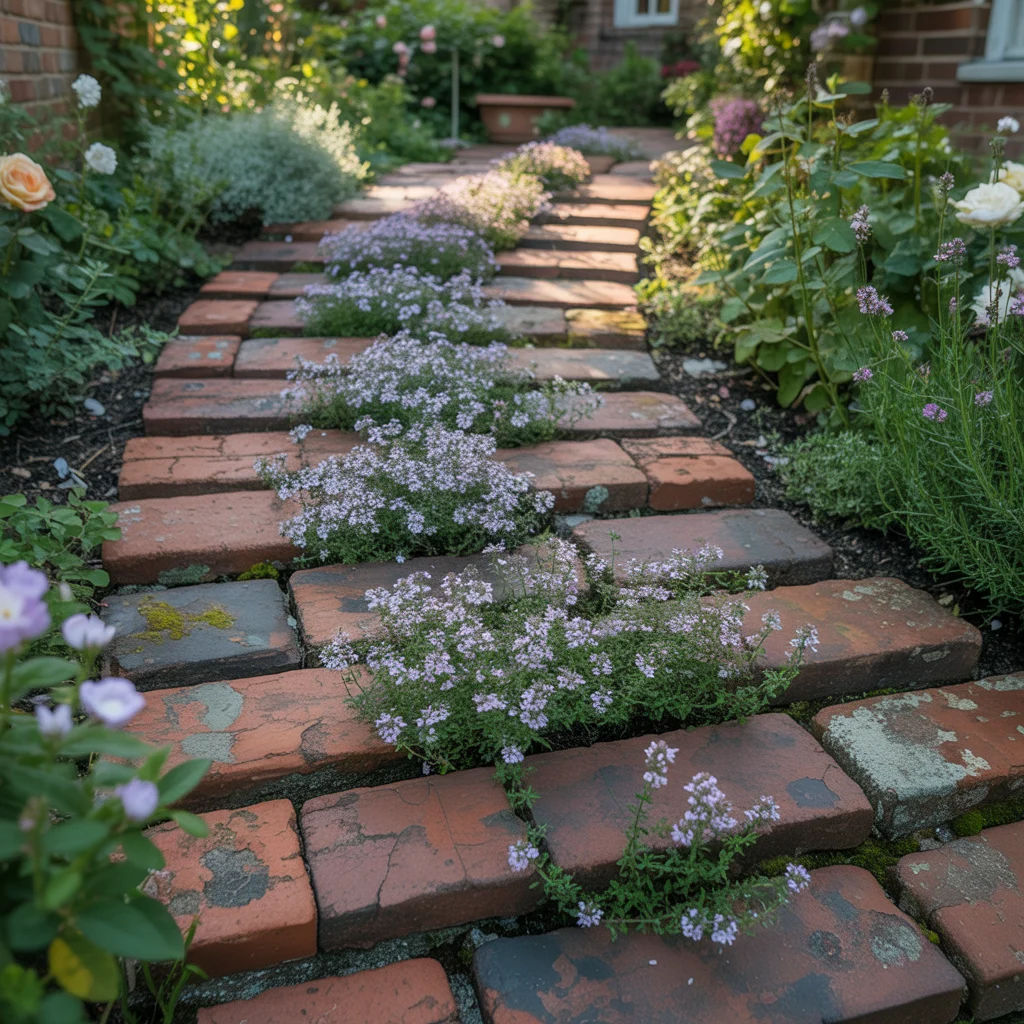
A brick path with creeping thyme planted in the mortar joints uses the natural gaps between brick pavers as the planting medium for Thymus serpyllum, creating a path surface where the thyme grows directly from the joints between the bricks and covers the gap surfaces with a fragrant, flowering mat that connects the hard brick material with a living plant element. I planted Thymus serpyllum in alternate joints on a herringbone brick path in my front garden, pressing small divisions of thyme into the open mortar joints with a narrow tool, and within one growing season the thyme had self-seeded into additional joints throughout the path, producing a natural spreading pattern across the full brick surface. Examples of this technique applied to narrow brick layouts are covered in these narrow brick garden paths with thyme filling the gaps.
Preparing Brick Path Joints for Creeping Thyme
Brick path joints for creeping thyme planting require a minimum joint width of 10mm and a minimum depth of 15mm of open soil or sand below the joint surface to provide enough growing medium for the thyme root system to establish. Joints filled with kiln-dried sand or loose pointing mortar allow thyme roots to penetrate more easily than fully grouted joints, which require the mortar to be raked out to 15mm depth before planting. I rake out alternate joints to 15mm depth using a small pointing tool before pressing thyme divisions of 2 to 3 stems each into the joint, watering the full path surface with a fine rose watering can for the first two weeks after planting to establish the root contact.
Thyme Self-Seeding in Brick Path Joints
Thymus serpyllum self-seeds freely into open mortar joints on a brick path after the first flowering season, spreading to additional joints without any further planting intervention from the second year onward. I deliberately leave spent flower heads on the thyme plants in August rather than deadheading, which allows the tiny seeds to fall naturally into the surrounding brick joints and establish new plants in the following spring. After three growing seasons on my herringbone brick path, the thyme had colonized 80% of the visible joint surface without any additional planting beyond the original divisions pressed into alternate joints in the first season, demonstrating the self-spreading capability that makes creeping thyme one of the lowest-maintenance joint plants available for a garden path.
Formal Garden Path With Creeping Thyme Lawn Sections
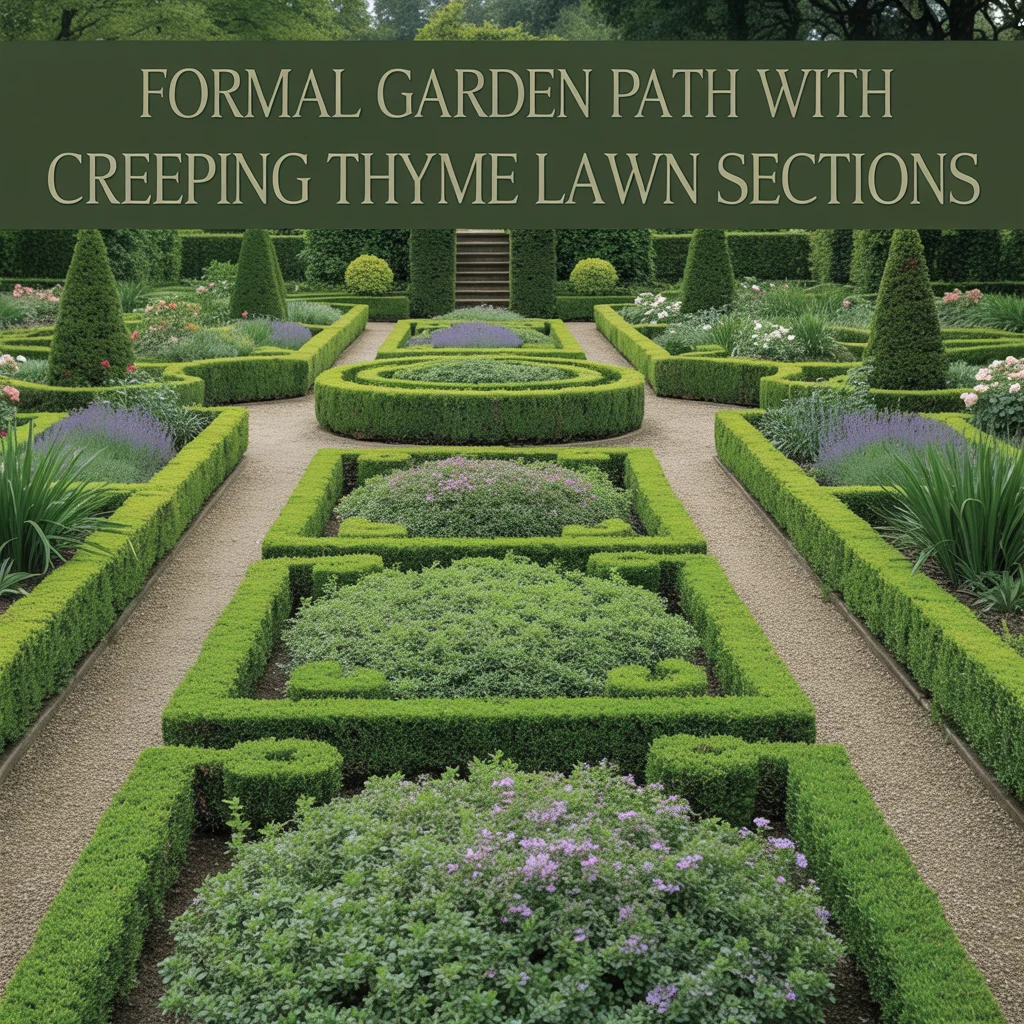
A formal garden path with creeping thyme lawn sections replaces areas of standard grass lawn alongside or between formal paved path sections with a creeping thyme lawn, creating a fragrant, flowering alternative to mown grass that requires no cutting, releases a herbal scent when walked on lightly, and produces a purple-pink flower carpet across the full thyme surface in June and July. I converted a 6-foot-wide section of lawn on both sides of a 20-foot formal York stone path to a Thymus serpyllum lawn by removing the existing grass, preparing the soil with sharp grit, and planting thyme plugs at 6-inch spacing across the full converted area, and the resulting thyme lawn produced its first full flowering display in the second growing season.
Creating a Creeping Thyme Lawn Alongside a Garden Path
A creeping thyme lawn alongside a garden path is created by removing all existing grass and weeds from the intended area, improving drainage by incorporating 2 inches of sharp grit into the top 6 inches of soil, and planting Thymus serpyllum plug plants at 6-inch spacing across the full area. The soil pH should measure between 6.0 and 8.0 for optimum thyme establishment, and the site requires a minimum of 4 hours of direct sunlight per day for the thyme to produce a dense, healthy lawn surface. I plant thyme lawns in spring between March and May on all formal path projects, applying a light top-dressing of sharp grit around each plant base at planting time to improve drainage immediately around the root crown.
Maintaining a Creeping Thyme Lawn on a Garden Path
A creeping thyme lawn alongside a garden path requires one light trim per year in late August after the main flowering flush has finished, using a rotary mower set to its highest blade position or garden shears to remove the old flower stems and encourage dense new growth from the base. The thyme lawn does not require any fertilizer application because excess nutrients produce lush, soft growth that loses the compact, dense character required for a walkable surface. I trim my thyme lawn with garden shears rather than a mower because the irregular surface of an established thyme lawn can catch a mower blade on the raised clump edges and scalp patches of the surface.
Cottage Garden Path With Creeping Thyme and Stepping Stones
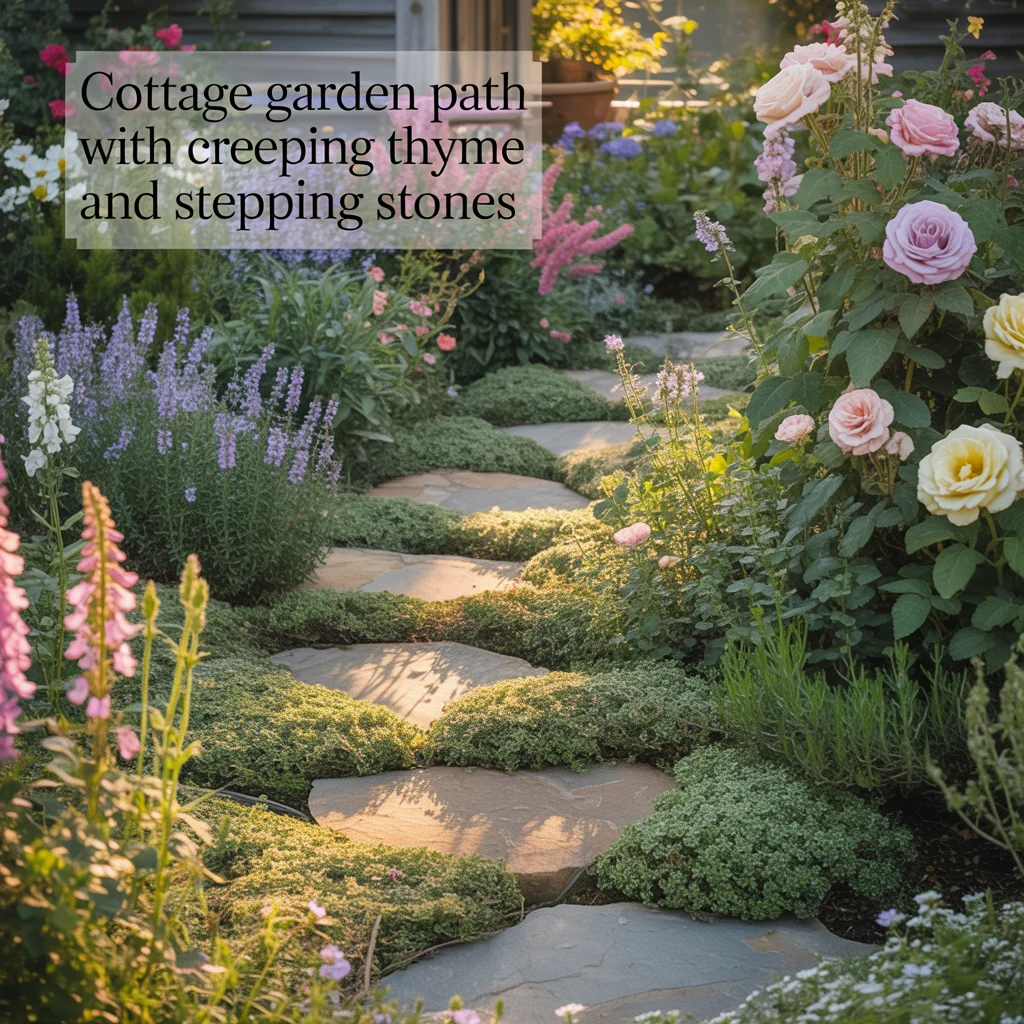
A cottage garden path with creeping thyme and stepping stones creates an informal, meandering walkway where large irregular stepping stones are set in a sea of creeping thyme that covers the ground between and around each stone, producing a path that looks as though the thyme established naturally around the stones rather than having been deliberately planted. I saw this design in a heritage cottage garden open day and spent considerable time studying the proportions and plant spacing before replicating it in my own garden using random-shaped slate stepping pads of 18 to 24 inches and a mixture of three Thymus serpyllum varieties in different flower colors planted at the gaps and beyond.
Mixing Creeping Thyme Varieties on a Cottage Garden Path
Thymus serpyllum Coccineus, Thymus serpyllum Album, and Thymus serpyllum Pink Chintz are three varieties suited to a mixed planting on a cottage garden path with creeping thyme. Thymus serpyllum Coccineus produces deep pink-red flowers from June to August and provides the most vivid flower color in a mixed thyme path planting. Thymus serpyllum Album produces white flowers from June to August and provides a pale contrast that creates a naturalistic mixed meadow effect when planted in alternating groups with the pink and red varieties. Thymus serpyllum Pink Chintz produces clear pale pink flowers at a lower height than the standard serpyllum varieties, staying below 0.5 inches and providing the most carpet-like surface appearance of the three in a cottage path planting.
Irregular Stepping Stone Placement in a Creeping Thyme Garden Path
Irregular stepping stones in a creeping thyme garden path are placed in a slightly offset line rather than a perfectly straight route, with each stone positioned to require a natural walking stride rather than an exaggerated step length or an awkward landing. I measure the comfortable walking stride of the path user by asking them to walk naturally on grass and measuring the distance between footfalls, typically 18 to 24 inches for an adult, and then position each stepping stone center at that interval along the slightly curved path route. Irregular stone shapes are oriented so their longest axis runs roughly across the path direction, which provides the widest available foot placement surface for each step.
Modern Garden Path With Creeping Thyme Ground Cover
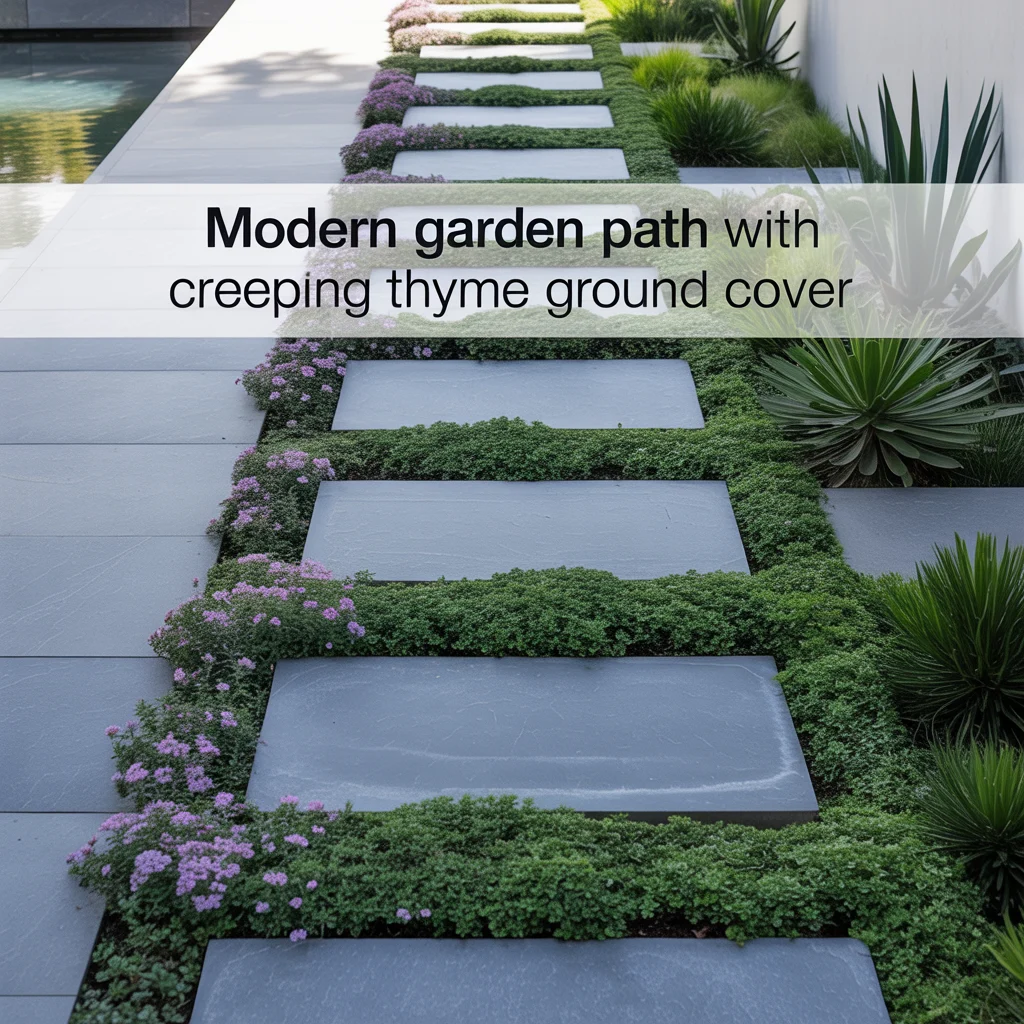
A modern garden path with creeping thyme ground cover uses large-format porcelain or concrete pavers as the primary path surface with creeping thyme planted in a continuous mat on both sides of the pavers rather than between them, creating a contemporary path where the geometric precision of the pavers contrasts with the soft, organic spreading habit of the surrounding thyme ground cover. I specified this design at a contemporary residential project using 600mm-by-600mm charcoal porcelain pavers set in two parallel rows as the path surface, with Thymus serpyllum planted in a continuous belt of 18 inches on both sides, and the combination of the dark geometric pavers and the low green thyme mat produced a modern garden path design with a living ground cover quality that suited the contemporary garden aesthetic.
Creeping Thyme Ground Cover Depth for a Modern Path
Creeping thyme used as a ground cover surface alongside a modern garden path grows to a maximum height of 1 to 3 inches depending on the variety, which provides a low-level ground cover that stays visually below the path paver surface and reinforces the horizontal character of a contemporary flat-surface path design. Thymus serpyllum Elfin stays below 1 inch in height and produces the flattest, most ground-hugging cover of any creeping thyme variety, suiting a modern path where the thyme functions as a green surface rather than a visible plant in its own right. I plant Thymus serpyllum Elfin at 8-inch spacing for modern garden paths with path ground cover projects and find it produces a complete surface cover within two growing seasons.
Watering Creeping Thyme Ground Cover Alongside a Path
Creeping thyme ground cover alongside a modern garden path requires weekly watering from planting until the root systems establish contact with the surrounding soil, typically 6 weeks after planting in spring conditions. After establishment, Thymus serpyllum requires no supplementary irrigation in normal UK garden conditions because the plant is native to well-drained, often dry Mediterranean and central European habitats and has developed deep root systems that access subsoil moisture during dry periods. I water newly planted thyme path ground cover using a fine rose watering can rather than a hose to prevent washing the shallow-rooted plug plants out of the soil surface during the vulnerable first two weeks after planting.
Herb Garden Path Entirely Surfaced With Creeping Thyme
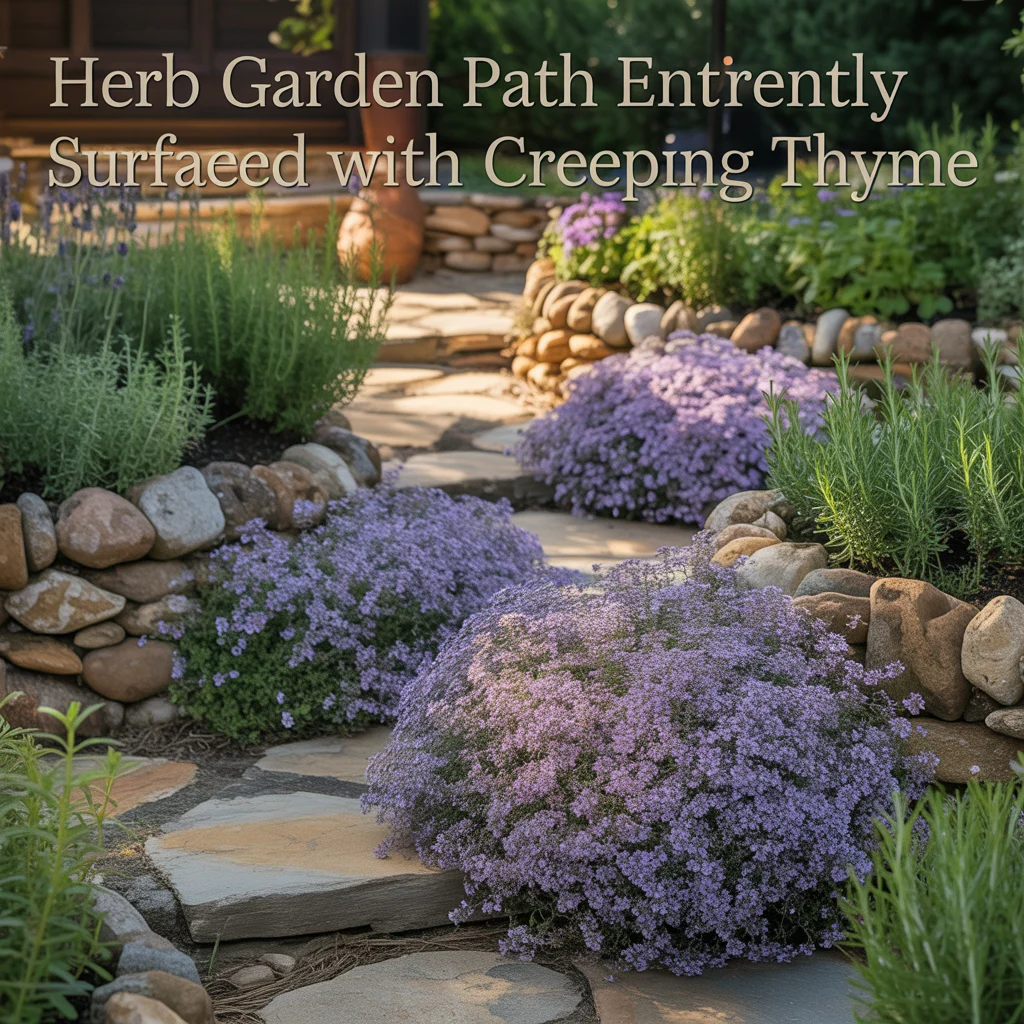
A herb garden path entirely surfaced with creeping thyme removes all hard paving materials and uses Thymus serpyllum as the complete walking surface of the path, creating a living, fragrant path that is soft underfoot, entirely covered in pink-purple flowers from June to August, and releases a warm herbal fragrance with every step. I created a 12-foot creeping thyme path as the central route through my herb garden by preparing a 2-foot-wide strip of well-drained soil with sharp grit and planting Thymus serpyllum Coccineus at 6-inch spacing across the full strip width, and by the second growing season I had a complete thyme surface path that required no paving, no edging, and no hard materials of any kind.
Preparing the Soil for a Full Creeping Thyme Garden Path
A full creeping thyme garden path requires well-drained soil with a pH of 6.0 to 8.0, a minimum of 4 hours of direct sunlight per day, and an incorporation of 2 inches of sharp horticultural grit into the top 6 inches of existing soil before planting. Clay soils require the most preparation work because clay retains moisture that causes root rot in Thymus serpyllum, which originates from free-draining rocky hillsides where drainage is rapid. I prepare clay soils for creeping thyme paths by incorporating a full 3 inches of sharp grit plus 1 inch of horticultural coarse sand into the top 6 inches, which changes the soil drainage rate sufficiently to support healthy thyme establishment on most clay garden soils in a sunny position.
Foot Traffic Tolerance on a Full Creeping Thyme Path
Thymus serpyllum tolerates moderate foot traffic of 10 to 20 walking passes per day on an established thyme surface path without developing permanent bare patches. Traffic above 30 daily passes produces visible wear tracks along the most frequently used line through the thyme surface, and the plants in the high-traffic zone require replacement every two to three seasons to maintain complete surface coverage. I manage high-traffic areas of my creeping thyme herb garden path by stepping on different areas of the surface rather than following exactly the same footfall line each time, which distributes the traffic pressure across a wider area of the thyme mat and reduces the concentration of wear at any single point on the path surface.
Garden Path With Creeping Thyme Between Irregularly Shaped Rocks
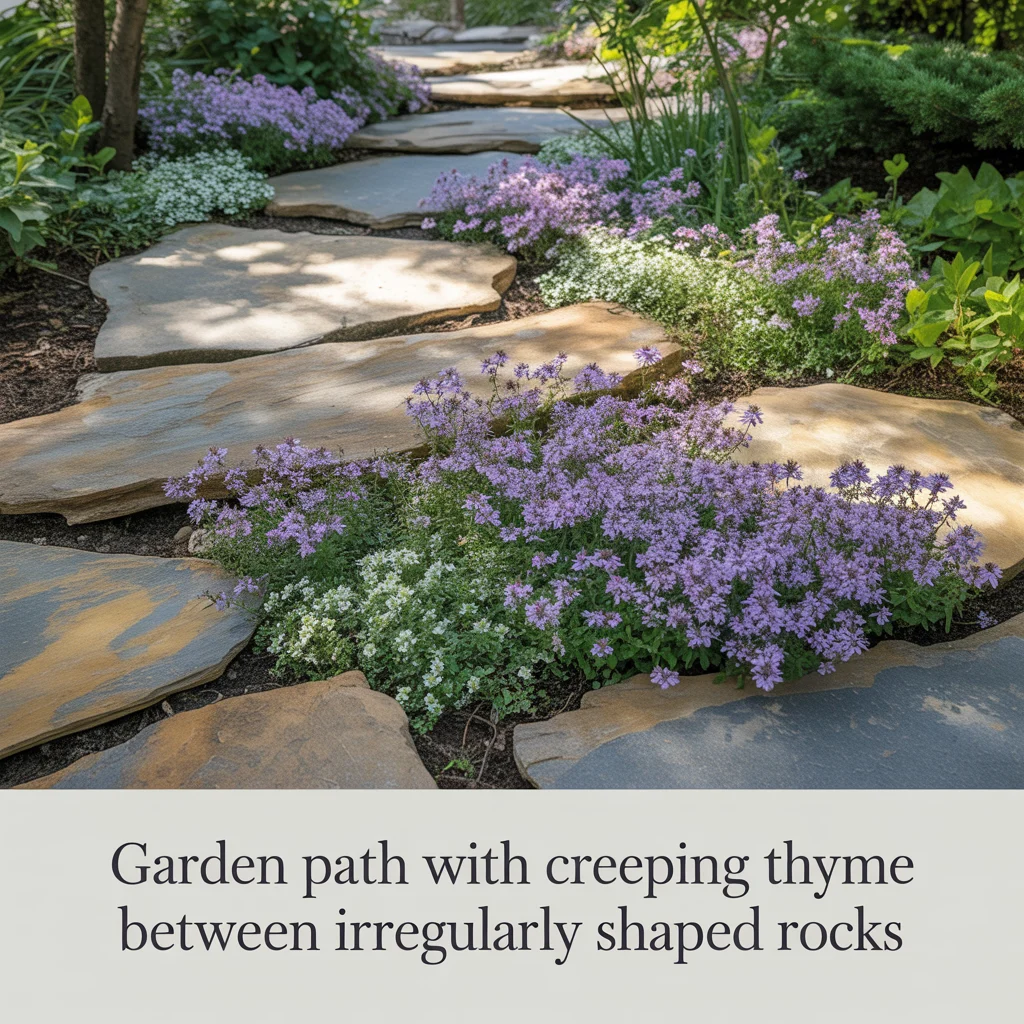
A garden path with creeping thyme between irregularly shaped rocks uses large boulders or rough-cut stone pieces set into the ground as stepping elements, with Thymus serpyllum filling all the gaps between and around the rocks to create a naturalistic path that evokes the appearance of a wild Mediterranean hillside. I visited a private alpine garden where this design was used on a gently sloping path, with large limestone boulders of 18 to 30 inches and Thymus serpyllum growing in dense mats between them, and the combination of the pale limestone and the deep pink thyme flowers in June was one of the most naturally beautiful path surfaces I have seen in a domestic garden setting.
Rock Types That Suit Creeping Thyme on a Garden Path
Limestone, sandstone, and granite boulders are three rock types suited to a creeping thyme boulder path in a domestic garden. Limestone boulders in pale grey or cream tones create the strongest visual contrast with the deep pink flowers of Thymus serpyllum Coccineus and suit a Mediterranean or alpine garden path where the light stone color coordinates with the dry, sunny conditions that creeping thyme requires for best performance. Sandstone boulders in warm buff or honey tones provide a softer visual contrast and suit a cottage or informal garden path where the warm stone color coordinates with the surrounding planting. Granite boulders in grey or pink-speckled tones provide the most durable and permanent path rock material and suit a formal or long-term rock and thyme path installation.
Setting Rocks for a Creeping Thyme Boulder Path
Rocks for a creeping thyme boulder path are set with their flat or most stable face as the top surface, sunk to one-third of their depth in the surrounding soil to provide stability without appearing buried. I excavate a shallow hollow for each rock using a spade and press the rock firmly into the hollow, checking that the top face is at a level walking height relative to adjacent rocks and that the rock is stable underfoot before planting any surrounding thyme. Rocks that move when tested by hand pressure from a standing position require deeper setting or repositioning in a more stable orientation before the creeping thyme is planted in the surrounding gaps.
Shaded Garden Path With Shade-Tolerant Creeping Thyme
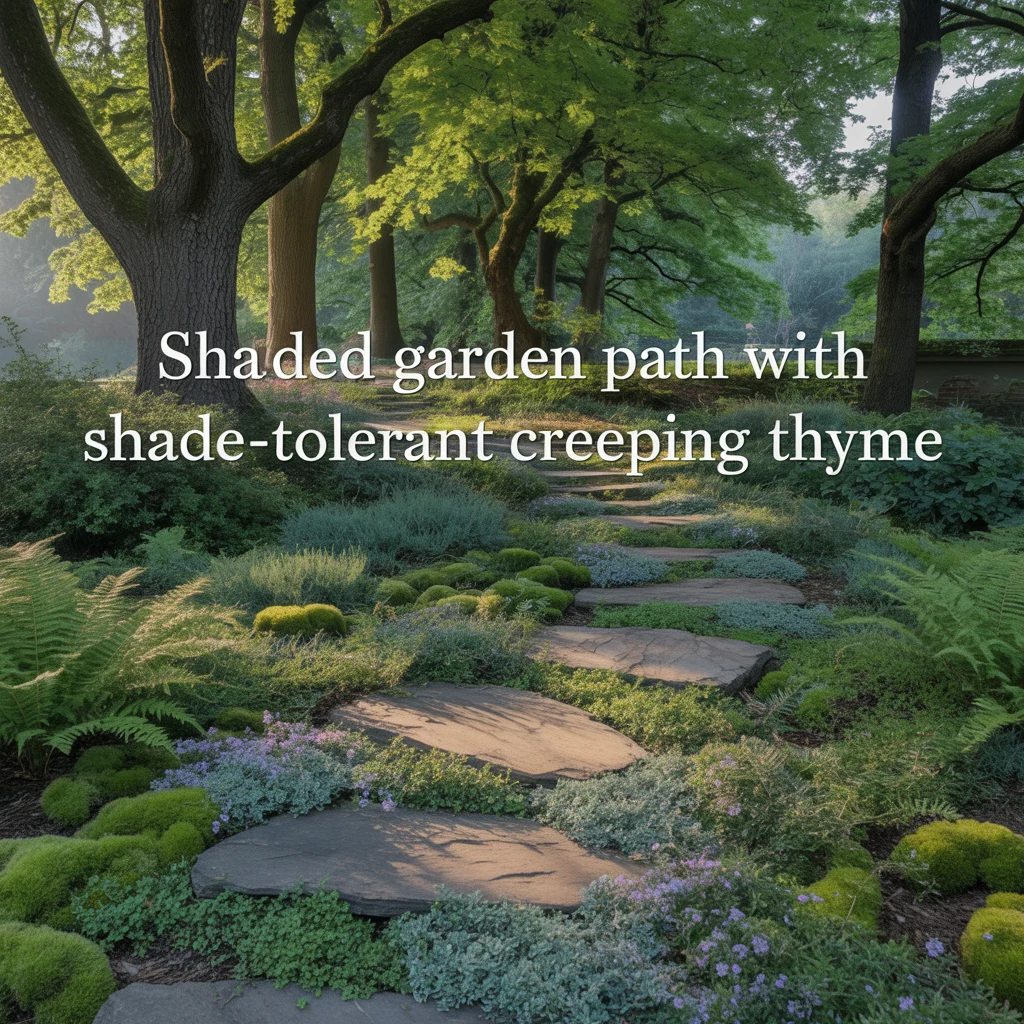
A shaded garden path with shade-tolerant creeping thyme uses Thymus praecox or Thymus polytrichus rather than the standard Thymus serpyllum varieties, because both species tolerate partial shade of 2 to 4 hours of direct sunlight per day and produce adequate growth and flowering in dappled light conditions where standard serpyllum varieties produce thin, sparse coverage. I planted Thymus praecox Albiflorus on a north-facing stepping stone path that received direct sun for only 2.5 hours per day, and found adequate establishment and some flowering in the first season, though the plant density and flower coverage was approximately 40% lower than a comparable planting of the same variety in a full-sun position.
Creeping Thyme Varieties That Tolerate Partial Shade
Thymus praecox, Thymus polytrichus, and Thymus pulegoides are three creeping thyme varieties that tolerate partial shade on a garden path. Thymus praecox tolerates 2 to 4 hours of direct sunlight per day and produces small white or pale pink flowers in June and July in a partial shade position, providing a functional if less abundant flowering display than the same variety in full sun. Thymus polytrichus tolerates similar partial shade conditions and produces a slightly denser mat than praecox in low-light situations, suiting a path where coverage density is more important than flower production. Thymus pulegoides, broad-leaved thyme, tolerates the most shade of any creeping thyme species and produces a larger leaf size that remains visually interesting in partial shade even when flower production is limited.
Improving Creeping Thyme Performance on a Shaded Path
Creeping thyme performance on a shaded garden path is improved by four practical measures. First, trim overhanging branches or surrounding shrubs to increase the daily direct sunlight reaching the path surface to the maximum achievable level within the garden’s constraints. Second, incorporate 2 inches of sharp grit into the path soil to maximize drainage because shade keeps the soil moist longer than sun-exposed positions, and excess moisture is more damaging to creeping thyme than insufficient sunlight. Third, plant at closer spacing of 6 inches rather than 12 inches to achieve faster initial coverage. Fourth, choose white or pale pink flowering varieties which are more tolerant of shade than the deep pink and red flowering varieties.
Alpine Garden Path With Creeping Thyme and Scree
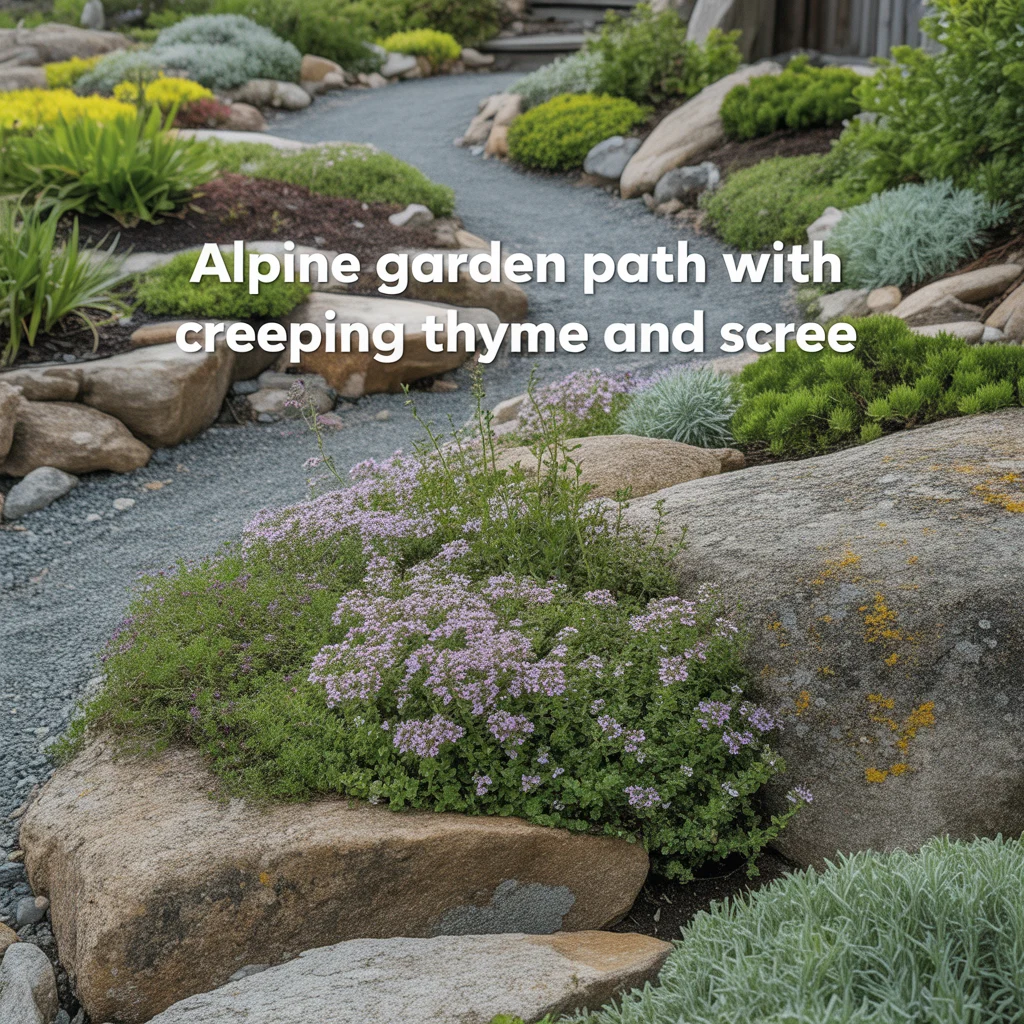
An alpine garden path with creeping thyme and scree uses a freely draining surface of crushed stone scree at 2 to 3-inch depth alongside and between the path stepping elements, with Thymus serpyllum planted directly into the scree surface to create a path that replicates the natural growing conditions of creeping thyme in its wild alpine and Mediterranean hillside habitat. I created this design on a south-facing slope in my garden using 20mm limestone scree spread over a well-drained sandy soil base, setting 18-inch natural limestone stepping pads at 14-inch intervals and planting Thymus serpyllum Minus between and around the scree surface at 8-inch spacing. The alpine conditions produced the most compact, dense thyme growth I have ever achieved on any path project.
Scree Materials for a Creeping Thyme Alpine Path
Crushed limestone, granite grit, and pea gravel are three scree materials suited to a creeping thyme alpine garden path. Crushed limestone at 10mm to 20mm chip size provides the most alkaline growing medium, raising the soil pH toward the 7.0 to 8.0 level that Thymus serpyllum prefers in its natural habitat, and suits a south-facing alpine path where maximum drainage and warmth reflection from the pale stone surface optimizes thyme performance. Granite grit at 6mm to 14mm provides a more neutral growing medium suited to a wider range of accompanying alpine plants alongside the thyme. Pea gravel at 10mm provides the most affordable scree material and suits a budget-conscious alpine thyme path where the rounded smooth pebble form is acceptable alongside the more angular stepping elements.
Companion Alpine Plants for a Creeping Thyme Path
Sedum acre, Arabis caucasica, and Aubrieta deltoidea are three alpine companion plants suited to a garden path with creeping thyme in an alpine scree setting. Sedum acre produces bright yellow flowers in June at the same time as the thyme’s main flowering peak, providing a yellow and pink color combination between the two species that is visually distinctive on an alpine path. Arabis caucasica produces white flowers in April and May before the thyme begins flowering, extending the flowering season of the alpine path from April through August as the two species flower in sequence. Aubrieta deltoidea produces purple-pink flowers from March to May and suits a path where a strong purple-pink color is present at the path surface from early spring before the thyme begins its own flowering period.
Fragrant Garden Path With Creeping Thyme and Lavender
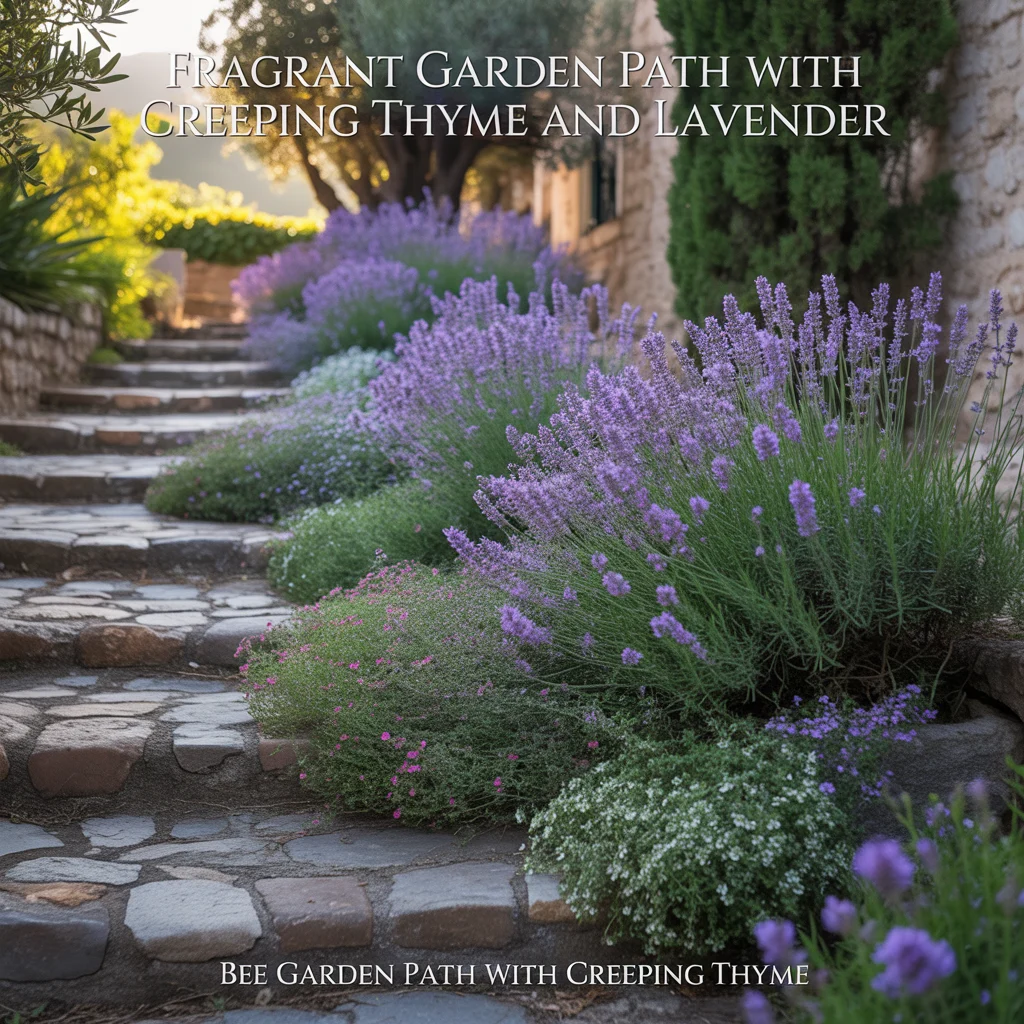
A fragrant garden path with creeping thyme and lavender combines the ground-level fragrance of Thymus serpyllum in the path gaps and edges with the mid-height fragrance of Lavandula angustifolia planted in the adjacent borders to create a walking route where the scent experience operates at both foot level and knee-to-waist height simultaneously. I planted this combination on a 22-foot York stone path at a residential project, planting Thymus serpyllum Coccineus in all stone gaps and Lavandula angustifolia Hidcote at 18-inch spacing along both path edges, and the combined fragrance on a warm June afternoon when both plants were in simultaneous flower was described by the homeowner as the best sensory experience in her garden.
Coordinating Thyme and Lavender Flower Colors on a Garden Path
Thymus serpyllum Coccineus deep pink with Lavandula angustifolia Hidcote deep purple, Thymus serpyllum Album white with Lavandula angustifolia Rosea pink, and Thymus serpyllum Pink Chintz pale pink with Lavandula angustifolia Vera pale blue are three color combinations suited to a fragrant creeping thyme and lavender garden path. The Coccineus and Hidcote combination produces the strongest, most saturated color display of the three options because both plants are in their deepest available colors and create a vivid pink and purple path display in June and July. The Album and Rosea combination produces the softest, most pastel color display and suits a romantic or pale-toned garden path design where strong saturated colors would be visually overpowering.
Planting Sequence for a Thyme and Lavender Fragrant Path
A fragrant creeping thyme and lavender garden path is planted in two stages. First, the lavender border plants are set at 18-inch spacing along both path edges in April, which establishes the taller border framework before the lower thyme planting fills the gaps and edges of the path. Second, the creeping thyme is planted in the stone gaps and any remaining bare soil at the lavender base level in May, four weeks after the lavender to allow the larger plants to establish root systems before the thyme planting begins. I always plant lavender before thyme on combined fragrant path projects because disturbing the soil for lavender planting after the thyme is established would damage the shallow thyme root systems around each lavender planting position.
Bee Garden Path With Creeping Thyme
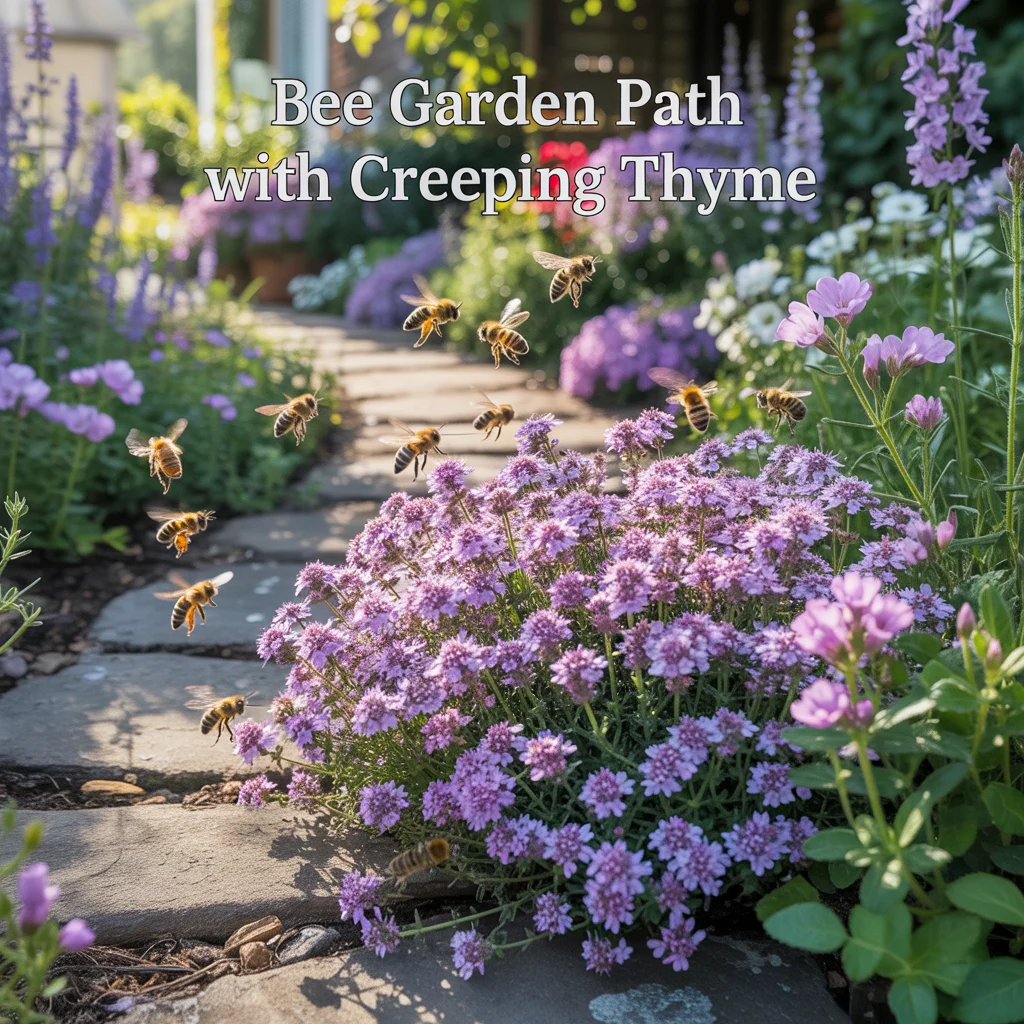
A bee garden path with creeping thyme uses the high pollinator attraction of Thymus serpyllum flowers to create a garden path that actively supports bee populations during the June to August flowering period, producing a path surface where honeybees, bumblebees, and solitary bee species visit the thyme flowers throughout the day. I counted bee visits on a 2-square-foot section of my creeping thyme path on a warm July afternoon and recorded 12 individual bee landings in a 10-minute observation period, which is a higher pollinator visit rate than any other single plant species in my garden during the same observation sessions.
Why Creeping Thyme Attracts Bees on a Garden Path
Thymus serpyllum produces nectar-rich flowers in dense clusters across the full surface of the flowering mat from June to August, providing a continuous accessible nectar and pollen source for visiting bee species. The small, open flower structure of Thymus serpyllum allows short-tongued bee species including Bombus terrestris and Bombus lapidarius to access the nectar directly without the tongue-length restrictions that tubular flowers impose on some visiting species. Research published by the Royal Horticultural Society identifies Thymus serpyllum as one of the top 10 nectar-producing plants per unit area available for domestic garden use in the UK, making a garden path with creeping thyme a significant pollinator resource during the July peak flowering period.
Creating a Pollinator Corridor With a Creeping Thyme Garden Path
A pollinator corridor using a garden path with creeping thyme extends the bee-supporting planting beyond the path itself by combining the thyme path surface with adjacent border plantings of Lavandula angustifolia, Nepeta x faassenii, and Echinacea purpurea to create a continuous nectar corridor from the garden entrance to the far boundary. I design pollinator corridor paths by selecting border plants with overlapping flowering periods that collectively cover the full season from March through October, with the creeping thyme providing the June to August peak and the surrounding border plants extending the nectar availability on both sides of the flowering calendar. The combined plant selection produces a garden path with flowers and bee activity throughout the main garden season.
When to Plant Creeping Thyme on a Garden Path
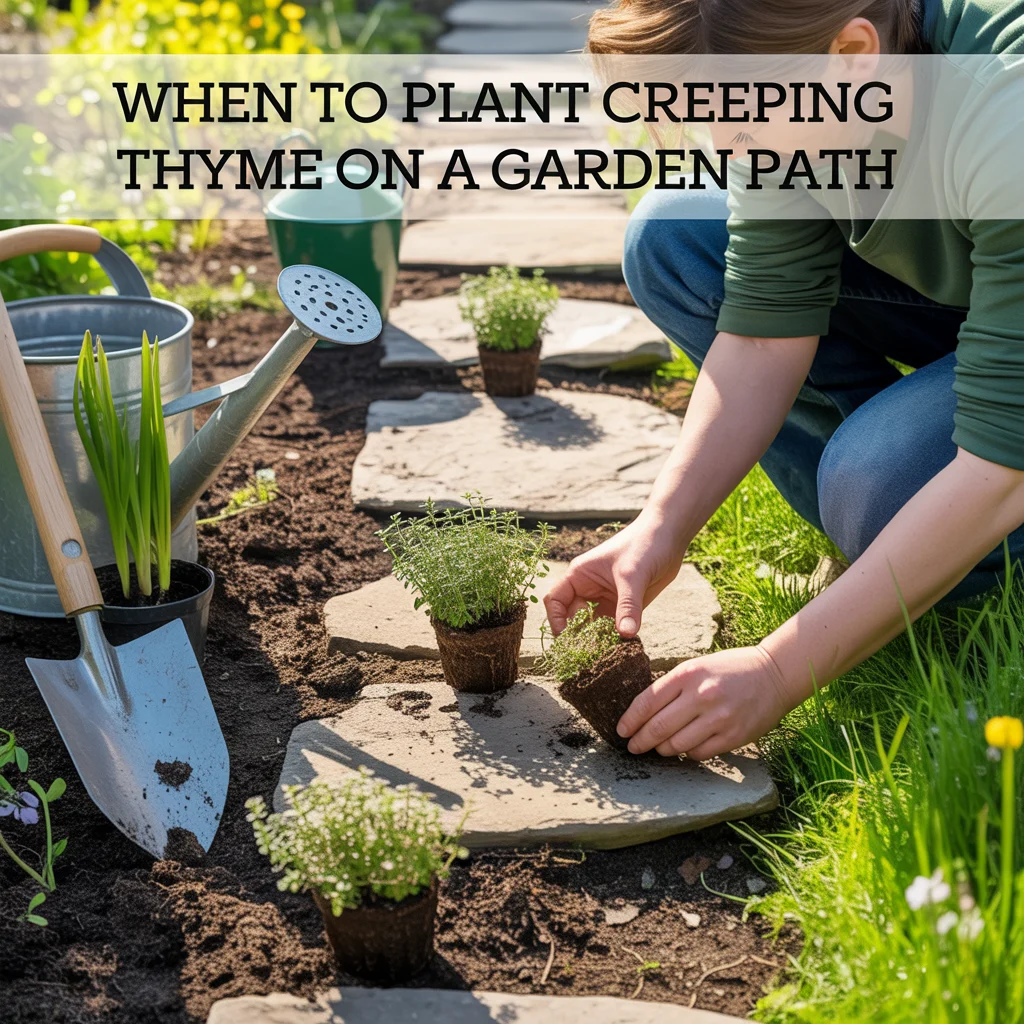
Knowing when to plant creeping thyme is critical to achieving the fastest possible establishment on a garden path, because thyme planted in the correct seasonal window establishes root systems before the first summer drought stress period and produces a flowering display in the same season as planting. I have planted creeping thyme in spring, summer, and autumn on different path projects and observed a clear difference in first-season establishment rate between the three planting windows that directly affects how quickly the path gaps and edges achieve complete coverage.
Spring Planting of Creeping Thyme on a Garden Path
Spring between mid-March and mid-May is the best time to plant creeping thyme on a garden path because the warming soil temperatures from 7 degrees Celsius upward stimulate rapid root growth, the increasing day length promotes active shoot extension, and the spring rainfall reduces the irrigation requirement during the critical first weeks of establishment. Plug plants planted in March on a south-facing path in my garden produced 6 to 8 inches of lateral spread by June of the same year and produced their first flowers in the same season as planting, compared to autumn-planted thyme that produced no flowers until the second season and showed only 3 to 4 inches of lateral spread by the following June.
Autumn Planting of Creeping Thyme on a Garden Path
Autumn between September and October provides a second planting window for creeping thyme on a garden path in gardens where spring planting is not possible due to existing path renovation schedules or plant availability. Autumn-planted thyme establishes root systems during the mild September and October soil temperatures before entering winter dormancy, which produces stronger root establishment than winter-planted thyme and results in earlier spring shoot emergence. I plant autumn thyme at the same spacing as spring plantings but apply a light top-dressing of sharp grit around each plant crown in October to protect the root collar from waterlogging during winter, which is the primary cause of thyme loss on autumn-planted garden path projects.
How Fast Does Creeping Thyme Grow on a Garden Path
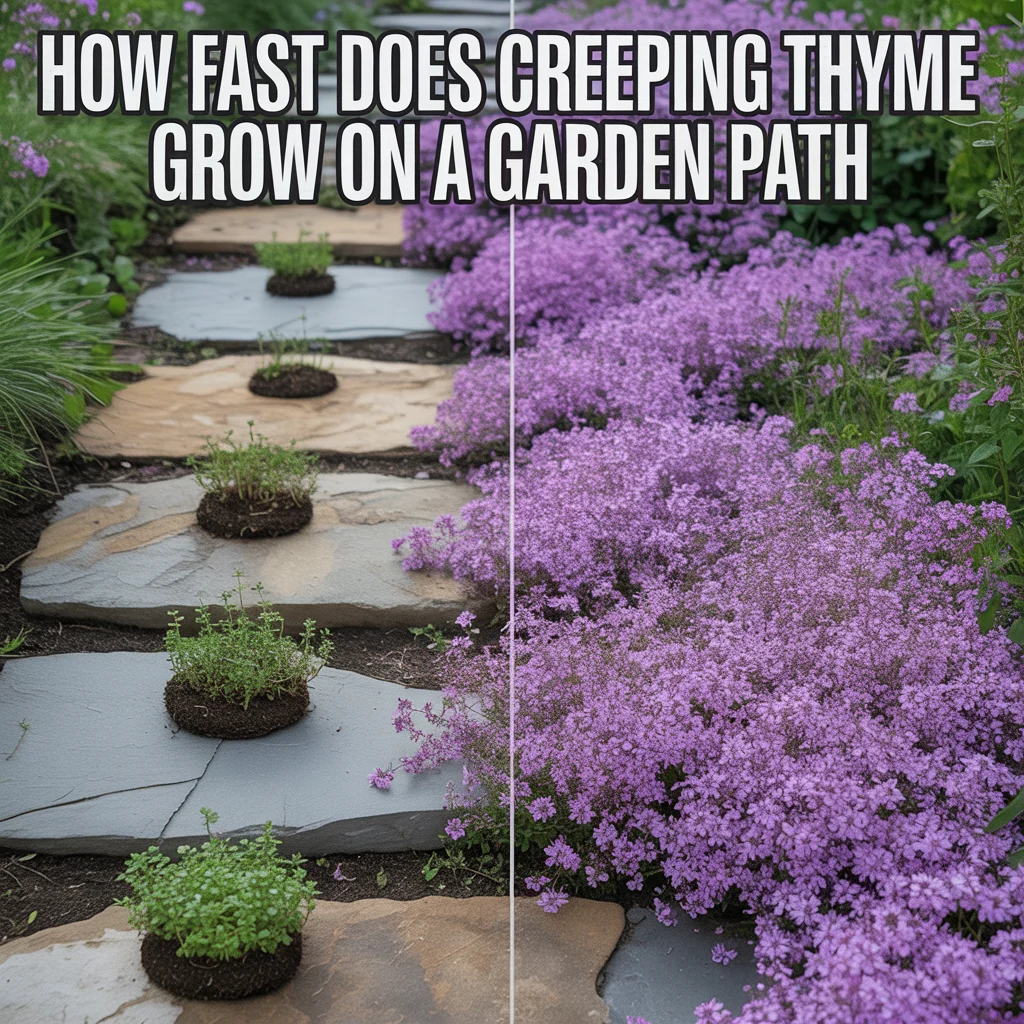
Understanding how fast creeping thyme grows helps set realistic expectations for how quickly a garden path with creeping thyme reaches full coverage, and allows the planting spacing to be adjusted to achieve a specific visual result within a defined timeframe. I have measured the lateral growth rate of five Thymus serpyllum varieties on a south-facing stepping stone path over three consecutive growing seasons and recorded consistent results that provide a reliable basis for planting spacing recommendations on any garden path with creeping thyme project.
Creeping Thyme Growth Rates by Variety
Thymus serpyllum Coccineus grows at 15 to 18 inches per plant per season in full sun on well-drained soil, making it the fastest-spreading creeping thyme variety for a garden path. Thymus serpyllum Album grows at 12 to 15 inches per season under the same conditions, providing moderately fast coverage suited to most path gap and edge planting applications. Thymus polytrichus grows at 8 to 12 inches per season and produces the densest mat of the three varieties despite its slower lateral rate, suiting a path where a tight, compact coverage is more important than the fastest possible gap-filling speed. Thymus serpyllum Elfin grows at only 4 to 6 inches per season and is the slowest-establishing creeping thyme for a garden path, requiring closer planting at 4-inch spacing to achieve full coverage within one growing season.
Spacing Creeping Thyme for Fast Path Coverage
Creeping thyme planted at 6-inch spacing on a garden path produces full surface coverage within 8 to 12 weeks of spring planting when using Thymus serpyllum Coccineus in a full-sun, well-drained position. Spacing at 12 inches produces full coverage within 14 to 20 weeks under the same conditions. Spacing at 18 inches requires one full growing season for complete coverage and suits a path where the budget does not extend to the higher plant quantity needed for closer spacing. I use 6-inch spacing on all path projects where the homeowner wants visible results in the same season as planting, and 12-inch spacing on projects where a 12-month establishment period is acceptable before the thyme path achieves its full visual appearance.
Creeping Thyme in Pots Alongside a Garden Path
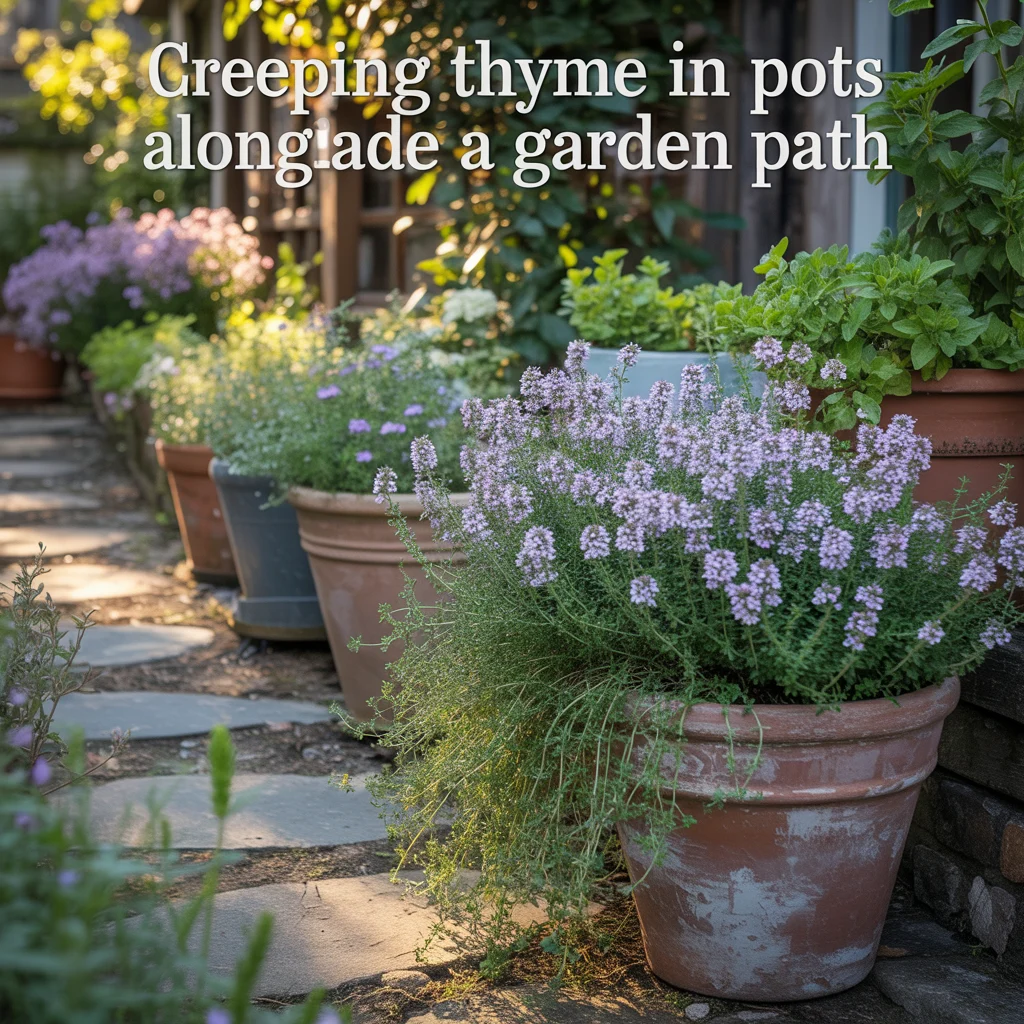
Creeping thyme in pots placed alongside a garden path uses container-grown Thymus serpyllum as a decorative and fragrant pot display that supplements or replaces planted path edge thyme in positions where direct planting in the path soil is not possible due to hard surfacing, shallow soil, or restricted access. I placed four 10-inch terracotta pots of Thymus serpyllum Coccineus along one side of a paved courtyard path where no soil planting was possible, and the flowering thyme in terracotta pots produced the same fragrant, visually attractive path edge effect as planted thyme without requiring any modification to the existing paved surface.
Pot Sizes for Creeping Thyme on a Garden Path
Terracotta pots of 8 to 10 inches diameter, shallow ceramic troughs of 12 to 18 inches length, and stone-effect fibreglass pots of 10 to 14 inches diameter are three container types suited to creeping thyme on a garden path. Terracotta pots at 8 to 10 inches diameter provide enough soil volume for one to three creeping thyme plants depending on the pot diameter, and the porous terracotta material promotes the free drainage that Thymus serpyllum requires to thrive in a container. Shallow ceramic troughs at 12 to 18 inches length suit a path where a longer, lower container display is preferred over individual circular pots, providing enough length for three to five creeping thyme plants at 4-inch spacing in a single trough.
Compost Mix for Creeping Thyme in Path Pots
Creeping thyme in pots alongside a garden path requires a free-draining compost mix of 50% standard multi-purpose compost and 50% horticultural grit or perlite, which replicates the fast-draining, low-nutrient growing conditions of Thymus serpyllum’s natural rocky hillside habitat. Standard multi-purpose compost alone retains too much moisture for creeping thyme in a pot, producing root rot within one to two seasons in all but the driest summers. I mix the 50/50 compost and grit blend directly in the pot before planting, filling to 1 inch below the pot rim, and apply a 5mm top-dressing of fine horticultural grit around each plant crown after planting to keep the stem base dry and prevent crown rot at the soil surface level.
Low Maintenance Garden Path With Creeping Thyme
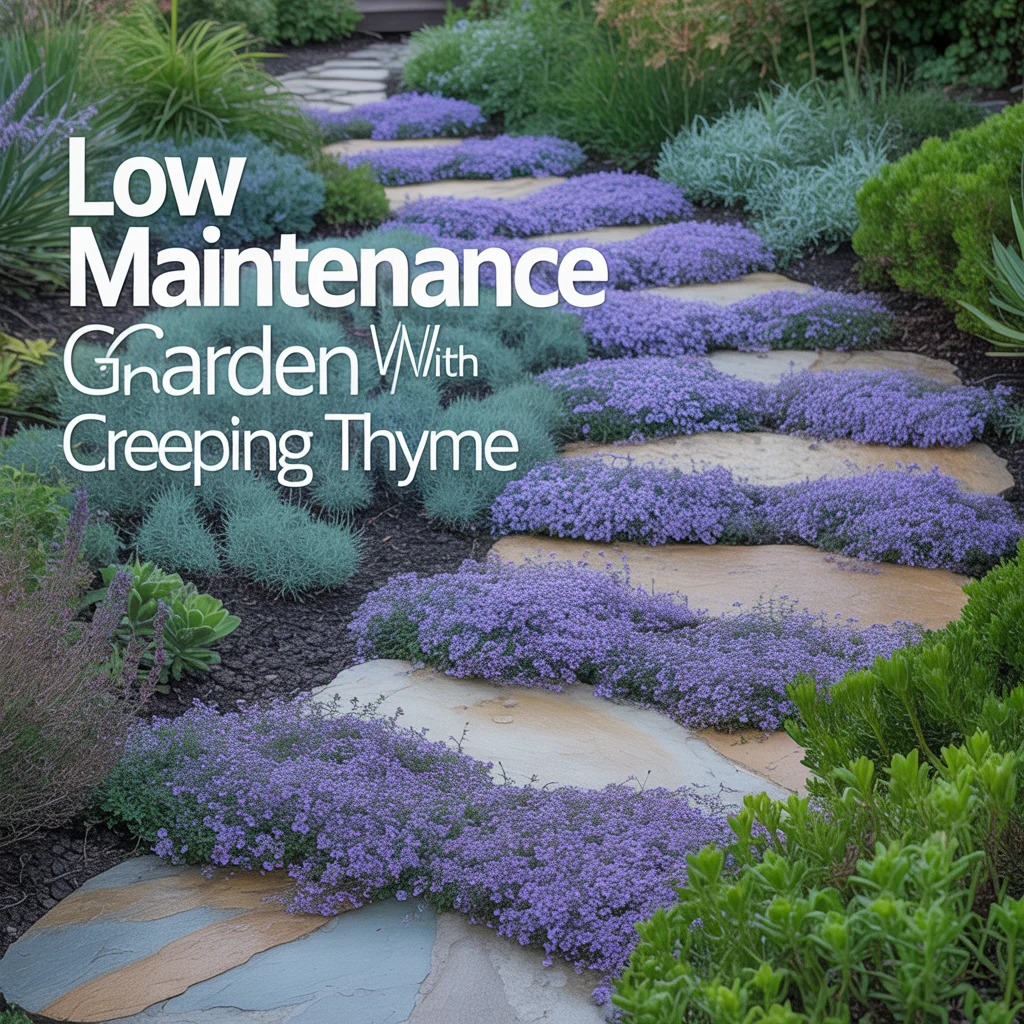
A low maintenance garden path with creeping thyme uses the naturally weed-suppressing, drought-tolerant, and self-spreading characteristics of Thymus serpyllum to create a path surface and edge planting that requires the minimum possible ongoing maintenance after the initial planting and establishment period. I maintain my own 15-foot stepping stone path with creeping thyme on a 20-minute-per-year maintenance schedule consisting of one light trim in late August and a visual check in April to identify any winter losses needing replacement, which is significantly less time than any other planted or hard-surface path I have installed in my garden.
Annual Maintenance Tasks for a Creeping Thyme Garden Path
One late-summer trim and one spring replacement check are the two annual maintenance tasks required for a creeping thyme garden path. The late-summer trim takes place in August immediately after the main flowering flush has finished, cutting all the thyme stems back to 1 inch above the woody base using garden shears to prevent the plant from becoming leggy and open at the center. The spring replacement check takes place in April to identify any plants that have died during winter due to waterlogging or frost damage and require replacement with new plugs at the same spacing as the original planting. I complete the August trim on my 15-foot thyme path in 20 minutes using hand shears and find the replacement check in April takes 10 minutes and typically requires the replacement of one to three plants per season.
Is Creeping Thyme Invasive on a Garden Path
Creeping thyme is not invasive on a garden path because Thymus serpyllum spreads by surface stolons rather than underground rhizomes, which means the plant extends only where its stems make contact with moist soil and cannot penetrate below hard paving surfaces or spread through underground root systems to emerge in unexpected positions. The lateral spread rate of 12 to 18 inches per season is slow enough to be managed by manual trimming at the path edges twice per season without chemical control. I trim the leading edges of my creeping thyme path plants back to the intended path boundary in May and again in August, which takes 15 minutes per trimming session and prevents the thyme from spreading onto the adjacent lawn or border areas.
Related
best border plants to combine with creeping thyme paths
how to plant flowers alongside a creeping thyme walkway
flagstone path ideas with creeping thyme in the cracks
Frequently Asked Questions
What is the best creeping thyme for a garden path?
Thymus serpyllum Coccineus is the best creeping thyme for a garden path because it combines the fastest lateral spread rate of 15 to 18 inches per season with the deepest, most vivid pink-red flower color available in any creeping thyme variety, making it both the quickest gap-filler and the most visually impactful flowering variety for a stepping stone or paved garden path. For a path in partial shade, Thymus praecox performs better than serpyllum varieties and provides adequate coverage in positions receiving 2 to 4 hours of direct sun per day. For a very flat, compact surface between closely spaced path stones, Thymus serpyllum Elfin provides the most ground-hugging growth at under 1 inch height.
When should I plant creeping thyme on a garden path?
Creeping thyme is planted most successfully between mid-March and mid-May on a garden path, when soil temperatures above 7 degrees Celsius promote rapid root establishment before the first summer drought period. Spring-planted creeping thyme produces its first flowers in the same season as planting and achieves 6 to 18 inches of lateral spread by the end of the first growing season depending on the variety and planting conditions. Autumn planting between September and October provides a viable second planting window that produces established root systems before winter dormancy and results in strong spring emergence, but does not produce flowers until the second season after planting.
How fast does creeping thyme spread on a garden path?
Thymus serpyllum Coccineus spreads at 15 to 18 inches per plant per growing season in full sun on well-drained soil, making it the fastest-spreading creeping thyme variety for a garden path. At 12-inch planting spacing, Thymus serpyllum Coccineus fills the gaps between stepping stones completely within 14 to 20 weeks of spring planting. At 6-inch spacing, full coverage is achieved within 8 to 12 weeks. Slower varieties including Thymus serpyllum Elfin spread at only 4 to 6 inches per season and require closer 4-inch planting spacing to achieve full coverage within one growing season on a garden path.
Is creeping thyme invasive on a garden path?
Creeping thyme is not invasive on a garden path because it spreads only by surface stolons at 12 to 18 inches per season, which is slow enough to control with two manual edge-trimming sessions per year. Unlike invasive plants that spread through underground rhizomes or aggressive self-seeding, Thymus serpyllum extends only where its stems make direct contact with moist soil at the surface, making the spread direction and rate fully predictable and manageable. I trim the leading edges of creeping thyme path plants twice per season in May and August, taking 15 minutes per session to maintain the plants within the intended path boundary without any chemical or physical barrier required.
Can creeping thyme grow in pots along a garden path?
Creeping thyme grows successfully in pots along a garden path when planted in a 50/50 mix of multi-purpose compost and horticultural grit in a container of minimum 8 inches diameter with drainage holes. The free-draining compost mix replicates the fast-draining, low-nutrient soil conditions of the plant’s natural hillside habitat and prevents the root rot that develops when creeping thyme is grown in standard multi-purpose compost without grit amendment. Terracotta pots of 8 to 10 inches diameter suit creeping thyme best of all container types because the porous terracotta material promotes air circulation and drainage around the root zone, further reducing the moisture retention that causes most container creeping thyme losses on garden paths.