18 Garden Paths With a Fountain for a Private Retreat

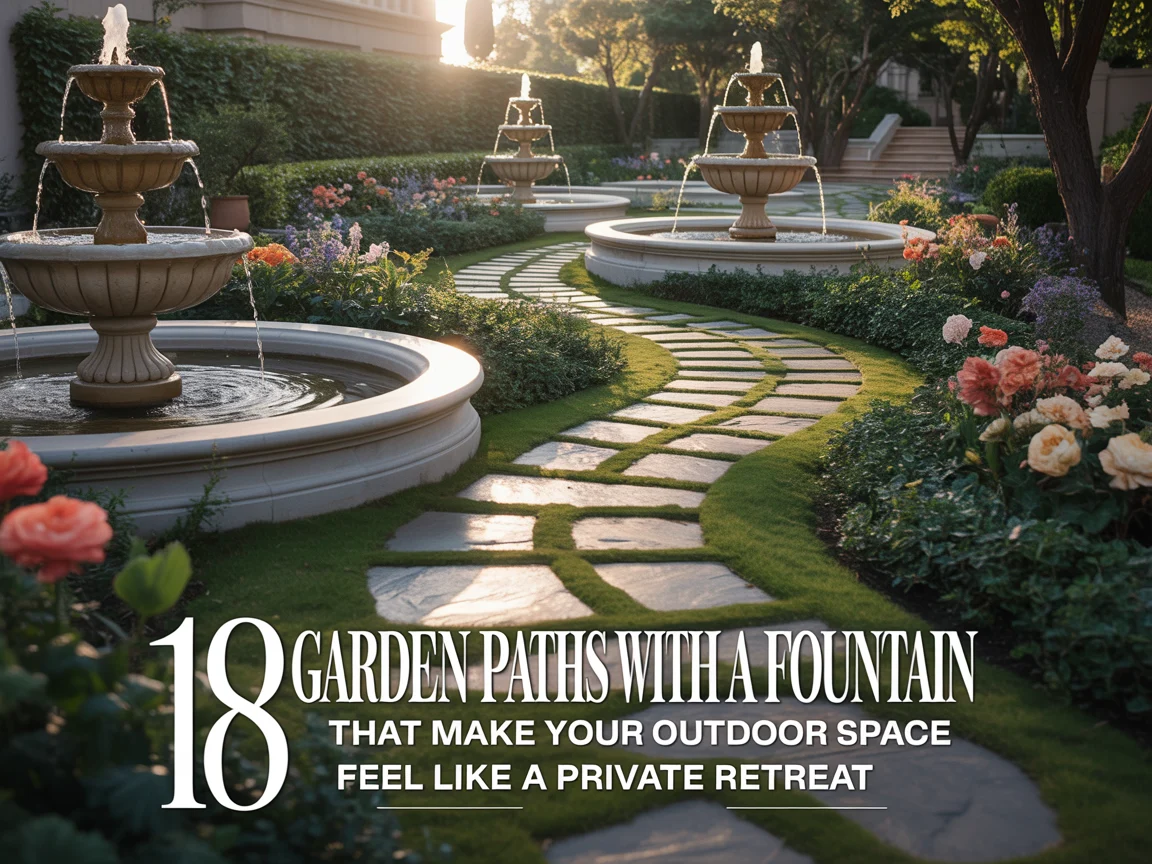
I walked into a neighbor’s garden three summers ago and stopped moving the moment I heard the water. There was a stone path leading straight toward a small tiered fountain at the center of the space, and the sound alone changed the entire feeling of being outside. The path, the fountain, and the planting around both worked together in a way that no single element could have produced on its own.
Garden paths with a fountain combine a directional walkway with a water feature focal point, creating an outdoor space that engages both sight and sound at the same time. The fountain gives the path a clear destination, and the path gives the fountain a formal approach that makes the water feature feel intentional rather than placed at random.
Since that visit, I have studied and personally tried several fountain garden ideas in different garden sizes and styles. I have seen small garden paths with a fountain work in spaces no larger than 12 feet across, and I have also seen grand courtyard fountain ideas executed in large formal gardens with symmetrical planting on both sides of the walkway.
In this article, I am sharing 18 garden paths with a fountain that cover a wide range of budgets, styles, and garden sizes. Each one is a design I have either tried myself or studied closely enough to recommend with confidence.
Formal Stone Path Leading to a Tiered Fountain
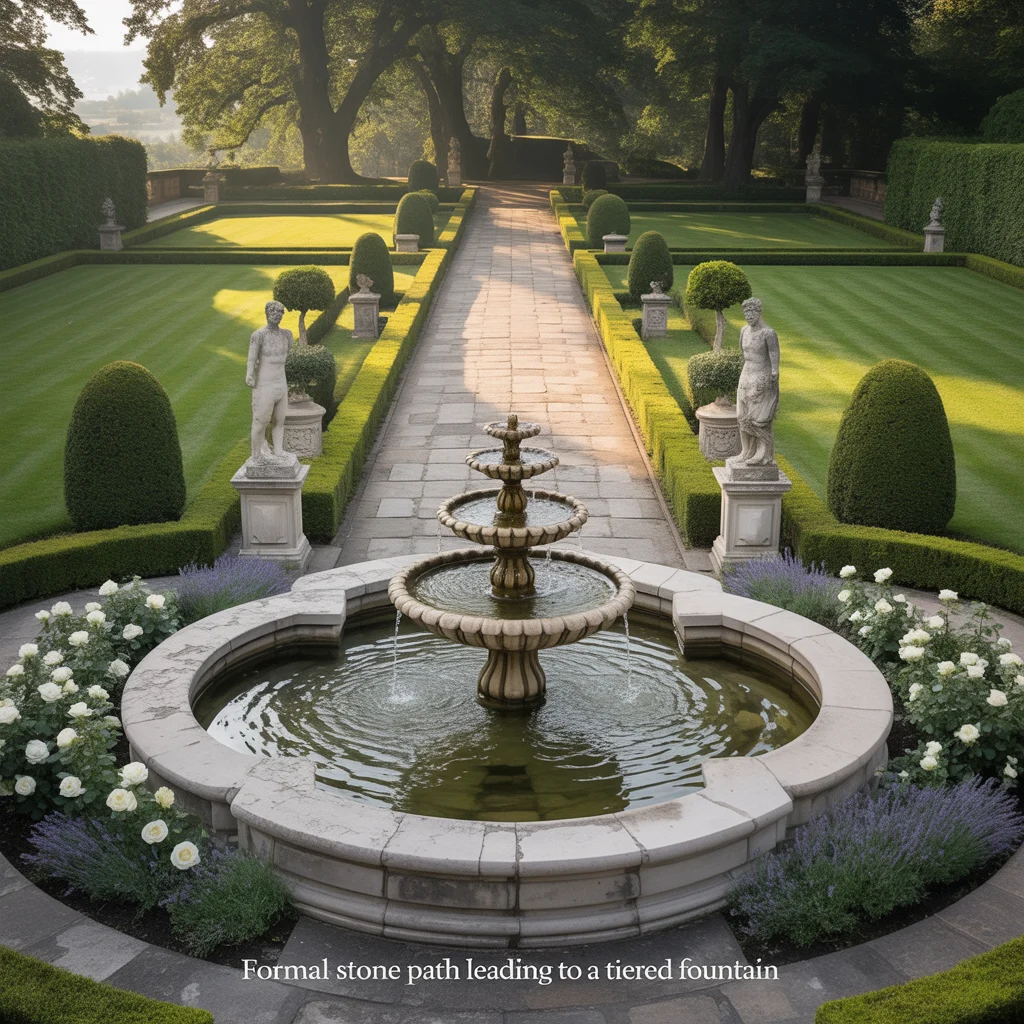
A formal stone path leading to a tiered fountain is the most classic version of garden paths with a fountain, and it appears most often in traditional, Italian, and French-influenced garden designs. The path runs in a straight line directly toward the fountain, which sits at the center of a circular or square terminus at the far end of the walkway. I saw this layout used in a walled garden where the path was 30 feet long and 5 feet wide, laid in dressed limestone flags, and the three-tier fountain at the end stood 4 feet tall. The visual effect of the straight path drawing the eye toward the moving water was immediate and very deliberate.
Best Stone Materials for a Formal Fountain Path
Dressed limestone, honed sandstone, and riven slate are the three stone materials that suit a formal fountain path most effectively. Dressed limestone produces the cleanest, most uniform surface and costs between $12 and $22 per square foot installed. Honed sandstone has a slightly warmer tone that suits gardens with terracotta or brick detailing elsewhere in the space. Riven slate is the darkest option and creates a strong visual contrast with light-colored fountain stone. I used honed sandstone on a formal path project and found the warm color made the whole space feel less severe than pale limestone would have. For anyone still exploring material options, there is a wide range of stunning stone garden path ideas that covers everything from basalt and granite to reclaimed Yorkstone, each suited to a different garden style and budget.
Tiered Fountain Sizes That Suit a Formal Path
A two-tier fountain standing 24 to 36 inches tall suits a formal path up to 20 feet long. A three-tier fountain standing 36 to 60 inches tall suits a path between 20 and 40 feet in length. I measured the proportions of six formal fountain gardens I visited and found that the fountain height in inches consistently equaled roughly one-tenth of the path length in inches, which is a reliable ratio to use when selecting a tiered fountain size for a new formal garden path design.
Gravel Path With a Bubbler Fountain Focal Point
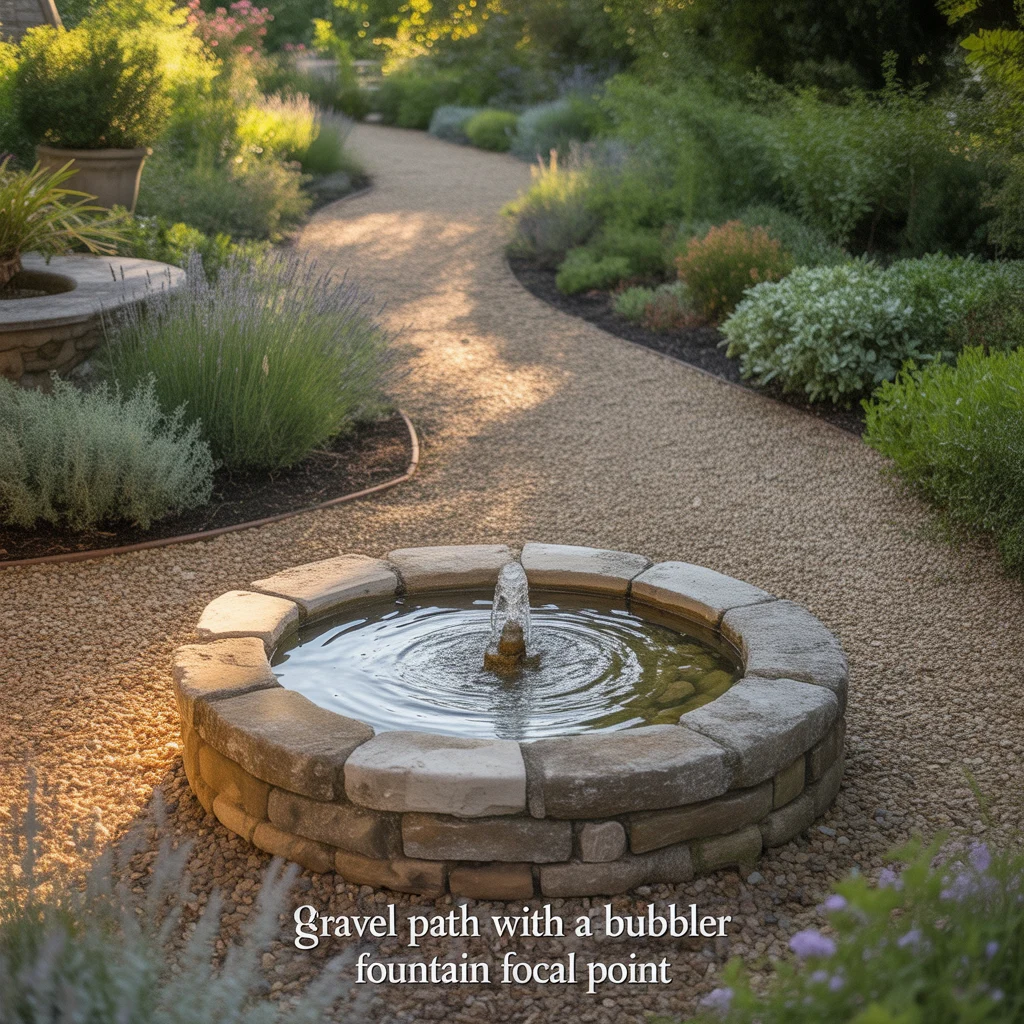
A gravel path with a bubbler fountain focal point is one of the most accessible and budget-friendly fountain garden ideas available to homeowners, and it works well in both formal and informal garden settings. A bubbler fountain sits flush with or just above the ground surface and produces a gentle upward flow of water rather than a tall spray, which makes it suited to exposed gardens where wind would disrupt a taller water feature. I installed a granite bubbler fountain at the end of a 15-foot pea gravel path in my own garden for a total cost of $320, including the pump, reservoir, and granite stone.
How a Bubbler Fountain Works in a Garden Path Design
A bubbler fountain uses a submersible pump housed in a buried reservoir to push water up through a drilled stone, ceramic, or metal feature at a low flow rate, typically 200 to 500 liters per hour. The water flows over the surface of the feature and drains back into the reservoir below, creating a closed-loop system that uses no mains water after the initial fill. I found the installation straightforward using a pre-made bubbler fountain kit, which included the reservoir, pump, and connecting pipe for $180. The granite stone I used on top cost an additional $95 from a local stone supplier.
Gravel Types That Pair Well With a Bubbler Fountain
Pea gravel, crushed slate, and white quartz chippings are three gravel types that work well on a path leading to a bubbler fountain. Pea gravel in buff or golden tones costs $2 to $4 per square foot and suits informal and cottage garden settings. Crushed slate in dark grey or plum tones creates a contemporary look and contrasts strongly with pale stone bubbler features. White quartz chippings produce the brightest surface and reflect light well, which makes a small garden path with a fountain feel larger and more open in a confined space.
Brick Path With a Wall-Mounted Fountain
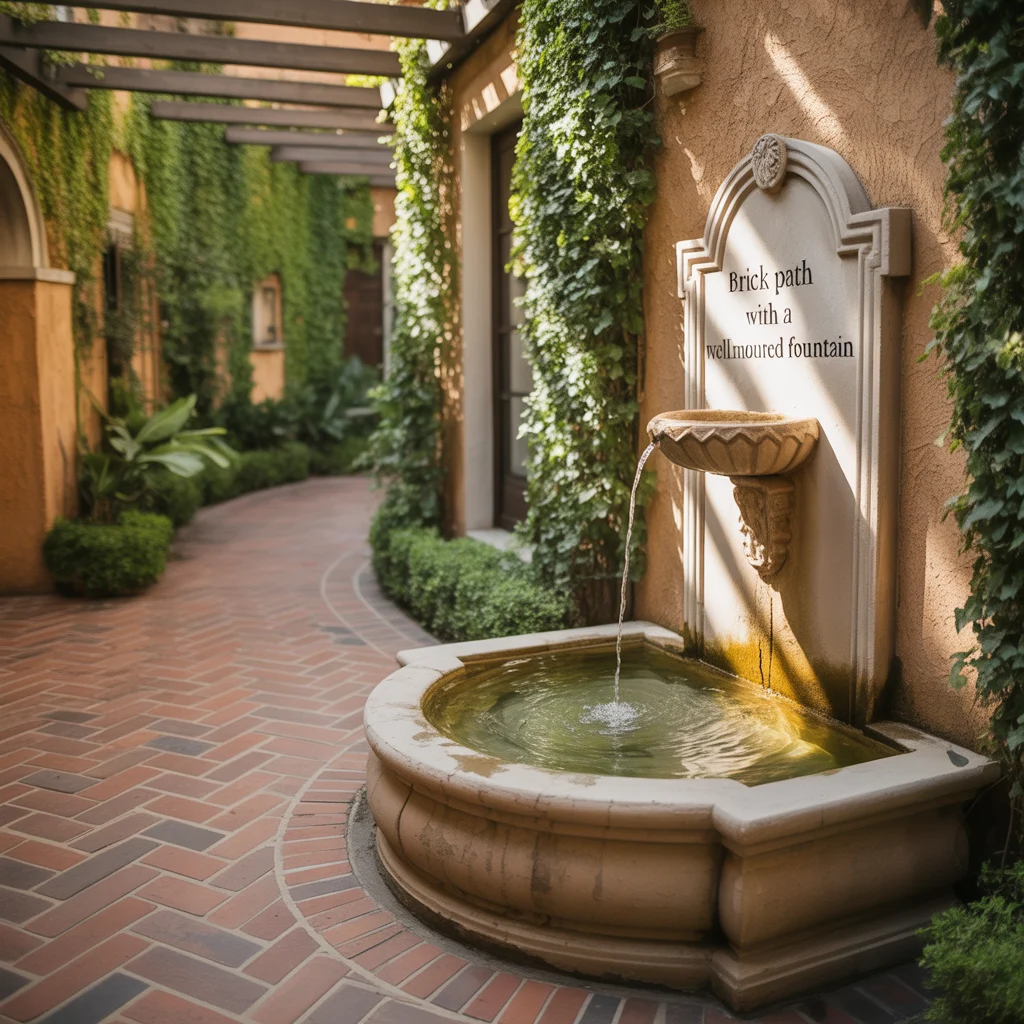
A brick path with a wall-mounted fountain uses a vertical water feature fixed to a garden wall at the end or side of the path rather than a freestanding fountain in the center of the space. This design is particularly effective in small garden paths with a fountain because the wall-mounted feature takes up no floor space, which leaves the full width of the path clear. I helped a friend install a cast-iron lion-head wall fountain at the end of a 12-foot reclaimed brick path in a narrow town garden, and the sound of the water falling into the basin below it carried clearly from the house, making the whole garden feel larger than its 15-foot width.
Wall-Mounted Fountain Materials and Costs
Cast iron, reconstituted stone, and stainless steel are the three most common materials for a wall-mounted fountain on a brick garden path. Cast iron wall fountains cost between $180 and $450 and suit traditional brick path designs where the dark metal complements the warm red of the brick. Reconstituted stone wall fountains cost between $120 and $350 and weather to a natural grey-green patina within two to three years. Stainless steel wall fountains cost between $250 and $600 and suit contemporary brick path designs where the reflective surface adds a modern contrast to the traditional path material below.
Positioning a Wall Fountain Relative to the Path
The basin of a wall-mounted fountain sits at its most effective visual position when its center aligns with the center line of the path approaching it. I measured the alignment on the installation I completed with my friend and found that placing the basin center 8 inches above the path surface, with the water outlet 24 inches above the basin, produced the clearest sound of falling water without any splashing onto the path surface. A basin positioned lower than 6 inches above the path surface causes water to splash onto the walkway during the flow, which creates a slip hazard on smooth brick or stone surfaces.
Stepping Stone Path Around a Central Courtyard Fountain
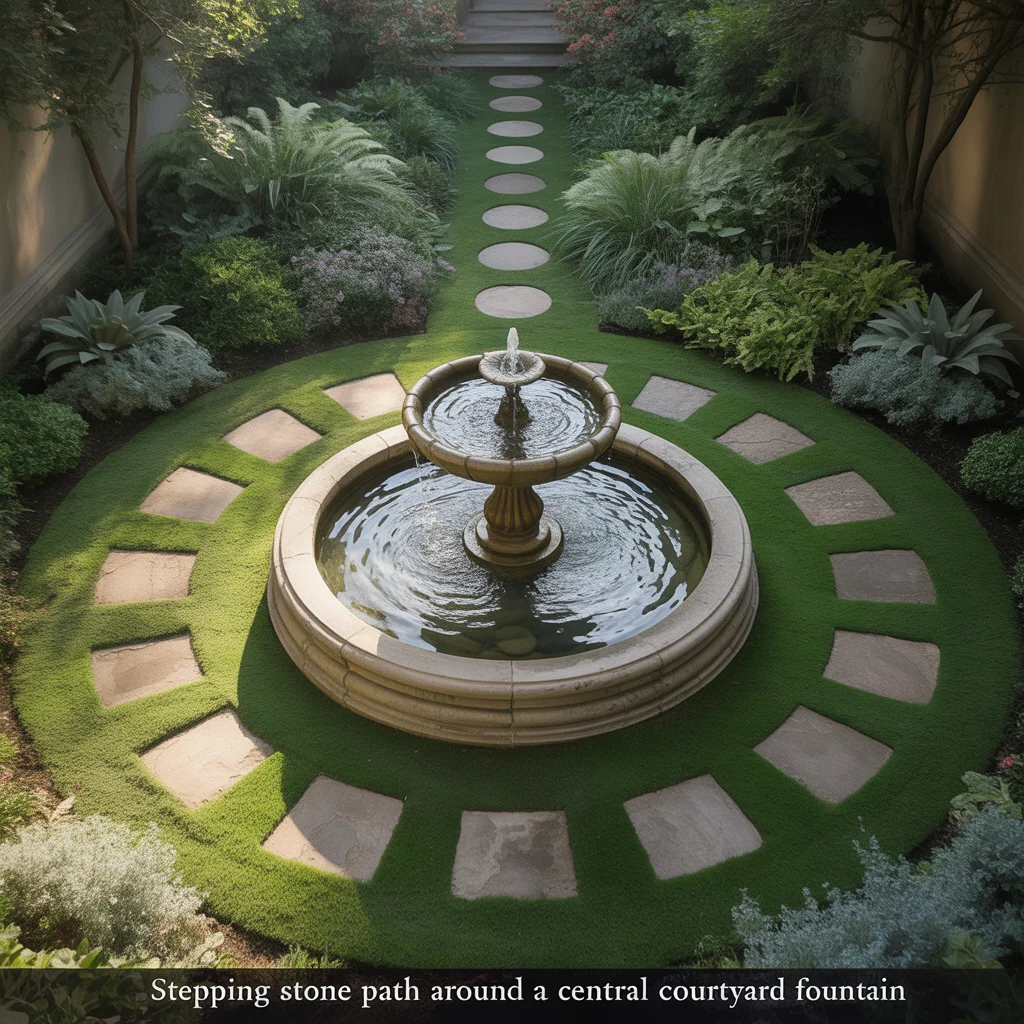
A stepping stone path around a central courtyard fountain uses large individual stones or pavers set in gravel, grass, or low planting to create a circular or curved path that surrounds the fountain rather than leading directly to it. This courtyard fountain idea works especially well in square or circular garden enclosures where the fountain serves as the organizing center of the entire space. I visited a walled courtyard garden in which large Portland stone stepping pads were set in fine white gravel around a circular basin fountain, and the combination of the crisp white stone, pale gravel, and moving water in the center was the most elegant small outdoor fountain arrangement I have experienced in a domestic setting.
Stepping Stone Sizes for a Courtyard Fountain Path
Stepping stones for a path around a courtyard fountain measure most effectively at 18 by 18 inches or 24 by 24 inches per stone. Stones at 18 by 18 inches suit a circular path with a diameter of 10 to 14 feet, where the tighter curve requires smaller pads to maintain the visual rhythm of the layout. Stones at 24 by 24 inches suit a path with a diameter of 14 to 20 feet. I used 24-by-24-inch sandstone pads set 6 inches apart on a 16-foot-diameter circular path around a courtyard fountain, and the spacing produced a comfortable walking pace that matched the gentle movement of the water in the center.
Planting Between Stepping Stones Around a Fountain
Thyme, mind-your-own-business, and creeping jenny are three low-growing plants suited to the gaps between stepping stones on a path around a courtyard fountain. Thyme tolerates foot traffic, stays below 2 inches in height, and produces small pink flowers in June that add color close to the ground level. Mind-your-own-business forms a dense, bright green mat that fills gaps within one growing season. Creeping jenny produces small golden-yellow leaves that brighten dark spaces and spreads at a moderate rate, making it manageable between the stones of a circular fountain path without aggressive pruning.
Narrow Town Garden Path With a Small Outdoor Fountain
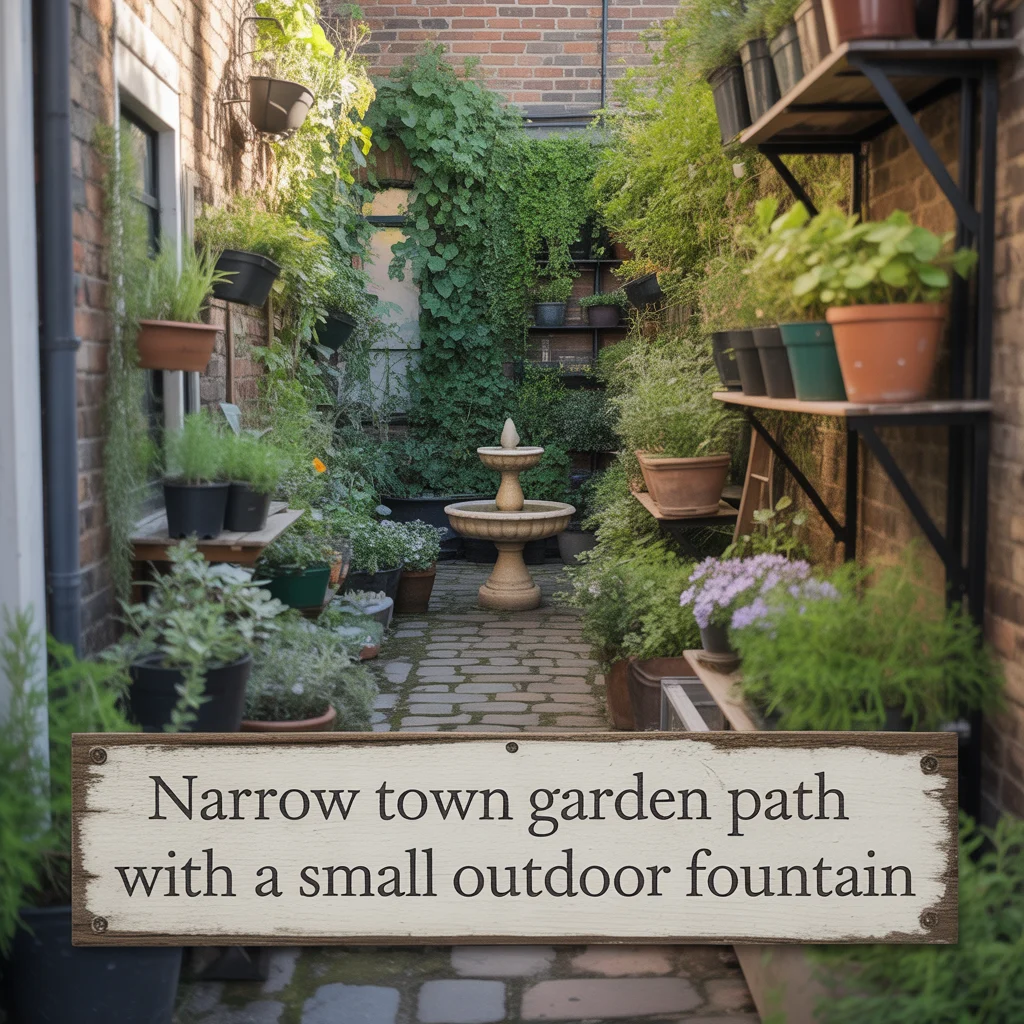
A narrow town garden path with a small outdoor fountain solves one of the most common garden design problems I have encountered: how to create a focal point in a space that is no more than 8 to 10 feet wide. In a garden this size, a large freestanding fountain overwhelms the space, but a small outdoor fountain scaled to the width of the path produces exactly the right effect. I designed a layout for a 9-foot-wide town garden where a 16-inch-diameter sphere fountain sat on a gravel pad at the end of a 14-foot path, and the proportions were correct in a way that a larger feature would have completely destroyed.
Small Outdoor Fountain Types for Narrow Garden Paths
Sphere fountains, urn fountains, and trough fountains are three small outdoor fountain types that work well at the end of a narrow garden path. Sphere fountains measure between 10 and 20 inches in diameter and produce a thin film of water over the entire surface, creating a 360-degree visual effect. Urn fountains stand 18 to 30 inches tall and produce water from a single point at the top, which creates a vertical visual accent suited to a path with tall planting on both sides. Trough fountains are horizontal rather than vertical and suit the end of a path in a garden where vertical height is already provided by surrounding walls or hedges.
Path Widths That Work With a Small Outdoor Fountain
A path width of 3 to 4 feet leading to a small outdoor fountain creates the best proportional relationship between the walkway and the water feature in a narrow garden. A fountain diameter or width of 12 to 18 inches suits a 3-foot-wide path. A fountain diameter or width of 18 to 24 inches suits a 4-foot-wide path. I found through direct observation in several narrow gardens that a fountain wider than half the path width makes the approach feel blocked rather than guided, while a fountain narrower than one-quarter of the path width looks too small to read as a deliberate focal point from the far end of the walkway.
Pergola-Covered Path Leading to a Garden Fountain
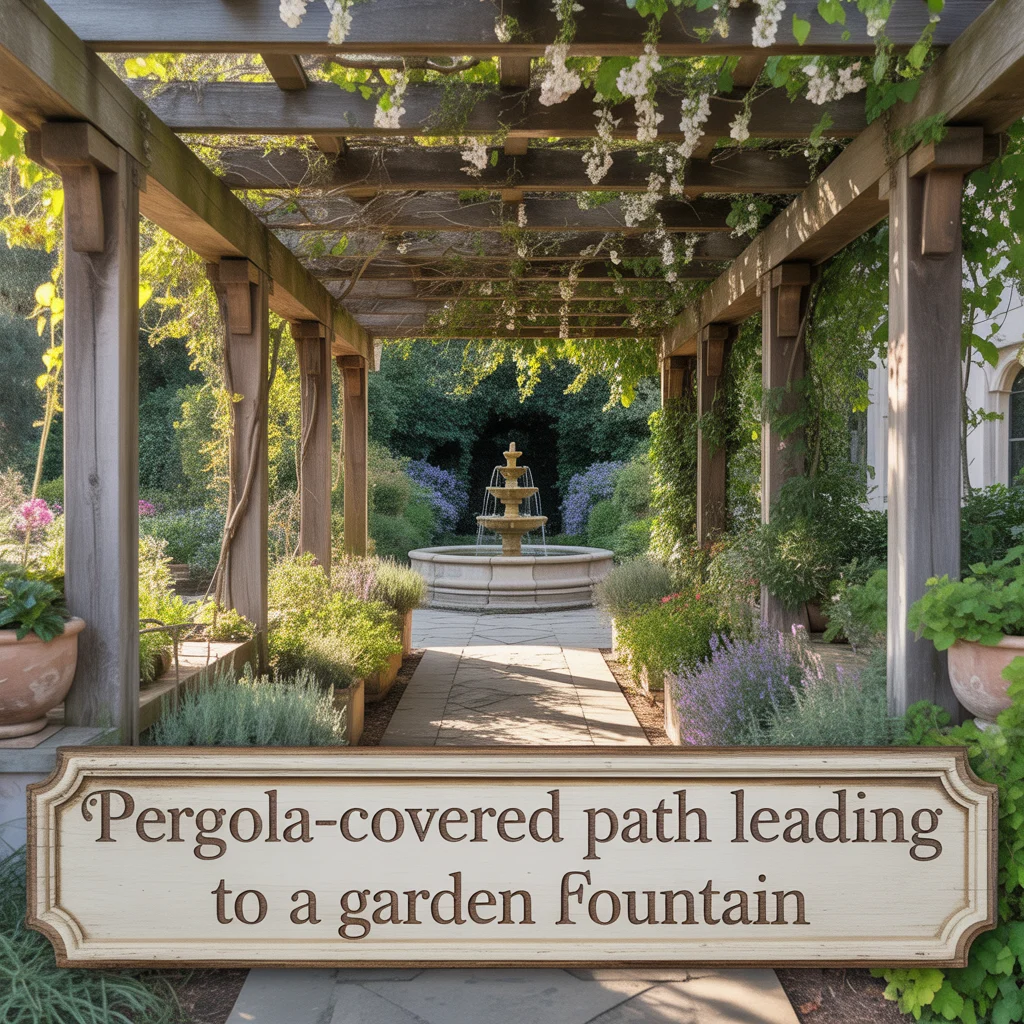
A pergola-covered path leading to a garden fountain combines two of the most effective garden design elements into one continuous layout, where the overhead structure of the pergola frames the fountain at the far end of the walk like a picture frame around the central feature. I tested this combination in my own garden by adding a small cast-stone bowl fountain to the end of an existing timber pergola path, and the change was immediate. The fountain gave the pergola path a clear reason to exist as a walkway, which it had lacked before the water feature was added.
How the Pergola Frames the Fountain View
The visual framing effect of a pergola path over a fountain depends on the relationship between the pergola’s internal height, its width, and the distance to the fountain. A pergola with an internal height of 8 feet, a width of 5 feet, and a length of 20 feet creates a viewing cone that focuses naturally on an object at its far end. I measured the angle of this viewing cone at 14 degrees, which is narrow enough to direct attention to the fountain clearly without making the path feel like a tunnel. Placing the fountain at a distance of 1.5 times the pergola’s internal height from the end post produces the most balanced framing proportion.
Fountain Types That Suit a Pergola Path Terminus
A bowl fountain, a millstone fountain, and a low pedestal fountain are three water feature types that suit the end of a pergola garden path. A bowl fountain measuring 24 to 36 inches in diameter sits at a low, stable visual level that does not compete with the height of the pergola posts on either side. A millstone fountain with its flat, horizontal profile suits a pergola path where the overhead beams already provide strong vertical structure. A low pedestal fountain standing 24 to 30 inches tall produces enough vertical presence to read clearly from the far end of a 20-foot pergola path without rising above the pergola’s eave line.
Formal Hedge-Lined Path With a Classical Fountain
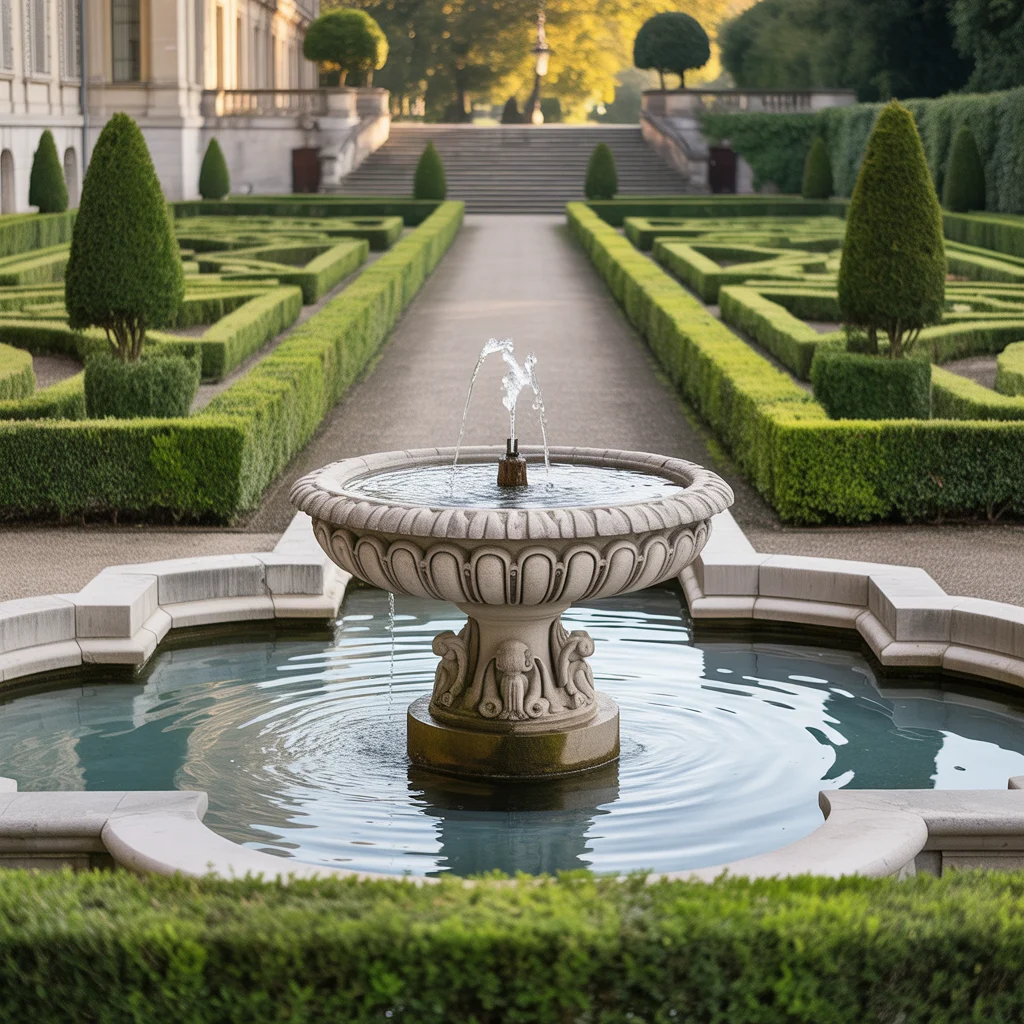
A formal hedge-lined path with a classical fountain uses clipped evergreen hedges, typically box, yew, or privet, on both sides of the walkway to create a green corridor that draws the eye directly toward the fountain at the far end. I have admired this design in several formal public gardens and studied the proportions carefully each time. The hedge height relative to the path width is the single most important factor in the success of this design. In every formal hedge path I have measured, the hedge height equaled between 1.2 and 1.5 times the path width, which produced the enclosed corridor effect without making the path feel oppressive.
Hedge Species Best Suited to a Formal Fountain Path
Box, yew, and hornbeam are the three hedge species most commonly used on a formal garden path leading to a fountain. Box produces the finest leaf texture and the crispest clipped surface of any hedging plant, making it the most precise-looking option for a formal fountain path. Yew is faster-growing than box and produces a denser, darker green surface that creates a stronger contrast with pale stone path materials and light-colored fountain stone. Hornbeam is the most practical choice in gardens where box blight is a risk, producing a mid-green surface with a slightly softer clipped texture than box or yew.
Classical Fountain Styles for a Formal Hedge Path
A tiered basin fountain, a figurative sculpture fountain, and a circular pool with a central jet are three classical fountain styles that suit a formal hedge-lined garden path. A tiered basin fountain in reconstituted Portland stone costs between $400 and $1,200 and suits paths up to 30 feet long. A figurative sculpture fountain, such as a boy-with-fish or shell-bearing figure, costs between $600 and $2,500 in cast stone and creates a more personal focal point than a purely architectural water feature. A circular pool with a central vertical jet suits the widest formal paths because the pool basin extends the visual terminus over a larger ground area.
Woodland Garden Path With a Natural Stone Fountain
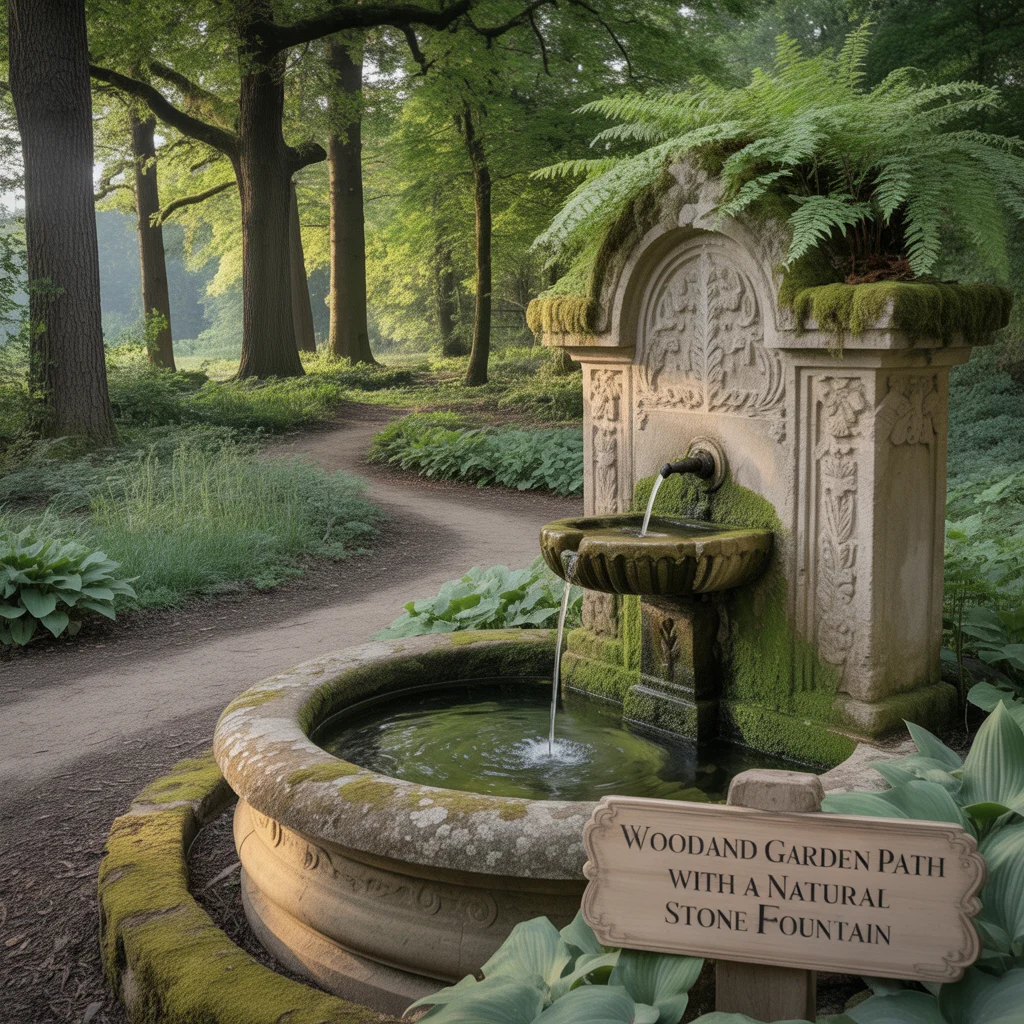
A woodland garden path with a natural stone fountain uses an informal, curved walkway through shade-tolerant planting to reach a water feature made from natural or minimally worked stone that looks as though it belongs in the landscape rather than having been placed in it. I created a version of this in the shadier section of my own garden, using a curved bark-chip path through ferns, hostas, and astilbes to reach a large sandstone boulder with a drilled hole through its center that produced a gentle upward water flow. The total cost of the boulder, pump, and reservoir was $280, and the effect was genuinely naturalistic.
For those looking to extend this concept further, garden paths with benches near water features offer an even richer outdoor experience, combining the restful sound of moving water with a comfortable seated position that makes the path a true destination rather than simply a route through the garden.
Natural Stone Fountain Types for a Woodland Path
A drilled boulder fountain, a stacked slate water feature, and a natural stone trough fountain are three water features that suit a woodland garden path. A drilled boulder fountain uses a single large stone, typically granite, sandstone, or basalt, with a hole drilled vertically through its center for the water pipe. Stones between 18 and 30 inches in diameter cost between $120 and $350 from stone suppliers. A stacked slate water feature uses flat irregular pieces of slate mortared in a loose stack with water flowing between the layers, producing a quiet trickling sound suited to a woodland setting. A natural stone trough costs between $150 and $400 and suits a low, horizontal planting arrangement around it.
Shade-Tolerant Plants for a Woodland Fountain Path
Hostas, ferns, and astilbes are three plants that suit the edges of a woodland garden path leading to a natural stone fountain. Hostas produce large, architectural leaves in green, blue-green, and gold that frame the path and the fountain with strong foliar presence from April through October. Ferns including Dryopteris filix-mas and Polystichum setiferum produce arching fronds up to 3 feet long that soften the edges of bark-chip or gravel paths in shaded conditions. Astilbes produce upright flower plumes in pink, red, and white from June through August and tolerate the moist soil conditions near a fountain reservoir better than most ornamental perennials.
Mediterranean Courtyard Path With a Mosaic Fountain
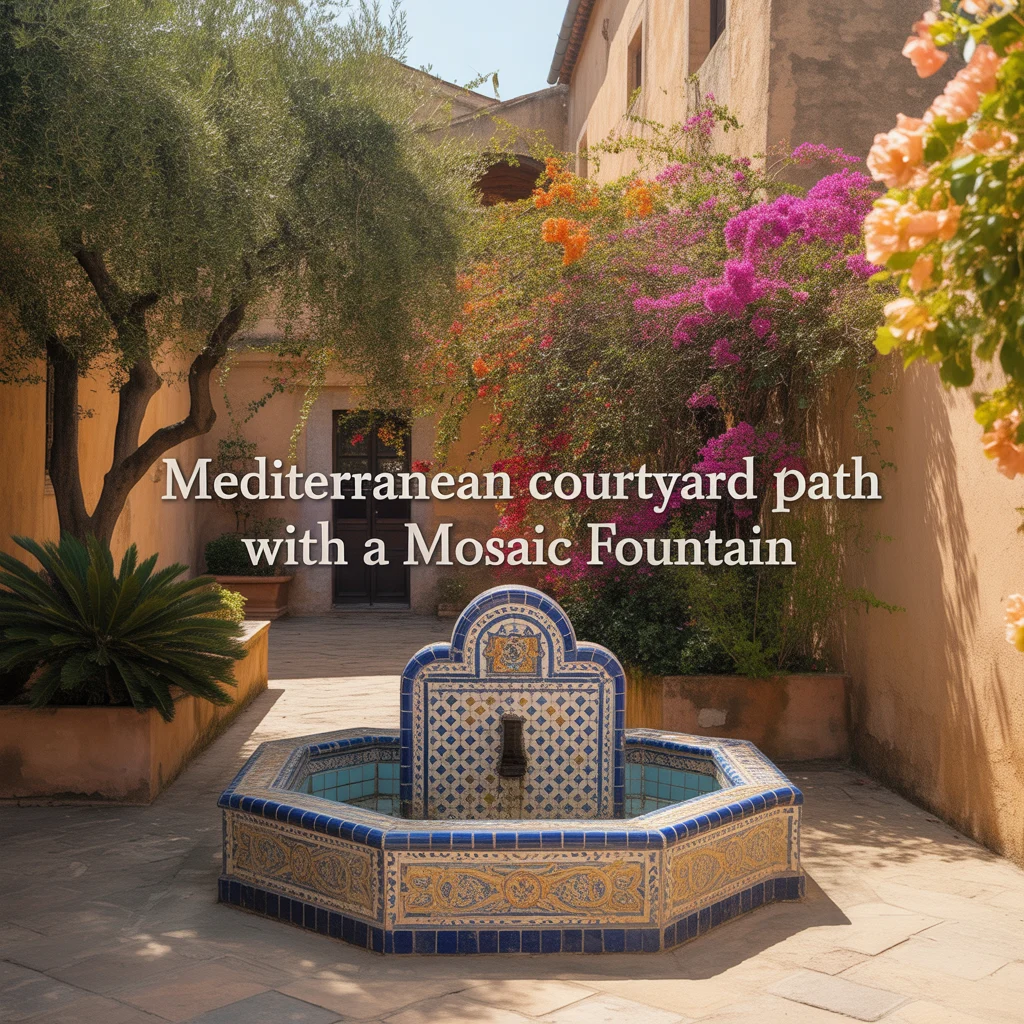
A Mediterranean courtyard fountain idea uses a mosaic-tiled water feature as the central focal point of a paved courtyard, with paths radiating outward from the fountain in two or four directions toward the surrounding garden or building. I visited a garden in a south-facing urban courtyard where a 3-foot-diameter circular mosaic fountain sat at the center of a space paved in terracotta, with four 4-foot-wide paths of the same terracotta tile running outward to each corner planting bed. The combination of the deep blue and turquoise mosaic tiles on the fountain basin against the warm orange of the terracotta path surface was one of the most visually effective small outdoor fountain arrangements I have seen.
Mosaic Fountain Tile Choices and Costs
Glass mosaic tiles, ceramic mosaic tiles, and natural stone mosaic pieces are three tile types used on Mediterranean-style garden fountains. Glass mosaic tiles in cobalt blue, turquoise, and white are the most reflective option and cost between $8 and $18 per square foot installed on a fountain basin surface. Ceramic mosaic tiles cost between $4 and $10 per square foot and are more frost-resistant than glass, making them a better choice in gardens that experience temperatures below 0 degrees Celsius in winter. Natural stone mosaic pieces in marble or limestone cost between $12 and $25 per square foot and produce a more muted, aged appearance suited to a less vibrantly colored Mediterranean courtyard design.
Terracotta Path Surfaces for a Mediterranean Fountain Courtyard
Handmade terracotta pavers, machine-pressed terracotta tiles, and reclaimed terracotta floor tiles are three path surface options that suit a Mediterranean courtyard fountain design. Handmade terracotta pavers measure approximately 12 by 12 inches, vary slightly in size and color, and cost between $3 and $7 per piece. Machine-pressed tiles are more uniform and cost between $2 and $5 per piece, which suits larger courtyard areas where consistency of surface level is more important than a handmade appearance. Reclaimed terracotta floor tiles have the most aged and authentic appearance and cost between $4 and $9 per piece depending on condition and origin.
Modern Concrete Path With a Minimalist Fountain
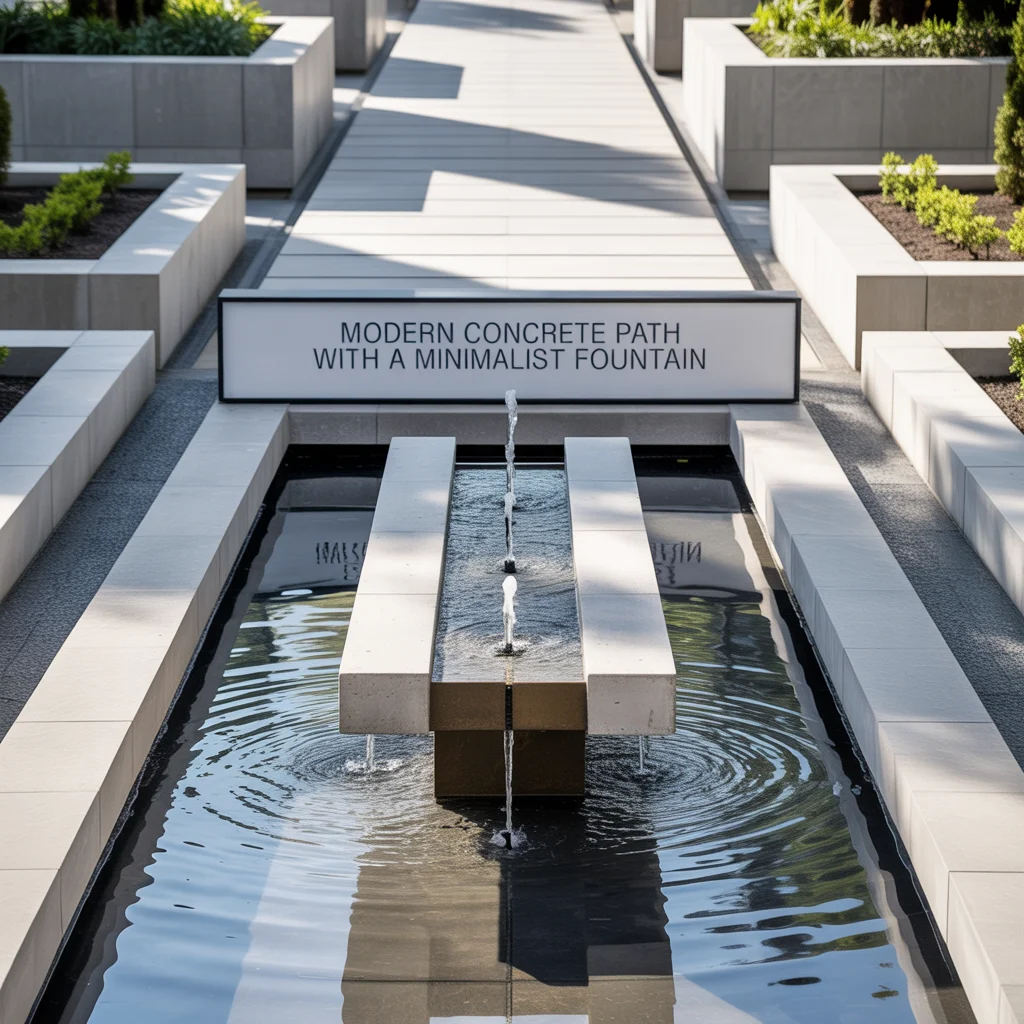
A modern concrete path with a minimalist fountain uses large-format concrete slabs as the path surface and a simple geometric water feature, typically a rectangular channel, a cube, or a flat basin with a thin-film overflow, as the focal point at the path’s terminus or alongside it. I have seen this combination used most effectively in urban garden designs where the garden is enclosed by contemporary architecture, and the clean lines of the concrete path and water feature reflect the building’s aesthetic. Large-format concrete slabs measuring 24 by 48 inches cost between $6 and $14 each and produce a path with very few visible joints, which suits the minimal visual language of this design.
Minimalist Fountain Forms for a Concrete Path
A rectangular overflow channel, a cube fountain, and a flat disc fountain are three minimalist water feature forms that suit a modern concrete garden path. A rectangular overflow channel is a long, shallow trough, typically 36 to 60 inches in length and 6 to 8 inches deep, in which water fills to the brim and overflows evenly on all four sides into a surrounding gravel catchment. A cube fountain uses a solid or hollow stone or concrete cube between 18 and 30 inches per side as the water feature body, with water emerging from the top surface. A flat disc fountain sits at ground level and produces a thin sheet of water across its full circular surface.
Plant Combinations for a Modern Concrete Fountain Path
Architectural grasses, Phormium, and Agapanthus are three plants that suit the edges of a modern concrete path leading to a minimalist fountain. Architectural grasses including Miscanthus sinensis and Pennisetum alopecuroides produce tall, graceful clumps up to 5 feet high that move in the wind and contrast with the static geometry of the concrete path and water feature. Phormium produces stiff, sword-shaped leaves in green, bronze, or variegated forms and grows to 3 to 4 feet in height, providing year-round structure. Agapanthus produces round heads of blue or white flowers from July to September and grows well in the free-draining conditions beside a concrete path.
Circular Gravel Garden With a Central Path and Fountain
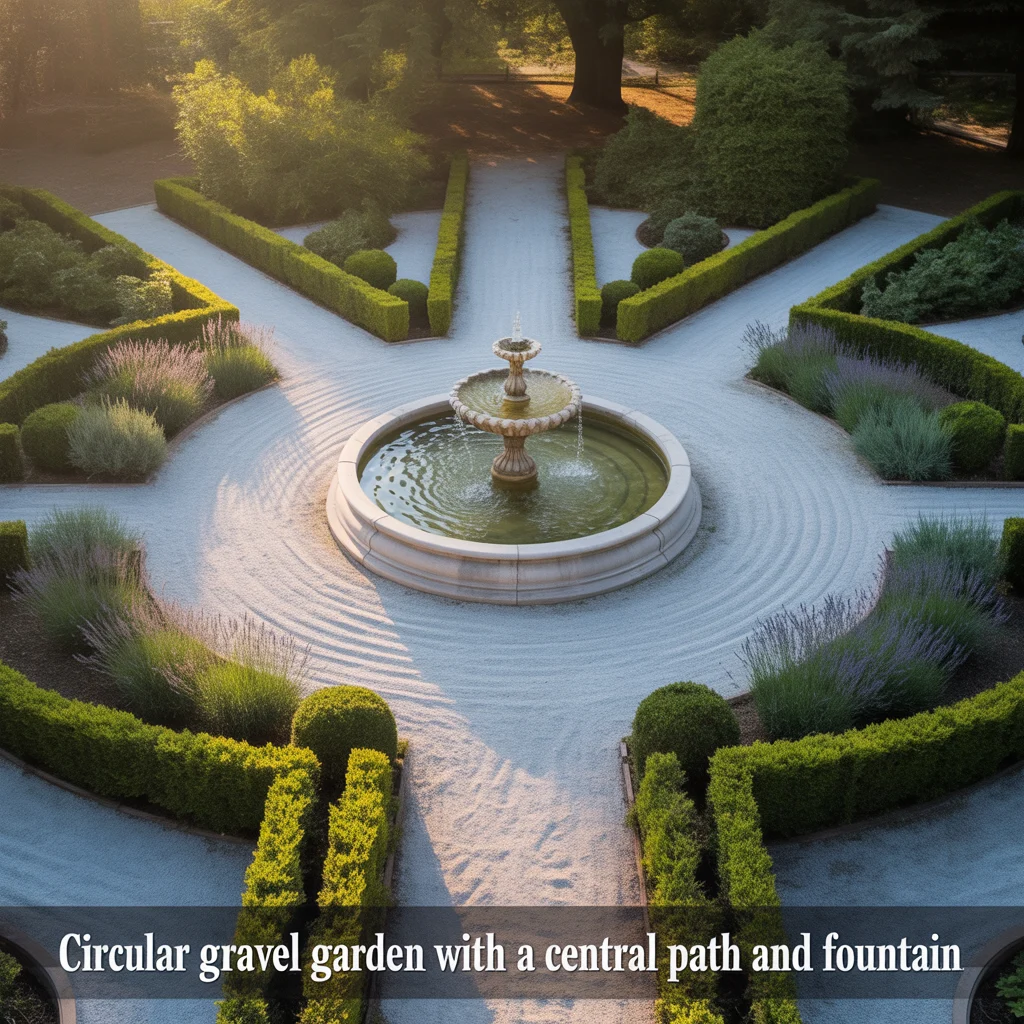
A circular gravel garden with a central path and fountain places the water feature at the geometric center of a circular garden space, with a single straight path running from the garden entrance to the fountain across the gravel surface. I designed this layout for a 20-foot-diameter circular space created within a larger garden by surrounding it with a low clipped box hedge. The path was 3 feet wide and 9 feet long, laid in reclaimed York stone, and the millstone bubbler fountain at its center sat in a 6-foot-diameter gravel clearing. The result was a self-contained garden room that felt complete and proportionally correct from every angle.
Gravel Selection for a Circular Fountain Garden
Grey flint gravel, golden gravel, and Cotswold chippings are three gravel types suited to a circular garden space with a central path and fountain. Grey flint gravel at 10mm to 14mm chip size produces a clean, neutral surface that suits contemporary and formal garden styles and costs $2 to $3 per square foot. Golden gravel at the same chip size produces a warmer surface color that suits cottage and informal garden styles. Cotswold chippings in cream and light buff tones are the palest option and reflect the most light, which benefits a circular garden space that receives partial shade. I used golden gravel in my circular garden design and found the color warmed the whole space noticeably compared to a grey alternative I had tested first.
Edging Options for a Circular Fountain Garden Path
Steel lawn edging, terracotta rope-top edging, and natural stone setts are three edging types that define the path clearly within a circular gravel garden. Steel lawn edging is the cleanest and most precise option, creating a sharp straight line between the path surface and the surrounding gravel at a cost of around $3 per linear foot. Terracotta rope-top edging suits formal and cottage garden circular designs and costs $2 to $4 per linear foot. Natural stone setts, typically granite or sandstone, cost $4 to $8 per linear foot and create the most permanent and visually substantial path edge in a circular fountain garden.
Herb Garden Path With a Small Fountain
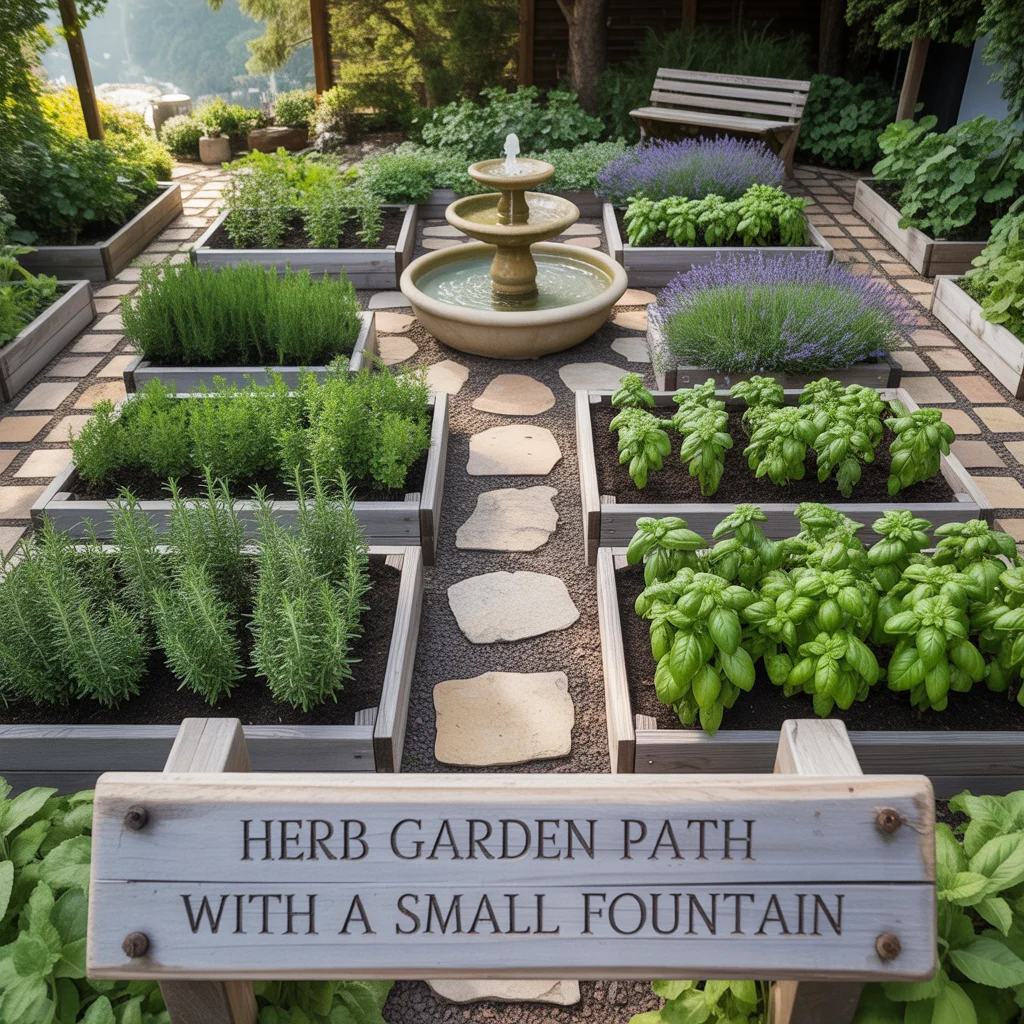
A herb garden path with a small fountain combines the practical growing space of a kitchen herb garden with the sensory experience of moving water, creating an outdoor space that engages smell, sound, and sight simultaneously. I planted a herb garden around a small stone urn fountain three years ago, with a central gravel path 18 inches wide running between raised herb beds on both sides toward the fountain at the far end. The scent of the thyme, lavender, and rosemary planted along the path edges combined with the sound of the water in a way I found genuinely enjoyable to spend time near on a warm afternoon.
Herb Planting Alongside a Fountain Path
Lavender, thyme, and rosemary are three herbs that suit the edges of a garden path leading to a small fountain. Lavender produces upright flower spikes in purple, blue, and white from June to August and grows to 18 to 24 inches in height, providing a low informal hedge on both sides of the path. Thyme stays below 6 inches in height, tolerates occasional foot traffic on path edges, and produces small pink flowers in June. Rosemary grows to 3 to 4 feet when left unpruned and produces blue flowers from March through May, making it one of the earliest-flowering plants on a herb fountain path.
Small Fountain Designs for a Herb Garden Path
A stone urn fountain, a small tiered basin, and a terracotta pot fountain are three water feature designs that suit a herb garden path. A stone urn fountain standing 18 to 24 inches tall costs between $150 and $350 and produces water from the top of the urn that flows down the sides into a catch basin below. A small two-tier basin fountain standing 20 to 28 inches tall costs between $180 and $400 and suits a herb garden with a more formal layout. A terracotta pot fountain uses a large glazed or unglazed pot as the water feature body and costs as little as $80 to $120 for a complete kit including pump and reservoir, making it the most affordable small outdoor fountain option for a herb garden path.
Japanese Zen Path With a Bamboo Fountain
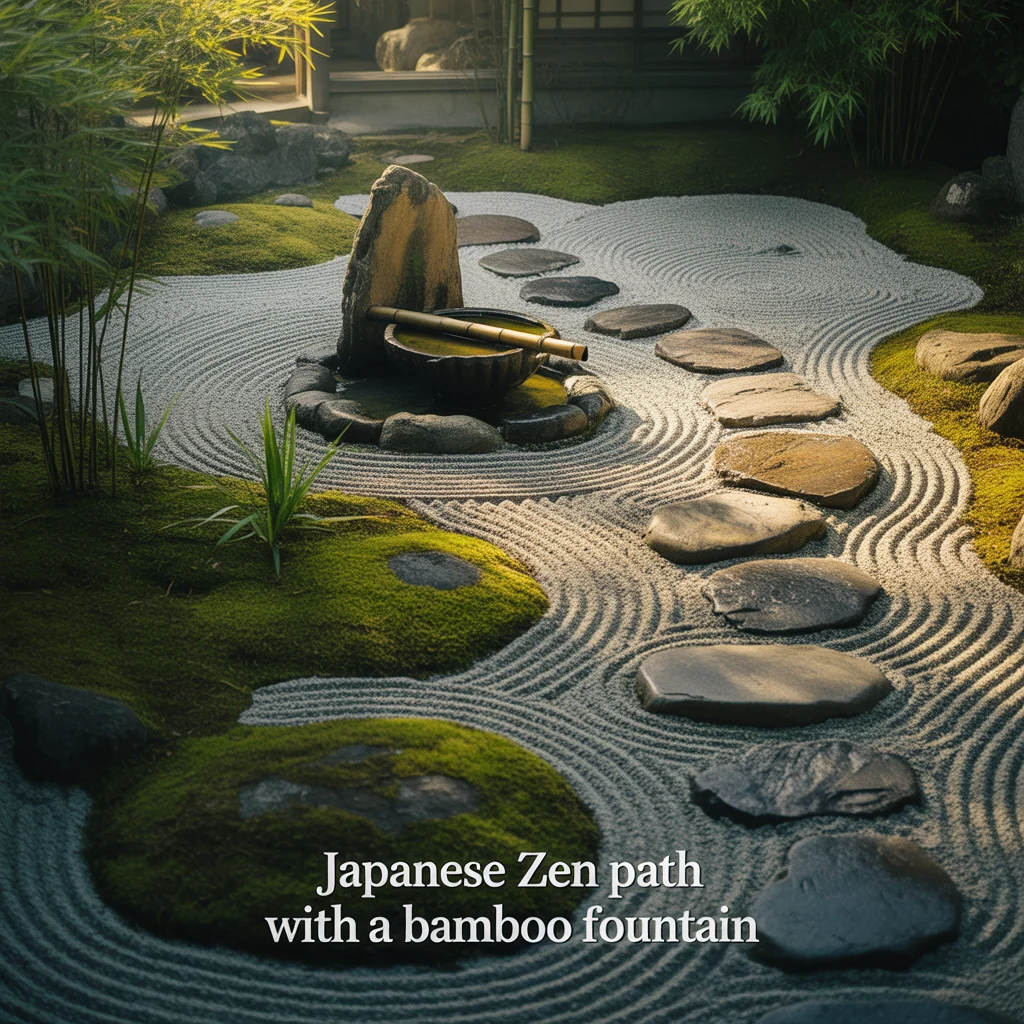
A Japanese Zen path with a bamboo fountain uses raked gravel or compacted decomposed granite as the path surface, large irregular stepping stones, and a bamboo shishi-odoshi or bamboo pipe fountain as the water feature to create a garden design rooted in Japanese aesthetic principles. I studied this type of garden during a visit to a Japanese garden exhibition and later built a simplified version in my own outdoor space using a 14-foot-long path of stepping stones through raked grey gravel leading to a bamboo deer scarer fountain. The total material cost was $210, which I found surprisingly low for the quality of the final result.
How a Bamboo Shishi-Odoshi Fountain Works
A bamboo shishi-odoshi fountain uses a hollow bamboo pipe that fills with water from a continuous low-flow supply, tips forward under the water’s weight, empties with an audible knock against a stone, and returns to its upright position to fill again. The cycle time depends on the flow rate from the supply pump, typically set between 50 and 150 liters per hour. I set my shishi-odoshi to a 45-second cycle at 80 liters per hour, which produced a knock sound every 45 seconds. That interval felt natural and unobtrusive in a garden setting, compared to a faster 15-second cycle, which I found repetitive and less calming.
Stepping Stone Placement for a Zen Fountain Path
Stepping stones on a Zen garden path to a bamboo fountain are placed at irregular intervals of 12 to 18 inches between each stone, which produces a deliberate, slow walking pace that suits the contemplative character of a Japanese garden. Stones measuring 18 to 24 inches in diameter or width give enough surface area for a secure footfall. I used 20-inch-diameter random-shaped slate pieces placed at 14-inch intervals on my Zen path, and found that the irregular spacing naturally slowed my walking pace to a point where I noticed the sound of the bamboo fountain before reaching it, which is exactly the intended effect of this design.
Raised Bed Kitchen Garden Path With a Trough Fountain
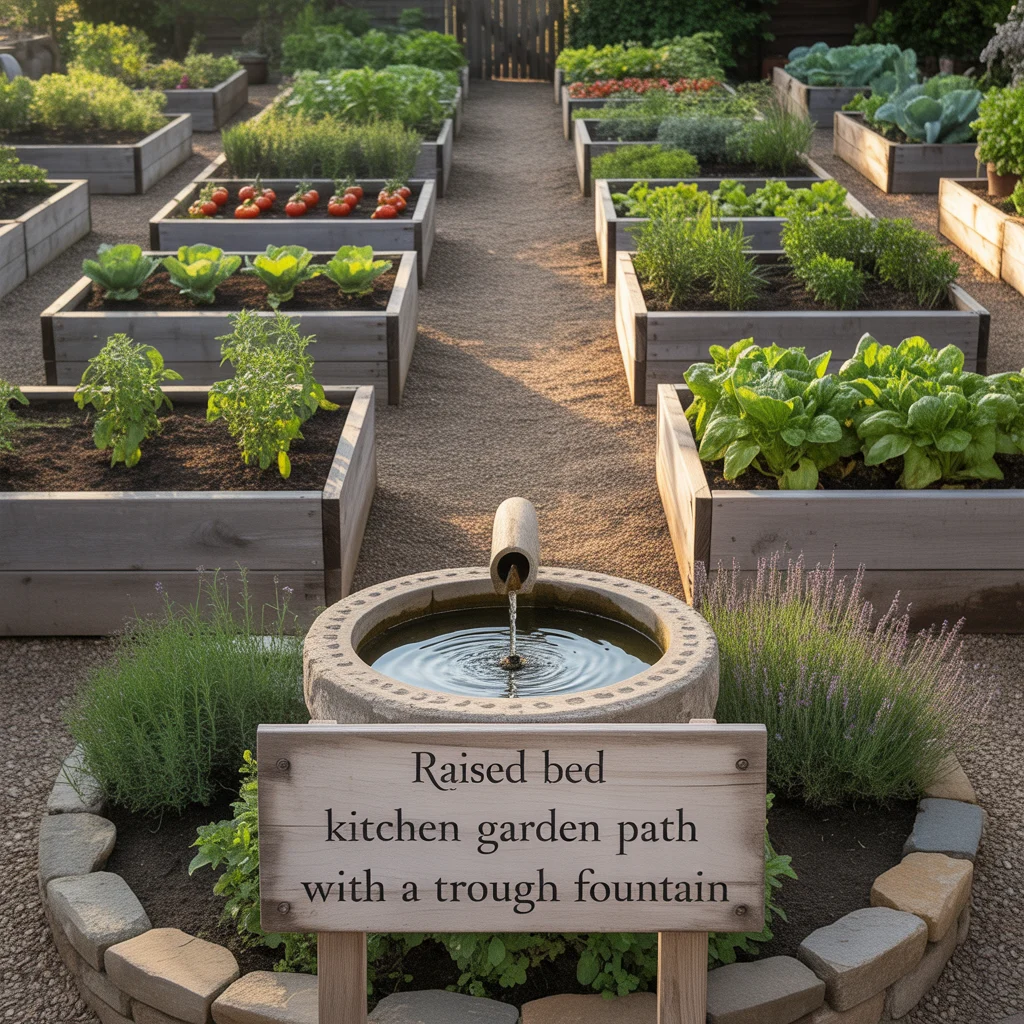
A raised bed kitchen garden path with a trough fountain places a long, narrow water feature alongside or at the end of the central path running between raised vegetable or cut-flower beds. I have visited three productive kitchen gardens that used this design, and in each case the trough fountain served both a decorative and practical function, providing a water source for beneficial insects and birds that contributed to pollination in the surrounding beds. The most effective version I saw used a 48-inch-long cast-iron trough set on two stone legs at the end of a 20-foot central gravel path between four raised beds, and the combination looked both utilitarian and considered.
Trough Fountain Materials and Proportions
Cast iron, natural stone, and galvanized steel are three materials used for trough fountains on a kitchen garden path. A cast-iron trough measuring 36 to 48 inches long and 12 to 16 inches wide costs between $200 and $450 and suits traditional and cottage kitchen garden styles. A natural stone trough in sandstone or limestone costs between $180 and $600 depending on size and produces a weathered appearance within two to three years. A galvanized steel trough costs between $60 and $180 and suits a contemporary or productive-style kitchen garden where the utilitarian appearance of the metal is consistent with the functional character of the growing space around it.
Combining a Trough Fountain With Kitchen Garden Path Planting
Edging the path on both sides with cut-flower or herbal planting enhances the visual connection between the trough fountain and the surrounding garden beds. I planted Ammi majus, sweet peas on low wire supports, and nepeta along both sides of a kitchen garden path leading to a stone trough fountain, and the combination of the wispy white flowers, the climbing sweet peas, and the low grey-green nepeta at path edge level framed the trough effectively. Sweet peas in particular produced a fragrance that was noticeable at the path entrance and increased in intensity as I walked toward the water feature at the far end.
Pebble Mosaic Path Leading to a Fountain
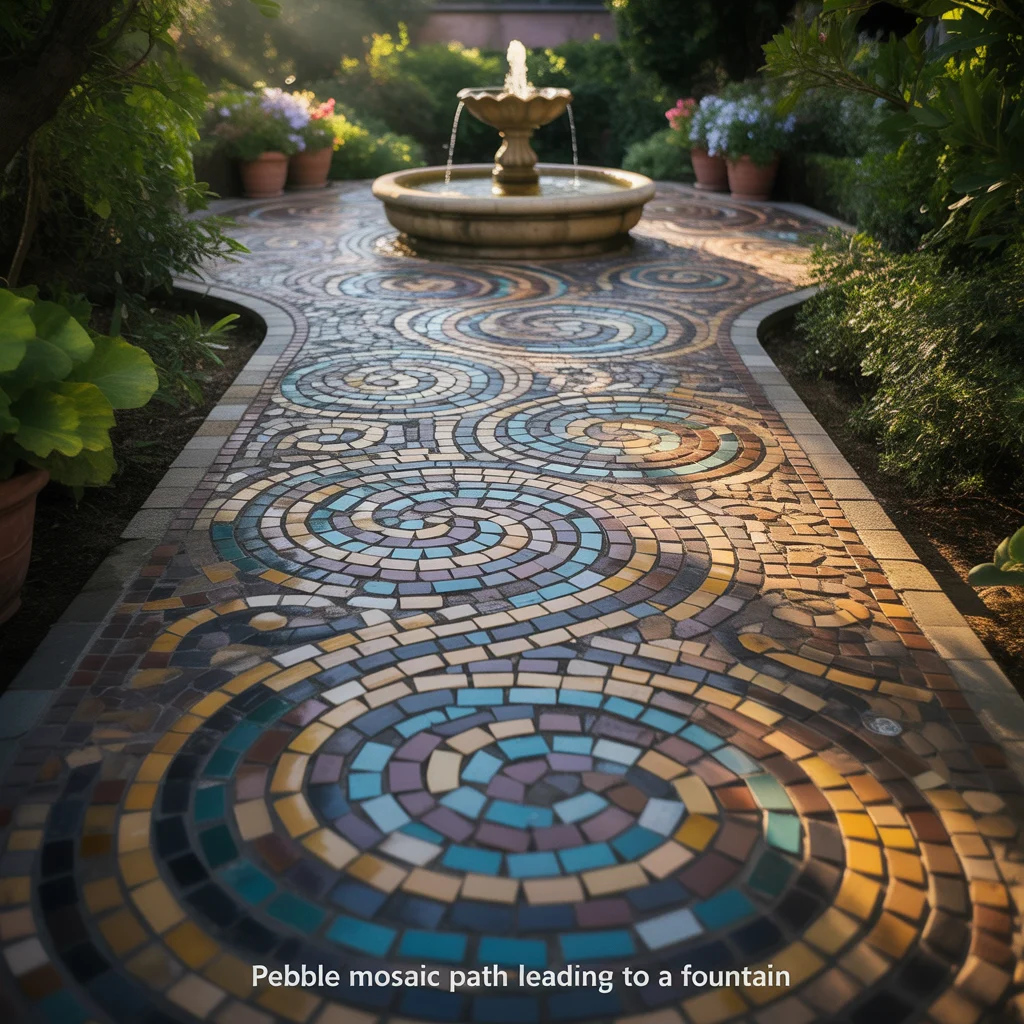
A pebble mosaic path leading to a fountain uses hand-set river pebbles in decorative patterns to create a path surface that is itself a visual feature, leading the eye toward the fountain through a sequence of pattern and color. I saw this design executed in a walled garden where the pebble mosaic path covered 60 square feet and used black, white, and terracotta pebbles in a geometric wave pattern running the full 18-foot length of the path toward a carved stone fountain at the far wall. The craftsmanship involved in laying the mosaic was significant, but the finished path required no maintenance beyond an annual cleaning and remained structurally intact after five years of regular use.
Pebble Types and Colors for a Mosaic Fountain Path
Black basalt pebbles, white quartz pebbles, and terracotta-toned sandstone pebbles are the three most commonly used stones in a decorative pebble mosaic path. Black basalt pebbles measure 1 to 2 inches in length and produce the sharpest contrast against pale path materials or grout. White quartz pebbles reflect light strongly and suit paths in shaded gardens where a brighter surface improves visibility. Terracotta-toned sandstone pebbles suit Mediterranean and cottage garden designs where the warm color of the mosaic path complements the stone or terracotta material of the fountain at the path’s end.
How to Lay a Pebble Mosaic Path
A pebble mosaic path is laid by setting individual pebbles vertically into a bed of stiff mortar at a consistent depth of two-thirds of each pebble’s length, with the flat face of the pebble exposed at the surface. The mortar bed is prepared at a depth of 3 inches over a compacted hardcore sub-base of 4 inches. I practiced this technique on a 2-square-foot test section before starting a larger project and found that working in small sections of 6 square inches at a time, completing each section before the mortar set, produced the most consistent results. The technique is slow, covering approximately 2 square feet per hour, but the finished surface is permanent and requires no re-laying.
Courtyard Fountain Idea With a Four-Path Layout
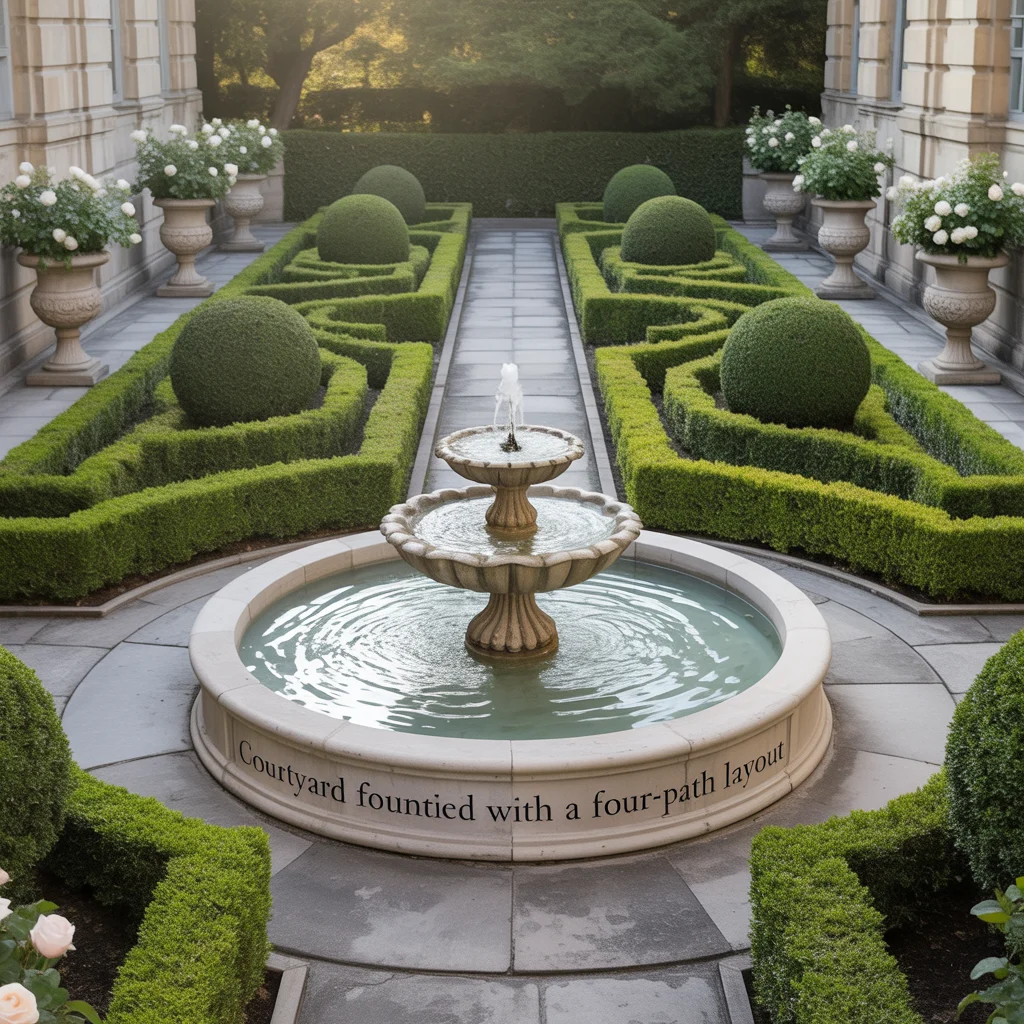
A courtyard fountain idea with a four-path layout places the fountain at the exact center of a square or rectangular courtyard space, with four equal-width paths running from the fountain outward to each side of the courtyard. This layout is called a chahar bagh in historical Persian garden design and appears in formal gardens across Europe, the Middle East, and South Asia. I designed a simplified version for a 16-by-16-foot walled courtyard, using 3-foot-wide gravel paths running north, south, east, and west from a central millstone fountain, with 4-by-4-foot planting squares filling the four corners of the space. The symmetry of the layout made the small space feel architecturally complete. For those who prefer a more permanent path surface in this type of arrangement, there are excellent flagstone path ideas for formal gardens that work particularly well within a structured four-path courtyard layout, offering the visual weight and natural stone character that gravel alone cannot provide.
Fountain Proportions for a Four-Path Courtyard Layout
The fountain in a four-path courtyard layout reads most effectively when its diameter or width equals between one-quarter and one-third of the courtyard’s total width. In a 16-foot courtyard, a fountain of 4 to 5 feet in diameter sits at the correct visual scale. A fountain wider than one-third of the courtyard width crowds the ends of the four paths, which I found reduces the feeling of arriving at a destination and instead creates a blocked-off center. A fountain narrower than one-fifth of the courtyard width loses presence as the central focal point and makes the space feel emptier than intended.
Planting the Corner Beds in a Four-Path Courtyard
Box balls, standard roses, and lavender are three planting choices for the corner beds in a four-path courtyard fountain layout. A single clipped box ball 18 to 24 inches in diameter in each corner bed provides year-round structure and reinforces the formal symmetry of the layout. A standard rose in each corner, such as Rosa The Fairy on a 36-inch stem, adds seasonal color from June through October while maintaining the vertical accent needed at each corner of the space. Lavender planted as a low informal edging along the path-facing sides of each corner bed costs $4 to $8 per plant and produces flower from June to August that reinforces the sensory experience near the central fountain.
Sloped Garden Path With a Cascade Fountain
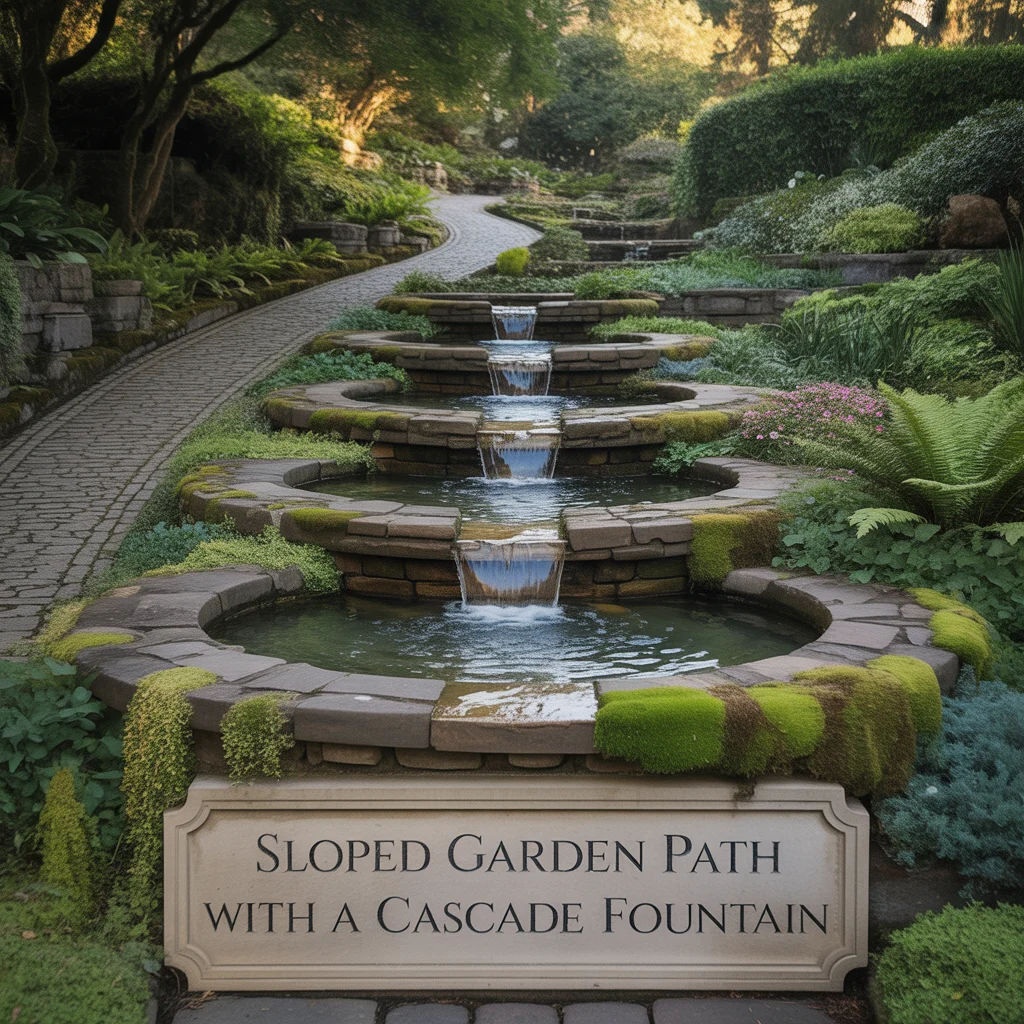
A sloped garden path with a cascade fountain uses the natural gradient of a sloping garden to create a water feature in which water flows down a series of stepped stone channels or pools alongside or beneath the path, producing a continuous sound of moving water for the full length of the walkway. I worked on a garden with a 1-in-8 slope where a 24-foot-long path ran diagonally down the slope with a three-step cascade channel running parallel to it on the lower side. The pump was housed in a sump at the base of the cascade and recirculated the water to the top continuously. The installation cost $680 in total including the pump, channel stones, and sump tank.
Cascade Fountain Channel Materials for a Sloped Path
Natural slate, cast concrete, and copper sheeting are three channel materials used in a cascade fountain alongside a sloped garden path. Natural slate channels use flat irregular pieces of slate laid in a stepped sequence with each step dropping 3 to 5 inches, producing a natural sound of falling water that suits informal garden designs. Cast concrete channels produce a more precise, uniform step profile and suit contemporary garden designs where the clean geometry of the cascade complements a modern path surface. Copper sheeting channels age to a distinctive verdigris green patina within two to three years and produce a clear, musical sound as water flows over the metal surface.
Pump Sizing for a Sloped Cascade Fountain Path
A submersible pump for a cascade fountain alongside a garden path requires a flow rate capacity of 500 to 1,500 liters per hour, depending on the width of the cascade channel and the total vertical drop. For a channel 6 inches wide with a total drop of 24 inches over three steps, a pump rated at 800 liters per hour produces a visible, audible water flow without excessive spray. I used a 1,000-liter-per-hour pump on the three-step cascade I installed and found the flow rate slightly high, producing spray onto the adjacent path surface in windy conditions, so I reduced the flow using the pump’s built-in adjuster to 750 liters per hour, which resolved the problem completely.
Wildflower Meadow Path With a Natural Stone Fountain
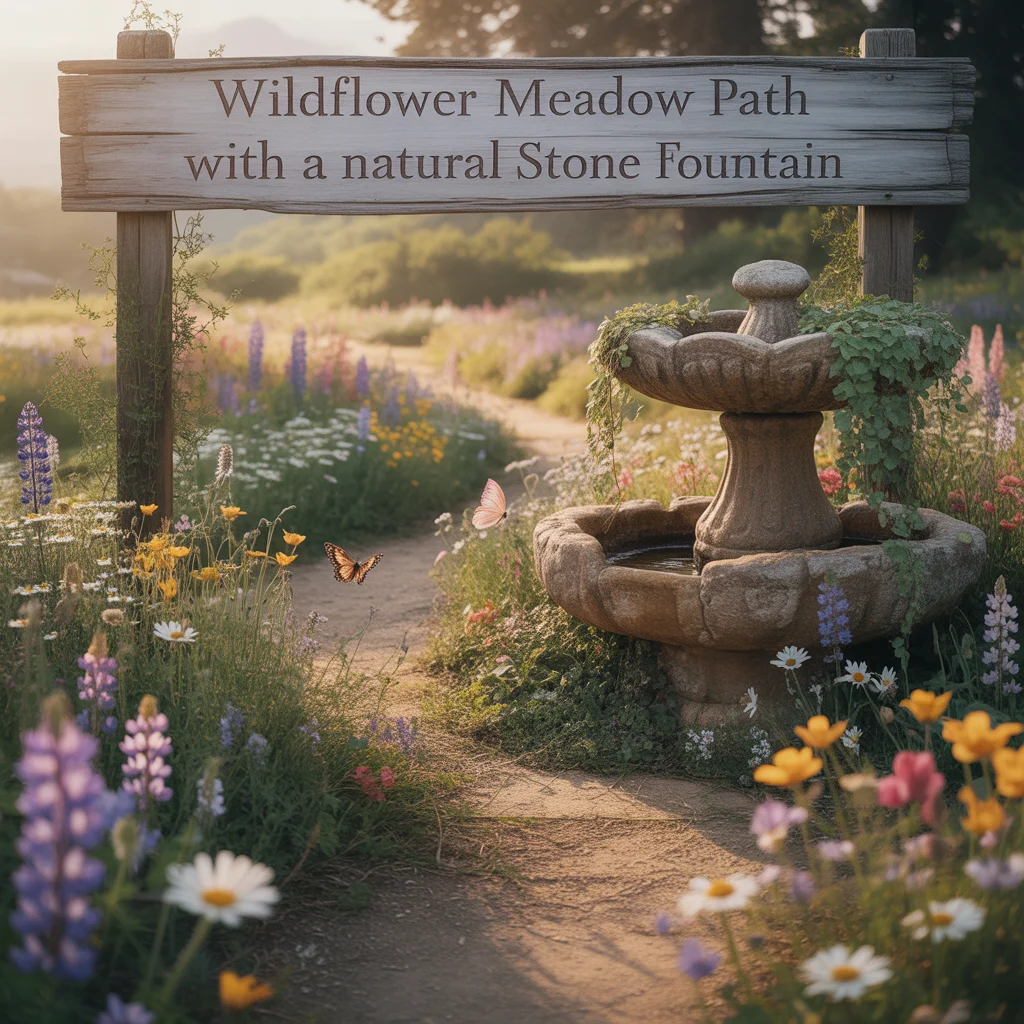
A wildflower meadow path with a natural stone fountain uses a mown grass strip or compacted earth path through a wildflower meadow to reach a natural stone water feature that looks as though it was already present in the landscape before the garden was created. I created a version of this in a section of my garden that I converted from mown lawn to a wildflower meadow three years ago, maintaining a 2-foot-wide mown grass path through the center of the meadow leading to a large granite boulder fountain at the far boundary. The combination of the tall wildflowers, the grass path, and the stone water feature produced the most naturalistic garden setting I have achieved in my own outdoor space.
Wildflower Species for a Meadow Fountain Path
Ox-eye daisy, field scabious, and common knapweed are three wildflower species that suit a meadow path leading to a natural stone fountain. Ox-eye daisy produces white flowers with yellow centers from May through July and grows to 24 to 30 inches in height, providing a strong visual mass on both sides of the mown path. Field scabious produces lilac-blue pin-cushion flowers from July through September and grows to 24 to 36 inches, extending the flowering period of the meadow well into late summer. Common knapweed produces purple thistle-like flowers from July through September and tolerates a wide range of soil types, making it one of the most reliable wildflowers for establishing a new meadow fountain path planting.
Maintaining a Mown Grass Path Through a Wildflower Meadow
A mown grass path through a wildflower meadow requires cutting to a height of 2 to 3 inches once every 7 to 10 days during the growing season to maintain a clear, firm surface for walking. The path edges need trimming with a half-moon edging tool or a string trimmer twice a season to prevent the meadow grasses and wildflowers from encroaching onto the walking surface. I cut my meadow path with a rotary mower set to its highest blade position and found that the contrast between the short mown strip and the 30-inch-tall wildflowers on both sides produced the strongest visual effect from the garden entrance, making the granite fountain at the far end visible as a distinct focal point from a distance of 40 feet.
Related
how to use pots along a garden path focal point
Best ground cover plants for paths around water features
Woodland garden sitting areas with peaceful ambiance
Frequently Asked Questions
How much does it cost to install a garden path with a fountain?
The total cost of installing a garden path with a fountain ranges from $250 for a simple gravel path with a bubbler fountain kit to $3,000 or more for a formal stone path with a classical tiered fountain. A mid-range installation using brick or sandstone pavers and a cast-stone pedestal fountain typically costs between $800 and $1,500 for a path of 15 to 20 feet in length. I completed a 15-foot gravel path with a granite bubbler fountain for $320 in total materials, which I found to be the most cost-effective starting point for homeowners new to fountain garden design. Labor costs from a professional landscaper add $400 to $1,200 on top of materials depending on the complexity of the installation.
What is the best small outdoor fountain for a garden path?
A bubbler fountain is the best small outdoor fountain for a garden path because it operates at a low flow rate, requires a small buried reservoir rather than a large above-ground basin, and produces a gentle water sound suited to a residential garden setting. Sphere fountains, urn fountains, and drilled boulder fountains are three other small outdoor fountain types that work well on a garden path in spaces under 20 feet long. I installed a granite bubbler fountain on a gravel path and found it required less maintenance than any other fountain type I have used, needing only an annual clean of the pump filter and a top-up of the reservoir water level every two to three weeks during summer.
How do I keep a garden path fountain clean?
A garden path fountain stays clean with four maintenance steps completed on a regular schedule. First, the pump filter requires cleaning every four to six weeks by removing it from the reservoir and rinsing it under running water. Second, the fountain surface needs scrubbing with a stiff brush and a diluted white vinegar solution every two months to remove algae and mineral deposits. Third, the reservoir water level needs checking and topping up every two to three weeks in summer to prevent the pump from running dry. Fourth, the entire fountain system benefits from a full drain, clean, and refill once a year in spring. I follow this schedule on my own fountain and find each step takes less than 20 minutes.
Can I install a garden fountain on a sloped path?
A garden fountain on a sloped path requires either a level platform cut into the slope to support the fountain basin, or a cascade-style water feature that uses the slope gradient as part of the fountain’s design. A level platform of 24 by 24 inches cut into a slope and retained by stone or timber edging provides a stable base for a standard pedestal or bowl fountain on a path with a gradient up to 1 in 6. A cascade fountain is the most effective design for slopes steeper than 1 in 6, where the falling water sound is naturally enhanced by the gradient and the stepped channel structin suits a four-path courtyard layout where the fountain serves as the organizing focal point of the entire space rather than simply the terminus of a single path. I found through visiting six courtyard gardens with fountains that the wall-mounted design worked most effectively in courtyards under 12 feet wide, while the central basin design worked best in spaces of 14 feet wide or more.
ure becomes a visual feature in its own right alongside the path. I used a cascade design on a 1-in-8 slope and found it far more effective than a static fountain would have been on that gradient.
What fountain works best in a courtyard garden path design?
A wall-mounted fountain or a central circular basin fountain works best in a courtyard garden path design because both types suit the enclosed, architectural character of a courtyard space. A wall-mounted fountain takes no floor space and suits narrow courtyard garden paths where a freestanding water feature would reduce the usable width of the walkway. A central circular basin founta