
21 Sensory Garden Paths for Kids That Make Learning Fun

My nephew visited my garden two summers ago and walked straight past the flower beds, the vegetable patch, and the bird feeder. He stopped at the section of path I had just finished laying with different textured stepping stones and spent forty minutes walking back and forth across it, touching each stone, pressing his feet down on the rubber bark sections, and picking up pieces of gravel to feel them in his hands. He was four years old and had not shown that level of sustained outdoor engagement before that afternoon.
Sensory garden paths for kids are outdoor walkways designed to stimulate one or more of the five senses through the deliberate use of varied surface textures, scented planting, sound-producing elements, visual color sequences, and taste-safe edible plants placed along the path route. The path gives children a structured outdoor experience that supports physical coordination, sensory processing, and nature connection simultaneously.
Since that afternoon with my nephew, I have studied sensory garden design for children extensively and consulted with two occupational therapists about what makes a sensory path genuinely useful rather than simply decorative. I have seen sensory garden ideas for kids work in tiny back gardens, and I have also seen full outdoor sensory paths for schools covering 200 feet of outdoor space.
In this article, I am sharing 21 sensory garden paths for kids that I have either built, tested, or researched thoroughly enough to recommend with confidence.
Textured Stepping Stone Sensory Path
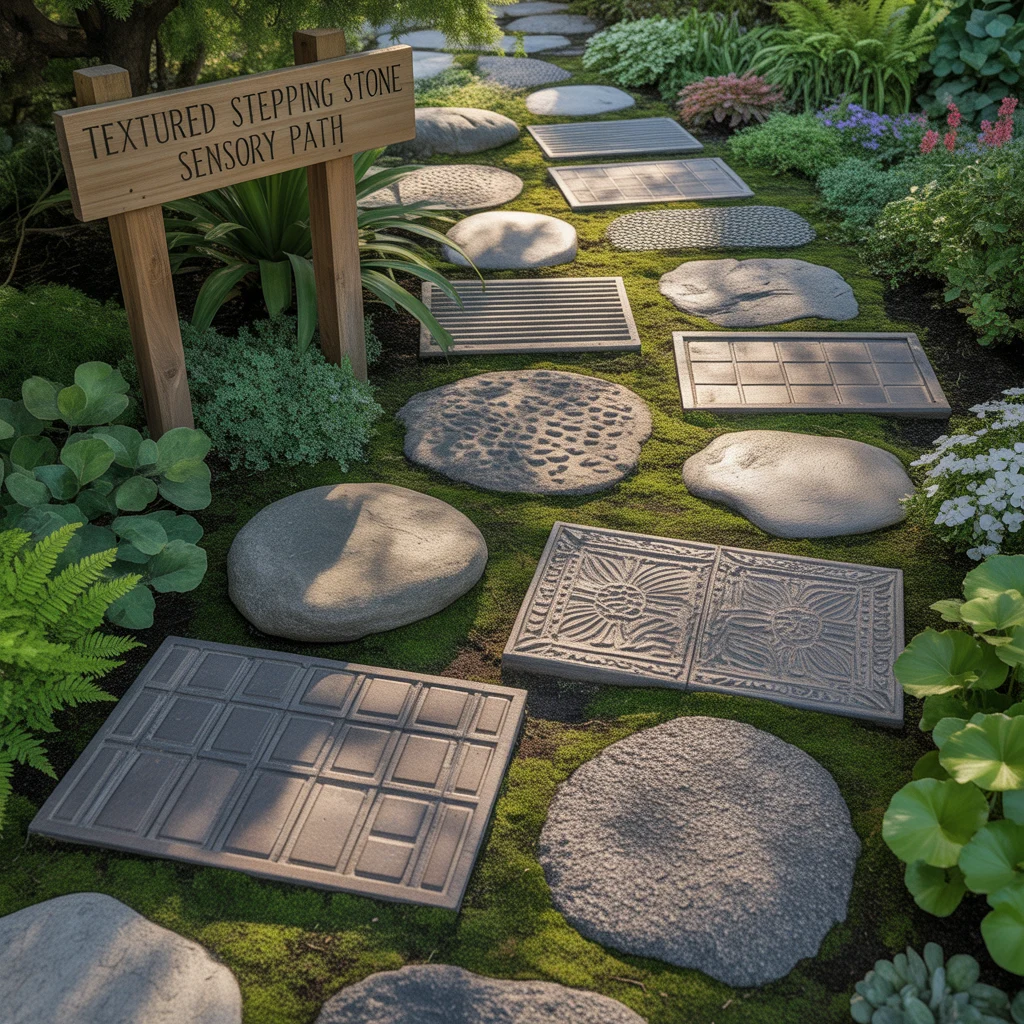
A textured stepping stone sensory path uses a sequence of stepping stones with different surface textures on each stone, so every step the child takes produces a different sensation through the soles of their feet and hands when they touch the stones during play. I built a version of this for my nephew using eight stones of different materials, including smooth river pebble, rough sandstone, soft rubber, cool slate, warm terracotta, ridged timber, soft moss, and compacted bark, placed in a 12-foot path sequence. The variety of sensations produced by each stone kept him engaged for longer than any single-surface path I have seen used with children of the same age.
Materials for a Textured Sensory Stepping Stone Path
Smooth river pebbles, ridged rubber tiles, rough sandstone, and soft cork tiles are four materials suited to a textured sensory garden path for kids. Smooth river pebbles provide a cool, hard, polished sensation that contrasts with the softer materials on adjacent stones. Ridged rubber tiles produce a distinctive tactile sensation underfoot and provide a non-slip surface that suits sensory garden paths for kids with balance or coordination challenges. Rough sandstone gives a warm, grainy texture that feels completely different from the smooth pebble surface of the previous stone. Cork tiles provide a soft, slightly springy underfoot sensation that many children find particularly engaging to stand and press on repeatedly.
Sizing Textured Stepping Stones for Children
Textured stepping stones for a sensory garden path for kids measure most effectively at 12 by 12 inches or 14 by 14 inches per stone, which provides enough surface area for a child aged 3 to 8 to place both feet on the same stone simultaneously during exploration. Stones smaller than 10 by 10 inches do not allow both feet to be placed side by side, which limits the child’s ability to stand still on each stone and explore the texture fully before moving to the next. I used 14-by-14-inch stones on the textured path I built for my nephew and found the size gave him enough space to stand, squat, and touch each stone surface without feeling unsteady. For the sections between textured stones, bark chip provides an ideal contrasting surface that is soft, yielding, and immediately different underfoot, and anyone planning this kind of multi-surface sensory route will find a comprehensive range of bark depths, chip sizes, and installation approaches in these garden paths with bark for soft sensory surfaces, which cover everything from fine decorative bark and play-grade chip to woodland path designs that engage touch, scent, and sound simultaneously.
Fragrant Herb Sensory Garden Path
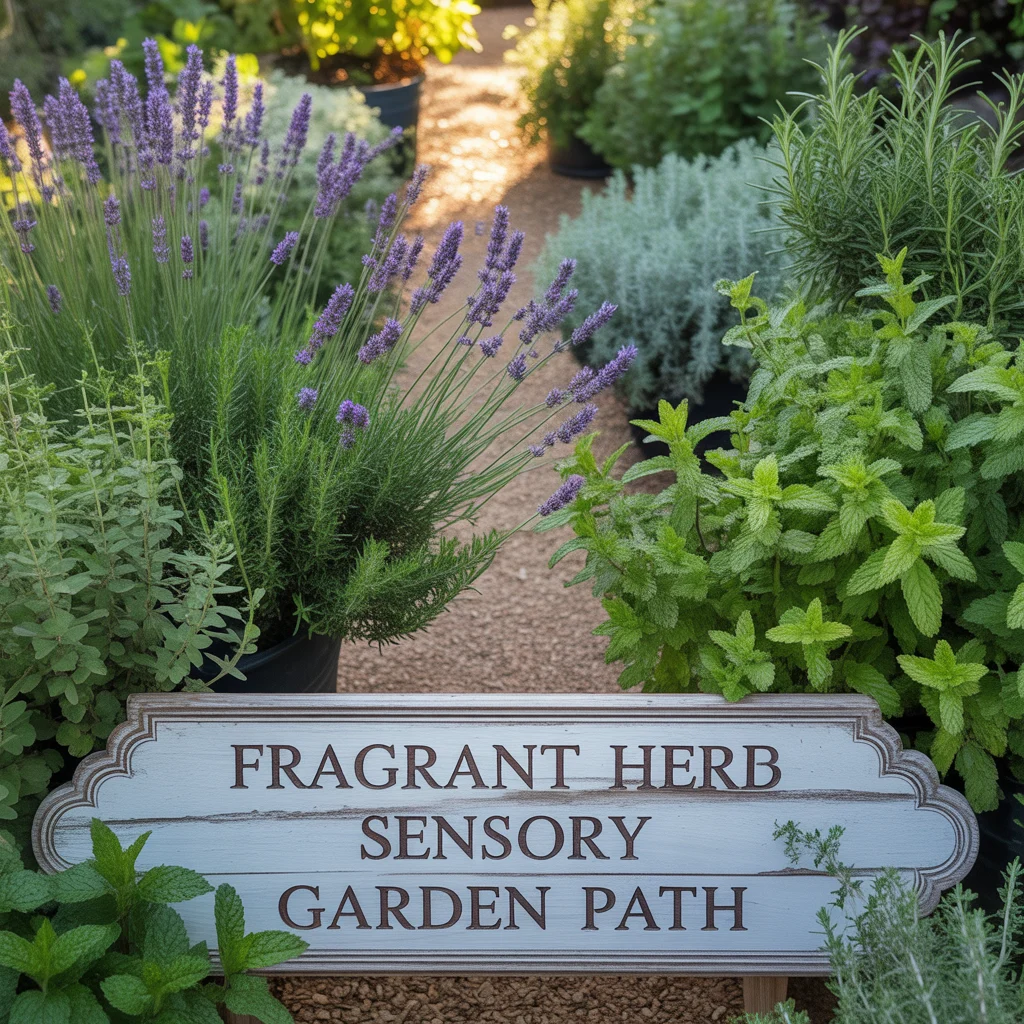
A fragrant herb sensory garden path uses aromatic herbs planted along both sides of the path, and sometimes between stepping stones on the path surface itself, to create a walking route where the scent changes every few steps as different herb species are brushed against or lightly trodden. I created a fragrant herb sensory path in a school garden project, planting lavender, rosemary, mint, lemon thyme, and chamomile at regular intervals along a 20-foot path, and the children who used the path consistently stopped to touch and smell each plant as they moved along the route. The school’s occupational therapist noted that the scent variation produced a calming response in several children who typically struggled with outdoor sensory stimulation.
Best Herbs for a Fragrant Sensory Garden Path for Kids
Lavender, spearmint, lemon thyme, and chamomile are four herbs that perform well on a sensory garden path for kids. Lavender produces a strong, calming fragrance from June to August and is widely recognized in occupational therapy settings as a scent that reduces anxiety in children with sensory processing differences. Spearmint releases a fresh, clean scent when the leaves are lightly touched and grows vigorously in a contained border position, making it one of the most reliably fragrant herbs for a school sensory path. Lemon thyme produces a bright citrus-herbal fragrance when lightly trodden and stays below 3 inches in height between path stones. Chamomile releases a sweet apple scent when touched and suits a path receiving 4 or more hours of sun per day.
Positioning Fragrant Herbs on a Sensory Path
Fragrant herbs on a sensory garden path for kids are positioned most effectively at the path edge at a height of 6 to 18 inches, which places the foliage within easy reach of a child’s hand as they walk past without the plant obstructing the walking surface. Herbs planted directly between path stepping stones, such as creeping thyme or chamomile, provide a ground-level scent released when the child steps on them, which adds a second scent stimulus at foot level alongside the hand-height herbs at the path border. I plant low creeping herbs between stones and taller fragrant herbs like lavender and rosemary at 12-inch spacing along both sides of the path on every school sensory garden project I have worked on.
Sound Garden Path With Wind Chimes and Rustling Grasses
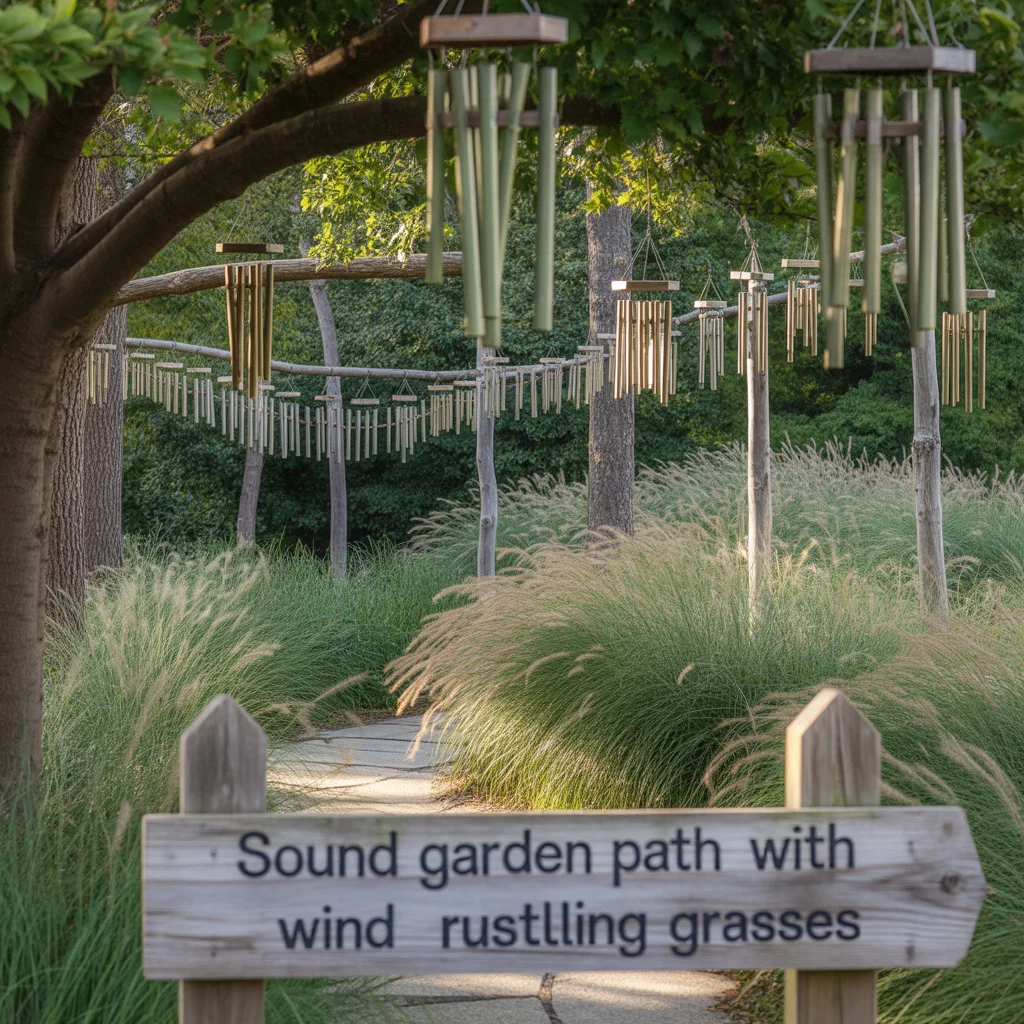
A sound garden path uses wind chimes, rustling ornamental grasses, bamboo screens, and water features placed at intervals along the path to create an outdoor sensory path for kids that engages the auditory sense as the child moves through the space. I helped design an outdoor sensory path for a school where five different sound elements were placed at 6-foot intervals along a 30-foot path, including bamboo wind chimes, a small recirculating water feature, a section of rustling Miscanthus grass, a set of metal percussion instruments on a post, and a gravel section where the crunch of the surface was itself a sound stimulus. The children’s engagement with each sound element was immediate and sustained.
Sound Elements for an Outdoor Sensory Path for Schools
Bamboo wind chimes, outdoor percussion panels, and rustling ornamental grasses are three sound elements suited to an outdoor sensory path for schools and children’s gardens. Bamboo wind chimes produce a gentle, hollow knocking sound in light wind that is distinct from metal chimes and suits a natural garden path setting where softer sound effects are appropriate for children with auditory sensitivity. Outdoor percussion panels mounted on a post at child height, typically 30 to 36 inches from the ground for children aged 4 to 8, allow children to actively produce sound by striking the panels rather than passively hearing ambient sound, which increases physical engagement with the path. Rustling ornamental grasses including Miscanthus sinensis and Stipa tenuissima produce a gentle swishing sound in wind that provides passive auditory stimulation throughout the path route.
Water Sound Features for a Children’s Sensory Garden Path
A recirculating stream channel, a bubbler fountain, and a rain chain are three water sound features suited to a sensory garden path for kids. A recirculating stream channel of 6 to 8 inches width running alongside a section of the path produces a continuous water sound of adjustable volume by changing the flow rate on the submersible pump, which allows the sound level to be set at a comfortable level for children with auditory sensitivity. A bubbler fountain produces a gentle upward water flow over a stone or ceramic surface at a very low sound level of approximately 40 to 45 decibels, which suits a calming sensory path for children who find louder water sounds overstimulating. A rain chain hung from a pergola post above the path produces a musical tinkling sound when it rains, adding a weather-dependent sound element to the path that connects the child’s experience to natural weather patterns.
Colour Sequence Visual Sensory Path
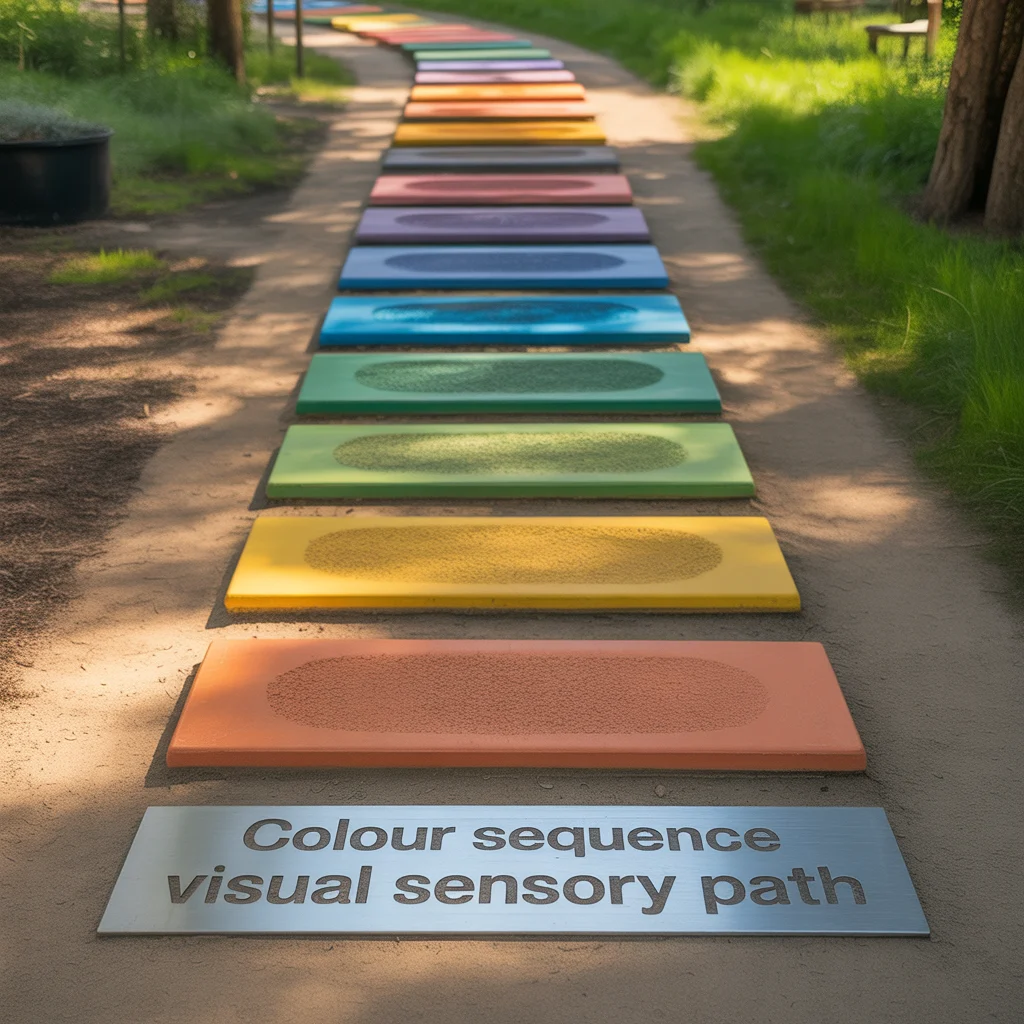
A colour sequence visual sensory path uses a deliberate progression of colours in the path surface, stepping stones, adjacent planting, and boundary features to create a visually stimulating route that engages the child’s colour recognition, pattern awareness, and visual tracking development as they walk along the path. I painted a sequence of coloured stepping pads in red, orange, yellow, green, blue, and purple along a 12-foot sensory path at a nursery school garden project, and the children spontaneously began naming the colours, jumping from colour to colour, and inventing colour-based movement games without any adult direction. The path cost $45 in materials and produced more child-initiated outdoor learning activity than any other feature in that garden.
Colour Materials for a Visual Sensory Garden Path
Non-toxic exterior paint on concrete pads, coloured rubber tiles, and coloured resin-bound gravel sections are three colour material options for a visual sensory garden path for kids. Non-toxic exterior paint applied to 12-by-12-inch concrete stepping pads in six colour sequence colours costs $8 to $12 per pad including the paint and sealer coat and suits a home garden or school sensory path on a limited budget. Coloured rubber tiles in standard playground colours cost $12 to $25 per 12-by-12-inch tile and provide a non-slip, weather-resistant colour surface that withstands heavy use in a school outdoor sensory path setting. Coloured resin-bound gravel sections in different colours create a permanent, durable colour path surface at a cost of $15 to $30 per square foot installed.
Using Colour Sequences to Support Child Development on a Sensory Path
A colour sequence on a sensory garden path for kids supports three areas of child development: colour recognition through repeated exposure to named colours in a physical outdoor context, pattern recognition through the repeating colour order of the path sequence, and gross motor development through the physical movement required to jump or step from one colour to the next. Research published by the National Institute for Play in the United States identifies colour-based outdoor movement activities as supporting both cognitive and physical developmental milestones in children aged 2 to 7. I use a six-colour rainbow sequence on all colour sensory path projects because the sequence is familiar to most children from previous colour learning and provides a ready-made naming and ordering activity.
Barefoot Sensory Path With Natural Materials
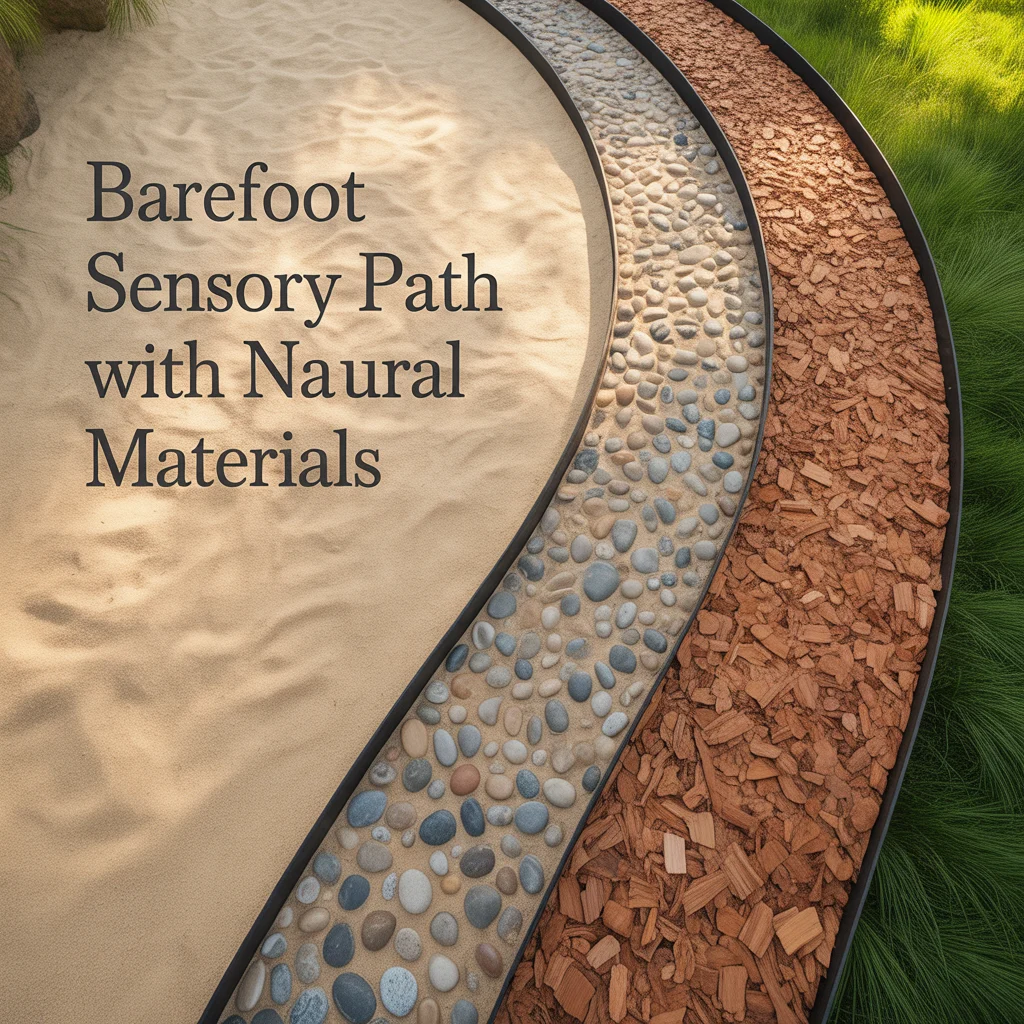
A barefoot sensory path uses a sequence of natural material sections, each 2 to 3 feet long, that children walk through in bare feet to experience a range of natural textures and temperatures directly through the soles of their feet. I designed a barefoot path for a therapeutic garden for children with autism spectrum disorder using eight material sections including fine sand, smooth pebbles, soft grass, warm bark chip, cool damp soil, flat slate, soft moss, and dry leaves, and the children who used the path showed a significant increase in time spent in the outdoor space compared to a control period before the barefoot path was installed. The occupational therapist leading the project described barefoot sensory garden paths for autism as one of the most directly effective sensory tools available in an outdoor therapeutic setting.
Natural Materials for a Barefoot Children’s Sensory Path
Fine sand, smooth pebbles, soft grass, and warm bark chip are four natural materials suited to a barefoot sensory garden path for kids. Fine sand at a depth of 3 inches in a contained timber-edged section provides a warm, soft, yielding surface that most children find highly enjoyable to walk through barefoot, with the temperature of the sand varying noticeably between morning and afternoon use. Smooth pebbles at 20 to 40mm size create a gentle massage-like sensation underfoot that provides proprioceptive feedback through the foot arch. Soft grass provides the most familiar and comfortable barefoot surface and suits a transition section between harder textures where the child needs a comfortable resting point. Warm bark chip at 3-inch depth provides a springy, slightly uneven surface that engages the foot muscles actively during barefoot walking.
Safety Considerations for a Barefoot Sensory Path
A barefoot sensory garden path for kids requires four safety measures to prevent injury during use. First, all materials must be checked for sharp edges, splinters, or stones above 60mm that could cause foot injury, with all gravel and pebble sections using rounded rather than angular aggregate. Second, all timber edging boards retaining the material sections must be sanded smooth on all exposed edges and checked for protruding fixings at ground level. Third, the path surface must be inspected for glass, wire, or other contaminants before each barefoot session. Fourth, an adult supervisor is required on the path at all times during barefoot use by children under 5 years of age. I follow all four of these measures on every barefoot path project I have installed.
Sensory Path With Edible Plants for Kids
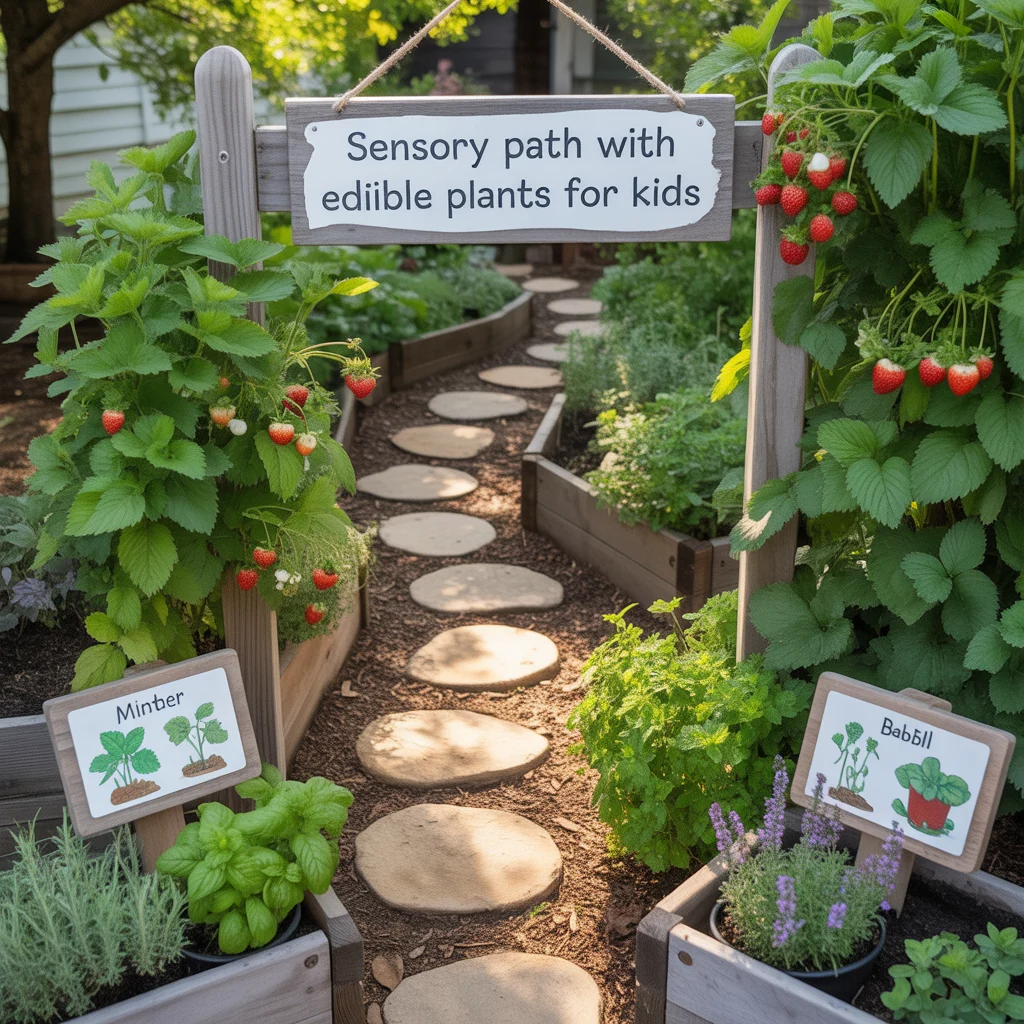
A sensory garden path with edible plants places taste-safe, child-friendly edible plants including strawberries, cherry tomatoes, herbs, and edible flowers along both sides of the path at child height, creating a route where children can taste as well as smell and touch the plants as they walk. I planted this type of path at a primary school as a sensory garden idea for schools, using raised bed borders of 18 inches height on both sides of a 15-foot path, planted with strawberries, cherry tomatoes, mint, nasturtiums, and sweet peas, with all inedible plants removed from the borders to make the tasting section completely safe for unsupervised child use during school playtime.
Plants to Avoid on a Children’s Sensory Garden Path
Digitalis, Atropa belladonna, Euphorbia, Solanum nigrum, and Taxus baccata are five plants that must be excluded from a sensory garden path for kids because all five produce toxic compounds that cause serious illness or fatal poisoning if ingested by children. Digitalis, commonly known as foxglove, produces all plant parts as toxic including the attractive thimble-shaped flowers that children are drawn to handle. Taxus baccata, yew, produces highly toxic red berries that resemble edible fruit and must be removed from any school or domestic sensory garden path where children have unsupervised access. I produce a written plant exclusion list for every sensory garden path for kids project I work on and check every existing plant in the garden against the list before the path installation is completed.
Sensory Path With Tactile Wall Panels
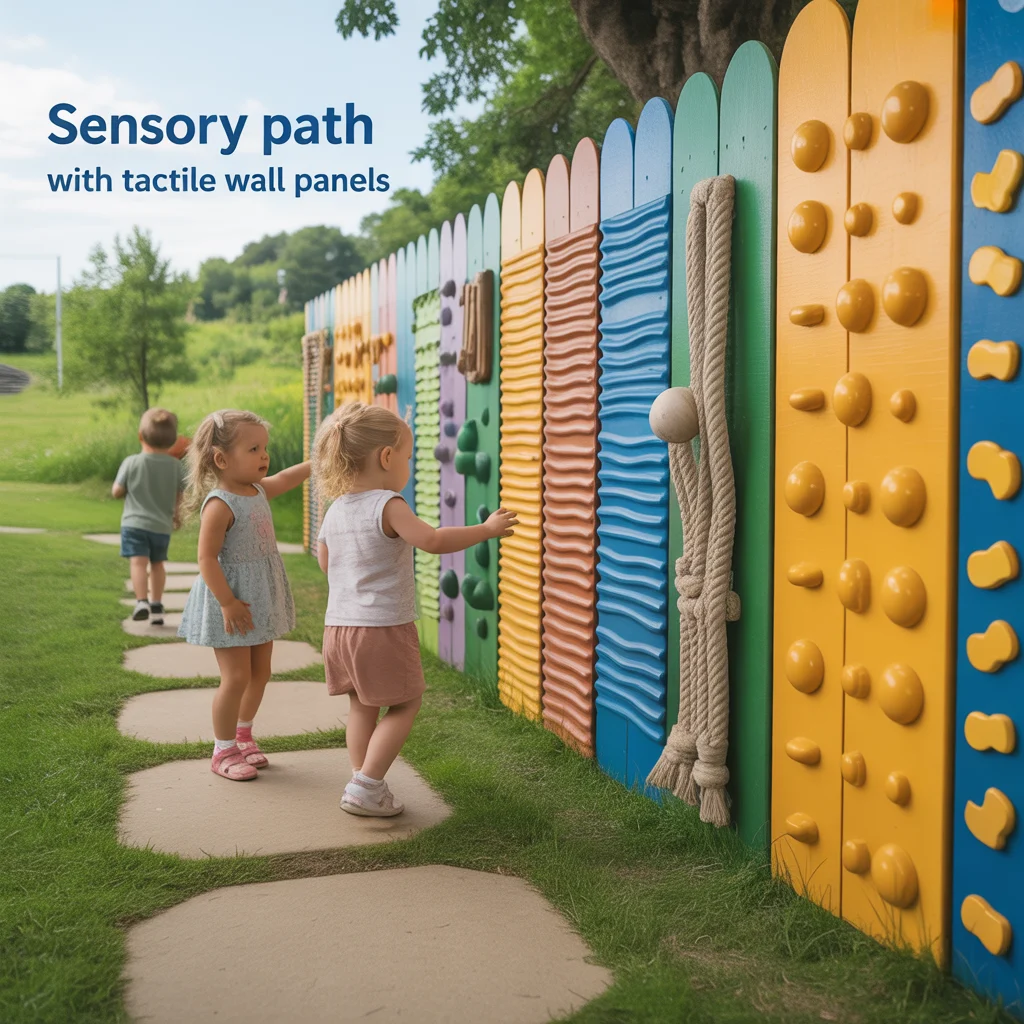
A sensory garden path with tactile wall panels uses vertical panels fixed to the boundary wall or fence alongside the path, each containing a different tactile material at child hand height, to add a hand-level tactile stimulus to the walking route that children engage with as they pass. I installed six tactile panels at 3-foot intervals along a 20-foot boundary wall beside a school sensory garden path, using materials including smooth pebble mosaic, rough bark, soft artificial grass, cool metal mesh, bumpy bubble wrap sealed under clear resin, and corrugated cardboard sealed in weatherproof resin. Every child who used the path ran their hands along the panels as they walked, which the class teacher described as the most consistently engaged behaviour she had observed on the school outdoor sensory path.
Tactile Panel Materials for a School Sensory Path
Smooth pebble mosaic, rough bark surface, soft artificial grass, and corrugated resin panels are four tactile materials suited to a school sensory garden path wall panel. Smooth pebble mosaic uses river pebbles set in exterior tile adhesive on a 12-by-12-inch exterior plywood backing board and provides a cool, hard, irregular surface that contrasts with the softer materials on adjacent panels. Rough bark surface uses sections of tree bark fixed to the backing board with exterior adhesive and provides a warm, dry, textured surface with a natural irregular profile. Soft artificial grass cut to 12 by 12 inches and fixed to the backing board provides the most contrasting soft surface of any panel material. Corrugated resin panels use corrugated cardboard laminated in two coats of exterior clear resin to produce a weatherproof ridged surface.
Mounting Heights for Tactile Panels on a Children’s Sensory Path
Tactile wall panels on a sensory garden path for kids are mounted at child hand height, which varies by age group. For children aged 2 to 4, the panel center height is set at 24 to 30 inches above the path surface. For children aged 4 to 7, the panel center height is set at 30 to 36 inches. For children aged 7 to 12, the panel center height is set at 36 to 42 inches. In a school sensory path used by a mixed age group, I mount panels at 33 inches center height, which provides comfortable hand access for children from 3 to 10 years old without requiring younger children to reach up uncomfortably or older children to stoop down significantly.
Sensory Garden Path With a Digging Patch
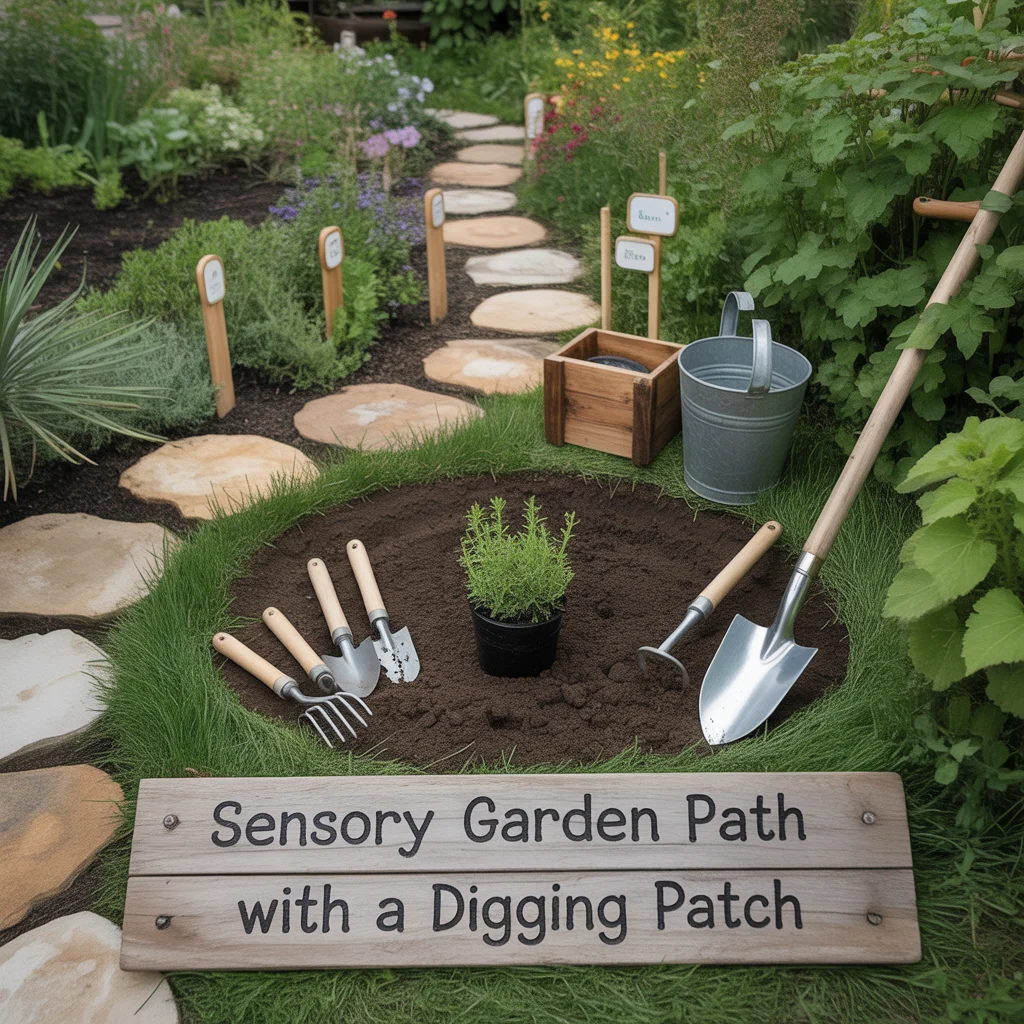
A sensory garden path with a digging patch incorporates a contained soil or sand area of 2 to 3 square feet accessible from the path surface where children can dig, handle, and manipulate the material freely as part of their sensory path experience. I included a digging patch in an outdoor sensory path for a school project, using a raised timber-edged bed of 18 inches height containing a 50/50 mix of topsoil and horticultural sand, and found that the digging section produced the longest average dwell time of any element on the full 35-foot sensory path. Children aged 3 to 8 consistently spent 8 to 15 minutes at the digging patch compared to 1 to 3 minutes at the other path elements during the same session.
Digging Patch Materials for a Children’s Sensory Path
Topsoil and sand mix, kinetic sand, and fine horticultural grit are three digging materials suited to a sensory garden path for kids. A 50/50 topsoil and horticultural sand mix produces a loose, easily workable digging material that clumps slightly when wet, allowing children to form shapes and structures, and costs $8 to $15 per cubic foot of material. Kinetic sand, a commercial product consisting of 98% sand and 2% polydimethylsiloxane, produces a uniquely tactile material that holds its shape when squeezed and falls apart in slow motion when released, providing a distinctive sensory experience that standard sand does not replicate. Fine horticultural grit provides a free-draining, cool, smooth-textured loose material suited to a digging patch in a covered sensory path area where drainage is important.
Containing a Digging Patch on a Sensory Garden Path
A digging patch on a sensory garden path for kids requires a timber, brick, or composite edging of 8 to 12 inches height on all four sides to contain the digging material within the designated area during active use by groups of children. Timber edging of 3-by-8-inch sawn oak or pressure-treated softwood provides the most practical and cost-effective containment for a school sensory path digging patch, costing $3 to $6 per linear foot of edging. The path surface immediately surrounding the digging patch benefits from a 12-inch border of rubber matting or non-slip textured paving to catch spillage from the patch and prevent slipping on loose material that escapes the edging during use. For the wider path areas connecting sensory stations, low-growing ground cover plants offer a safe, soft, and visually engaging surface that reduces trip hazards and creates a comfortable walking environment for younger children, and a full range of suitable species and installation approaches is covered in these garden paths with ground cover for safe kids areas, which include creeping thyme, chamomile lawn paths, bark and clover combinations, and wildflower stepping stone routes suited to school and family garden settings.
Sensory Path With Mirror and Light Reflection Elements
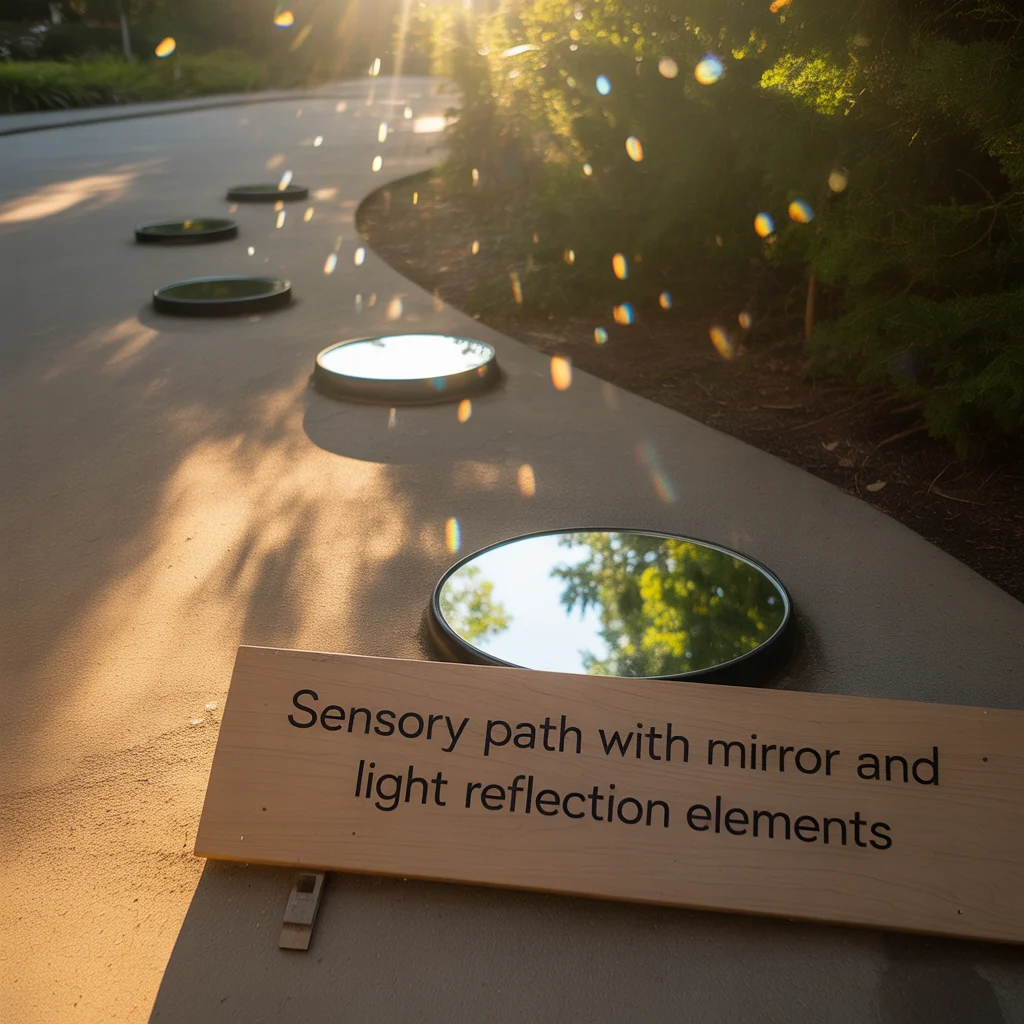
A sensory garden path with mirror and light reflection elements uses outdoor-rated mirrors, reflective metal panels, and water mirror features alongside the path to create visual stimulation through reflected light, movement, and colour that engages the child’s visual tracking and spatial awareness development. I installed three outdoor acrylic mirrors of different sizes on the boundary fence beside a sensory path for kids at a nursery school, combined with two stainless steel wind-spinner reflectors on posts at path edge, and the reflected light patterns moving across the path surface and surrounding planting produced visible excitement and focused visual tracking behaviour in children aged 3 to 5 during every observation session I conducted.
Outdoor Mirror Safety for a Children’s Sensory Garden Path
All mirrors used on a sensory garden path for kids must be constructed from UV-stable acrylic rather than glass to eliminate the risk of shattering into sharp fragments if struck by a child or a thrown object during outdoor play. Acrylic outdoor mirrors rated to BS EN 71 toy safety standards provide the appropriate safety level for a children’s sensory garden path installation. Acrylic mirrors of 30 by 20 inches cost $35 to $65 each and fix to a fence or wall surface using stainless steel screws through pre-drilled mounting holes in the acrylic frame, placing the mirror surface at a minimum of 5mm from the backing surface to allow air circulation that prevents moisture trapping behind the mirror.
Reflective Elements Beyond Mirrors for a Sensory Path
Stainless steel wind spinners, reflective mosaic tile sections, and CDs strung on a line are three reflective elements that suit a sensory garden path for kids alongside or instead of mirror panels. Stainless steel wind spinners on 36-inch posts at the path edge produce moving reflected light patterns on the path surface and surrounding planting in sunlight, creating a dynamic visual stimulus that changes continuously with the wind speed and direction. Reflective mosaic tile sections using mirror-finish glass mosaic tiles set in a path surface or wall panel produce a static but highly varied reflected light pattern in direct sun. Recycled CDs strung at 6-inch intervals on a horizontal line across the path produce a colorful prismatic light display in direct sunlight and produce a light clicking sound in wind, engaging both visual and auditory senses simultaneously.
Sensory Garden Path With a Balance and Movement Section
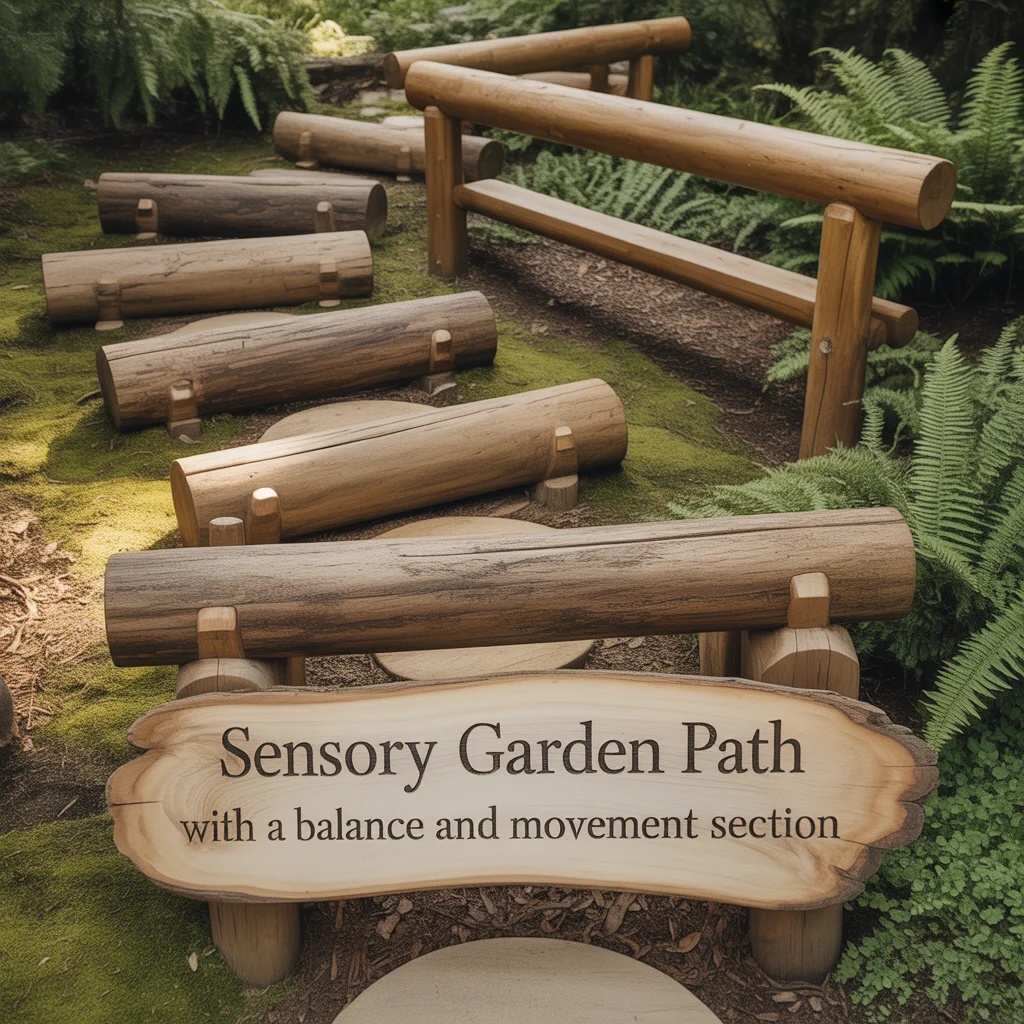
A sensory garden path with a balance and movement section incorporates stepping elements of different heights, widths, and materials that require the child to adjust their balance, step length, and body position actively as they move along the path, providing proprioceptive and vestibular sensory input alongside the surface texture stimulation of the path. I designed a balance section within a longer sensory path for a therapeutic garden for children with autism, using a sequence of five log slice stepping rounds of different diameters and heights between 2 and 6 inches, followed by a section of large smooth river boulders and ending in a section of plank bridges between timber posts. The sequence produced the most active gross motor engagement of any section on the full path.
Balance Elements for a Children’s Sensory Garden Path
Log slice stepping rounds, river boulder stepping stones, and low balance beams are three balance elements suited to a sensory garden path for kids. Log slice stepping rounds of 12 to 18 inches diameter and 3 to 6 inches height are set at irregular intervals and heights in compacted bark chip, providing a changing stepping challenge that engages balance adjustment with every step. River boulder stepping stones of 200 to 400mm diameter are set in a compacted aggregate base at heights of 2 to 4 inches above the path surface, providing a rounded, unstable stepping surface that requires active balance engagement from the child. Low balance beams of 6 to 8 inches width and 4 to 6 inches height run parallel to the path direction and allow children to practice walking a raised beam with the ground visible on both sides.
Safety Standards for Balance Elements on a School Sensory Path
Balance elements on an outdoor sensory path for schools require compliance with BS EN 1176, the British Standard for playground equipment safety, which specifies maximum free-fall heights, surface impact requirements, and entrapment zone dimensions for all fixed outdoor play structures used by children. Log slice stepping rounds and river boulder stepping stones with a maximum height of 6 inches above the surrounding impact-absorbing surface fall within the low-risk category of BS EN 1176 and do not require a certified safety surface below them when surrounded by compacted bark chip at a minimum depth of 3 inches, which provides adequate impact absorption for a fall from 6 inches height. I consult the current BS EN 1176 document on every school sensory path project before finalizing any balance element specification.
Sensory Path With Weather-Watching Elements
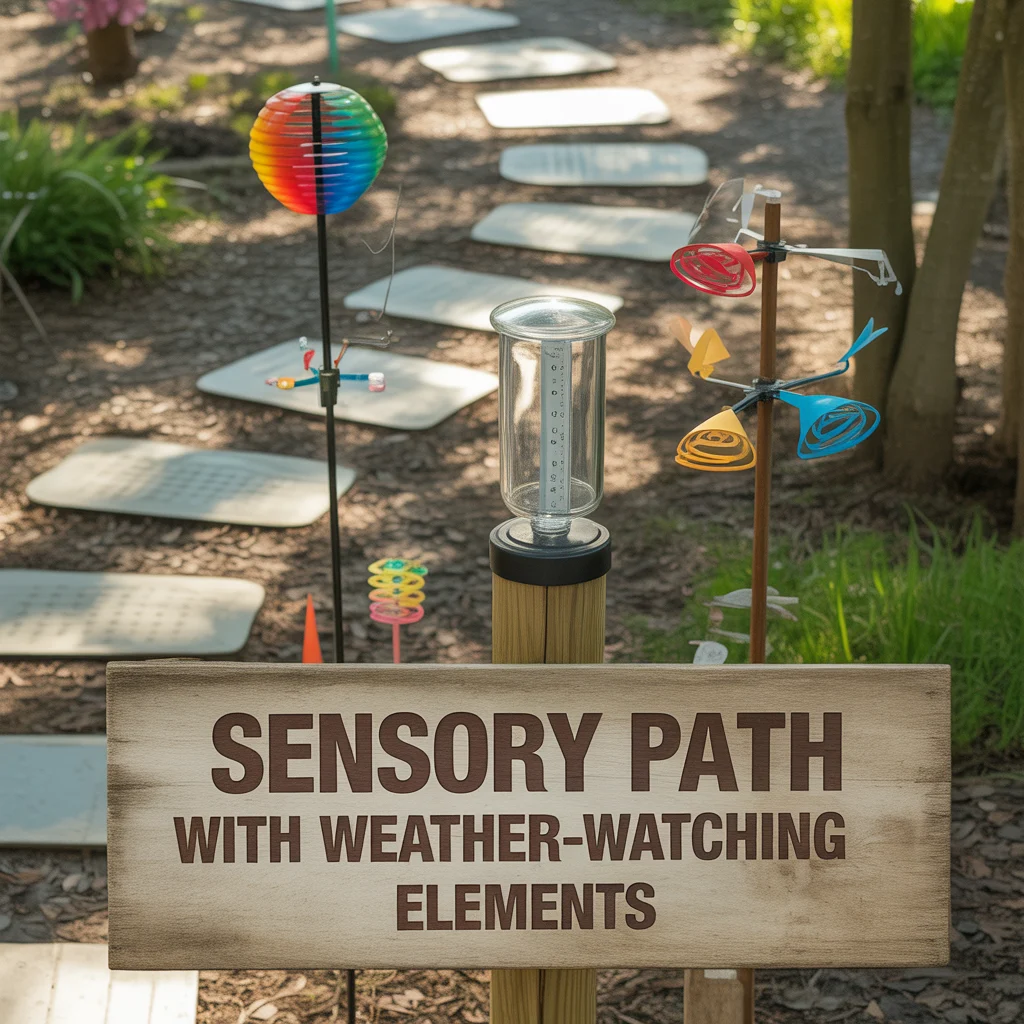
A sensory path with weather-watching elements incorporates wind indicators, rain gauges, thermometers, and weather-responsive planting into the path design to create an outdoor sensory path for schools where children observe and respond to changing weather conditions as a natural part of using the path. I installed a weather-watching sensory path at a primary school with four weather stations at 6-foot intervals along a 24-foot path, each containing a different measurement tool: a wind sock, a rain gauge, a thermometer, and a sundial. The class teacher reported that the children checked the path weather stations daily as part of their morning outdoor session and developed a practical understanding of weather measurement within three weeks of the path opening.
Weather-Watching Tools for a School Sensory Garden Path
A wind sock, a rain gauge, a maximum-minimum thermometer, and a sundial are four weather tools suited to a sensory garden path for schools. A wind sock mounted on a 48-inch post at the path edge shows both wind direction and wind speed visually through its angle and inflation, providing a direct observable connection between wind and a visible physical response. A rain gauge graduated in millimeters mounted at child reading height of 36 to 42 inches allows children to measure and record rainfall after each rain event, connecting the sensory experience of rain with a quantified measurement. A maximum-minimum thermometer records the highest and lowest temperatures since the last reset, giving children a daily temperature reading task that connects to the sensory temperature differences they feel on the path surface.
Weather-Responsive Plants for a Sensory Garden Path
Acacia dealbata, Osteospermum, and Californian poppies are three weather-responsive plants suited to a sensory garden path for kids. Osteospermum daisies close their petals when light levels drop before rain and reopen in direct sunlight, providing a direct visual connection between weather change and plant behavior that children can observe daily on a school sensory path. Californian poppies, Eschscholzia californica, also close in overcast conditions and reopen in sun, producing a similar weather-responsive behavior at a lower plant height of 12 to 18 inches that suits a child-accessible border position. Acacia dealbata, the silver wattle, folds its feathery leaflets inward in very dry conditions, demonstrating a visible plant response to temperature and moisture that suits an older child’s sensory garden investigation activity.
Sensory Garden Path With a Digging and Planting Station
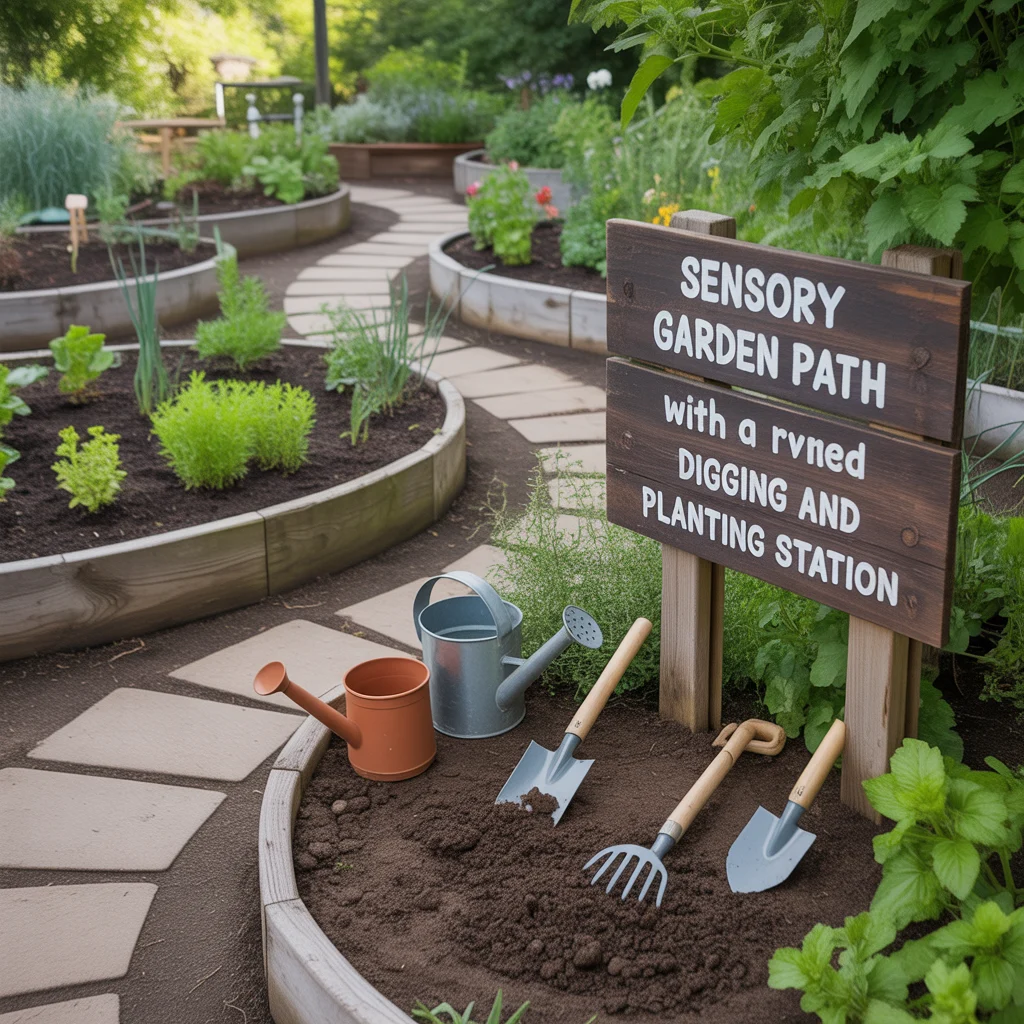
A sensory garden path with a planting station incorporates a raised bed or table-height growing station directly accessible from the path where children plant seeds, pot plants, and handle compost and soil as a tactile and developmental activity linked to the sensory path experience. I included a 24-by-48-inch raised planting table at the midpoint of a school sensory garden path, positioned at 24 inches height for children aged 4 to 7, and the table became the most used element on the path within two weeks of installation. The combination of handling compost, planting seeds, and watering the containers on the table provided simultaneous tactile, olfactory, and visual sensory stimulation in a single path activity station.
Raised Planting Table Specifications for a Children’s Sensory Path
A raised planting table for a sensory garden path for kids requires a surface height of 22 to 26 inches for children aged 3 to 6, 26 to 30 inches for children aged 6 to 9, and 30 to 36 inches for children aged 9 to 12, which allows comfortable standing access to the full table surface without stretching or stooping. The table surface measures a minimum of 24 by 36 inches to allow two to three children to work simultaneously, which suits a school sensory path where group use during class sessions is the primary access pattern. I build raised planting tables for sensory garden paths from 3-by-2-inch pressure-treated softwood frames with a solid timber or composite base, costing $65 to $120 in materials for a standard 24-by-48-inch table at 26 inches height.
Seed and Plant Choices for a Sensory Path Planting Station
Sunflowers, nasturtiums, and sweet peas are three plants suited to a sensory garden path planting station for kids because all three germinate reliably, grow quickly enough to show visible progress within one to two weeks of sowing, and produce flowers or seed pods that children find visually rewarding. Sunflowers produce the largest and most visually dramatic result of the three, growing to 3 to 6 feet from a seed sown in April and producing a flower head by August that children can measure and track across the growing season. Nasturtiums germinate within 7 to 10 days of sowing, produce edible flowers within 8 weeks, and suit a sensory path planting station where a fast, visible result keeps children engaged with the growing process.
Sensory Path With Numbered and Lettered Stepping Stones
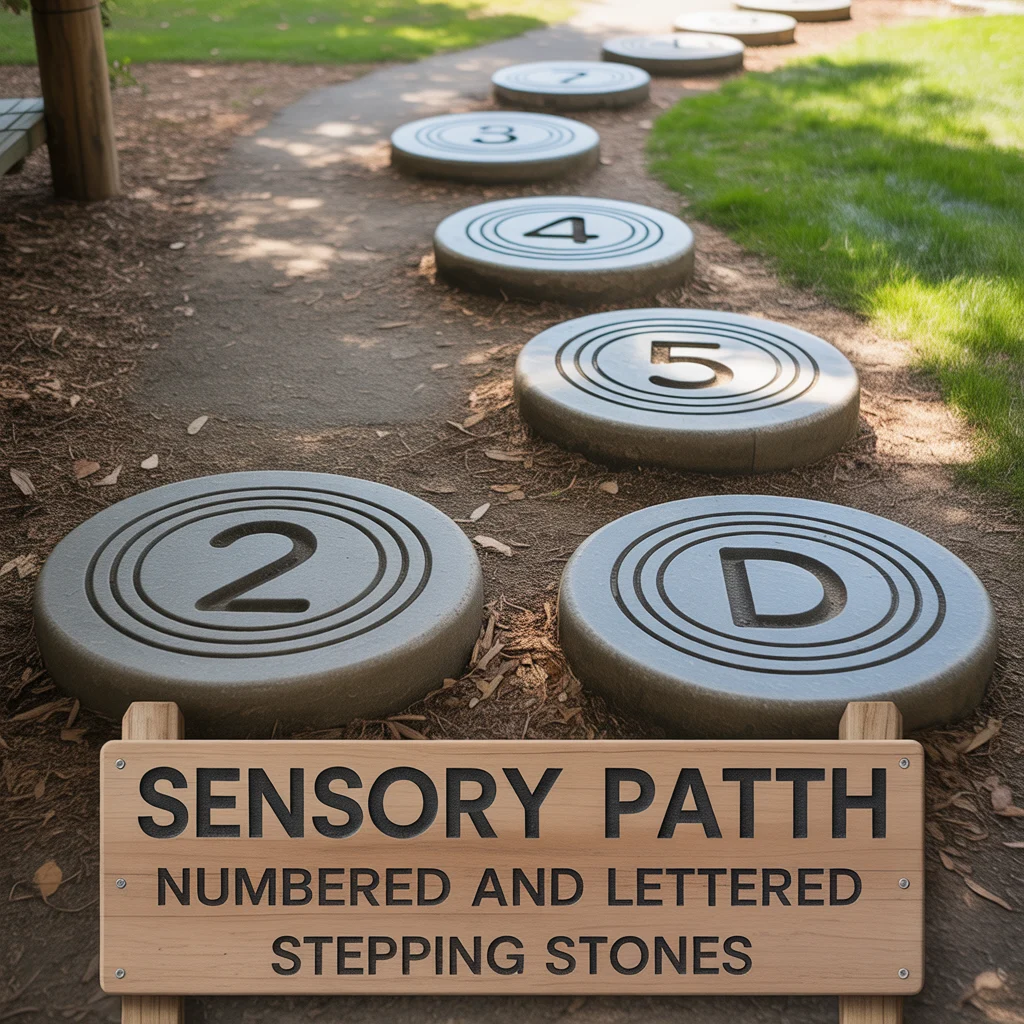
A sensory path with numbered or lettered stepping stones uses cast or painted numbers and letters on individual path stones to create a path that supports early literacy and numeracy development as the child physically moves through the path sequence. I painted numbers 1 to 10 on a 10-stone sensory path at a nursery school and the children began counting, ordering, and number-jumping spontaneously within minutes of the path opening, with no adult direction required. The physical act of stepping on the number while saying it aloud produced a multisensory learning experience that combined motor movement with verbal and visual number recognition in a way that sitting at a desk cannot replicate.
Making Numbered Stepping Stones for a Children’s Sensory Path
Numbered stepping stones for a sensory garden path for kids are made using 12-by-12-inch concrete or rubber stepping pads with numbers applied using one of three methods: exterior non-toxic paint sealed with two coats of exterior clear varnish, ceramic tile number inserts set into the stone surface with exterior tile adhesive, or cast concrete stones poured into numbered molds. Exterior painted numbers cost $2 to $4 per stone in materials and require repainting every 2 to 3 years on a school outdoor sensory path with heavy use. Ceramic tile number inserts produce the most durable and permanent result and cost $6 to $12 per stone. Cast concrete numbered stones from commercial molds cost $8 to $20 per stone from specialist sensory garden suppliers.
Number and Letter Sequence Ideas for a School Sensory Path
A 1 to 10 number sequence, an alphabet sequence in sections, and a times table sequence are three sequence ideas for a numbered sensory garden path for kids. A 1 to 10 sequence suits a nursery or Reception year sensory path where early number recognition and counting are the primary developmental targets. An alphabet sequence broken into four sections of 6 to 7 letters each suits a longer primary school outdoor sensory path where the full 26-letter sequence is spread across the path length. A times table sequence using a single times table displayed on 12 stepping stones suits a Key Stage 2 school sensory path where multiplication practice is the developmental goal, with the physical movement of stepping from one product to the next reinforcing the numerical sequence in memory.
Sensory Garden Path With Animal and Nature Prints
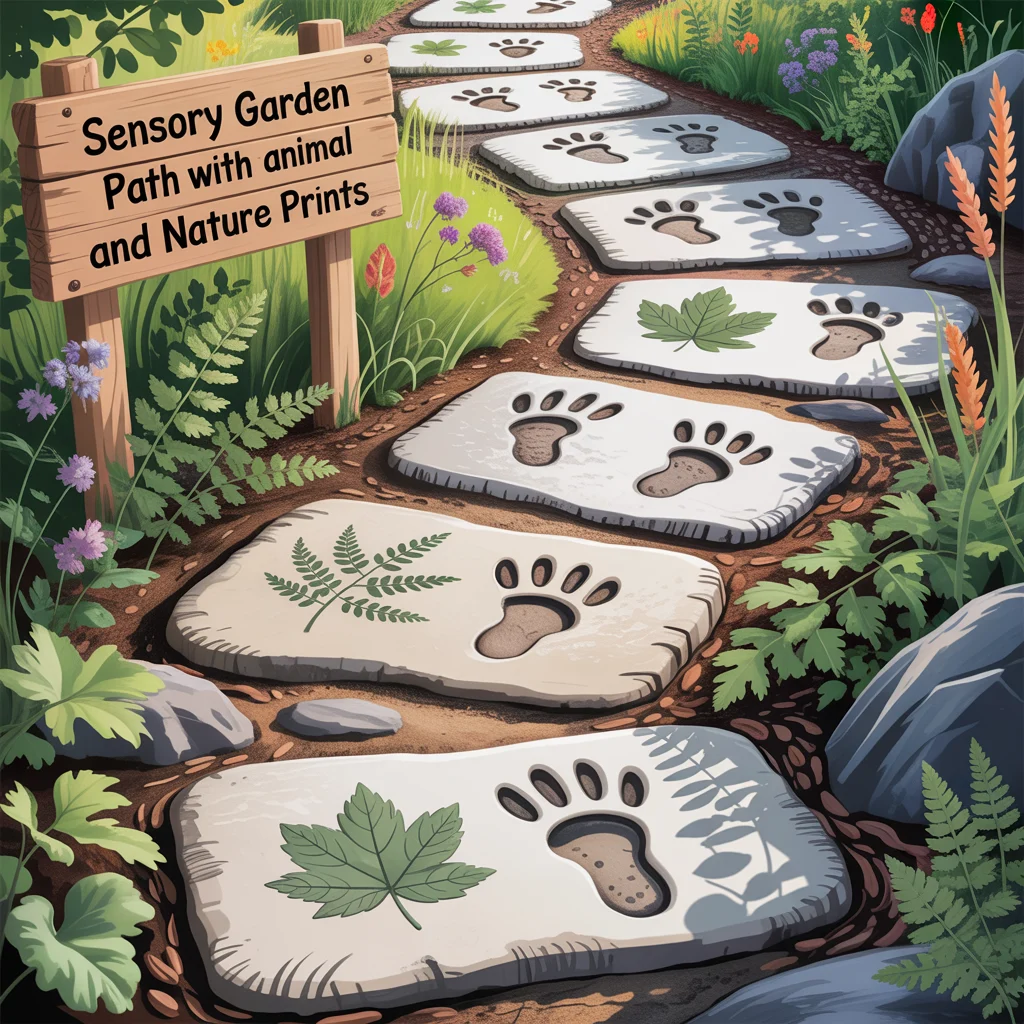
A sensory garden path with animal and nature prints uses cast or printed animal footprints, leaf shapes, insect outlines, and nature pattern stamps embedded in or applied to the path surface to create a visually engaging nature discovery path that connects children to the natural world through recognizable animal and plant imagery. I cast a series of 12 animal footprints including fox, badger, rabbit, duck, deer, and hedgehog directly into wet concrete stepping pads at a school sensory garden path, and the children used the prints to practice animal identification, track measurement, and imaginary animal tracking games during every observed outdoor session following installation.
Casting Animal Prints Into Sensory Path Stepping Stones
Animal prints are cast into concrete sensory path stepping stones by pressing a commercially produced silicone animal print stamp into the wet concrete surface at the correct depth of 5 to 8mm, then removing the stamp cleanly after 20 minutes when the concrete has set sufficiently to retain the impression without the edges crumbling. Commercial silicone animal footprint stamps in fox, badger, rabbit, and bird formats cost $8 to $20 per set and produce a sharp, accurate impression in standard 3:1 sand and cement concrete mix at a water-cement ratio of 0.45. I cast all 12 animal print stones for a school sensory path project in a single afternoon session, producing the stepping stones at a total material cost of $35 for the concrete mix and $22 for the commercial print stamp set.
Nature Print Path Designs for Sensory Garden Ideas for Kids
Leaf print sections, insect outline mosaic, and tree ring cross-sections are three nature print designs suited to sensory garden paths for kids. Leaf print sections use large leaves of sycamore, oak, or horse chestnut pressed into wet concrete to cast a permanent leaf surface impression, producing a nature print that children can identify and name as they step on each stone. Insect outline mosaic uses small glass or ceramic tile pieces arranged in the outline of a ladybird, butterfly, or bee on the path stone surface, providing a visual nature identification element alongside the tactile mosaic surface. Tree ring cross-sections use a slice of a log set flush with the path surface, displaying the annual growth rings that children can count and study as they stand on the stone.
Sensory Path With a Mud Kitchen Station
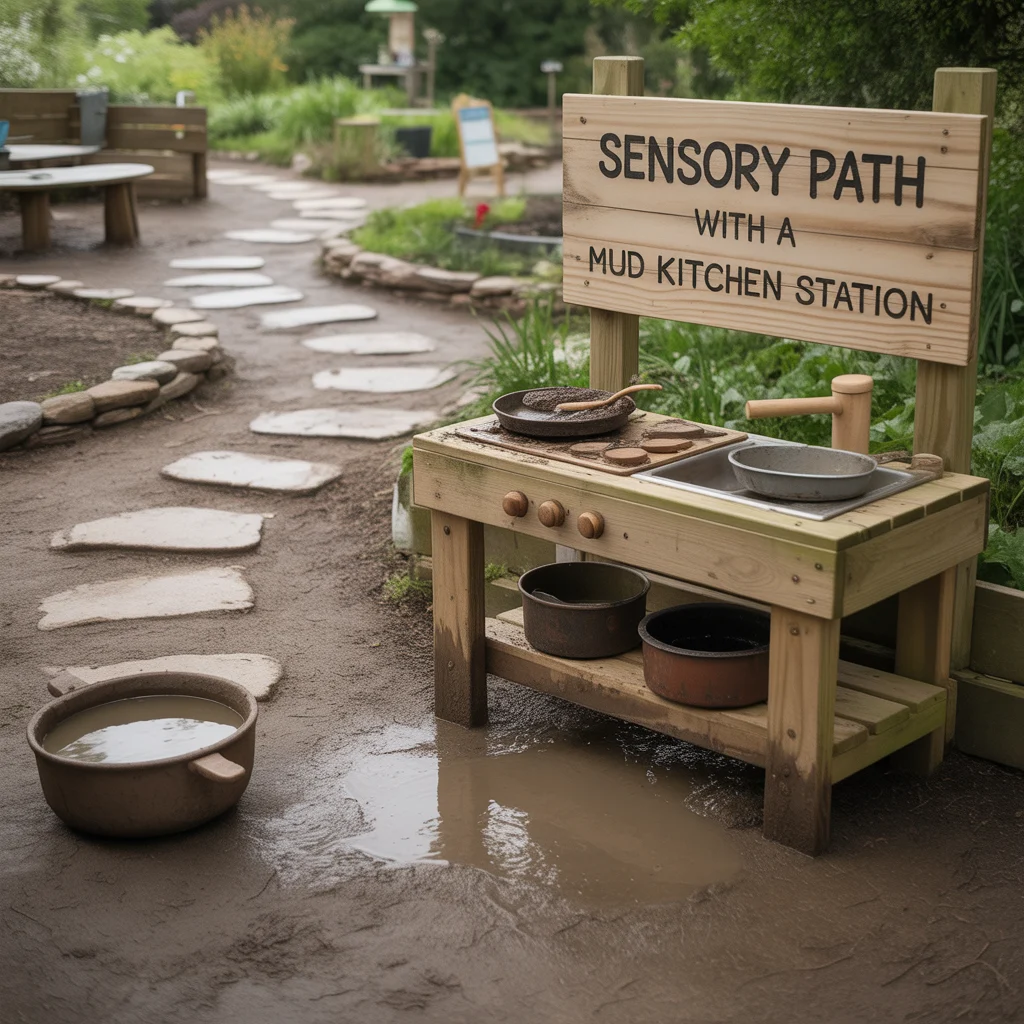
A sensory path with a mud kitchen station incorporates a child-height outdoor kitchen unit positioned directly off the path, containing containers, utensils, and a water supply that allows children to mix mud, water, leaves, and natural materials in a structured outdoor cooking play activity that provides intense tactile and olfactory sensory stimulation. I built a mud kitchen station for a sensory garden path at a school using reclaimed timber, a Belfast sink mounted at 24 inches height, and a low-pressure water tap connected to a garden hose, and the mud kitchen became the most used element on the entire outdoor sensory path within one week of opening. The children’s engagement with the mud, water, and natural materials lasted consistently longer than any other single activity on the path.
Building a Mud Kitchen for a Children’s Sensory Garden Path
A mud kitchen for a sensory garden path for kids requires three components: a stable work surface at 22 to 26 inches height for children aged 3 to 7, a water source of adjustable flow, and a contained mud supply area of 18 by 18 inches minimum. The work surface is built from 3-by-2-inch pressure-treated softwood with a 19mm exterior plywood top surface, which costs $45 to $75 in materials for a 24-by-36-inch unit. The water source connects to an outdoor garden tap using a standard hose fitting with a child-operable lever valve, which costs $12 to $25 for the valve and connector. I always position the mud kitchen on a non-slip rubber matting surface of at least 36 by 48 inches to prevent slipping on wet mud surrounding the station during active use.
Natural Materials for a Mud Kitchen Sensory Path Station
Leaf litter, pine cones, seed heads, and small pebbles are four natural materials suited to a mud kitchen station on a sensory garden path for kids. Leaf litter collected from surrounding garden trees provides a fragrant, varied tactile material that children add to mud mixes for texture variation and color. Pine cones provide a hard, structured material that children use as decorative additions to mud constructions and as a distinct textural contrast to the soft mud base material. Seed heads from plants including allium, nigella, and teasel provide round, structured, and geometrically varied objects that children incorporate into mud kitchen play without any adult suggestion, responding to the natural variety of shape and texture the seed heads provide.
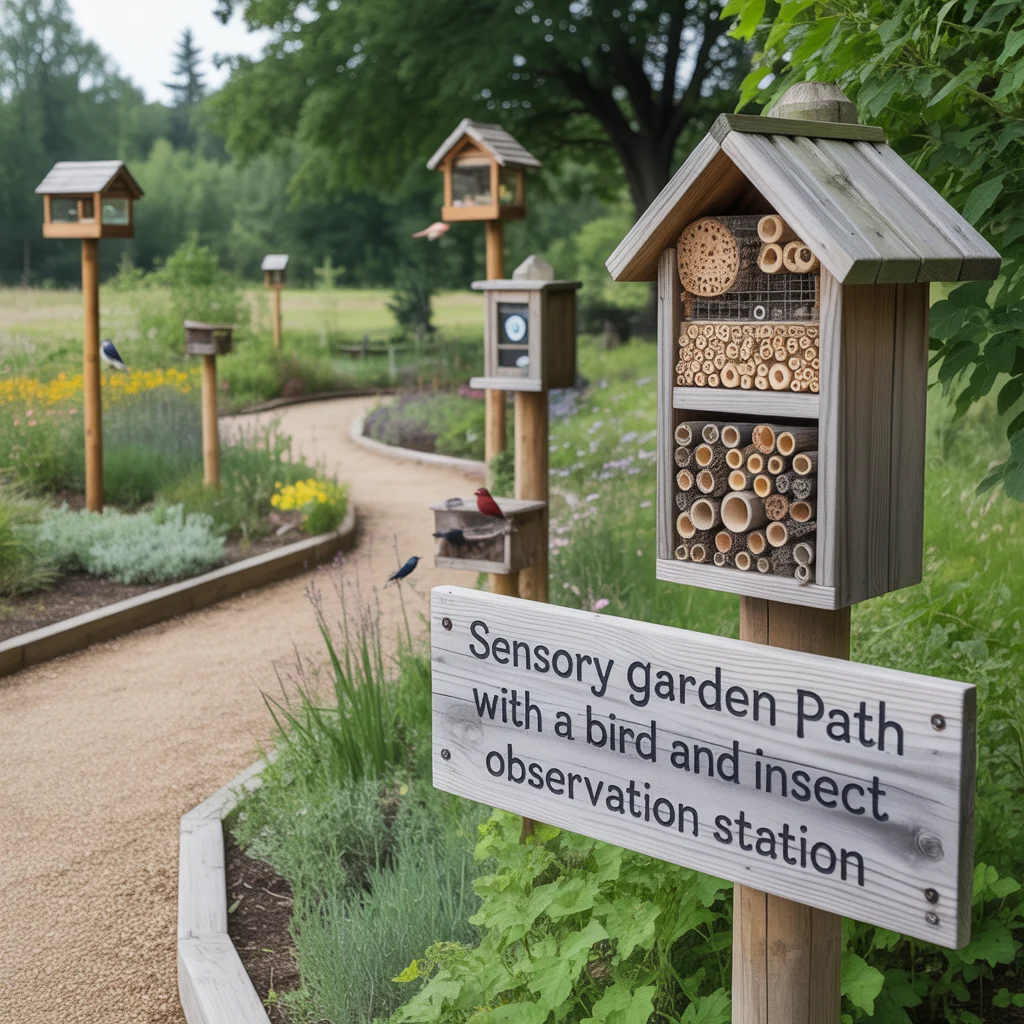
Sensory Garden Path With a Bird and Insect Observation Station
A sensory garden path with a bird and insect observation station incorporates bird feeders, insect hotels, log piles, and nectar-rich planting at the path edge to create a living nature observation point where children observe real wildlife directly from the path as part of their sensory experience. I installed an insect hotel and two bird feeders at a school sensory garden path observation station, combined with a 6-foot border of lavender, echinacea, and Verbena bonariensis, and recorded bee, butterfly, and bird activity at the station on 19 out of 20 observed sessions during the June to September period. The children’s ability to sit quietly and observe the insects and birds developed measurably over the six weeks following installation.
Insect Hotel Designs for a Children’s Sensory Garden Path
A layered natural material insect hotel, a drilled log block, and a bundled bamboo tube bundle are three insect hotel designs suited to a sensory garden path observation station for kids. A layered insect hotel using sections of hollow bamboo, drilled timber blocks, pinecones, and dried leaves packed into a timber-framed box of 12 by 18 inches provides habitats for solitary bees, lacewings, and ladybirds and costs $25 to $60 to build from natural materials. A drilled log block using a 6-inch-diameter log section with 5 to 8mm diameter holes drilled to a depth of 50mm at 20mm intervals provides a simple, effective nesting habitat for red mason bees and costs $0 if a suitable log section is available in the garden.
Nectar Plants for a Sensory Path Wildlife Observation Station
Lavandula angustifolia, Echinacea purpurea, and Verbena bonariensis are three nectar-rich plants suited to a border planting at a children’s sensory garden path wildlife observation station. Lavandula angustifolia produces nectar from June to August and attracts bumblebees and honeybees at a consistently high rate, making bee observation reliable throughout the lavender flowering period. Echinacea purpurea produces large pink daisy flowers from July to September that attract butterflies including peacock, red admiral, and painted lady, providing butterfly observation opportunities on the sensory path from midsummer. Verbena bonariensis produces tall stems of small purple flowers from July to October and attracts butterflies and hoverflies at a rate that makes it one of the most reliably insect-visited plants available for a school sensory garden path observation station.
Sensory Path With Colour-Changing Plants Through the Seasons
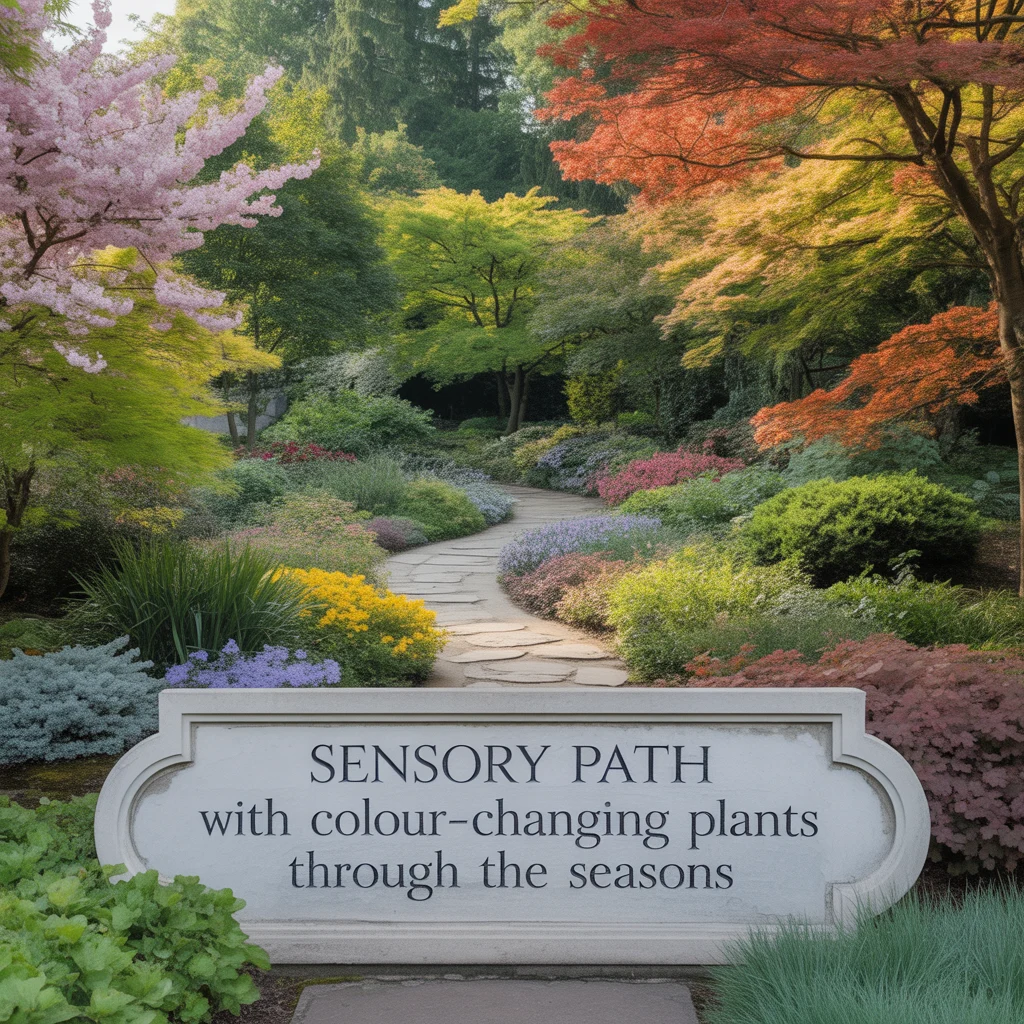
A sensory garden path with colour-changing seasonal planting uses a planned sequence of bulbs, perennials, and shrubs that produce different flower colours and foliage tones in each season, creating a sensory garden path that looks and smells different in spring, summer, autumn, and winter and gives children a direct observable connection to seasonal change. I planned a four-season colour path for a school sensory garden using spring bulbs, summer perennials, autumn-berrying shrubs, and winter bark interest plants, and the class teacher reported that children began noticing and commenting on the plant changes without any adult prompting by the second half of the first year of use.
Spring Plants for a Seasonal Sensory Garden Path
Narcissus, Muscari, and Tulipa are three spring-flowering bulbs suited to a seasonal sensory garden path for kids. Narcissus produces yellow and white flowers from March to April at heights of 12 to 18 inches and releases a fragrance that provides an olfactory spring signal on the sensory path before most other plants have produced any growth. Muscari, the grape hyacinth, produces dense spikes of small deep blue flowers in March and April at 6 to 8 inches height, providing a very low-level spring colour element directly at children’s ground-viewing height. Tulipa in a bold colour sequence of red, yellow, orange, and purple suits a colour-sequence sensory garden path for kids where the spring bulb display introduces the colour theme that the summer perennial planting continues.
Autumn and Winter Interest for a Seasonal Sensory Path
Cotoneaster horizontalis, Cornus alba, and Stipa tenuissima are three plants that provide autumn and winter sensory interest on a seasonal garden path for kids. Cotoneaster horizontalis produces bright red berries from September through to February that attract birds to the sensory path observation station during the winter months and provide a strong visual colour on the path border when most other plants have lost their leaves. Cornus alba Sibirica produces vivid red stems that provide intense winter colour on the sensory path from November through March, becoming most visible after leaf fall exposes the full length of the stem. Stipa tenuissima produces feathery golden-buff seed heads that catch winter light and move in the slightest wind, providing a sound and visual stimulus on the sensory path throughout the winter months.
Sensory Path With a Water Play Section
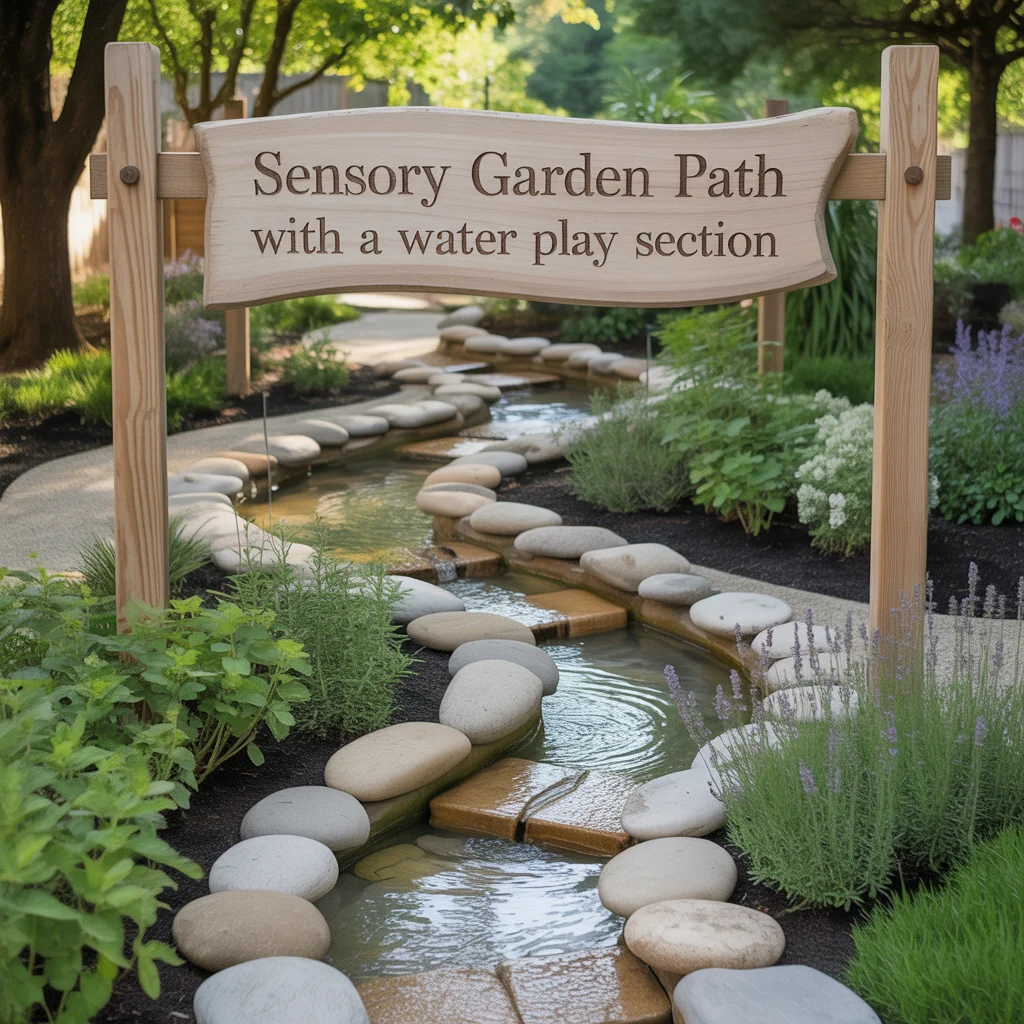
A sensory garden path with a water play section incorporates a contained water play area of 18 to 24 inches width directly accessible from the path surface, allowing children to engage with flowing or standing water as a tactile and auditory sensory activity within the structured path experience. I included a shallow recirculating water channel of 8 inches width and 3 inches depth running alongside a 6-foot section of a school sensory path, with the channel surface containing smooth pebbles, small water plants, and a gentle current produced by a low-flow submersible pump. Children engaged with the water channel by trailing their hands in the flow, placing and moving the pebbles, and observing the water movement around the stones for an average of 12 minutes per child per session.
Water Play Containment for a Children’s Sensory Garden Path
A water play section on a sensory garden path for kids requires a watertight liner of 1.5mm EPDM rubber or fiberglass, a surrounding non-slip rubber matting zone of 24 inches on the path side of the water feature, a maximum water depth of 3 inches at any point to comply with child safety guidelines for unsupervised water access, and a drainage outlet with a lockable cover that allows the water to be emptied after each session. I specify a maximum depth of 3 inches on all children’s water play sensory path installations because this depth complies with the standard guidance issued by the Royal Society for the Prevention of Accidents for water features in child-accessible outdoor spaces.
Aquatic Plants for a Sensory Path Water Section
Caltha palustris, Mentha aquatica, and Myosotis scorpioides are three aquatic or marginal plants suited to a water play section on a sensory garden path for kids. Caltha palustris, marsh marigold, produces bright yellow flowers from March to May in shallow water of 0 to 3 inches depth and provides a strong early-season visual stimulus in the sensory path water section. Mentha aquatica, water mint, grows in water of 0 to 3 inches depth, produces a strong mint fragrance when touched, and suits the water section of a sensory garden path for kids where the olfactory stimulation of the fragrance adds a scent element to the water play experience. Myosotis scorpioides, water forget-me-not, produces small blue flowers from May to August in shallow water and stays below 6 inches in height, suiting the shallow depth of a sensory path water channel.
Sensory Path With Giant Outdoor Musical Instruments
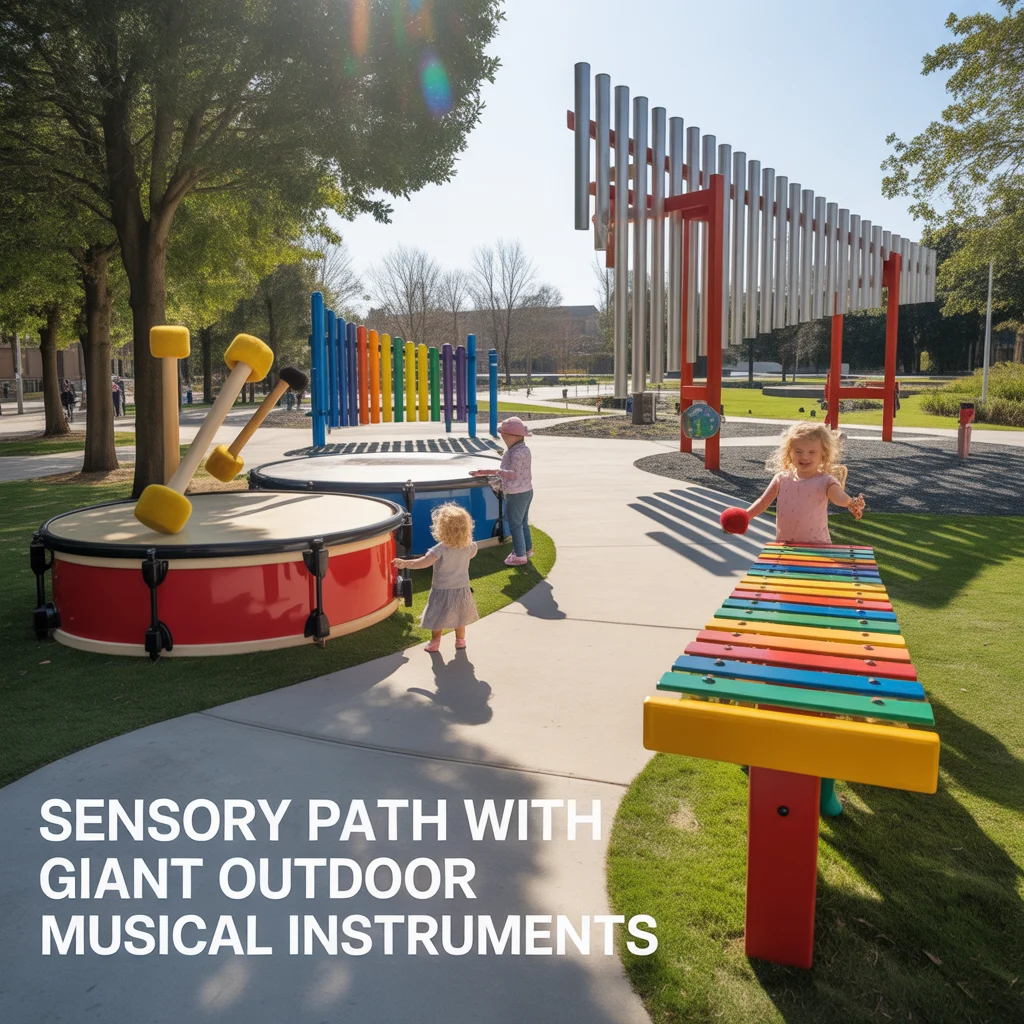
A sensory garden path with giant outdoor musical instruments places child-height percussion, string, and resonating instruments at intervals along the path for children to play actively as they move through the route, providing an intentional music-making element on the sensory path rather than the passive wind-dependent sound of chimes and rustling grasses. I specified four outdoor musical instruments for an outdoor sensory path for a school: an outdoor xylophone, a set of bongo drums on a post, a resonating steel tongue drum, and a set of mounted tubular bells, all positioned at 36-inch playing height and spaced at 8-foot intervals along the path. The combination produced a path where children could compose a sequential piece of music by moving from one instrument to the next.
Outdoor Instrument Types for a School Sensory Garden Path
An outdoor xylophone, a set of outdoor bongo drums, and a steel tongue drum are three outdoor instruments suited to a sensory garden path for schools. An outdoor xylophone with aluminium or stainless steel keys produces a clear, tuned note sequence that allows children to pick out simple melodies, costing $180 to $450 from specialist outdoor music suppliers. Outdoor bongo drums use weather-resistant synthetic drum heads stretched over a stainless steel frame and produce a warm percussion sound when struck with the palm or fingers, costing $120 to $280 per set. A steel tongue drum produces a series of tuned metallic notes from individual cut steel tongues that vibrate when struck with a mallet, producing a sound suited to a calming sensory path for children with autism who respond positively to gentle musical tones.
Mallet Storage for Outdoor Instruments on a Sensory Path
Outdoor musical instruments on a sensory garden path for kids require mallets or beaters stored permanently at the instrument to allow independent child use without an adult fetching equipment before each session. Stainless steel mallet holders of 25mm diameter tube welded to the instrument post provide a permanent, weatherproof storage point for one or two mallets at each instrument. I specify mallet cord lengths of 300mm maximum on all school sensory path instrument installations, which prevents the mallet from being carried more than 300mm from the instrument but allows full arm movement during playing. Mallets with a rubber head diameter of 40mm produce the clearest note on both xylophone and tongue drum instruments and are the most durable mallet type for outdoor school use.
Sensory Path With a Mindfulness and Calm Corner
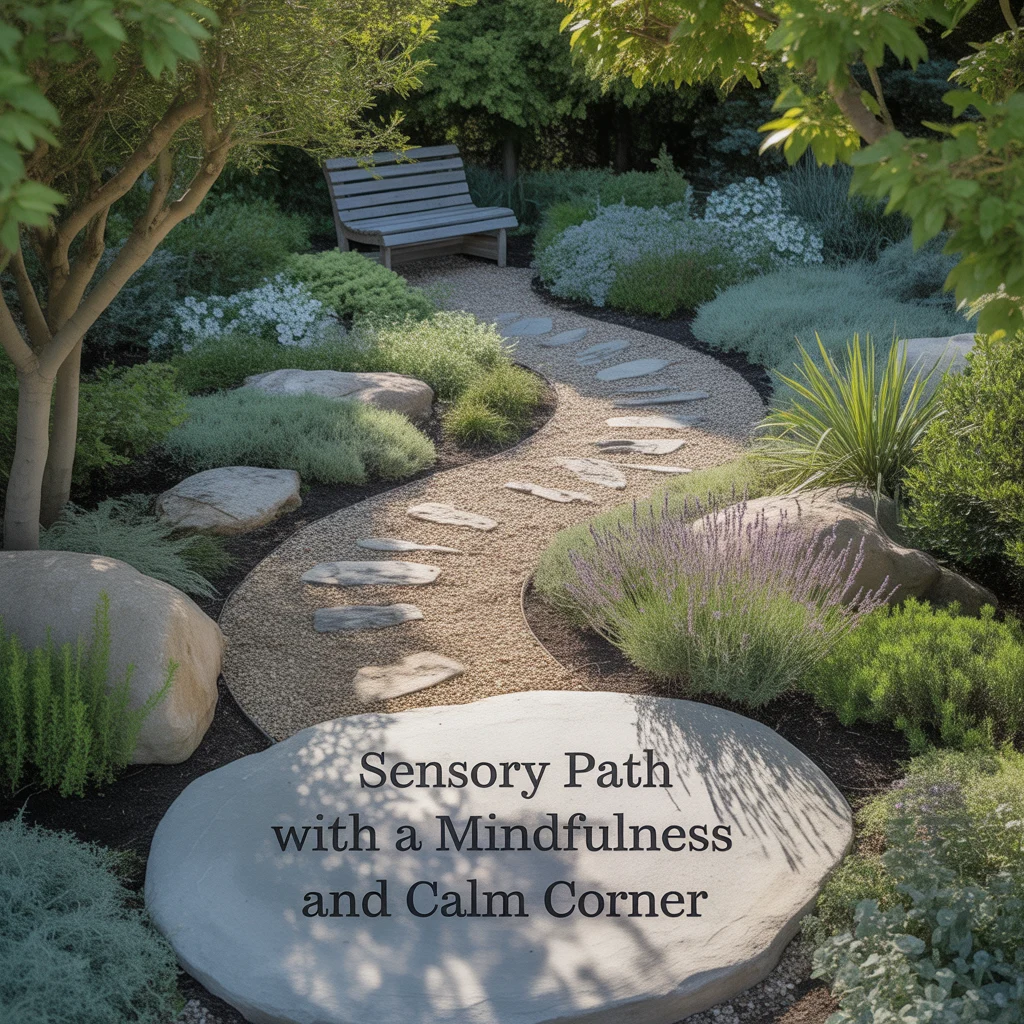
A sensory garden path with a mindfulness and calm corner incorporates a sheltered seating or resting area directly accessible from the path, surrounded by calming lavender, soft grass, and gentle sound elements, where children can sit, breathe, and regulate their sensory experience after walking the more stimulating sections of the path. I included a calm corner at the end of a school sensory garden path using a curved willow screen enclosing a 4-foot-square area with a low wooden bench, a border of lavender, and a bamboo chime above, and the occupational therapist working with the school reported that several children with sensory processing differences used the corner independently as a self-regulation space during school sessions.
Calm Corner Planting for a Children’s Sensory Garden Path
Lavandula angustifolia, Stachys byzantina, and Festuca glauca are three calming plants suited to a mindfulness corner on a sensory garden path for kids. Lavandula angustifolia provides the most widely recognized calming scent available in a garden planting, with research published in the International Journal of Neuropsychopharmacology in 2014 identifying lavender fragrance as producing measurable reductions in anxiety levels in both adults and children. Stachys byzantina, lamb’s ear, produces intensely soft, woolly silver leaves that children find highly soothing to touch, providing a tactile calming stimulus directly from the plant without any processing or equipment. Festuca glauca produces a fine-textured blue-grey grass mound that produces a gentle rustling sound in light wind and suits the visual calm of a sensory path mindfulness corner.
Willow Screen Construction for a Calm Corner on a Sensory Path
A willow screen enclosing a calm corner on a sensory garden path for kids uses living or dried willow rods woven between upright stakes to create a partial enclosure of 4 to 5 feet height that provides a sense of shelter and privacy without fully enclosing the space. Living willow screens use freshly cut Salix viminalis rods inserted at 8-inch intervals into moist soil and woven horizontally, rooting within the first growing season to produce a permanent, self-renewing screen. Dried willow hurdle panels of 6 feet width by 4 feet height provide an immediately effective screen without the establishment period of living willow and cost $35 to $65 per panel from countryside suppliers. I use living willow for calm corners in school sensory garden paths where long-term establishment and the natural development of the screen over time provides an additional nature observation element.
Sensory Garden Path With a Nature Collection Station
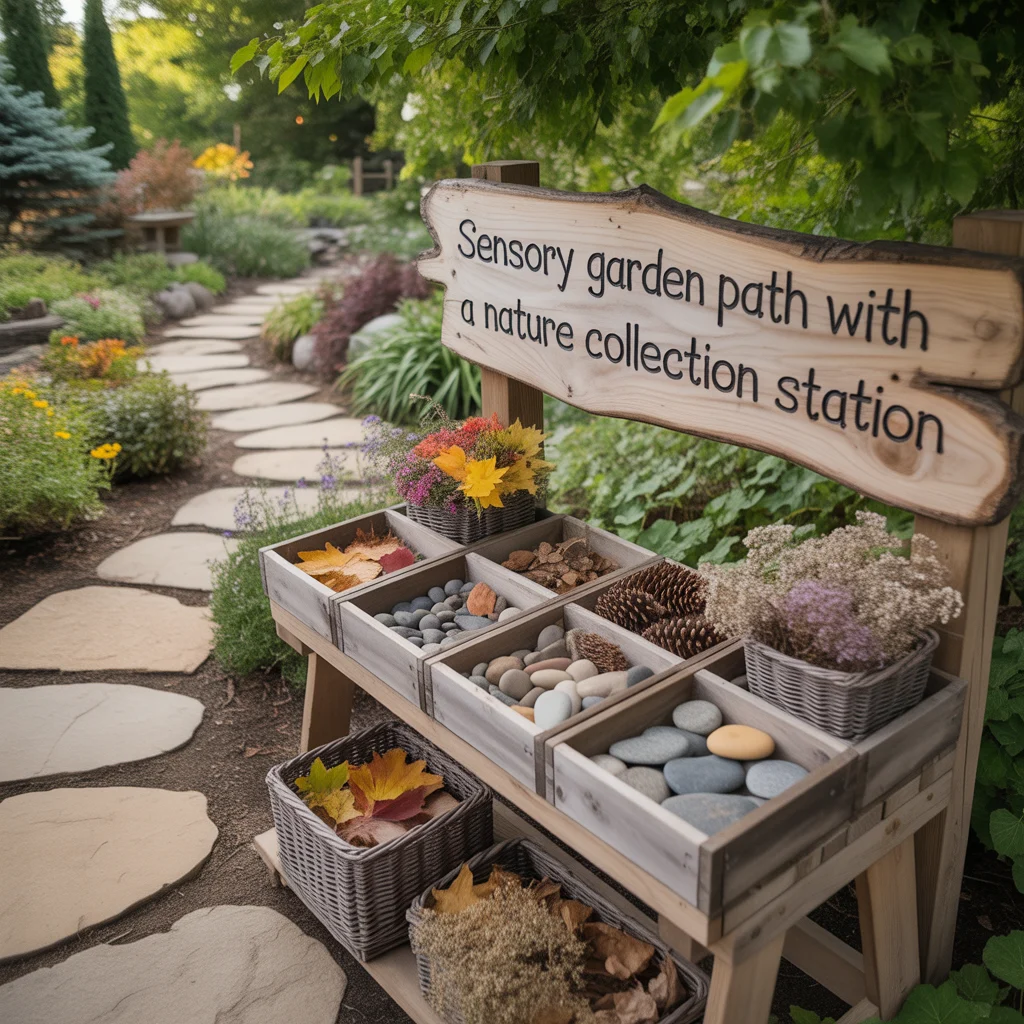
A sensory garden path with a nature collection station provides a wall-mounted or post-mounted display board at child height where children collect and display natural objects found in the garden during the path session, including leaves, seed heads, stones, feathers, and bark pieces, creating a tactile and visual nature documentation activity linked to the sensory path experience. I installed a nature collection board with 20 individual compartments at 32 inches height on the boundary fence beside a school sensory garden path, and the children began filling the compartments with natural objects within the first session, returning on subsequent days to replace objects, compare finds, and label their collections with the help of their class teacher.
Nature Collection Board Construction for a Sensory Path
A nature collection board for a sensory garden path for kids is constructed from a 600mm-by-900mm sheet of 12mm exterior plywood divided into 12 to 20 individual compartments using 2-by-1-inch timber dividers, with the entire board sealed in two coats of exterior varnish and mounted on a post or wall at 32 inches center height. Each compartment measures approximately 80mm by 80mm by 30mm depth, which suits natural objects up to 70mm in any dimension including most seed heads, small stones, feathers, and leaf sections. I build nature collection boards for sensory garden path projects at a material cost of $25 to $40 each and find them one of the most cost-effective engagement elements on the full path in terms of child interaction time generated per dollar of material cost.
Natural Objects to Collect on a Sensory Garden Path
Seed heads, feathers, bark pieces, and smooth pebbles are four natural objects suited to a nature collection station on a sensory garden path for kids. Seed heads including allium globes, nigella pods, teasel heads, and poppy capsules provide visually distinctive, geometrically varied objects that children differentiate and sort by shape without adult direction. Feathers found in the garden provide a very soft, light tactile object that contrasts strongly with the harder natural objects in the collection and suit sensory garden ideas for autism where contrast between very different tactile properties is a deliberate therapeutic goal. Smooth pebbles provide a cool, hard, dense object that children naturally sort by size and color, supporting early classification and comparison skills as part of the sensory path outdoor learning experience.
Related
best flowers to plant along a children’s garden path
how to use pots along a kids sensory garden walkway
woodland garden sitting areas for family outdoor spaces
Frequently Asked Questions
What is a sensory garden path for kids?
A sensory garden path for kids is an outdoor walkway designed to stimulate one or more of the five senses through textured surfaces, fragrant plants, sound elements, visual colour sequences, and taste-safe edible plants placed along the route. The path provides children with a structured outdoor environment that supports sensory processing development, physical coordination, and nature connection simultaneously. Sensory garden paths for kids are used in domestic gardens, primary schools, nurseries, and therapeutic settings including sensory garden ideas for autism programmes. The path format suits children from age 2 upward and is adaptable to different developmental needs, sensory sensitivities, and outdoor space sizes from a 10-foot home garden path to a 200-foot school outdoor sensory trail.
How do you make a sensory garden path for kids at home?
A sensory garden path for kids at home is made by laying six to eight stepping stones of different textures at 14-inch intervals along a path of 10 to 15 feet, planting fragrant herbs including lavender, mint, and thyme at the path edges, and adding one sound element such as a wind chime or small water feature alongside the path. The total material cost for a basic home sensory path of this specification ranges from $45 to $120 depending on the stepping stone materials and plant choices. I built a version of this for my nephew for $68 in materials in a single afternoon, and the path produced immediate and sustained sensory engagement that exceeded every other garden feature in his observable interest and dwell time.
What plants are best for a sensory garden path for kids?
Lavender, creeping thyme, spearmint, chamomile, and nasturtiums are the five plants best suited to a sensory garden path for kids because each provides a different primary sensory stimulus: lavender for calming scent, thyme for foot-level fragrance and texture, spearmint for a strong tactile-release fragrance, chamomile for a sweet ground-level scent and soft texture, and nasturtiums for edible colour and mild flavour. All five plants are non-toxic, child-safe, and available from standard garden centres at a cost of $2 to $6 per plant. I plant all five species on every sensory garden path for kids project I design to cover the olfactory, tactile, visual, and gustatory senses within the planting scheme alone.
What materials are used in an outdoor sensory path for schools?
Outdoor sensory paths for schools use rubber tiles, textured concrete stepping pads, smooth river pebbles, bark chip, artificial grass sections, and resin-bound coloured gravel as the primary surface materials, with additional tactile wall panels, numbered stepping stones, and balance elements added to extend the developmental range of the path. Rubber tiles rated to BS EN 1176 playground safety standards are the most widely used material on school outdoor sensory paths because they provide a non-slip, impact-absorbing surface in a range of colours and textures suited to both tactile and visual sensory stimulation. I specify rubber tiles for all school sensory path projects because the material complies with UK playground safety standards and withstands the daily foot traffic of a school environment without surface degradation.
Are sensory garden paths useful for children with autism?
Sensory garden paths for autism provide structured outdoor sensory experiences that support sensory integration, self-regulation, and nature engagement in children on the autism spectrum, according to guidance published by the National Autistic Society and applied by occupational therapists in therapeutic garden settings across the United Kingdom. Barefoot paths, tactile wall panels, calm corners with lavender planting, and gentle water sound features are the four sensory path elements most consistently reported by occupational therapists as producing positive responses in children with autism spectrum disorder. I have worked on two therapeutic sensory garden path projects specifically designed for children with autism and observed sustained engagement, reduced anxiety behaviours, and increased voluntary outdoor time in the children using both paths within six weeks of opening.