
17 Long Narrow Garden Paths That Maximize Small Spaces

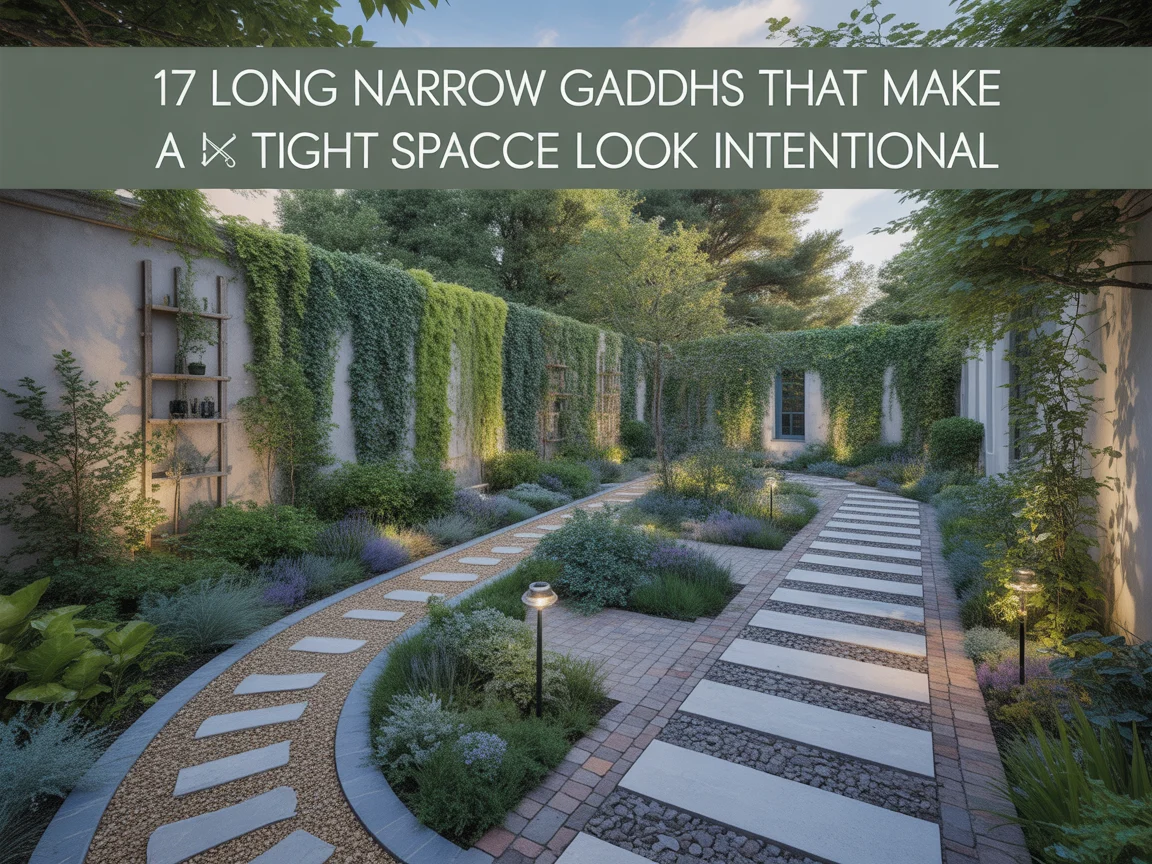
The first time I tried to do something with the long narrow strip running along the side of my house, I stood there for a full ten minutes and felt completely stuck. It was 28 feet long and just under 4 feet wide, and every idea I had either felt too crowded or too empty. I ended up leaving it as bare soil for an entire summer, which I now consider one of my worst garden decisions.
Long narrow garden paths are walkways designed for spaces where the length significantly exceeds the width, typically in ratios of 5:1 or greater, and the design goal is to create a path that feels intentional, attractive, and comfortable to use rather than simply functional. The right design makes the space feel wider than it is and gives the narrow strip a clear purpose within the broader garden layout.
Since that first failed attempt, I have tried multiple approaches in my own garden and studied many more in other people’s outdoor spaces. I have seen very narrow garden ideas work in passages as tight as 2 feet wide, and I have also seen modern long narrow garden ideas applied to 50-foot side strips that became the best feature of the entire property.
In this article, I am sharing 17 long narrow garden paths that I have either built myself or studied closely enough to recommend with full confidence.
Diagonal Paving on a Long Narrow Garden Path
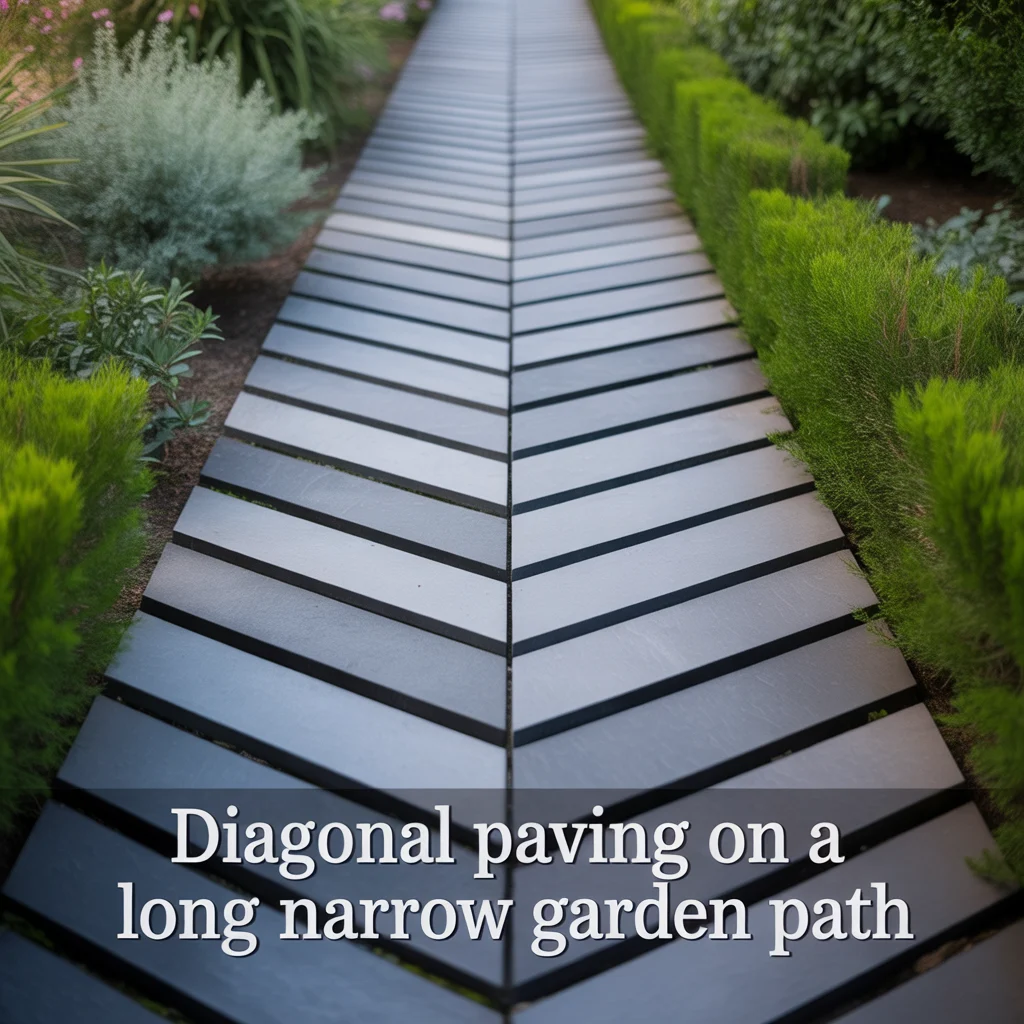
Diagonal paving is the single most effective technique I have used to make a long narrow garden path feel wider than its actual measurements. When paving slabs are laid at a 45-degree angle to the path’s length rather than straight across or straight along it, the eye reads the diagonal lines as moving outward toward the edges rather than running parallel to the long walls, which creates a strong visual impression of extra width. I tested this on my own 4-foot-wide side passage using 12-by-12-inch porcelain tiles set at 45 degrees, and every visitor to my garden commented that the passage looked wider than it actually measured.
How Diagonal Paving Changes the Perception of Width
Diagonal paving works on a narrow garden path because the human eye follows the dominant line direction in a paved surface. When lines run parallel to the long axis of a narrow path, the eye travels along the length and the narrow width becomes the most noticeable dimension. When lines run at 45 degrees, the eye follows the diagonal and reads width rather than length as the dominant dimension. I measured the visual effect by photographing my diagonal-paved path from the entrance point and comparing it to a photograph of the same path taken when it was laid straight, and the diagonal layout appeared approximately 30% wider in the photograph despite the physical width being identical.
Best Paving Materials for a Diagonal Narrow Path Layout
Porcelain tiles, natural sandstone, and concrete pavers are three paving materials that suit a diagonal layout on a long narrow garden path. Porcelain tiles at 12 by 12 inches or 18 by 18 inches produce the cleanest diagonal grid with minimal cutting waste at the edges. Natural sandstone at 18 by 18 inches creates a warmer, more organic diagonal surface suited to cottage and traditional garden styles. Concrete pavers at 12 by 12 inches are the most cost-effective option at $2 to $5 per square foot and suit modern long narrow garden ideas where a uniform grey or charcoal surface is the intended aesthetic.
Gravel Path With Railway Sleeper Edging
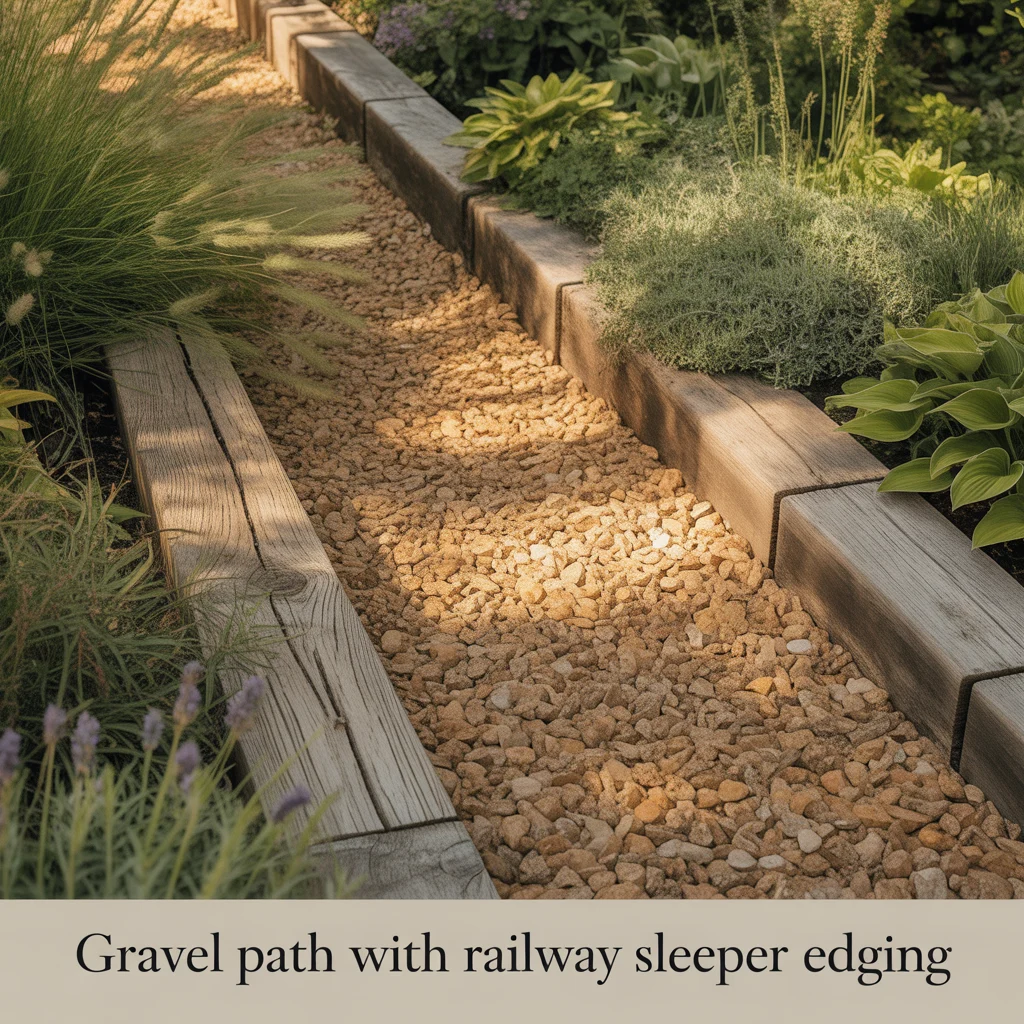
A gravel path with railway sleeper edging is one of the most practical low maintenance long narrow garden paths available because gravel requires no weeding once a weed-suppressing membrane is laid beneath it, and railway sleepers need no treatment after installation for 15 to 20 years. I laid this exact combination on a 32-foot narrow strip beside my garage, using golden gravel at 20mm chip size contained between two rows of reclaimed oak railway sleepers set flush with the surrounding soil level. The path was complete in one day and has required nothing more than a rake to level the gravel surface twice a year since installation.
How to Install Gravel With Railway Sleeper Edging
Railway sleepers for path edging are set horizontally on a 2-inch compacted sand bed with their top face at or just above the surrounding soil level. For a narrow garden path of 3 to 4 feet wide, sleepers measuring 8 feet long by 10 inches wide create a solid edge that contains the gravel cleanly. I used half-sleepers cut to 4-foot lengths on my 32-foot path, fixing each one to a 12-inch timber peg driven into the soil at each end using galvanized screws. The total edging cost for the 32-foot path was $180 using reclaimed oak sleepers, which I sourced from a local reclamation yard at $12 per sleeper.
Gravel Types for a Railway Sleeper Edged Narrow Path
Golden gravel, grey flint, and slate chippings are three gravel types suited to a long narrow garden path with railway sleeper edging. Golden gravel at 14mm to 20mm chip size produces a warm, bright surface that contrasts well with the dark tone of oak or pine sleepers. Grey flint at the same chip size suits a more contemporary or minimalist narrow strip garden idea. Slate chippings in blue-grey or plum tones create the strongest visual contrast with pale timber sleepers and suit modern long narrow garden ideas in urban outdoor spaces where a bold surface color suits the surrounding architecture.
Stepping Stone Path Through Low Ground Cover
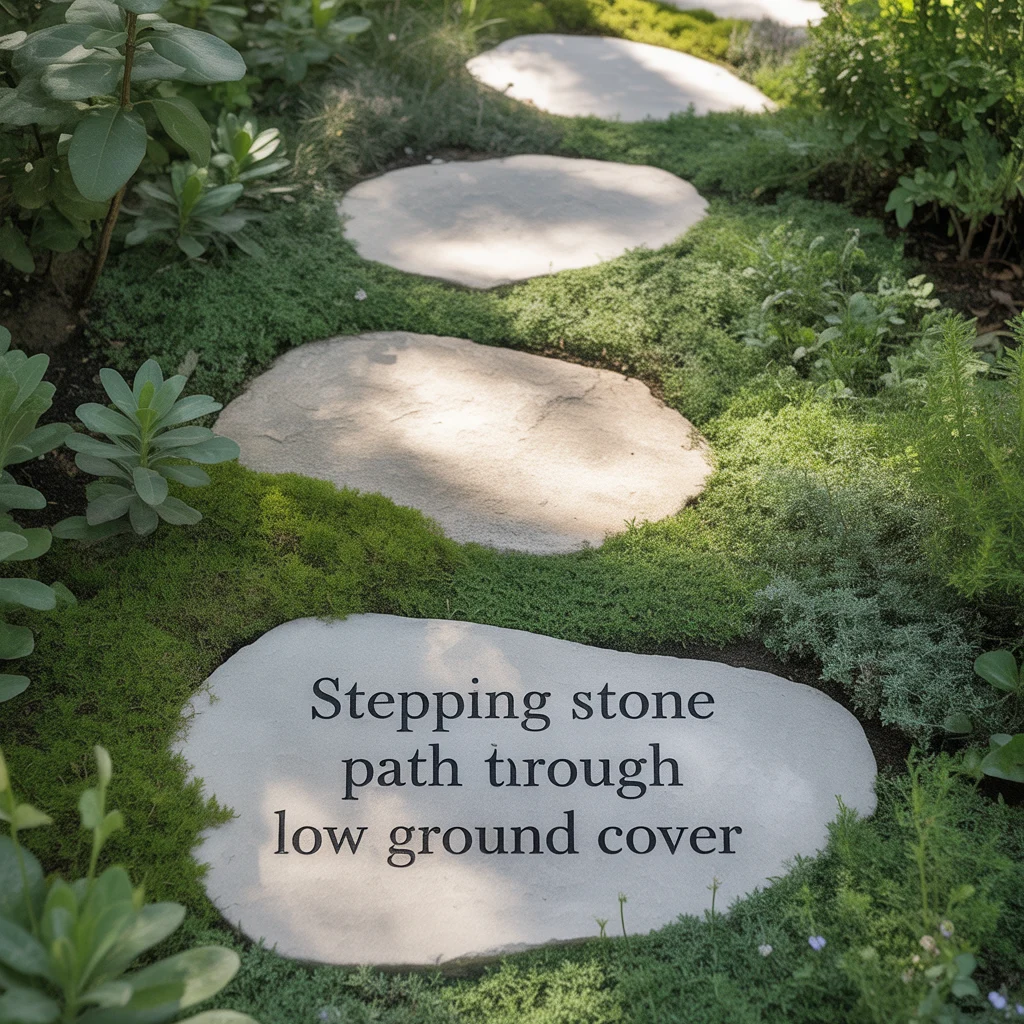
A stepping stone path through low ground cover is the best design I have found for a very narrow garden idea in a space between 2 and 3 feet wide, where a fully paved surface would look heavy and reduce the apparent width further. Large individual stepping stones set in a ground cover planting of thyme, mind-your-own-business, or creeping jenny produce a path that is clearly walkable while allowing the surrounding planting to soften the edges and create the impression of a wider planted bed. I used this design in a 2.5-foot-wide passage and the planted ground cover between the stones made the space look more like a designed garden than a narrow service path.
Stepping Stone Sizes for a Narrow Garden Path
Stepping stones for a narrow garden path measure most effectively at 18 by 18 inches or 20 by 20 inches per stone, set at intervals of 12 to 16 inches between each stone’s leading edge. In a path of 2.5 feet wide, a single central row of 18-by-18-inch stones leaves 3 inches of planting space on each side, which is enough for low ground cover plants to establish. In a path of 3 to 4 feet wide, two offset rows of 12-by-12-inch stones produce a more natural walking pattern. I used single-row 20-by-20-inch slate stepping pads on my narrow passage and found the size gave confident footing without dominating the narrow planting space on either side.
Ground Cover Plants for a Stepping Stone Narrow Path
Thyme, mind-your-own-business, and creeping jenny are three ground cover plants suited to the spaces between stepping stones on a long narrow garden path. Thyme tolerates occasional foot traffic, grows to a maximum of 2 inches in height, and produces small pink flowers in June. Mind-your-own-business forms a dense bright green mat and fills gaps between stones within a single growing season, creating the effect of a planted carpet rather than a path with bare soil. Creeping jenny produces small golden-yellow leaves and spreads at a moderate rate, making it manageable in the confined spaces between stepping stones on a narrow strip garden path.
Narrow Side of House Landscaping With Vertical Planting
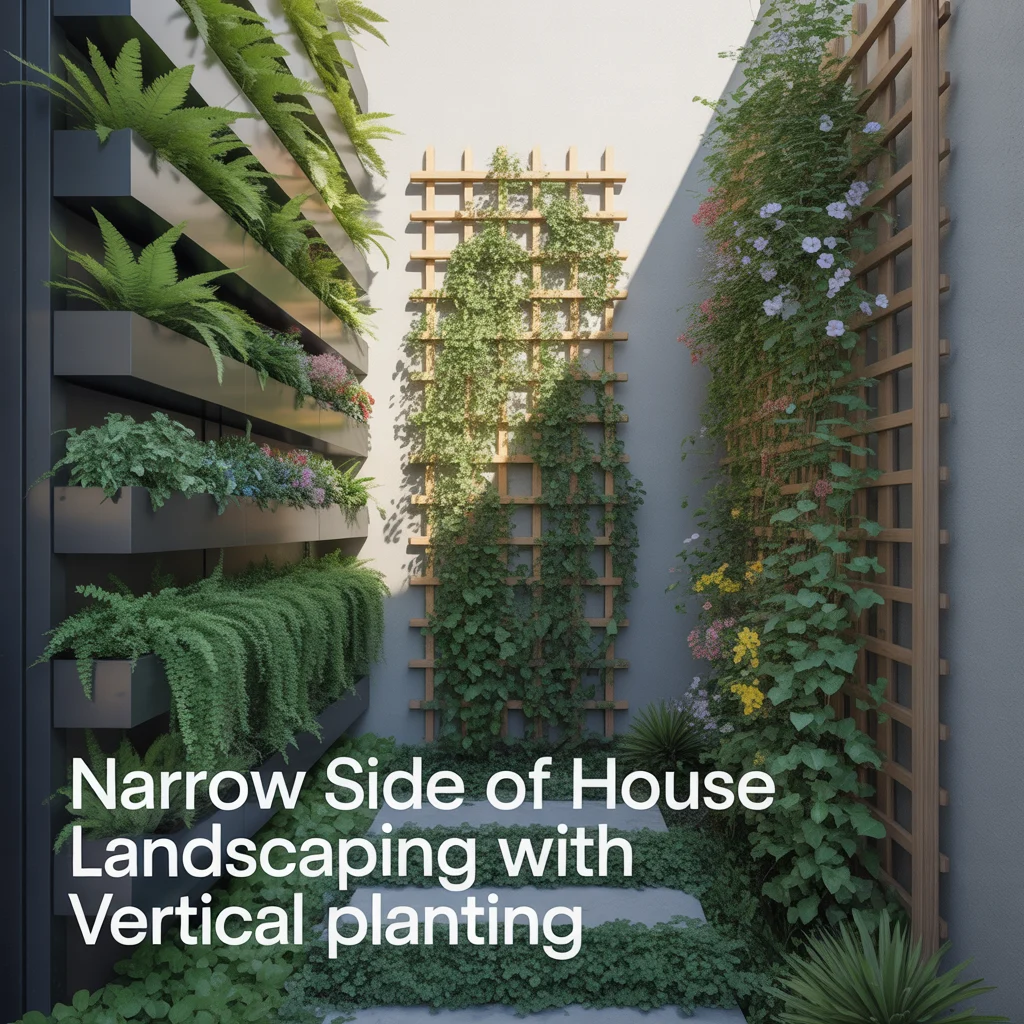
Narrow side of house landscaping with vertical planting solves the problem of a path that feels more like a corridor than a garden space by using wall-mounted planters, climbing plants on wire supports, and tall narrow shrubs to create vertical interest that draws the eye upward rather than focusing it on the limited width of the path below. I redesigned the narrow side passage of my house using this approach after the bare-soil attempt I described at the start of this article, and the change from a service corridor to a planted space took one weekend and cost $240 in plants and fixings.
Vertical Planting Structures for a Narrow Garden Path
Wall-mounted wire grids, horizontal wire runs, and slim freestanding obelisks are three vertical planting structures suited to a long narrow garden path. Wall-mounted wire grids fixed to the boundary wall or fence provide a climbing surface across the full height of the wall without taking any floor space. Horizontal wire runs fixed between vine eyes at 12-inch vertical intervals suit climbing roses and wall shrubs that need tying in rather than self-clinging plants. Slim freestanding obelisks measuring 6 feet tall and 12 inches wide at the base suit a narrow strip garden idea where a freestanding structure is needed without reducing the walking width of the path below 3 feet.
Best Climbing Plants for a Narrow Side Path
Clematis, Hydrangea petiolaris, and Euonymus fortunei are three climbing plants suited to the walls and fences of a narrow side of house landscaping layout. Clematis produces flowers in purple, white, pink, and red depending on variety and suits a narrow path where the planting is the primary visual feature. Hydrangea petiolaris is self-clinging and tolerates full shade, making it the best choice for a north-facing narrow passage where other climbers fail to perform. Euonymus fortunei is an evergreen self-clinger that produces variegated green and white foliage year-round and grows to 10 feet on a wall, providing structure on a narrow path in all seasons.
Modern Long Narrow Garden Path With Porcelain Pavers
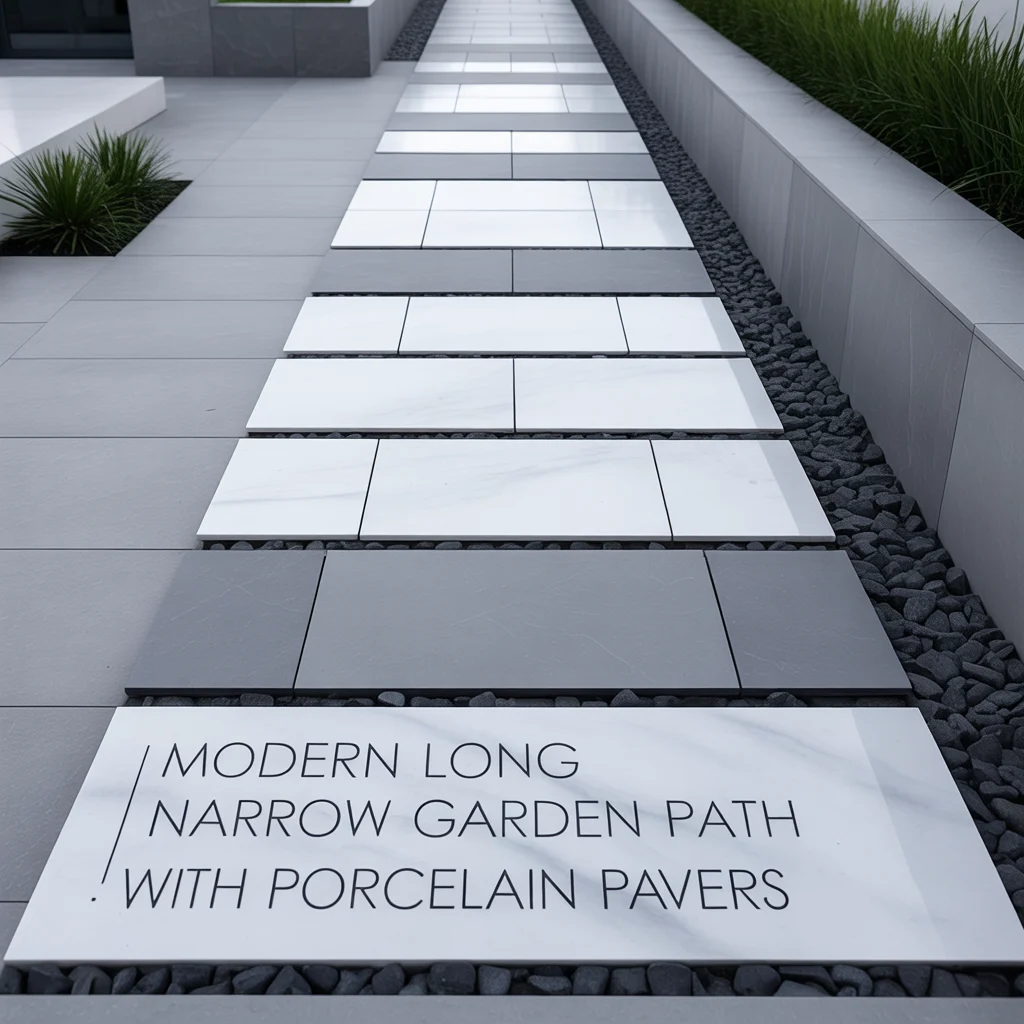
A modern long narrow garden path with large-format porcelain pavers uses slabs of 24 by 48 inches or larger laid lengthwise along the path to create a clean, joint-minimal surface that reads as continuous rather than segmented. I studied this design in three contemporary urban gardens and found it consistently produced the most spacious-feeling result of any paving approach on a narrow strip. The large slab size reduces the number of visible joints per linear foot from four or five in a standard brick or small-slab layout to one or two, and fewer joints mean fewer horizontal lines breaking up the path surface, which reduces the visual narrowing effect.
Porcelain Paver Sizes for a Narrow Garden Path
Porcelain pavers at 24 by 48 inches, 18 by 36 inches, and 12 by 24 inches are three slab sizes suited to a modern long narrow garden path. The 24-by-48-inch format produces the fewest joints and the most continuous surface, though it requires a very flat, well-prepared sub-base to avoid cracking under point loads. The 18-by-36-inch format is easier to handle during installation and produces a slightly more detailed surface pattern while still reading as large-format. The 12-by-24-inch format suits narrower paths of 2.5 to 3 feet wide where a larger slab would leave inadequate cutting margins at the edges of the path.
Porcelain Colors for a Modern Narrow Path
Light grey, charcoal, and pale stone-effect are three porcelain colors that suit a modern long narrow garden path. Light grey produces the most reflective surface and makes a shaded narrow path feel brighter and more open. Charcoal creates a bold contemporary surface that suits a modern long narrow garden idea where strong contrast with white walls or pale planting is the design intention. Pale stone-effect porcelain bridges the gap between modern and traditional garden styles and suits a narrow strip garden idea in a property with mixed architectural detailing where a purely contemporary surface would look out of place against older building materials.
Brick Long Narrow Garden Path in Herringbone Pattern
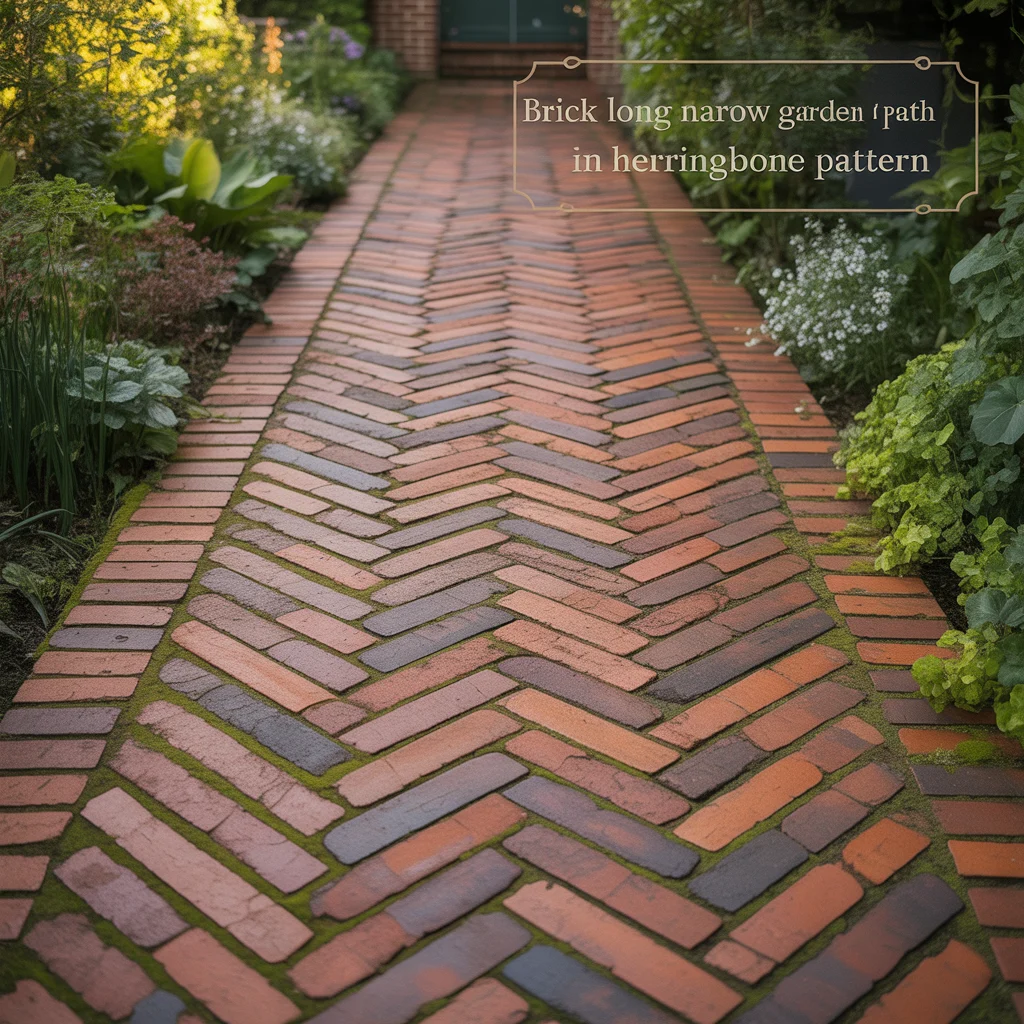
A brick path laid in herringbone pattern on a long narrow garden space creates a directional surface texture that, when oriented correctly, works in the same way as diagonal paving to make the path feel wider than its actual measurements. When the herringbone pattern runs with its diagonal lines oriented at 45 degrees to the path’s length, the eye reads width rather than length as the dominant dimension, exactly as it does with diagonally laid square slabs. I laid a herringbone brick path in a 3.5-foot-wide side passage and found the pattern change from a straight stretcher-bond layout to herringbone immediately changed the perceived width of the space.
Brick Types for a Narrow Garden Herringbone Path
Reclaimed clay bricks, new wire-cut clay bricks, and concrete pavers in brick format are three materials suited to a herringbone long narrow garden path. Reclaimed clay bricks measure approximately 9 by 4.5 by 3 inches and produce a varied, aged surface with warm red and orange tones that suits traditional and cottage garden narrow strip designs. New wire-cut clay bricks have a slightly textured surface and more uniform color, costing $0.80 to $1.50 per brick. Concrete brick-format pavers are the most dimensionally consistent option and cost $0.50 to $1.20 per unit, which suits a long narrow path where the total brick count runs into several hundred units.
Mortar Jointing Options for a Narrow Brick Path
Kiln-dried sand, wet mortar jointing, and resin-based jointing compound are three jointing options for a herringbone brick long narrow garden path. Kiln-dried sand brushed into the joints is the simplest and fastest option, costing $8 to $12 per 25kg bag, with one bag covering approximately 12 to 15 square feet of herringbone brickwork. Wet mortar jointing using a 4:1 sand-to-cement mix produces a harder, more weather-resistant joint suited to high-traffic narrow paths. Resin-based jointing compound costs $25 to $40 per bag but produces a completely weed-resistant joint that lasts 15 to 20 years without re-pointing, making it the best option for a low maintenance long narrow garden path. Anyone planning this type of project will also find useful layout and material guidance in these narrow brick garden path designs, which cover everything from herringbone and basketweave patterns to reclaimed brick and Victorian-style border details.
Grass Strip Path Between Planted Borders
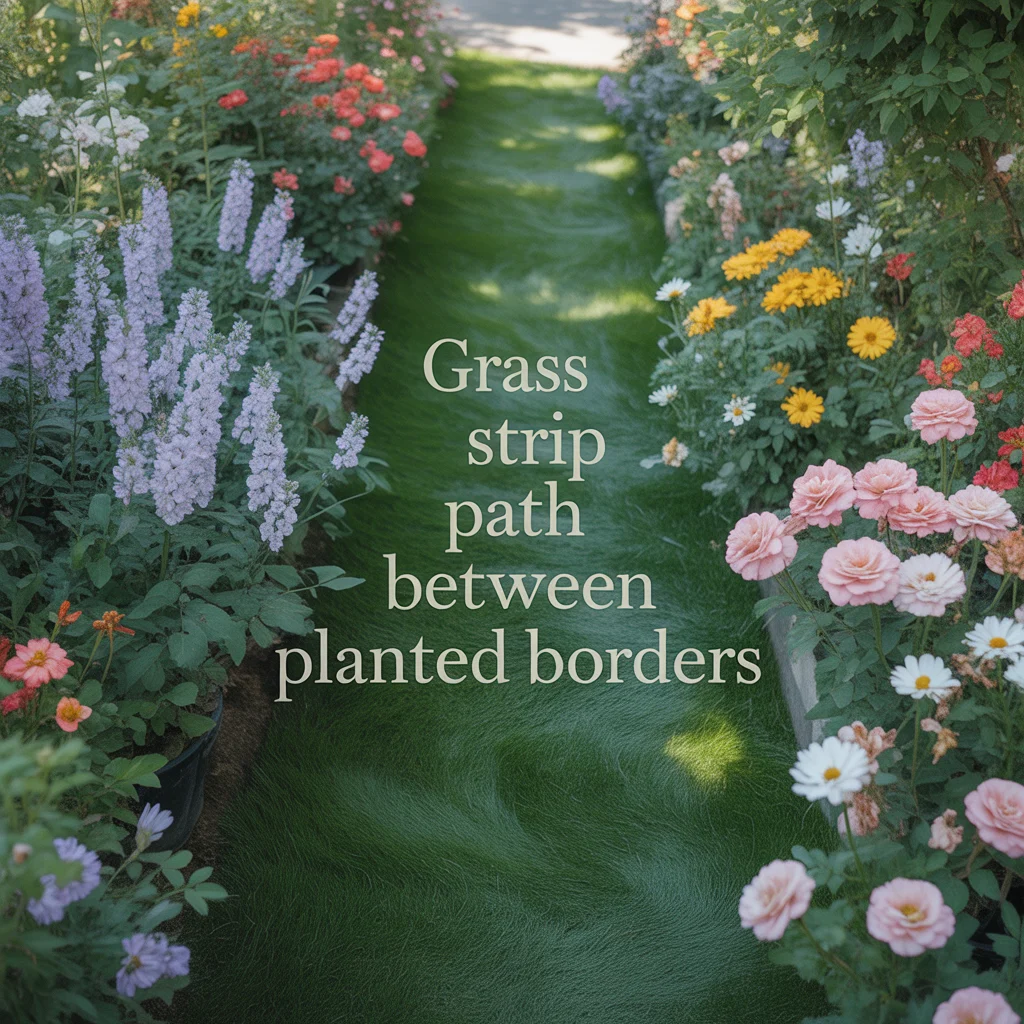
A grass strip path between planted borders uses a central mown grass strip of 2 to 3 feet wide running the full length of a narrow garden space, with mixed border planting on both sides between the grass edge and the boundary walls or fences. I created this layout in a 16-foot-wide garden section that had previously been entirely lawn, reducing the mown area to a 2.5-foot central strip and planting both sides with a combination of perennials, grasses, and low shrubs. The result was a path that felt like a garden room rather than a service route, and the reduction in mown area cut my weekly mowing time in that section from 15 minutes to 4 minutes.
Grass Varieties for a Narrow Strip Path
Fine fescue lawn seed, dwarf rye grass, and microclover lawn mix are three grass types suited to a narrow strip path in a long narrow garden. Fine fescue produces a dense, fine-textured surface that tolerates moderate foot traffic and stays green without heavy feeding or watering in dry summers. Dwarf rye grass grows more slowly than standard rye and requires less frequent cutting, which suits a low maintenance long narrow garden path where reducing maintenance time is a priority. Microclover lawn mix produces a fine green surface with small white flowers that attracts pollinators and requires no feeding because the clover fixes nitrogen from the air.
Border Planting for a Grass Strip Narrow Garden Path
Salvia nemorosa, Geranium rozanne, and Nepeta x faassenii are three perennials suited to the borders alongside a grass strip long narrow garden path. Salvia nemorosa produces upright violet-blue flower spikes from June to August and grows to 18 inches in height, creating a clear vertical presence at the edge of the grass strip. Geranium rozanne produces blue-violet flowers continuously from June through October and spreads to 24 inches wide, forming a low mound that softens the transition between the grass path and the taller planting behind it. Nepeta x faassenii produces lavender-blue flowers from May to September and grows to 18 inches, releasing a pleasant fragrance when brushed against on a narrow path.
Sleeper and Gravel Stepped Path on a Sloped Narrow Garden
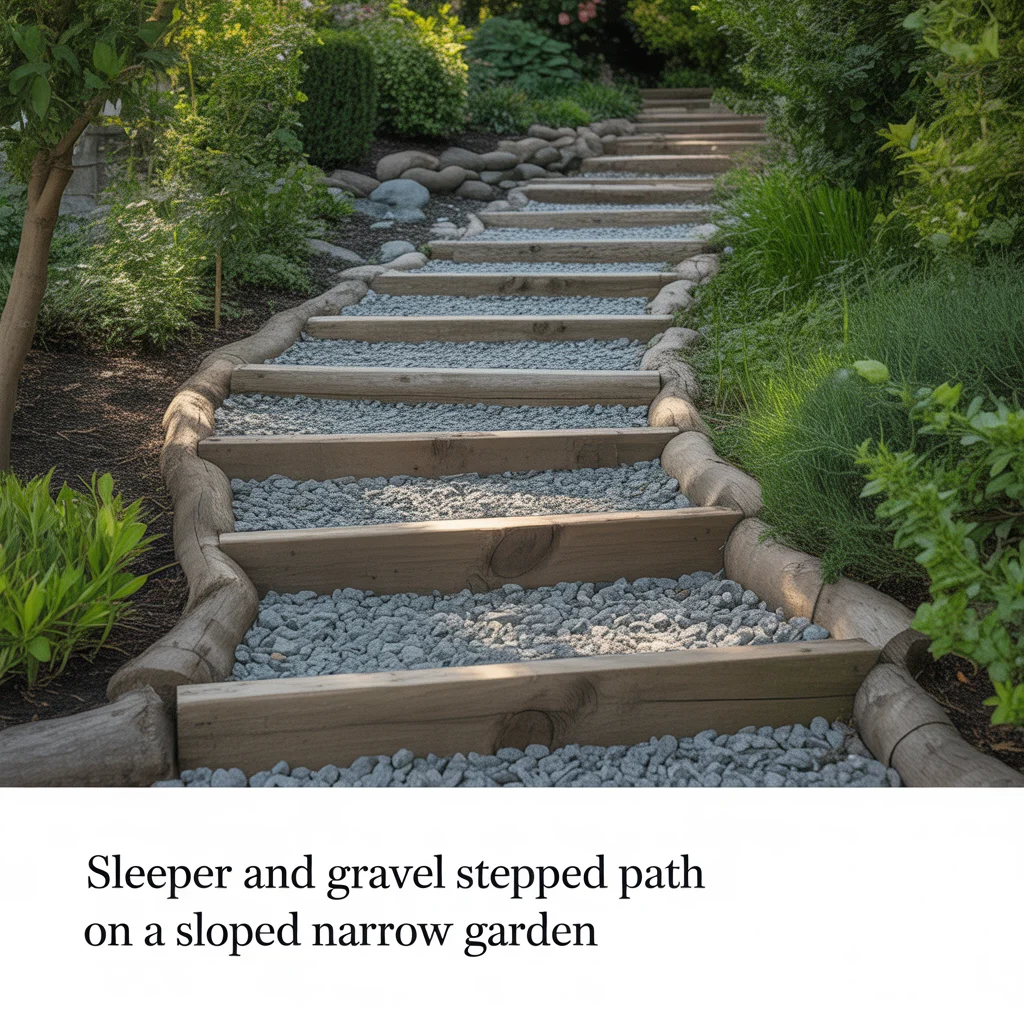
A sleeper and gravel stepped path on a sloped narrow garden uses horizontal railway sleepers as step risers with gravel fills between each riser to create a terraced path that manages a gradient across a long narrow outdoor space. I used this design on a narrow 3.5-foot-wide sloped passage that dropped 18 inches over its 24-foot length. Using six oak sleeper risers spaced 4 feet apart with pea gravel fills between each step, I converted an unusable muddy slope into a clearly defined path that drained well after rain and required no ongoing maintenance beyond an annual rake of the gravel surface.
How to Calculate Sleeper Step Spacing on a Sloped Narrow Path
Sleeper step spacing on a sloped narrow path is calculated by dividing the total vertical drop by the number of steps required. A comfortable step riser height for an outdoor path is 4 to 6 inches. For an 18-inch total drop, four steps at 4.5 inches per riser produce comfortable, easily walked steps. I used six steps at 3 inches each on my 18-inch drop path and found the shallower riser more comfortable for regular use, particularly when carrying garden tools or equipment along the narrow passage. Each horizontal tread between risers measured 4 feet in length, which gave enough flat walking distance between each step change.
Fixing Railway Sleeper Risers on a Sloped Narrow Garden Path
Railway sleeper risers on a sloped narrow path are fixed using 18-inch galvanized steel stakes driven into the ground behind the sleeper face and screwed to the sleeper using 4-inch galvanized screws. Two stakes per sleeper, placed 12 inches from each end, provide sufficient resistance to the forward pressure of the gravel fill behind the riser. I drove each stake with a club hammer to a depth of 14 inches before screwing it to the sleeper face, and none of the six risers on my path has moved in three years of use. The total fixing hardware cost for six risers was $48 in stakes and screws from a builders’ merchant.
Long Narrow Garden Path With Optical Illusion Planting
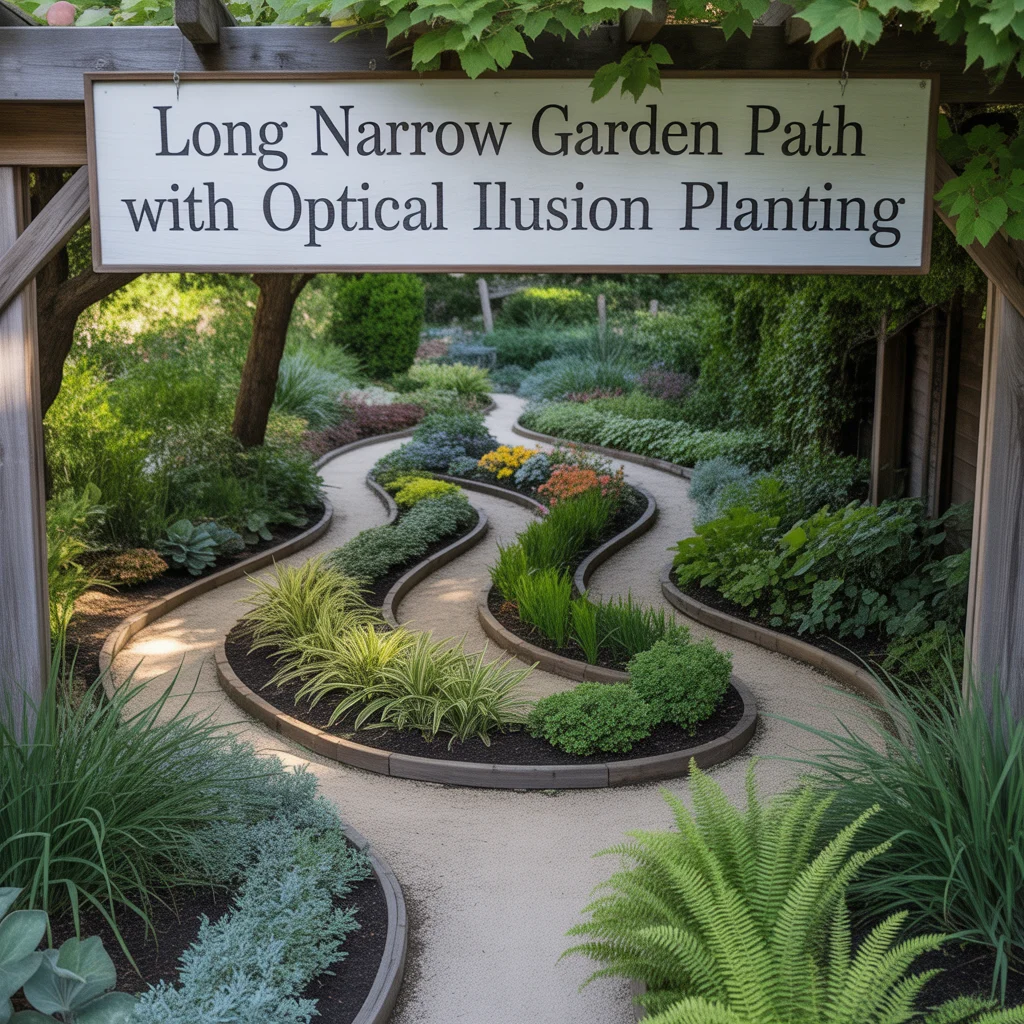
A long narrow garden path with optical illusion planting uses a specific plant placement technique to make the far end of the path appear closer and the path itself appear wider than it actually measures. The technique involves planting larger, bolder foliage plants at the far end of the path and smaller, finer-textured plants at the near end, which reverses the normal perspective reduction that makes objects at a distance appear smaller. I applied this technique to a 30-foot narrow strip and found that visitors consistently estimated the length of the path as shorter than it actually was, which in a confined space is exactly the effect worth creating.
Large Foliage Plants for the Far End of a Narrow Path
Hosta sieboldiana, Fatsia japonica, and Rodgersia podophylla are three large-foliage plants suited to the far end of a long narrow garden path optical illusion planting scheme. Hosta sieboldiana produces blue-green leaves up to 18 inches wide and grows to 30 inches in height, creating a strong bold presence that reads as close rather than distant from the path entrance. Fatsia japonica produces deeply lobed leaves up to 16 inches wide and grows to 5 feet in height, providing year-round large foliage structure in both sun and shade. Rodgersia podophylla produces horse-chestnut-shaped leaves up to 12 inches wide in a bronze-green color that suits a shaded narrow path setting.
Fine-Textured Plants for the Near End of a Narrow Path
Astrantia major, Geranium pratense, and Achillea millefolium are three fine-textured plants suited to the near end of a long narrow garden path optical illusion scheme. Astrantia major produces small, intricate pincushion flowers in white and pink from June to August and has finely divided foliage that reads as delicate and small-scale from the path entrance. Geranium pratense produces deeply divided leaves and small violet-blue flowers from June to August, creating a fine texture that contrasts with the bold foliage placed at the far end of the path. Achillea millefolium produces feathery, finely divided leaves and flat flower heads in white, pink, and yellow from June to September.
Low Maintenance Long Narrow Garden Path With Slate Chippings
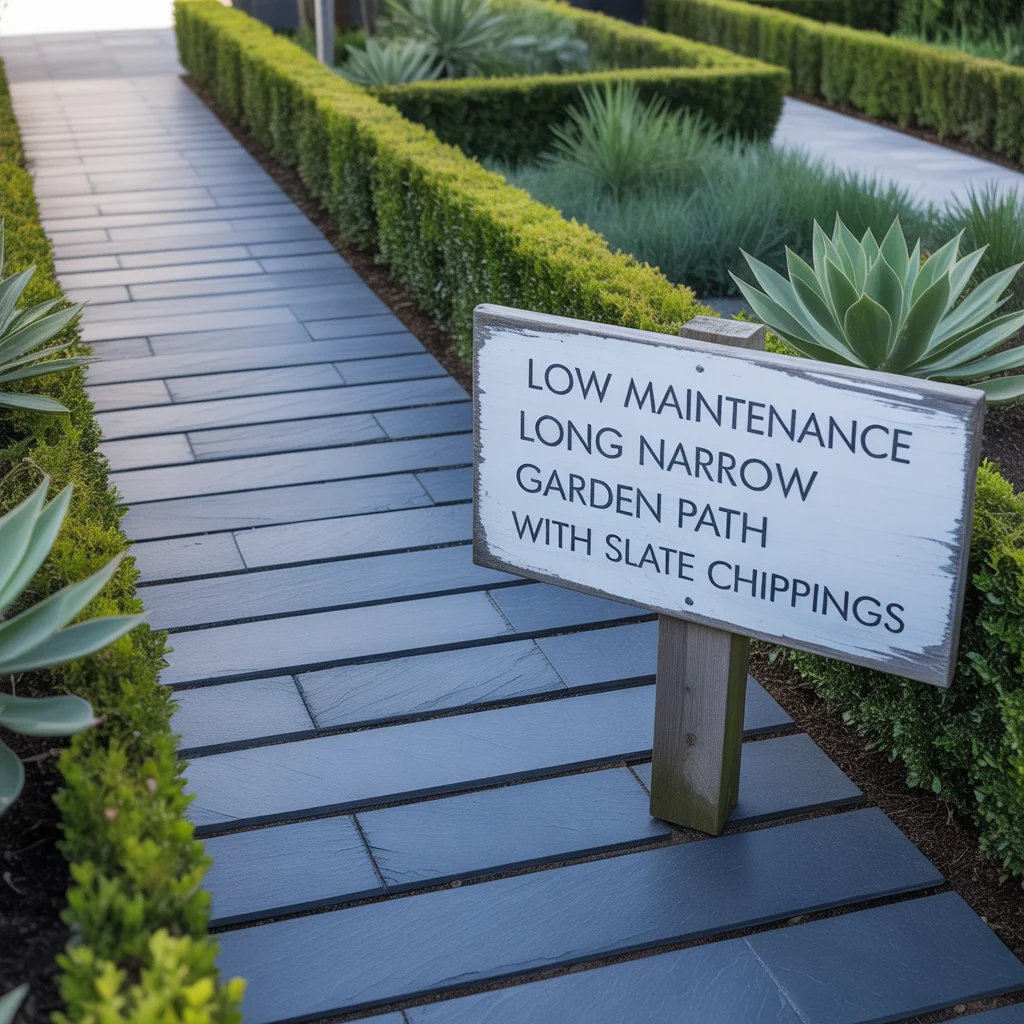
A low maintenance long narrow garden path with slate chippings uses a compacted hardcore sub-base, a heavy-duty weed-suppressing membrane, and a 3-inch depth of slate chippings to create a path surface that requires no weeding, no sealing, and no re-laying for a minimum of 10 years. I have maintained this type of path in two separate garden projects and found the annual maintenance requirement amounts to approximately 30 minutes per year of raking to redistribute the chippings and topping up the depth every 3 years with a single bag of additional material costing $18 to $25. No other path type I have used comes close to this maintenance level.
Sub-Base Preparation for a Slate Chipping Narrow Path
A correct sub-base for a slate chipping long narrow garden path consists of 4 inches of compacted Type 1 MOT hardcore laid over the cleared and leveled soil, followed by a heavy-duty woven geotextile membrane laid over the entire surface with edges turned up and fixed behind the path edging. I used this preparation method on a 25-foot-long narrow path and found zero weed penetration through the membrane after four years of use, compared to a path I prepared using a lighter membrane on an earlier project where weeds penetrated within 18 months. The geotextile membrane costs $0.40 to $0.80 per square foot and is the single most important component of a low maintenance slate chipping path.
Slate Chipping Sizes for a Narrow Garden Path
20mm slate chippings, 40mm slate chippings, and slate gravel at 10mm are three sizes suited to a long narrow garden path with slate surfacing. The 20mm size is the standard for path use because the chip is large enough to stay stable underfoot without shifting excessively, while small enough to produce a relatively flat walking surface. The 40mm size produces a more decorative, bold surface texture suited to a path that is seen but not frequently walked. The 10mm slate gravel produces the flattest, most stable walking surface and suits a narrow path used as a frequent access route, such as a narrow side of house landscaping path used to reach a back garden from the front.
Narrow Strip Garden Idea With a Central Feature Plant
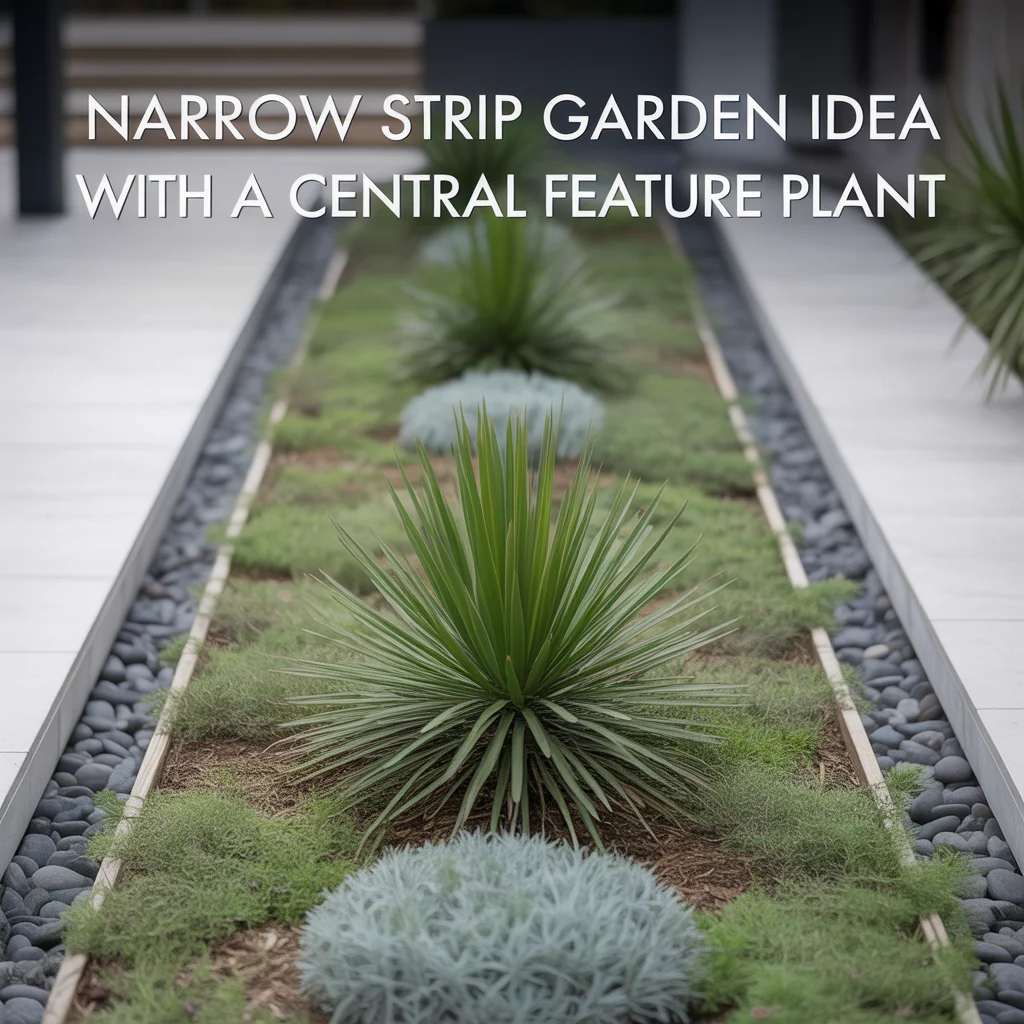
A narrow strip garden idea with a central feature plant uses a single specimen plant with strong architectural form placed at the midpoint or far end of the long narrow space to break the length of the path visually and give the eye a clear point of interest other than the path’s confined width. I planted a standard-trained Photinia x fraseri Red Robin at the midpoint of a 28-foot narrow path, and the single specimen on a clear stem immediately divided the path into two shorter sections that each felt more manageable in scale than the full uninterrupted length had done before.
Architectural Plants for a Narrow Strip Garden Path
Photinia x fraseri Red Robin, Prunus lusitanica standard, and Acer palmatum are three architectural plants suited as central feature specimens on a long narrow garden path. Photinia x fraseri Red Robin produces vivid red new growth from April to June and responds well to standard training, reaching 5 to 6 feet on a clear stem at a spread of 3 to 4 feet, which suits a narrow path where a wide-spreading specimen would block the walkway. Prunus lusitanica trained as a standard produces a dense evergreen globe of dark green foliage on a clear stem and provides year-round structure. Acer palmatum produces finely divided leaves in green or red-purple and suits a narrow strip in partial shade.
How to Position a Feature Plant on a Narrow Garden Path
A feature plant on a long narrow garden path is positioned most effectively when its stem center sits at the midpoint of the path’s width so the plant grows symmetrically into the space above the path without leaning toward one side. The stem base sits in a circular planting pocket cut into the path surface, typically 18 to 24 inches in diameter, with the surrounding path surface continuing around it on both sides. I cut an 18-inch circular pocket in my gravel path for the Photinia standard and left 9 inches of path on each side of the stem, which was enough space to walk through comfortably while the canopy above created the overhead focal point the path needed.
Very Narrow Garden Idea With Mirror and Planting
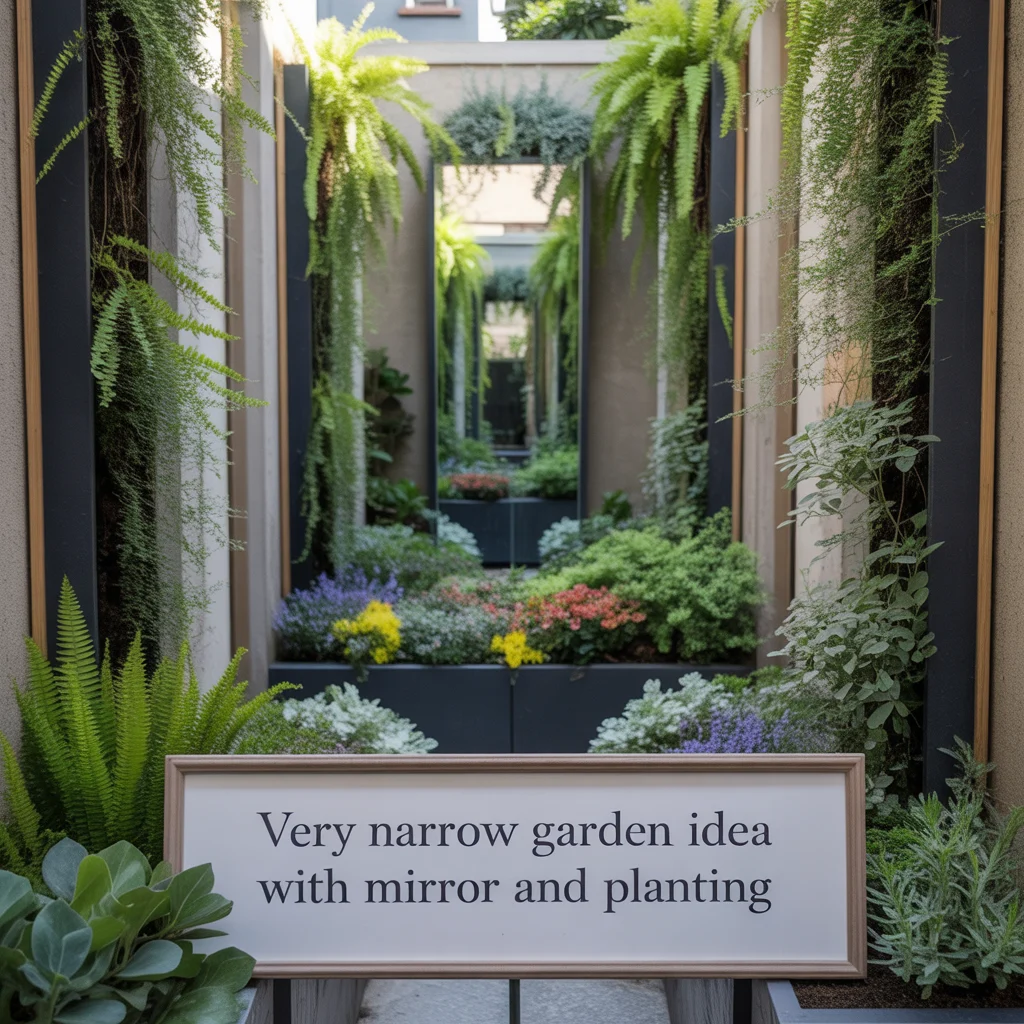
A very narrow garden idea using a mirror fixed to the end wall of a long narrow path creates the optical effect of the path continuing beyond the actual boundary, which doubles the apparent length of the space and removes the closed-in feeling that a blank end wall produces. I fitted a 4-foot-wide by 5-foot-tall exterior-rated mirror to the end wall of a 26-foot-long, 3-foot-wide garden passage, surrounding it with climbing Hydrangea petiolaris on both sides, and the reflected image of the path and planting made the space look continuous from the entrance rather than terminating at a hard wall 26 feet away.
Choosing an Exterior Mirror for a Narrow Garden Path
An exterior garden mirror for a narrow path requires UV-stable acrylic rather than glass construction to prevent shattering if struck, and a stainless steel or powder-coated aluminum frame to resist rust in outdoor conditions. Acrylic exterior garden mirrors cost between $60 and $250 depending on size and frame finish. I used a 48-by-60-inch acrylic mirror with a black powder-coated frame on my narrow passage and found the reflection accurate enough to produce a convincing continuation of the path image from the entrance. The mirror fixed to the masonry end wall using four stainless steel mirror screws and took 45 minutes to install level and plumb.
Planting to Frame a Mirror on a Narrow Garden Path
Climbing Hydrangea petiolaris, Euonymus fortunei Emerald Gaiety, and Hedera helix are three plants suited to framing a wall mirror on a long narrow garden path. Climbing Hydrangea petiolaris produces a natural, irregular frame of white flower heads around the mirror in June and creates a green leafy surround from April through October. Euonymus fortunei Emerald Gaiety produces white-edged green leaves that stay on the plant year-round, providing a permanent evergreen frame around the mirror in all seasons. Hedera helix grows rapidly on a wall surface and creates a dense green surround within one to two growing seasons, framing the mirror in a natural ivy border.
Narrow Side of House Landscaping With Lighting

Narrow side of house landscaping with path lighting transforms a long narrow garden passage from a dark, underused service route into a clearly defined, safely navigable, and visually attractive outdoor space that functions during evening hours as well as daylight. I fitted ground-recessed LED bollard lights at 6-foot intervals along a 24-foot narrow side passage and the change after dark was immediate. The passage, which previously felt unsafe to navigate without a torch, became a well-lit route that also produced an attractive pattern of light and shadow across the path surface and the wall planting on both sides. The same principle of transforming a neglected or awkward space through thoughtful path design applies equally to sloped and uneven terrain, and anyone dealing with a gradient or irregular ground surface will find genuinely practical solutions among these garden paths for uneven ground ideas, which cover everything from railway sleeper steps and bark chip treads to resin bound surfaces and accessible ramp designs.
Lighting Types for a Long Narrow Garden Path
Ground-recessed LED spotlights, wall-mounted bollard lights, and LED strip lighting fixed to wall-mounted trellis are three lighting types suited to a long narrow garden path. Ground-recessed LED spotlights sit flush with the path surface, produce no obstruction to walking, and create a distinctive pattern of upward light that emphasizes the planting above the path level. Wall-mounted bollard lights at 900mm height produce a downward wash of light across the path surface and cost $25 to $80 per fitting. LED strip lighting fixed behind a trellis batten produces a soft diffused glow along the full length of the path wall and costs $15 to $30 per meter installed.
Solar vs Mains Lighting for a Narrow Side Path
Solar path lights and mains-powered LED fittings are two power options for a long narrow garden path, and each suits a different installation situation. Solar lights cost $8 to $30 per unit, require no electrical installation, and suit a narrow path that receives at least 4 hours of direct sunlight per day to charge the solar panel. Mains-powered LED fittings cost $25 to $100 per unit plus wiring and installation by a qualified electrician, but produce consistent light output regardless of the available daylight, making them the correct choice for a north-facing narrow side of house landscaping path where solar charging is insufficient for reliable nightly operation.
Formal Long Narrow Garden Path With Clipped Hedging
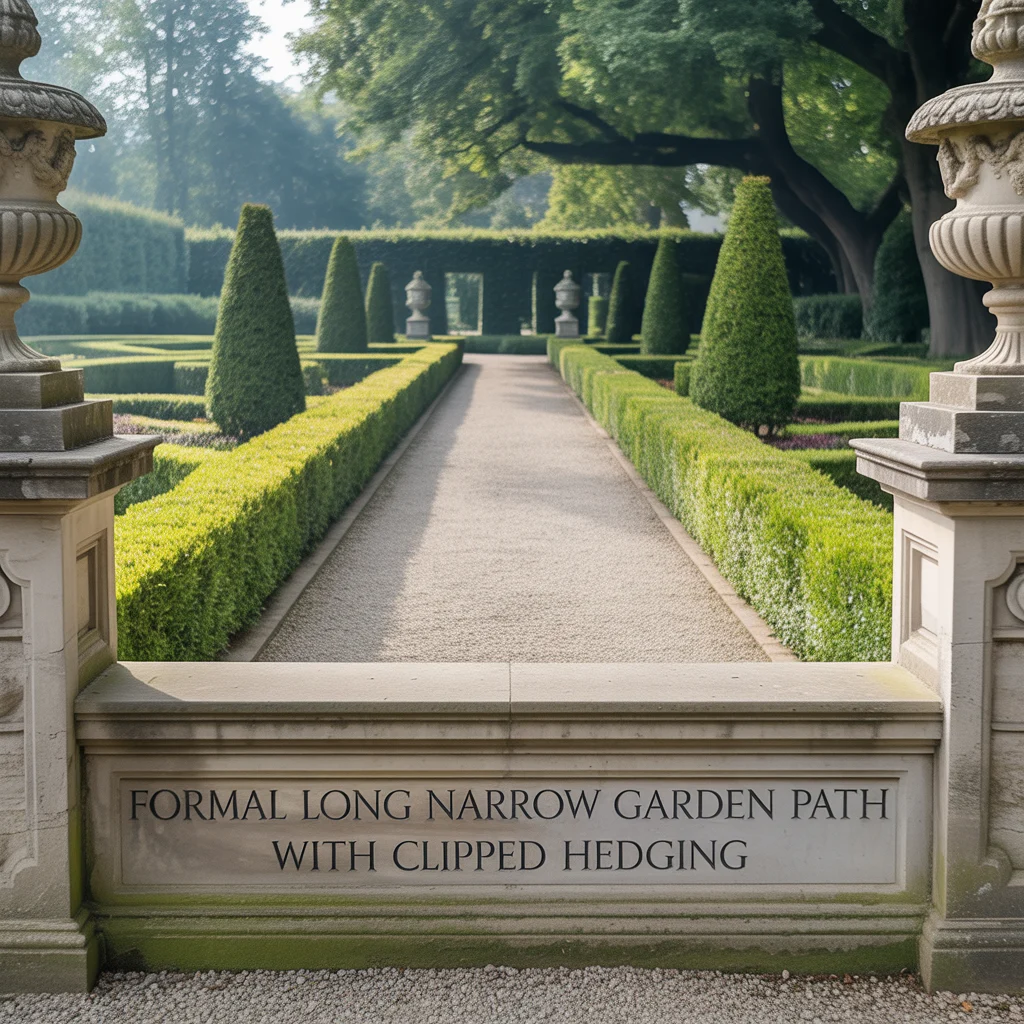
A formal long narrow garden path with clipped hedging uses low evergreen hedges of 12 to 18 inches in height on both sides of the path to create a defined green corridor that gives the narrow space a structured, intentional appearance. I saw this design applied to a 40-foot-long, 4-foot-wide path in a walled town garden where double rows of clipped box hedging at 14 inches in height ran the full length of the path on both sides, with the path surface of York stone running between them. The combination of the precise hedge lines and the warm stone surface made a genuinely tight space look like a formal feature rather than a service passage.
Hedging Plants for a Formal Narrow Garden Path
Box, Ilex crenata, and Euonymus japonicus are three hedging plants suited to a formal long narrow garden path where a clipped low edge is the design intention. Box produces the finest leaf texture and the most precise clipped surface of any low hedging plant and responds well to clipping twice a year to maintain a tight 12-to-18-inch height. Ilex crenata is a box substitute that resists box blight and produces a similarly fine-textured dark green surface when clipped, making it the practical alternative for gardens where box blight is established in the local area. Euonymus japonicus produces larger leaves than box but clips well to a formal edge at 12 to 20 inches in height.
Clipping Schedule for a Formal Narrow Path Hedge
A formal hedging plant on a long narrow garden path requires clipping twice a year to maintain a precise, tight surface. The first clip takes place in late May or early June, after the first flush of new growth has extended beyond the intended profile. The second clip takes place in late August or early September, after the second flush of growth. I clip my box hedging with electric hedge shears in both sessions and find each 20-foot run takes approximately 25 minutes to clip and tidy. A formal narrow path hedge clipped only once a year produces a looser, less precise surface that loses the architectural quality that makes this design effective in a confined space.
Long Narrow Garden Path Pictures Style: Zigzag Stepping Stones
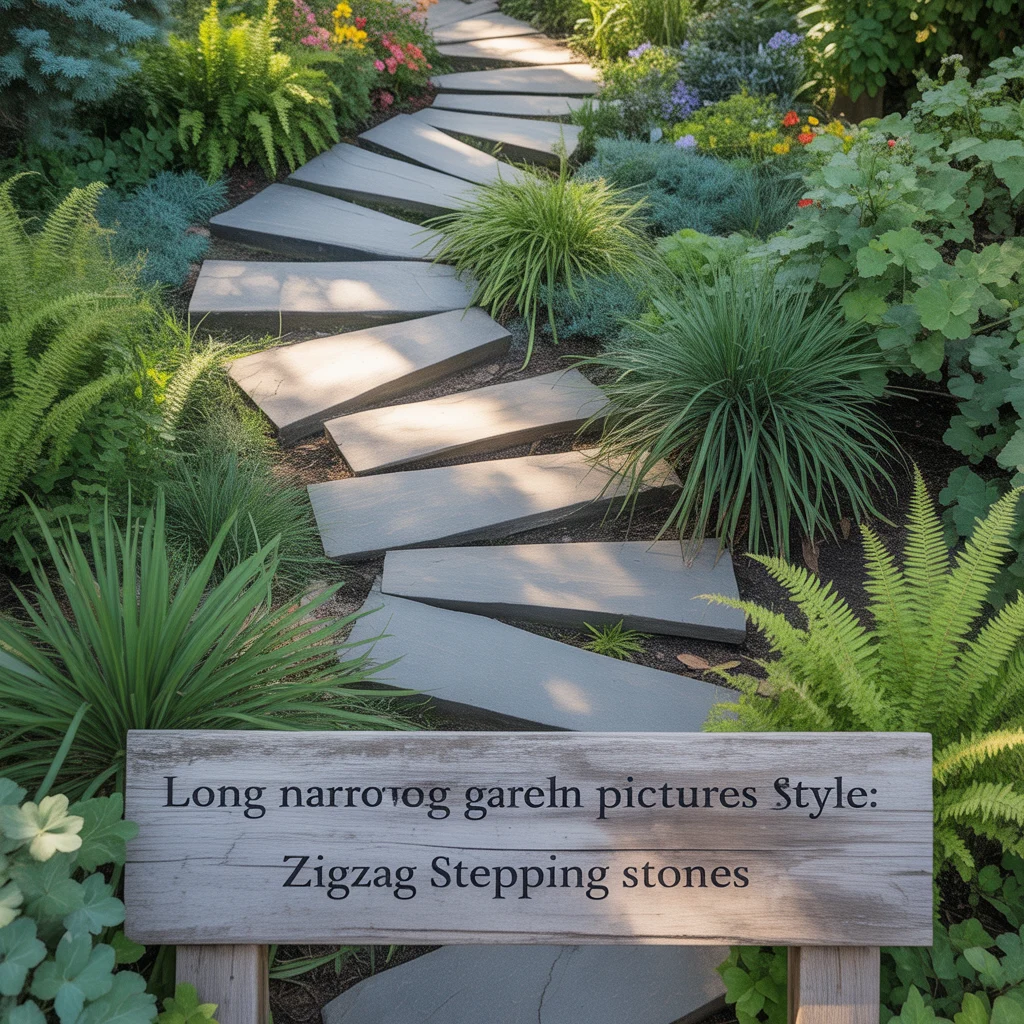
A zigzag stepping stone path places individual stepping stones in an alternating left-right pattern rather than a single straight central row, which creates a path surface that is wider in visual presence than the stone size alone would suggest and produces a more interesting walking route than a straight central line. I used this layout in a 3-foot-wide grass path, placing 18-by-18-inch sandstone pads alternately 4 inches from the left edge and 4 inches from the right edge at 18-inch intervals, and the resulting zigzag line made the path look deliberately designed rather than simply functional. This is one of the most photographed narrow path layouts in long narrow garden paths pictures collections online.
Stone Sizes and Spacing for a Zigzag Narrow Path
Stepping stones for a zigzag long narrow garden path measure most effectively at 18 by 18 inches or 20 by 20 inches per stone, set at 14 to 18 inch intervals measured from the leading edge of one stone to the leading edge of the next. The lateral offset between alternating stones in a zigzag pattern should equal 50 to 60% of the path width to produce a clearly visible zigzag effect without placing stones so close to the path edges that they feel unstable. I used a 60% offset in my 3-foot-wide grass path, placing stones 4 inches from each edge in alternation, and found the resulting walking line natural and comfortable for regular use.
Surface Treatments Around Zigzag Stepping Stones
Mown grass, moss, and creeping thyme are three surface treatments suited to the gaps around and between zigzag stepping stones on a long narrow garden path. Mown grass is the simplest option, requiring only that the lawn mower passes over the stones without scalping the surface, which means the stones sit no higher than 5mm above the turf level. Moss establishes naturally in shaded narrow paths and produces a green, soft surface that suits a Japanese or woodland garden style. Creeping thyme establishes more slowly than moss but produces a more colorful surface with pink and white flowers in June and tolerates more sunlight than moss, making it the better choice for a south-facing narrow path.
Long Narrow Garden Path With Water Feature Alongside
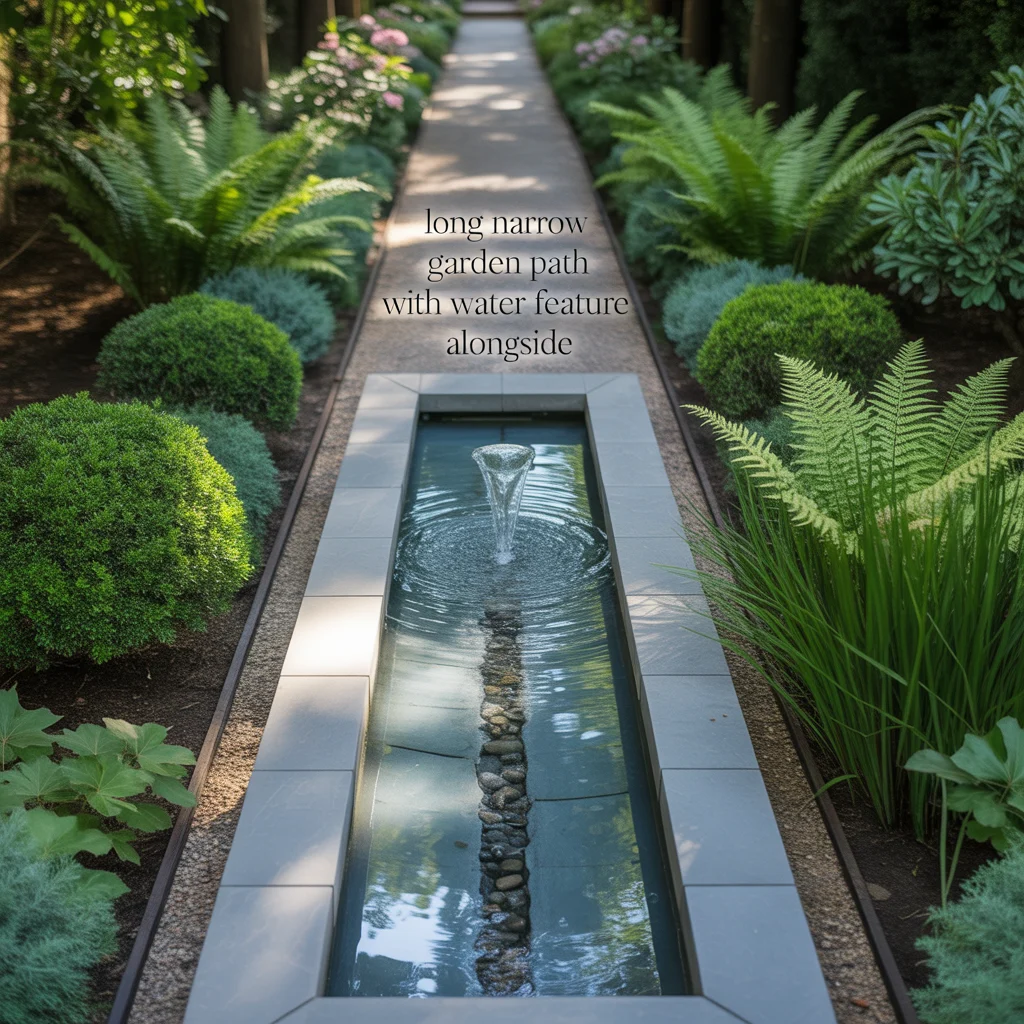
A long narrow garden path with a water feature alongside uses a narrow rill, channel fountain, or lined trough running parallel to the path for part or all of its length to introduce the sound and visual presence of water into a tight space without using any of the path’s walking width. I saw this design used most effectively in a 4-foot-wide walled passage where a 6-inch-wide copper rill ran along the base of one wall for 18 feet beside a York stone path, and the sound of the moving water made the confined space feel significantly less enclosed. The rill took up only 6 inches of the 4-foot width and produced a continuous gentle water sound audible from both ends of the passage.
Rill Construction for a Narrow Garden Path
A narrow garden path rill is constructed using a 6-to-8-inch-wide channel formed in concrete, lined with a flexible butyl rubber pond liner, and edged with stone or metal coping flush with the path surface. The rill requires a submersible pump at the low end and a header tank or overflow point at the high end to create a recirculating water flow. I built a 12-foot rill alongside a gravel path using a concrete channel 6 inches wide and 4 inches deep, lined with 1mm butyl liner and edged with 2-inch-wide steel coping, at a total material cost of $190. The pump runs on a timer set to operate from 7am to 9pm, consuming $0.40 per day in electricity.
Materials for a Narrow Path Rill Edge
Copper sheet, cor-ten steel, and natural stone are three edge materials suited to a rill alongside a long narrow garden path. Copper sheet edging at 2mm thickness produces a warm metallic edge that weathers to a verdigris green patina within two to three years, creating a distinctive border between the rill and the path surface. Cor-ten steel edging weathers to a deep orange-brown rust patina within six to twelve months and suits a modern long narrow garden idea where the warm metal tone contrasts with a grey or charcoal path surface. Natural stone coping in sandstone or limestone produces the most traditional edge and suits a formal or cottage-style narrow path layout.
Long Narrow Garden Path With Repeating Planting Rhythm
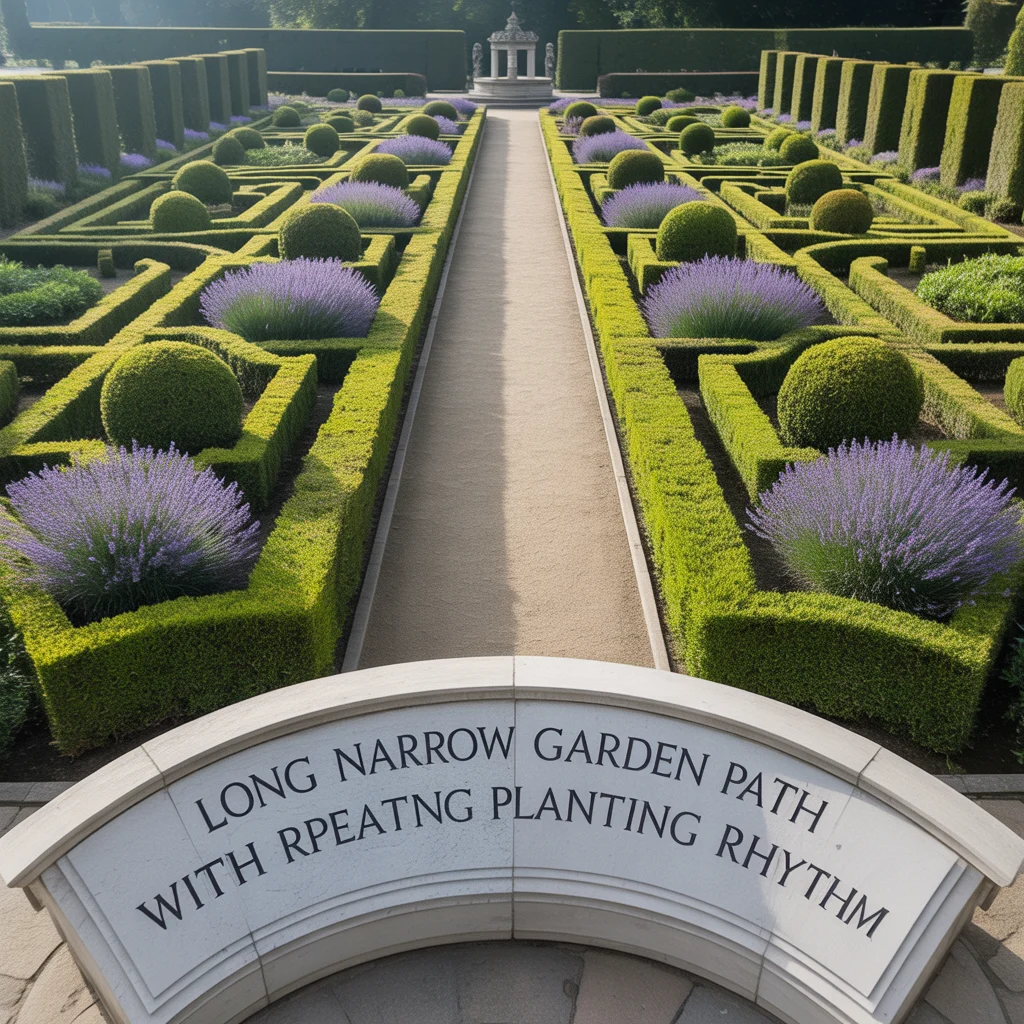
A long narrow garden path with repeating planting rhythm uses the same plant species or combination repeated at regular intervals along both sides of the path to create a visual pattern that makes the confined width feel structured and deliberate rather than restricted. I planted Agapanthus africanus at 24-inch intervals on both sides of a 35-foot narrow path, and the repeated upright form of the plants every 2 feet along the full length created a rhythm that made the path feel like a designed feature. The regular spacing also made the path appear shorter than its actual length because the repeated pattern gave the eye a series of equally spaced reference points rather than an uninterrupted stretch of confined space.
Plants That Create Effective Rhythm on a Narrow Path
Agapanthus, Allium hollandicum, and Pennisetum alopecuroides are three plants that create an effective repeating rhythm on a long narrow garden path. Agapanthus africanus produces round blue flower heads on 3-foot stems from July to September and grows in a tight clump 18 inches wide, which suits placement at 24-inch intervals without encroaching on the walking width of a 3-to-4-foot path. Allium hollandicum produces spherical purple flower heads on 3-foot stems in May and June and dies back by July, leaving space for later-season planting to fill the rhythm gaps. Pennisetum alopecuroides produces arching grass clumps 24 inches wide with purple-brown bottlebrush flowers from August to October.
Spacing Repeating Plants on a Long Narrow Garden Path
Repeating plants on a long narrow garden path are spaced at intervals equal to 1.5 times the mature width of the individual plant clump, which produces a rhythm where each plant reads as a distinct unit while the overall line still reads as continuous. For a plant with a mature spread of 18 inches, the correct spacing interval is 27 inches. I used 24-inch spacing on my Agapanthus planting because I wanted a slightly denser rhythm than the 27-inch calculation produced, and found the closer spacing created a stronger sense of enclosure and direction along the path without the plants crowding each other significantly after three growing seasons.
Related
Best hedge ideas to frame a long garden walkway
How to use gates at the end of a narrow garden path
stepping stone ideas for slim backyard paths
What is the minimum width for a long narrow garden path?
The minimum practical width for a long narrow garden path is 2 feet, which allows a single adult to walk through comfortably without brushing against planting or walls on both sides. A width of 3 feet is the recommended minimum for a path used as a regular access route, as it allows a person to walk through carrying garden tools or other items without difficulty. For a path used by two people simultaneously, a minimum width of 4 feet is required. I have worked with paths as narrow as 20 inches in very tight side passages and found them navigable but uncomfortable for daily use, particularly in wet weather when wall planting is wet and presses against clothing on both sides.
How do I make a long narrow garden path look wider?
A long narrow garden path looks wider when diagonal paving, zigzag stepping stones, or optical illusion planting techniques are applied to the design. Diagonal paving at 45 degrees to the path’s length makes the eye follow the diagonal rather than the confined width dimension, producing an apparent width increase of 20 to 30% in photographs and in person. Planting larger, bolder foliage at the far end and finer, smaller foliage at the near end reverses the normal perspective effect and makes the path appear shorter and therefore proportionally wider. I have tested both techniques on my own narrow paths and found diagonal paving the most immediately effective single change available.
What are the best low maintenance long narrow garden paths?
Slate chipping paths on a weed-suppressing membrane, gravel paths with railway sleeper edging, and large-format porcelain paver paths are the three lowest maintenance options for a long narrow garden. A slate chipping path on a correctly prepared sub-base with a heavy-duty geotextile membrane requires approximately 30 minutes of maintenance per year. A gravel path with railway sleeper edging requires raking twice a year and a top-up of gravel every 3 years. A large-format porcelain path requires only sweeping and an occasional wash with a garden hose. I maintain a slate chipping path in my own garden and find it the least demanding surface of any I have installed across multiple garden projects over eight years.
What plants work best alongside a long narrow garden path?
Slim, upright plants with a spread under 18 inches are the most practical choice alongside a long narrow garden path because they provide visual interest without reducing the walking width of the path as they mature. Salvia nemorosa, Agapanthus africanus, and Allium hollandicum all grow in tight clumps under 18 inches wide and produce flowers at heights of 18 to 36 inches that are visible along the full length of the path. Climbing plants on wall supports are the best option for paths under 3 feet wide because they use vertical space on the surrounding walls rather than occupying any of the limited horizontal path width. I use a combination of both approaches on my own narrow paths.
How do I light a long narrow garden path effectively?
Ground-recessed LED spotlights at 6-foot intervals are the most effective lighting approach for a long narrow garden path because they produce no obstruction to walking, create a clear sightline along the full length of the path after dark, and highlight the planting and path surface simultaneously. For a mains-powered installation, a qualified electrician rs of direct sun per day and cost $8 to $30 per unit without any installation cost, making them the most accessible starting point for lighting a long narrow garden path on a limited budget.connects the fittings to a switched circuit from the house consumer unit using armored outdoor cable buried at a minimum depth of 18 inches below the path surface. Solar LED path lights suit a narrow path that receives 4 or more ho