
Brilliant Astilbe Varieties for Shade Gardens


Astilbe varieties earn their reputation as one of the few perennials that bloom reliably in shade, sending up feathery plumes in colors from pure white to deep wine red at a time of year when most flowering shade plants have nothing to offer. Height and bloom timing matter more than color when choosing between them, since a dwarf variety planted where a 4-foot giant belongs will simply disappear, and the 11 varieties below are organized around exactly those two decisions.
Why Bloom Timing Matters Most

Why bloom timing matters more than most astilbe advice suggests is that astilbe’s bloom window per variety is genuinely short, usually 3 to 4 weeks, so a garden planted with only one bloom-time group goes dark for the rest of the season. Mixing early, mid, and late varieties is what actually produces months of color rather than a single showy month.
The Three Bloom Groups Worth Knowing
The three bloom groups worth knowing are early summer (Astilbe arendsii types like Deutschland and Fanal), midsummer (most Astilbe japonica varieties), and late summer into fall (Astilbe chinensis varieties like Pumila and Visions), and a shade border with one variety from each group stays in bloom far longer than a border planted with several varieties from the same group.
Astilbe’s short 3-4 week bloom window per variety makes bloom-group mixing the real strategy for season-long color, not variety count alone.
1. Deutschland for the Earliest White Plumes

Deutschland for the earliest white plumes opens its bright white flower spikes in early summer, ahead of most other astilbe varieties, on a compact 18 to 24 inch plant that works well toward the front of a mixed shade border.
Deutschland’s early bloom time makes it the variety to plant specifically for kicking off the astilbe season before other varieties open.
2. Fanal’s Deep Red Plumes and Bronze Foliage

Fanal for the deepest red plumes and bronze foliage pairs dark garnet-red flower spikes with distinctively bronze-tinted young foliage, giving it color interest even before the plumes open, on a mid-height 24-inch plant.
Why the Bronze Foliage Fades Over Time
Why Fanal’s foliage color fades as the season progresses is normal, not a sign of stress. The bronze tint is strongest on new spring growth and gradually shifts toward green as the leaves mature through summer.
Fanal’s bronze new growth is a temporary spring feature, not a permanent foliage color, so its shift to green later in the season is expected.
3. Sprite for the Best Dwarf Variety

Sprite for the best dwarf variety stays under 12 inches tall with soft shell-pink plumes, making it one of the few astilbe varieties genuinely suited to a container, a rock garden edge, or the front few inches of a shaded border.
At under 12 inches, Sprite is small enough for containers and edging where taller astilbe varieties would overwhelm the space.
4. Purpurkerze for a Tall Back-Border Statement

Purpurkerze for a tall back-border statement reaches up to 4 feet with narrow, upright magenta-purple plumes, giving it enough height to anchor the back of a shaded border the way a shrub would in a sunnier bed.
Spacing Tall Varieties to Prevent Flopping
Spacing tall astilbe varieties so they don’t flop matters more as height increases. Purpurkerze and other 3-4 foot varieties benefit from planting in groups of three or more spaced closely enough that the plants support each other against wind and heavy rain.
Purpurkerze’s height is an asset at the back of a border but needs group planting for support, since a single tall stem is more prone to flopping than a clustered planting.
5. Bressingham Beauty for Reliable Pink Midseason Color

Bressingham Beauty for reliable pink midseason color produces dense, arching rose-pink plumes on a well-proportioned 30-inch plant, widely considered one of the most dependable midsummer astilbe varieties for a mixed border.
Bressingham Beauty’s reputation for reliability makes it a safe default choice for gardeners who want one dependable midsummer variety without comparing a dozen options.
6. Visions for Dense, Fragrant Rose-Red Plumes
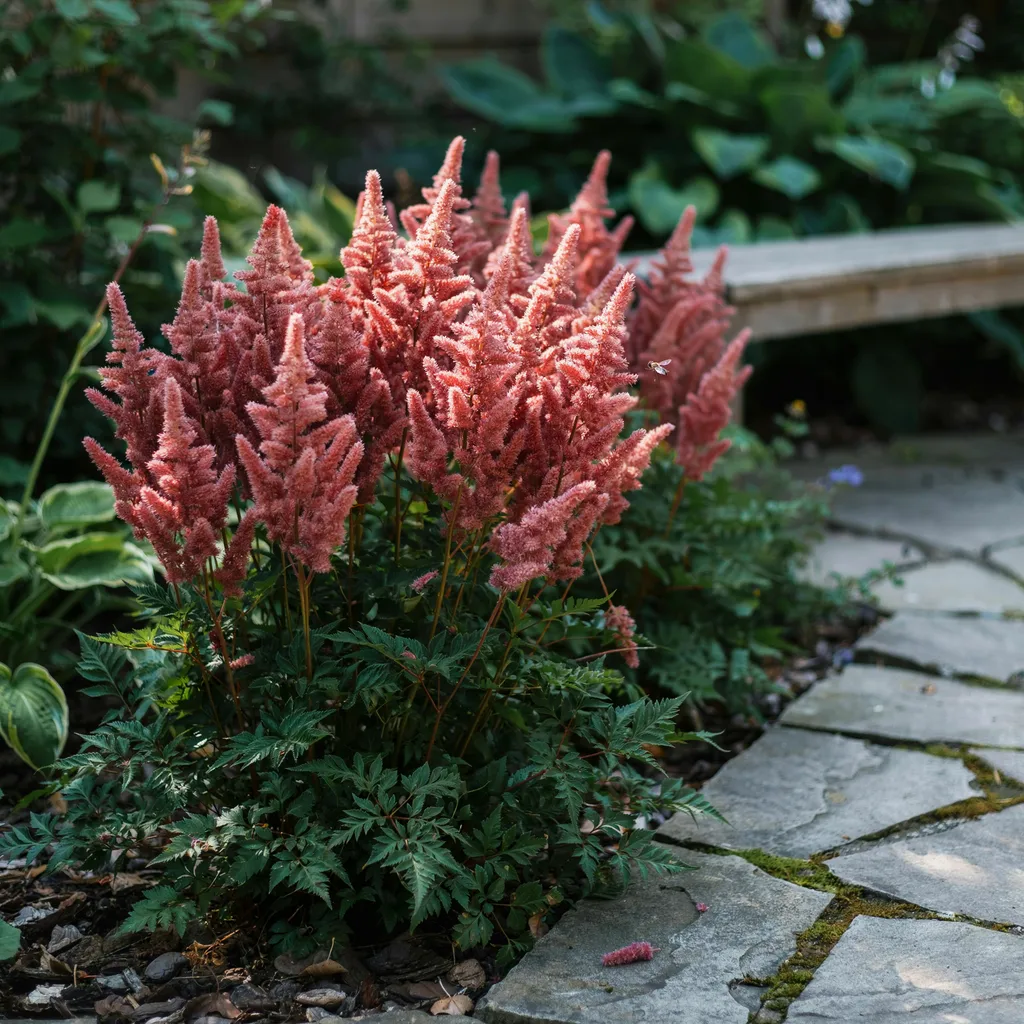
Visions for dense, fragrant rose-red plumes stands out among Astilbe chinensis varieties for two features most astilbe lack entirely: a light fragrance and denser, more compact plume clusters than the airier arendsii types.
Visions is one of the few fragrant astilbe varieties, which is worth knowing specifically for gardeners planting near seating areas or pathways.
7. Pumila for Late Bloom and Groundcover

Pumila for the latest bloom and best groundcover habit blooms later than most varieties on this list, often into early fall, on a low, spreading 12-inch plant that fills in as a flowering groundcover rather than staying in a single clump.
Pumila both extends the astilbe bloom season latest and spreads to cover ground, doing two jobs most single-clump varieties don’t.
8. Rheinland’s Classic Pink Plumes

Rheinland for classic pink plumes on a compact plant delivers bright, clear pink flower spikes on a tidy 24-inch plant, a reliable middle-of-the-road choice between the dwarf and giant varieties on this list.
Rheinland’s mid-range size makes it a flexible default when neither a dwarf nor a giant variety fits the specific spot being planted.
9. Amethyst for Lavender-Purple Color Most Lists Skip

Amethyst for lavender-purple color most lists skip fills a genuine color gap, since most astilbe varieties cluster around white, pink, and red, while Amethyst’s soft lavender-purple plumes read as a distinct color rather than a shade of pink.
Amethyst covers a color range (true lavender-purple) that most other varieties on this list don’t touch, worth choosing specifically for that reason.
10. Astilboides Tabularis for Foliage-First Shade Drama

Astilboides tabularis for foliage-first shade drama is not a true astilbe but a closely related shade plant often listed alongside them, grown mainly for its enormous, rounded leaves rather than its modest white plumes, giving big-leaf texture that no true astilbe variety provides.
|
Comparison |
True Astilbe |
Astilboides Tabularis |
|---|---|---|
|
Grown primarily for |
Flower plumes |
Enormous foliage |
|
Mature leaf size |
Small, ferny |
Up to 2.5 feet wide |
|
Bloom significance |
Main feature |
Secondary, modest |
Astilboides tabularis is grown for dramatic foliage rather than flowers, making it a texture choice rather than a bloom choice within an astilbe-style planting.
Choosing Astilbe Varieties by Garden Role

Choosing astilbe varieties by garden role means deciding what job each plant needs to do before comparing colors, since height and bloom timing determine whether a variety works in a given spot far more than which shade of pink or red it happens to be.
|
Garden Role |
Recommended Variety |
|---|---|
|
Front edge or container |
Sprite |
|
Back-of-border statement |
Purpurkerze |
|
Extending bloom into fall |
Pumila |
|
Reliable midseason default |
Bressingham Beauty |
|
Fragrance near seating |
Visions |
Match variety to role first (edging, back border, season extension) and treat color as the secondary decision, since most varieties on this list come in similar pink-to-red tones anyway.
The Bottom Line
Astilbe varieties differ mainly by height, bloom timing, and how long a specific plume color holds interest, not by fundamentally different care needs, so choosing well means picking a spread across early, mid, and late bloomers rather than several varieties that all flower in the same three-week window. Sprite handles the smallest spaces, Purpurkerze anchors the back of a border, and Pumila carries color latest into the season.
Frequently Asked Questions
What Is the Best Astilbe Variety for Deep Shade?
Most astilbe varieties actually prefer partial shade with some morning sun rather than deep, all-day shade, and bloom production drops off in very dark conditions regardless of variety, so improving light with selective pruning of overhead branches often does more for bloom quality than switching varieties.
Do Astilbe Varieties Need a Lot of Water?
Yes, astilbe is a genuinely thirsty perennial across all varieties, and consistently moist soil matters more to bloom quality and plant health than almost any other single factor, with dry soil quickly causing scorched, crispy plume edges.
How Long Do Astilbe Plumes Last on the Plant?
Individual astilbe plumes typically stay attractive for 3 to 4 weeks per variety, though leaving spent plumes in place through fall and winter adds structural interest to the garden even after the color has faded.
Can Astilbe Varieties Be Grown in Containers?
Dwarf varieties like Sprite are well suited to containers, but taller varieties like Purpurkerze need a genuinely large, deep container to support their root system and height, making dwarf and compact varieties the more practical container choice.
What’s the Difference Between Astilbe Arendsii and Astilbe Japonica Types?
Astilbe arendsii varieties like Fanal and Deutschland tend to bloom earliest with looser, more feathery plumes, while astilbe japonica varieties generally bloom slightly later with denser, more compact flower spikes, though the practical difference for most gardeners comes down to the specific bloom timing listed for each variety.
Do All Astilbe Varieties Attract Pollinators?
Astilbe is only lightly visited by pollinators compared with true nectar plants, since its plumes are more about visual structure than nectar production, so gardeners specifically building a pollinator garden should treat astilbe as a shade-filler rather than a primary pollinator plant.
How Do I Get Astilbe to Rebloom?
Astilbe does not rebloom after deadheading the way some perennials do, since each variety produces one bloom cycle per season, so extending color through the astilbe season means planting multiple varieties with staggered bloom times rather than trying to coax a second flush from a single plant.