
Boulders for Woodland Gardens That Look Natural

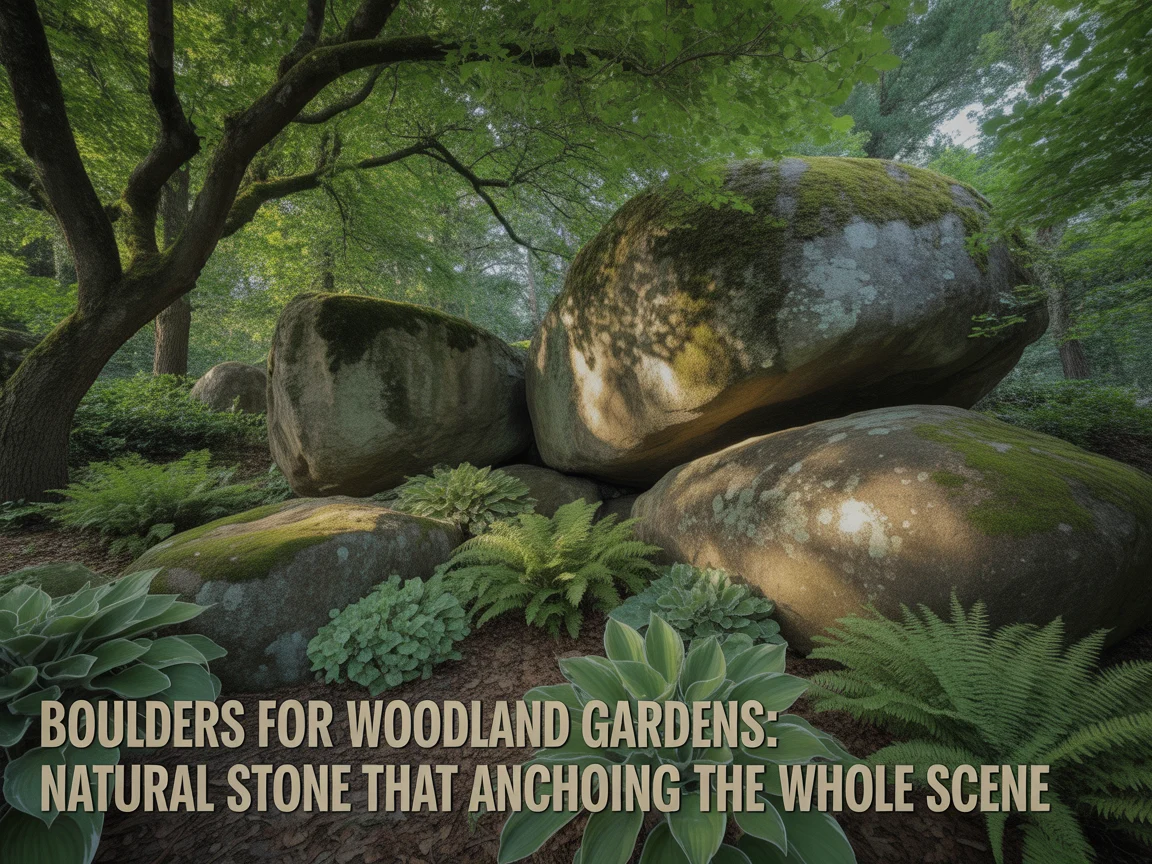
I rolled my first proper boulder into a woodland garden eight years ago, and I got it completely wrong. It was a beautiful piece of weathered granite, but I set it sitting flat on the soil surface like an egg on a table, and it looked exactly like what it was — a large rock that had been delivered and dumped. The owner was too polite to complain, but I knew. I came back the following week, dug a third of the boulder down into the ground, tilted it so its grain ran with the slope, and tucked ferns tight against its buried base. The transformation was total. The same stone now looked as though it had pushed up through the woodland floor over ten thousand years, and the garden suddenly had a center of gravity it had been missing. That single afternoon taught me the most important lesson in this entire subject: a boulder in a woodland garden is not placed on the ground, it is set into it.
Boulders for woodland gardens are large natural stones — typically granite, sandstone, limestone, or basalt — set partially buried and carefully oriented among shade-tolerant planting beneath a tree canopy to create dramatic focal points, structural anchors, and authentic naturalistic geology that makes a cultivated woodland garden read as a genuine wild landscape. The boulders give the woodland garden scale, permanence, and a sense of ancient natural structure, while the surrounding ferns, mosses, and woodland planting soften the stone and bind it into the scene so it looks discovered rather than delivered.
Since that early mistake I have sourced, placed, and planted boulders across woodland gardens ranging from compact urban plots needing a single characterful stone to large rural sites where multi-tonne boulder groupings form the bones of an entire design. I have seen a single well-set boulder transform an ordinary shaded border, and I have also seen elaborate boulder arrangements create complete naturalistic rock landscapes of genuine drama. In this article I am sharing the best boulder garden ideas for woodland settings covering stone types, sizing, placement, planting, sourcing, and cost. For anyone wanting to take the water element further, a full range of design and construction ideas is covered in these woodland gardens with ponds as natural water features.
Moss-Covered Granite Boulders Emerging From Fern Beds
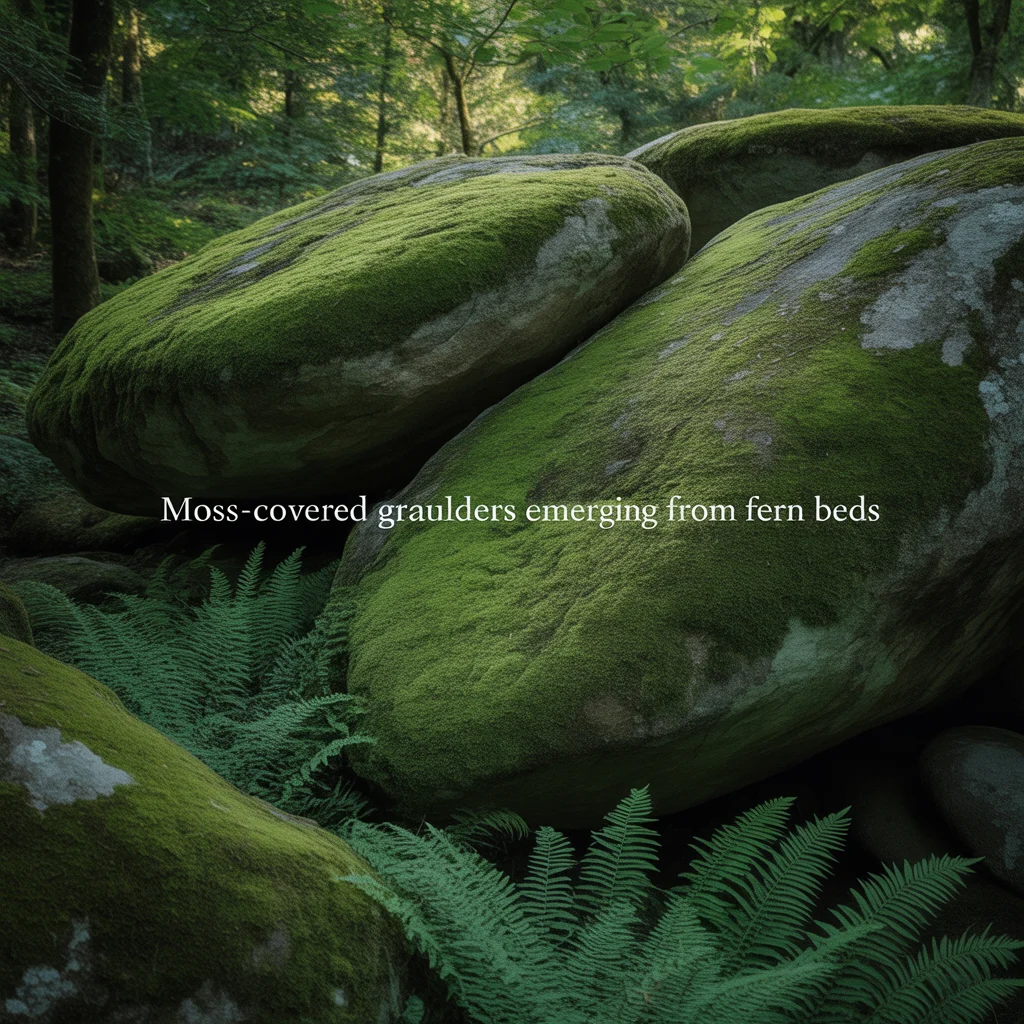
Moss-covered granite boulders emerging from fern beds are the most iconic boulder idea for a woodland garden, using large, rounded, weathered granite set low among ferns so the stone appears to rise from the forest floor beneath a soft cloak of moss. I set a group of three granite boulders into an established fern bed and encouraged moss over their bases, and within two seasons the moss-softened granite rising from the fronds had become the single most photographed feature in the whole garden because it looked utterly ancient and entirely natural.
Granite Types for a Woodland Garden
Weathered rounded granite, grey speckled granite, and pink-toned granite are three granite types suited to a woodland garden. Weathered rounded granite that has been naturally smoothed provides the most ancient, glacial appearance and the rounded form that reads as a long-settled woodland stone, making it the most naturalistic granite for a woodland setting. Grey speckled granite provides a cooler, neutral tone that recedes quietly into shaded planting and coordinates with the bark of mature trees. Pink-toned granite provides a warmer accent that catches what little light reaches the woodland floor, suiting a boulder intended as a deliberate focal point.
Encouraging Moss on Granite Boulders
Moss is encouraged on a granite boulder by siting it in deep shade, keeping the surface consistently moist, and applying a moss slurry to accelerate colonization. I position boulders intended to naturalize in the most shaded, humid parts of the woodland garden where moss establishes readily on its own, and I brush a slurry of blended fresh moss and buttermilk onto the shaded upper faces in spring to speed coverage. The essential conditions are full to partial shade, consistent moisture without baking sun, and a porous or textured stone surface that holds the dampness moss needs.
Setting Granite Into a Fern Bed
Granite boulders are set into a fern bed by burying the lower third of the stone, orienting its grain to sit naturally with the ground, and planting ferns tight against the buried base. I bury at least one third of every boulder so it appears to emerge from the earth rather than rest on it, I tilt the stone so any visible grain or strata runs consistently with the slope, and I plant ferns hard against the base so the transition from stone to planting is seamless rather than an abrupt line on bare soil.
Sandstone Boulder Groupings Beside a Woodland Stream
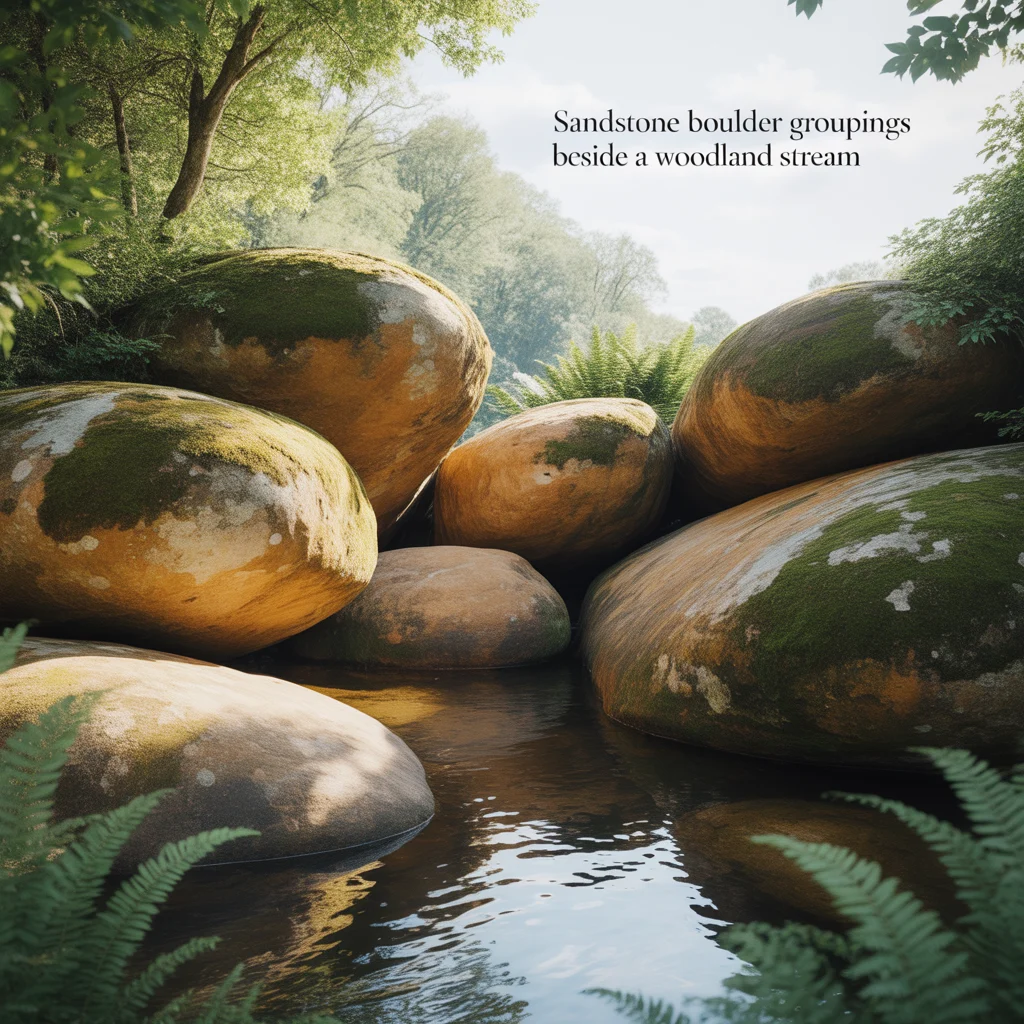
Sandstone boulder groupings beside a woodland stream combine the warm, layered character of sedimentary sandstone with the movement and reflection of water, creating one of the most atmospheric naturalistic features a woodland garden can hold. I placed a grouping of sandstone boulders along the bank of a small woodland stream, and the way the warm stone framed the moving water and caught the light at the stream’s edge produced a scene of such natural rightness that visitors assumed the stones had been there far longer than the stream itself.
Sandstone Characteristics for Woodland Use
Layered buff sandstone, riven red sandstone, and rounded watercourse sandstone are three sandstone characteristics suited to a woodland stream setting. Layered buff sandstone shows visible horizontal strata that read as natural geological bedding when oriented consistently, providing the most authentic sedimentary character. Riven red sandstone provides a warmer tone that glows against green planting and moving water. Rounded watercourse sandstone that has been naturally smoothed suits direct placement at the water’s edge where angular stone would look freshly quarried rather than river-worn.
Grouping Boulders in Odd Numbers
Boulders are grouped most naturally in odd numbers of three, five, or seven, with varied sizes and a connected, overlapping arrangement rather than evenly spaced individual stones. I always group boulders in odd numbers because an odd grouping reads as a natural, informal cluster while an even pairing looks deliberately placed. I use one dominant large stone supported by smaller satellites, set them close enough that their bases appear to belong to the same buried mass, and avoid the soldier-row spacing that instantly betrays an artificial arrangement.
Setting Boulders at a Stream Edge
Boulders at a woodland stream edge are set with their bases below the normal water level so they appear to rise from the streambed, and oriented so the water flows naturally around them. I bed streamside boulders firmly so they cannot shift in flowing water, set the bases below the waterline so the stone appears geologically continuous with the bed, and position the largest stone at the outside of a bend where a real watercourse would have eroded around it.
Lichen-Encrusted Limestone Boulders With Woodland Wildflowers
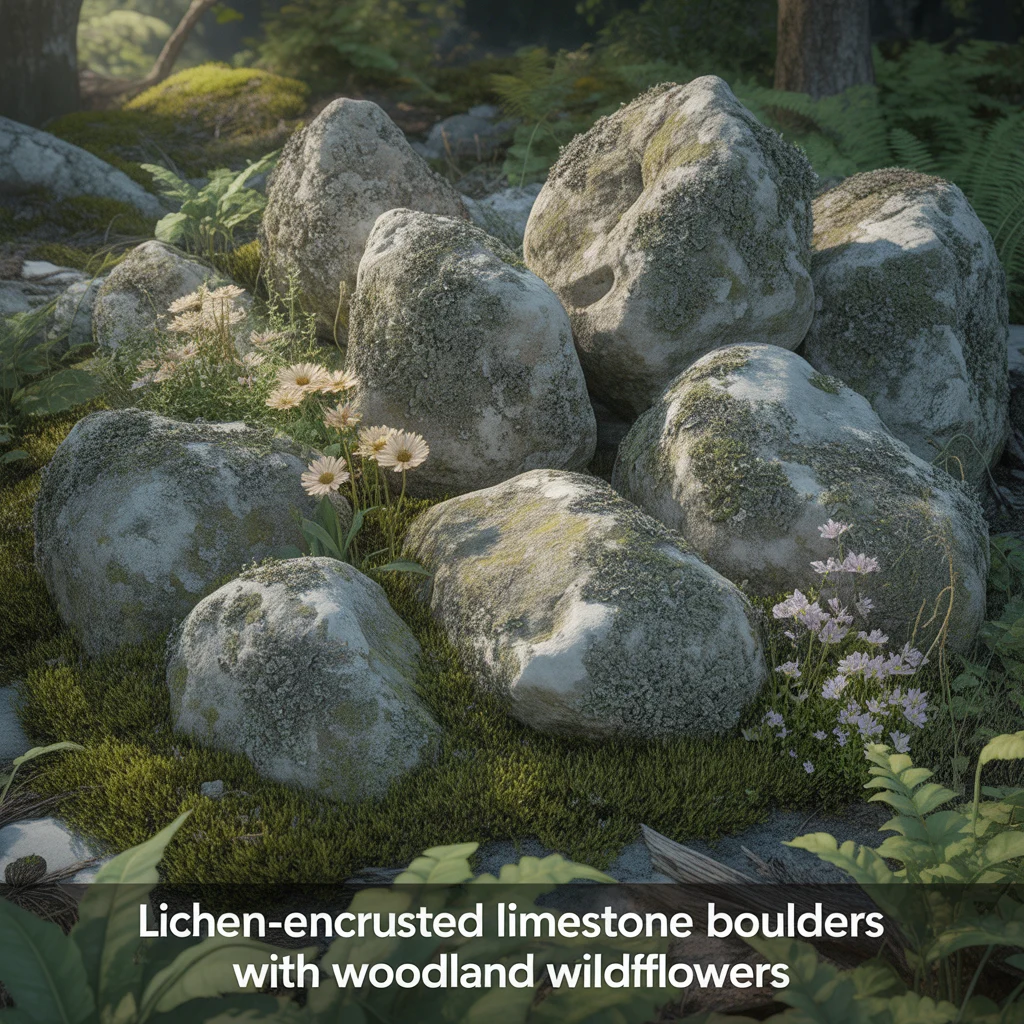
Lichen-encrusted limestone boulders surrounded by native woodland wildflowers create a softer, paler boulder feature that suits a woodland garden on alkaline soil and provides the cool, weathered stone character associated with limestone country. I set pale limestone boulders among a planting of native woodland wildflowers, and the combination of the lichen-patterned stone with the delicate flowers growing around its base produced a gentle, naturalized feature that looked as though it had stood in a limestone wood for generations.
Limestone Types for a Woodland Garden
Pale grey limestone, cream weathered limestone, and fissured karst limestone are three limestone types suited to a woodland garden. Pale grey limestone provides a cool, light surface that brightens a shaded woodland corner and shows lichen colonization beautifully. Cream weathered limestone offers a warmer pale tone that coordinates with the bark of birch and ash. Fissured karst limestone with its naturally weathered grooves and pockets provides planting niches and the most characterful surface, suiting a boulder intended as a textured focal point.
Wildflowers for Limestone Boulder Bases
Primula vulgaris, Geranium sylvaticum, and Digitalis purpurea are three woodland wildflowers suited to limestone boulder bases. Primula vulgaris, the native primrose, produces pale yellow flowers from February to April nestled at the boulder base in partial shade. Geranium sylvaticum, wood cranesbill, produces violet-blue flowers in early summer that soften the stone with informal native colour. Digitalis purpurea, foxglove, produces tall flower spikes that rise against the boulder and self-seed around its base to naturalize the feature over successive seasons.
Dramatic Basalt Boulder Arrangements
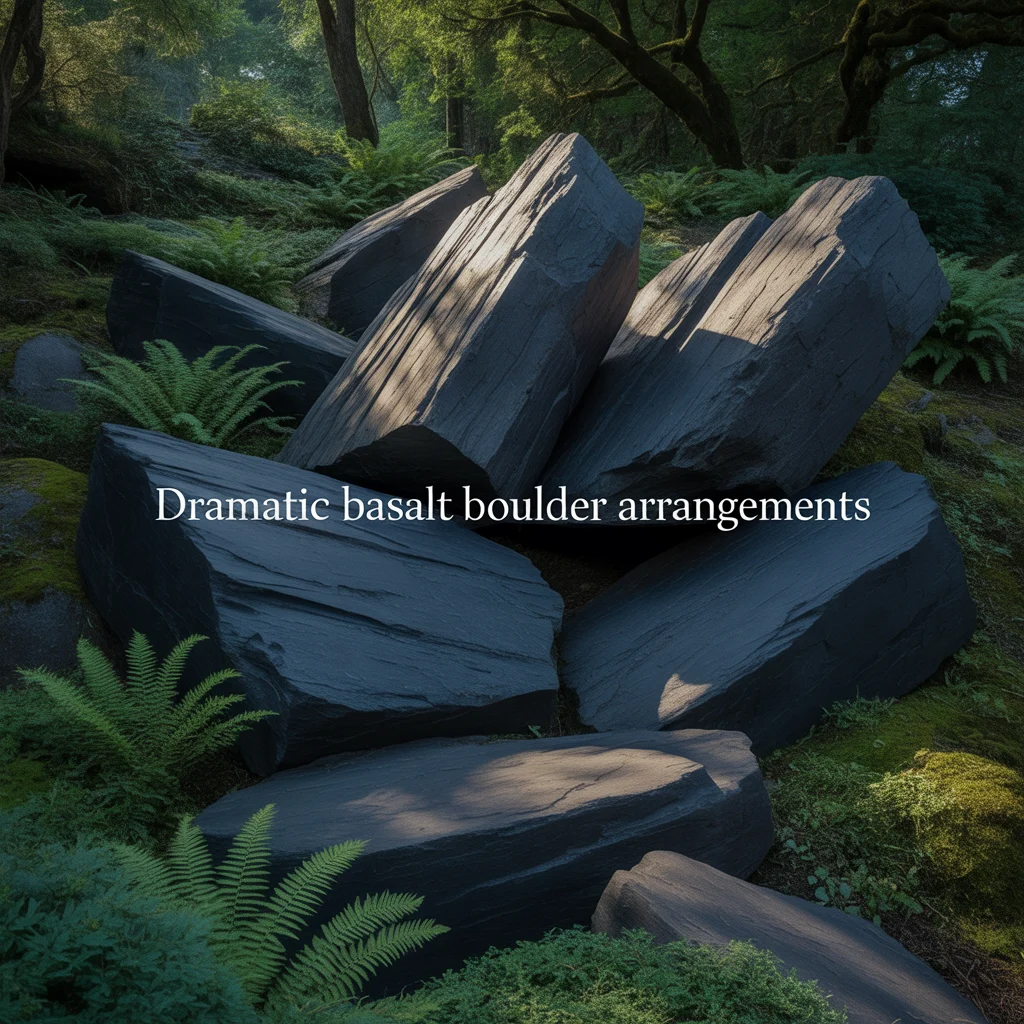
Dramatic basalt boulder arrangements use dark, dense, often angular basalt to create a bold, sculptural rock feature with strong visual weight, suiting a contemporary or dramatically naturalistic woodland garden where the stone is intended as a powerful statement. I built a basalt boulder arrangement under a stand of mature trees using dark angular stone of varied height, and the deep colour and strong form of the basalt against the green woodland planting created a feature of real sculptural drama that anchored the entire composition.
Basalt Characteristics for a Woodland Garden
Angular dark basalt, columnar basalt, and rounded volcanic basalt are three basalt characteristics suited to a woodland garden. Angular dark basalt provides strong, faceted forms and the deepest colour for a bold, sculptural arrangement. Columnar basalt with its natural vertical fracture provides striking upright forms that contrast with the horizontal woodland floor and suit a contemporary naturalistic design. Rounded volcanic basalt offers a softer, more weathered form for a setting where the dark colour is wanted without the hard angular edges.
Creating Visual Drama With Dark Stone
Height variation, tight grouping, and contrast planting are three techniques suited to a dramatic basalt arrangement. Varying the height of the stones so one rises clearly above the others creates a focal apex that draws the eye. Grouping the stones tightly so they read as a single fractured mass produces more drama than scattered placement. Contrasting the dark stone with bright or fine-textured planting such as silver-fronded ferns or pale-variegated hostas makes the basalt read even darker and more sculptural by comparison.
Single Specimen Feature Boulder
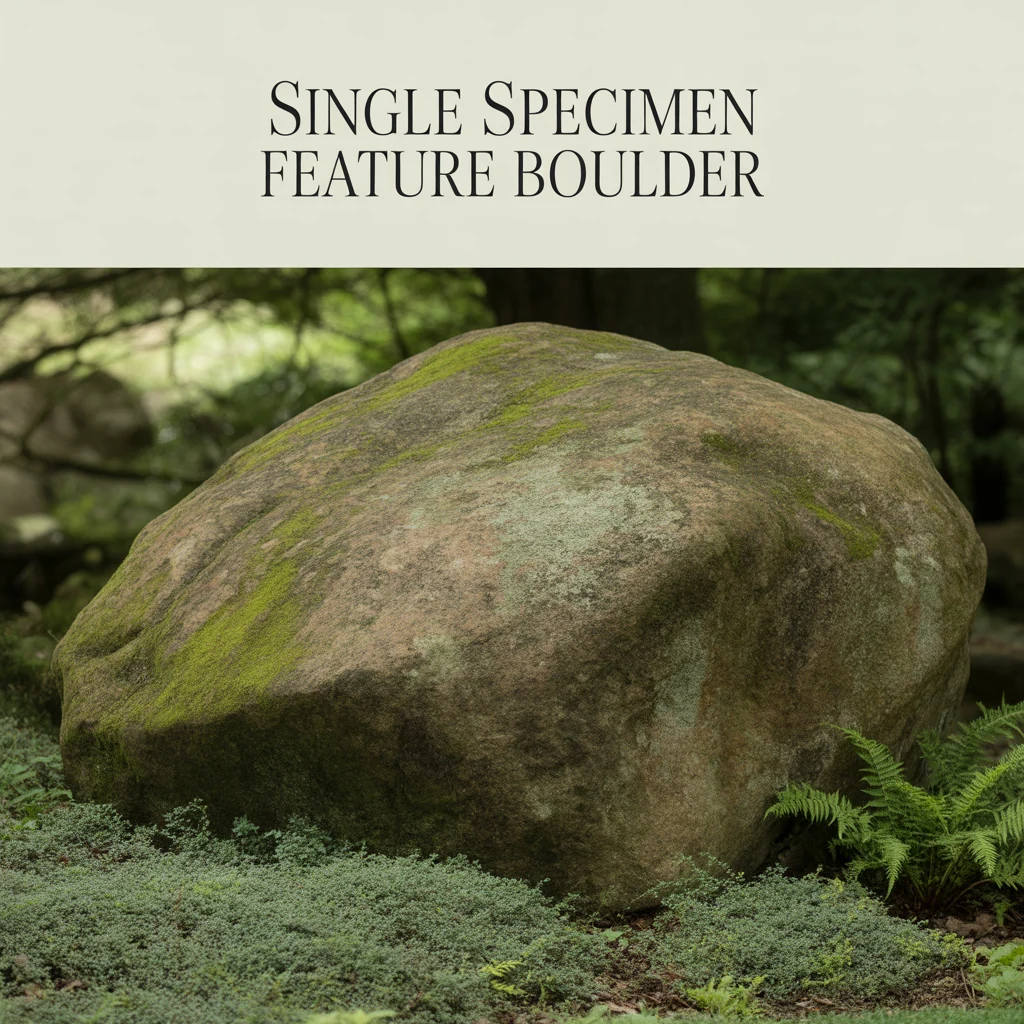
A single specimen feature boulder uses one carefully chosen, characterful large stone as a deliberate focal point in a woodland garden, providing maximum impact from minimum material and suiting a smaller garden or a position that needs one strong anchor rather than a grouping. I placed a single specimen boulder of unusual weathered form at the turn of a woodland path, and that one well-chosen stone provided more structure and focus than a scattering of lesser boulders ever could, because all the visual weight was concentrated in a single confident statement.
Choosing a Specimen Boulder
Distinctive form, characterful surface, and appropriate scale are three qualities suited to a specimen feature boulder. A distinctive form with an interesting profile, an asymmetry, or a natural lean gives the stone individual character that justifies its role as a focal point. A characterful surface of weathering, lichen, fissures, or strata rewards the closer attention a feature stone receives. An appropriate scale that is large enough to command its position without overwhelming the space is essential, because a specimen boulder must look generous and intentional rather than merely big.
Positioning a Single Boulder for Impact
A path turn, a sightline terminus, and a planting clearing are three positions suited to a single feature boulder. Placing the boulder at the turn of a woodland path creates a natural pause point and a visual anchor at the directional change. Setting it at the end of a sightline gives the eye a destination and draws the viewer through the garden toward it. Positioning it within a small clearing in the planting allows the stone to stand clear and be appreciated fully, framed by the surrounding woodland.
Boulder Steps and Natural Stairways
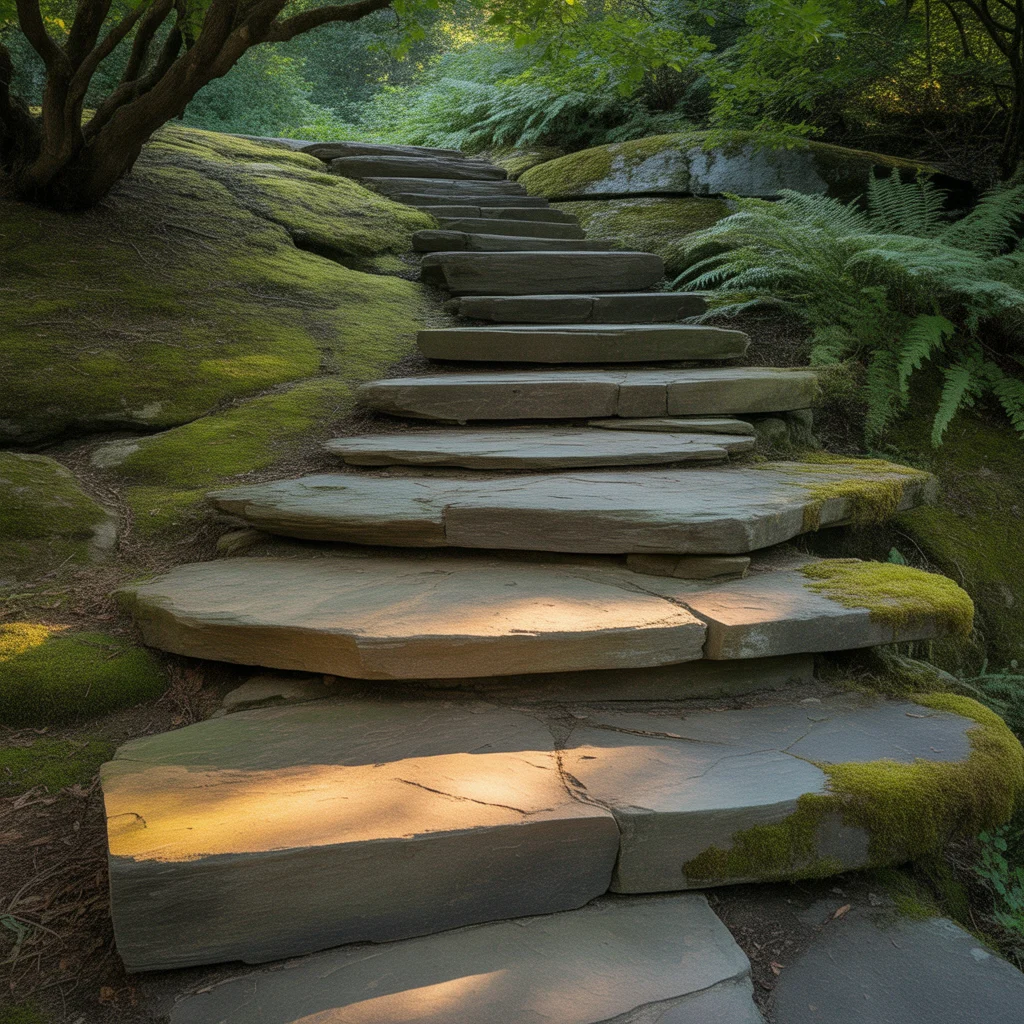
Boulder steps and natural stairways use large flat-topped stones set into a woodland slope to create a rugged, naturalistic route up or down a gradient, combining the practical function of steps with the authentic character of stone outcropping. I built a flight of boulder steps up a wooded bank using broad flat sandstone blocks set into the slope, and the steps both solved a real access problem and looked as though walkers had simply found a natural rock stairway through the woodland over many years.
Stone Selection for Boulder Steps
Flat-topped sandstone blocks, broad granite slabs, and riven limestone treads are three stone choices suited to boulder steps. Flat-topped sandstone blocks provide a naturally textured, slip-resistant tread that weathers attractively in a woodland setting. Broad granite slabs provide the most durable and stable step for heavy use. Riven limestone treads provide a pale, characterful step with natural slip resistance from the riven surface, suiting a woodland garden on limestone.
Setting Boulder Steps Safely
Boulder steps are set safely by bedding each stone firmly on a compacted base, ensuring a consistent comfortable rise, and providing a stable level tread that does not rock. I bed every step stone on a compacted sub-base so it cannot settle or shift, I keep the rise between treads consistent at a comfortable height for safe walking, and I test each tread for any movement before the stairway is used, because an unstable step on a woodland slope is a genuine hazard.
Boulders as Natural Seating
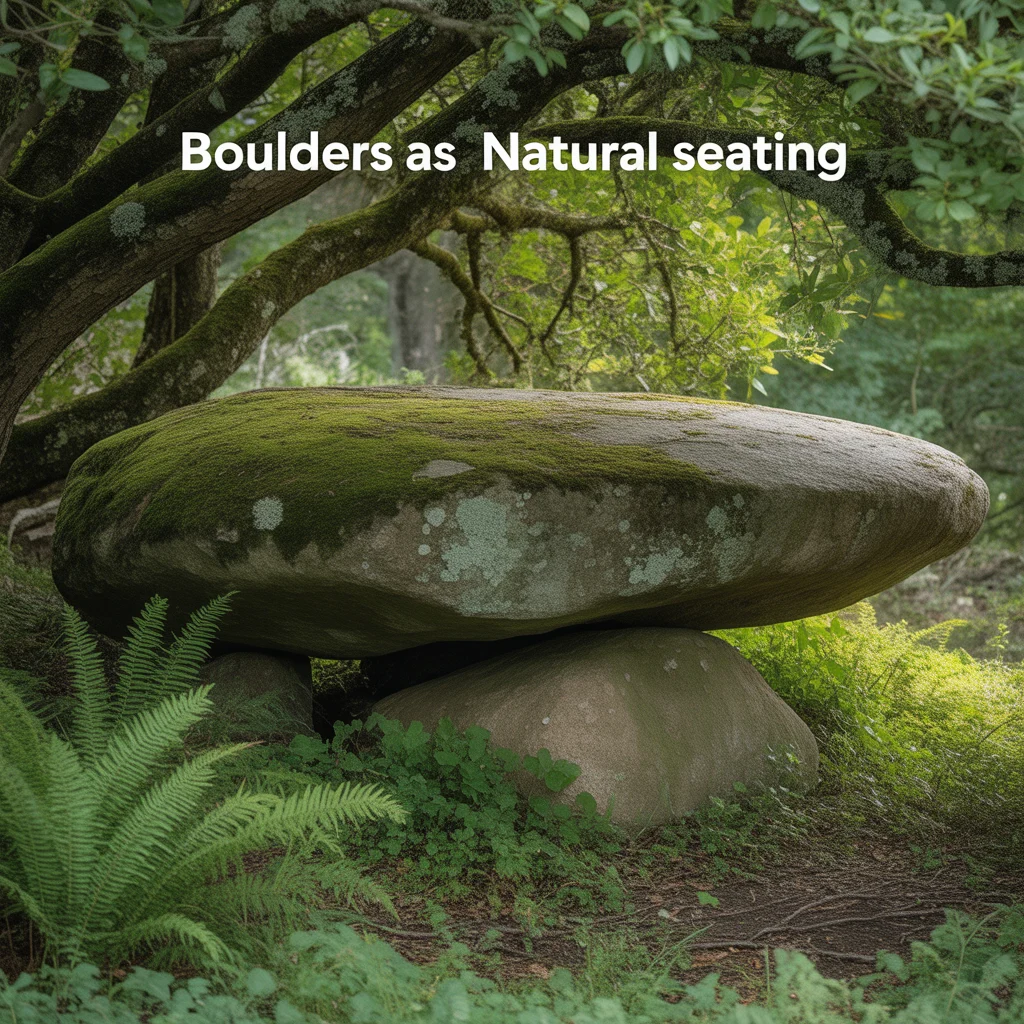
Boulders used as natural seating provide an informal, organic place to rest within a woodland garden, using a large flat-topped stone at sitting height as a sculptural seat that doubles as a focal point and needs no maintenance. I positioned a broad flat-topped boulder at a viewpoint along a woodland path, and it became the most-used resting spot in the garden simply because sitting on a warm, solid stone in the heart of the woodland feels more natural and grounding than any manufactured bench.
Selecting a Seating Boulder
A flat broad top, a comfortable height, and a stable base are three qualities suited to a seating boulder. A flat, broad top of sufficient area provides a genuinely usable sitting surface. A comfortable height of around 16 to 18 inches at the top face suits natural seating without the stone being a clamber to reach. A stable, broad base ensures the boulder cannot rock or shift under a sitter’s weight, which is essential for safe informal seating.
Siting a Seating Boulder
A viewpoint, a path junction, and a sunny clearing are three positions suited to a seating boulder. Placing the seat at a viewpoint gives a reason to pause and a scene to enjoy from the stone. Siting it at a path junction creates a natural resting and orientation point. Positioning it in one of the few sunny clearings within the woodland provides a warm, inviting spot to sit, since the stone will hold the warmth of any sun it receives.
Boulder and Fern Combination Planting
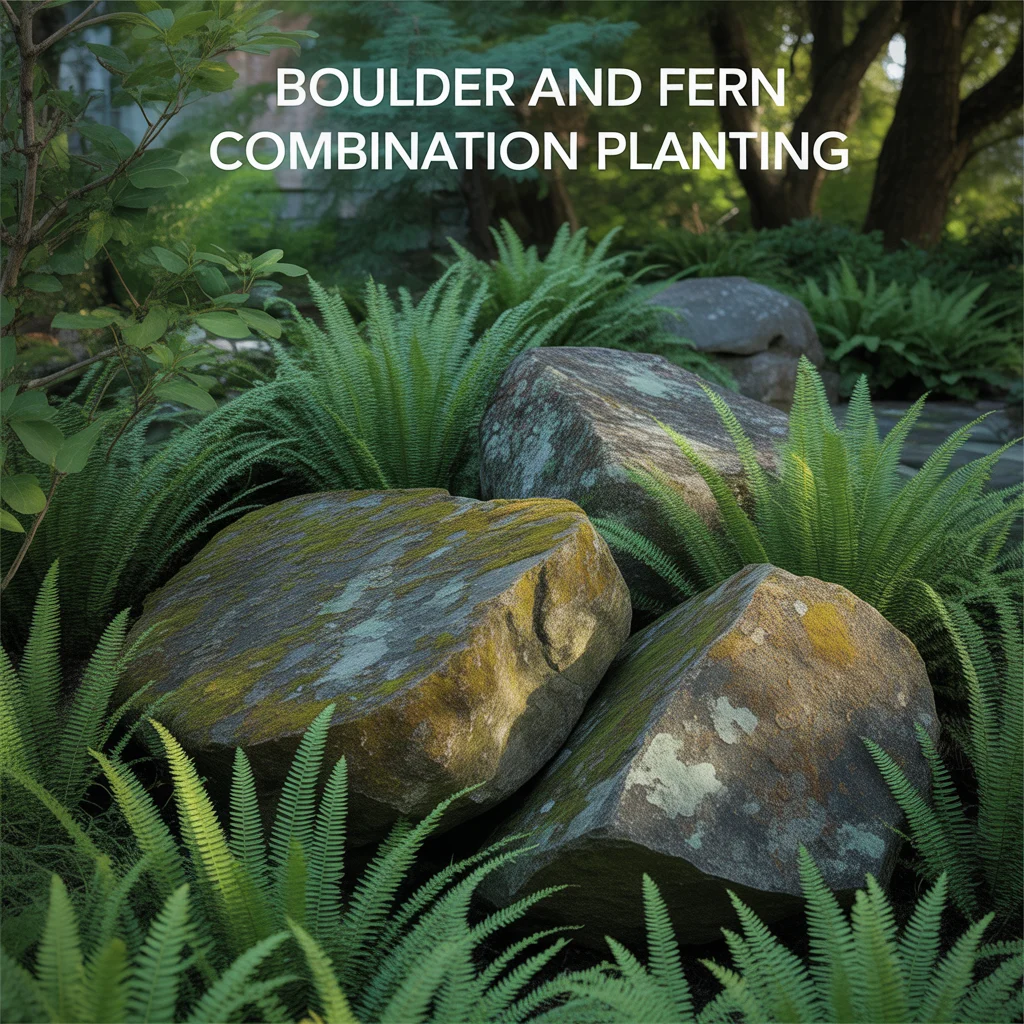
Boulder and fern combination planting pairs large stone with shade-tolerant ferns to create the definitive woodland boulder feature, the soft, arching fronds of the ferns contrasting with and softening the hard solidity of the stone in the most natural of all woodland partnerships. I plant ferns against the base of almost every boulder I set, because the moment fern fronds begin to spill over and around a stone, the boulder stops looking placed and starts looking as though the woodland has grown up around it over decades.
Ferns for Boulder Base Planting
Dryopteris filix-mas, Polystichum setiferum, and Asplenium scolopendrium are three ferns suited to boulder base planting. Dryopteris filix-mas produces robust arching fronds that tolerate the dry, competitive soil at a boulder base under tree canopy better than most ferns, making it the most reliable choice. Polystichum setiferum is semi-evergreen and provides winter structure against the stone after deciduous ferns die back. Asplenium scolopendrium, the hart’s tongue fern, produces glossy strap-shaped fronds that emerge dramatically from fissures and gaps in and around the boulder.
Planting Ferns Against Stone
Ferns are planted against stone by setting them tight to the buried base, tucking smaller ferns into surface fissures, and layering fern sizes from the stone outward. I plant the largest ferns hard against the base to hide the soil line where stone meets ground, I tuck small ferns into any natural pockets or fissures in the boulder surface so they appear to grow from the rock itself, and I grade fern sizes from tall at the stone down to lower ground cover outward, creating a natural settling of planting around the feature.
Boulder Outcrop Rock Garden Feature
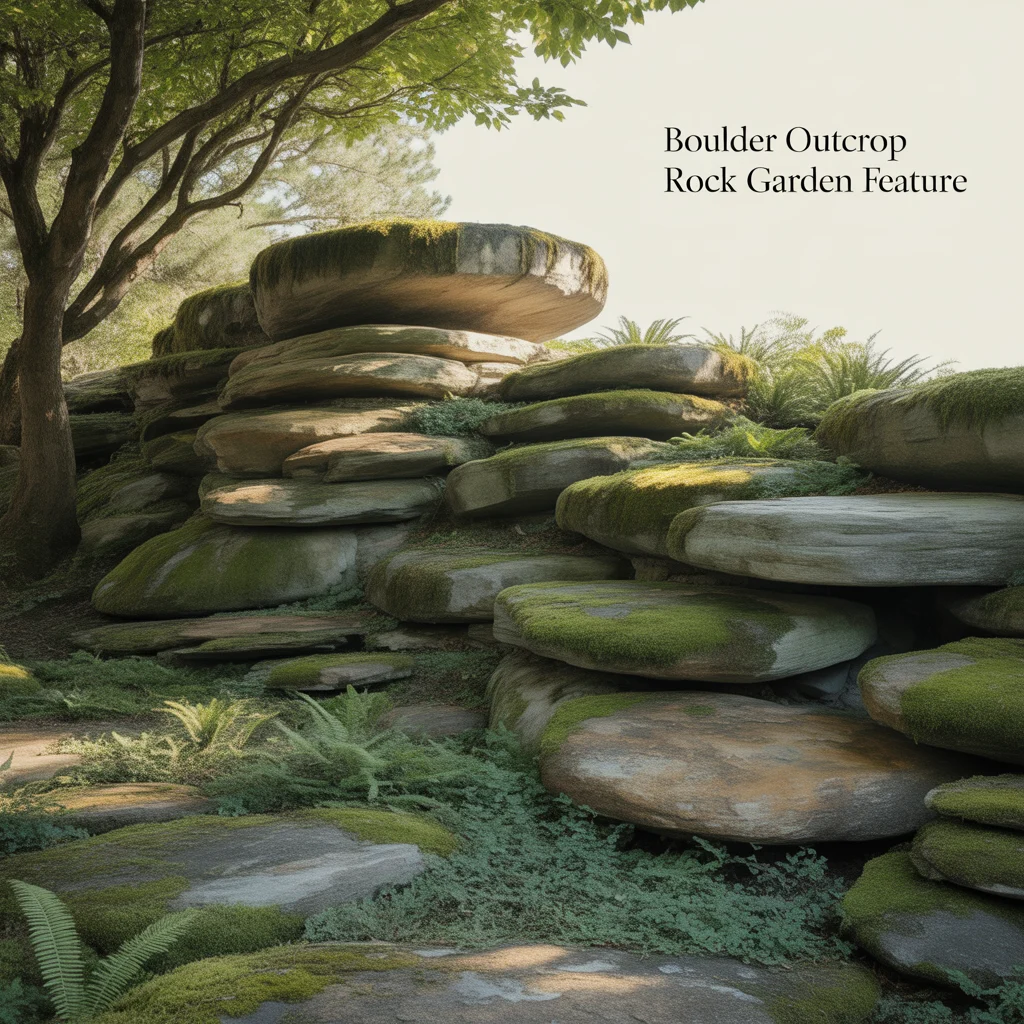
A boulder outcrop rock garden feature arranges multiple boulders to simulate a natural rock outcropping where bedrock breaks through the woodland floor, creating a substantial geological feature that becomes the structural heart of a naturalistic woodland garden. I built a boulder outcrop on a wooded slope using stones of a single rock type set as if exposed by erosion, and the resulting outcrop looked so convincingly like natural bedrock that it became impossible to imagine the garden without it.
Designing a Convincing Outcrop
Single stone type, consistent grain orientation, and exposed-bedrock logic are three principles suited to a boulder outcrop. Using a single rock type throughout is essential, because a real outcrop is one geology, and mixing stone types instantly destroys the illusion. Orienting the grain or strata of every stone consistently in the same plane makes the separate boulders read as one continuous buried mass. Following exposed-bedrock logic, with stone emerging most on the higher or eroded side of a slope, gives the outcrop natural credibility.
Planting a Boulder Outcrop
Crevice planting, drift planting, and a single specimen tree are three planting approaches suited to a boulder outcrop. Crevice planting of small ferns and woodland plants into the gaps between stones makes the outcrop look colonized and alive. Drift planting of a single species flowing across and around the stones unifies the feature. A single specimen tree or shrub rising from the outcrop, as a self-sown tree often does from a real rock face, completes the naturalistic picture.
Boulders for a Small Woodland Garden
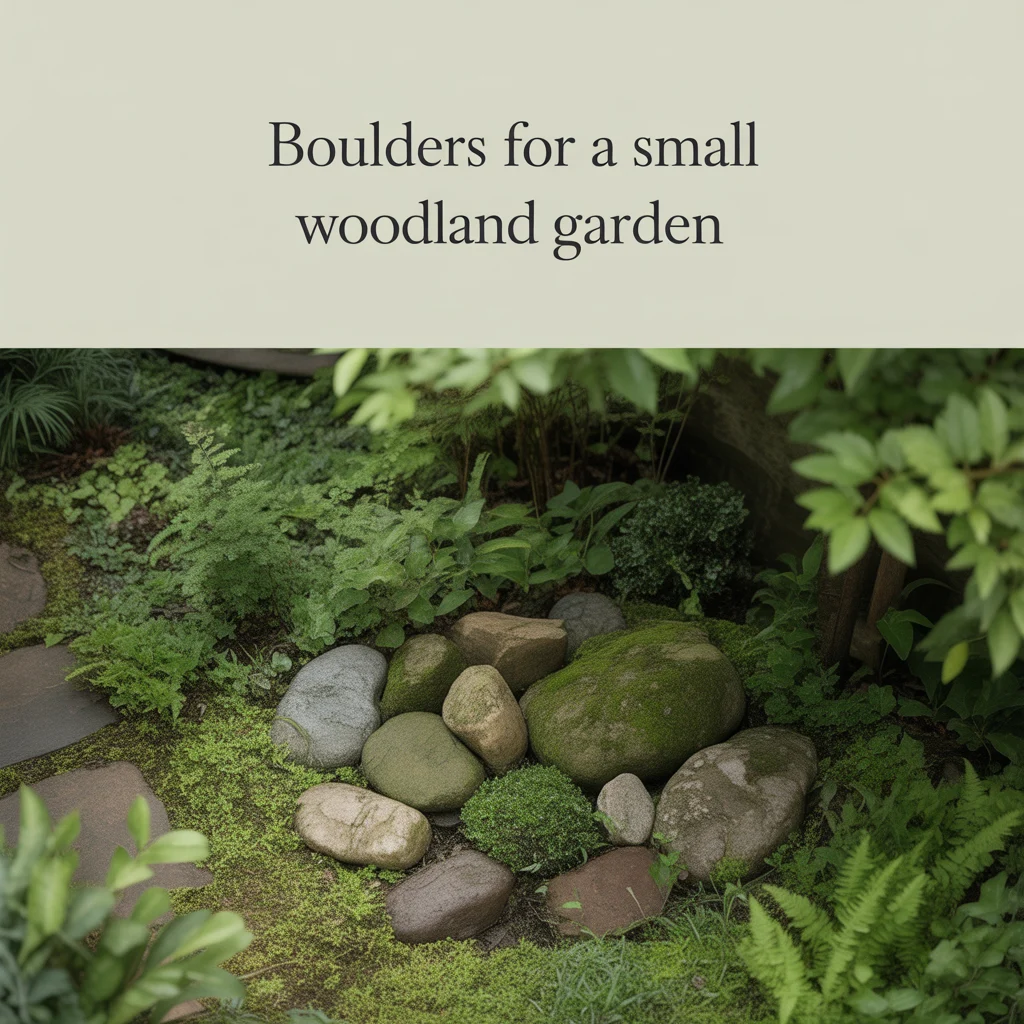
Boulders for a small woodland garden use carefully scaled stone and restrained placement to bring naturalistic drama to a compact space without overwhelming it, proving that a single well-chosen boulder can anchor even the smallest shaded garden. I placed one appropriately scaled boulder in a tiny urban woodland garden, and rather than crowding the space, the single stone gave it a focal point and a sense of permanence that made the small garden feel considered and complete.
Scaling Boulders to a Small Space
Proportionate size, a single dominant stone, and partial burial are three principles suited to boulders in a small woodland garden. Choosing a boulder proportionate to the space avoids the stone overwhelming a small garden while still providing genuine presence. Using one dominant stone rather than a competing group keeps a small space calm and uncluttered. Burying a generous portion of the boulder reduces its apparent bulk while preserving its character, so even a large stone can sit comfortably in a modest plot.
Maximizing Impact in a Compact Garden
A focal position, tight planting, and a single sightline are three techniques suited to a small-garden boulder. Placing the boulder at the natural focal point of the small space concentrates its impact. Planting tightly around its base with ferns and hostas integrates it immediately so it never reads as an isolated rock. Aligning it with the main sightline from the house or seating area ensures the one boulder is seen and appreciated from where the garden is most often viewed.
Understanding Boulder Stone Size and Selection
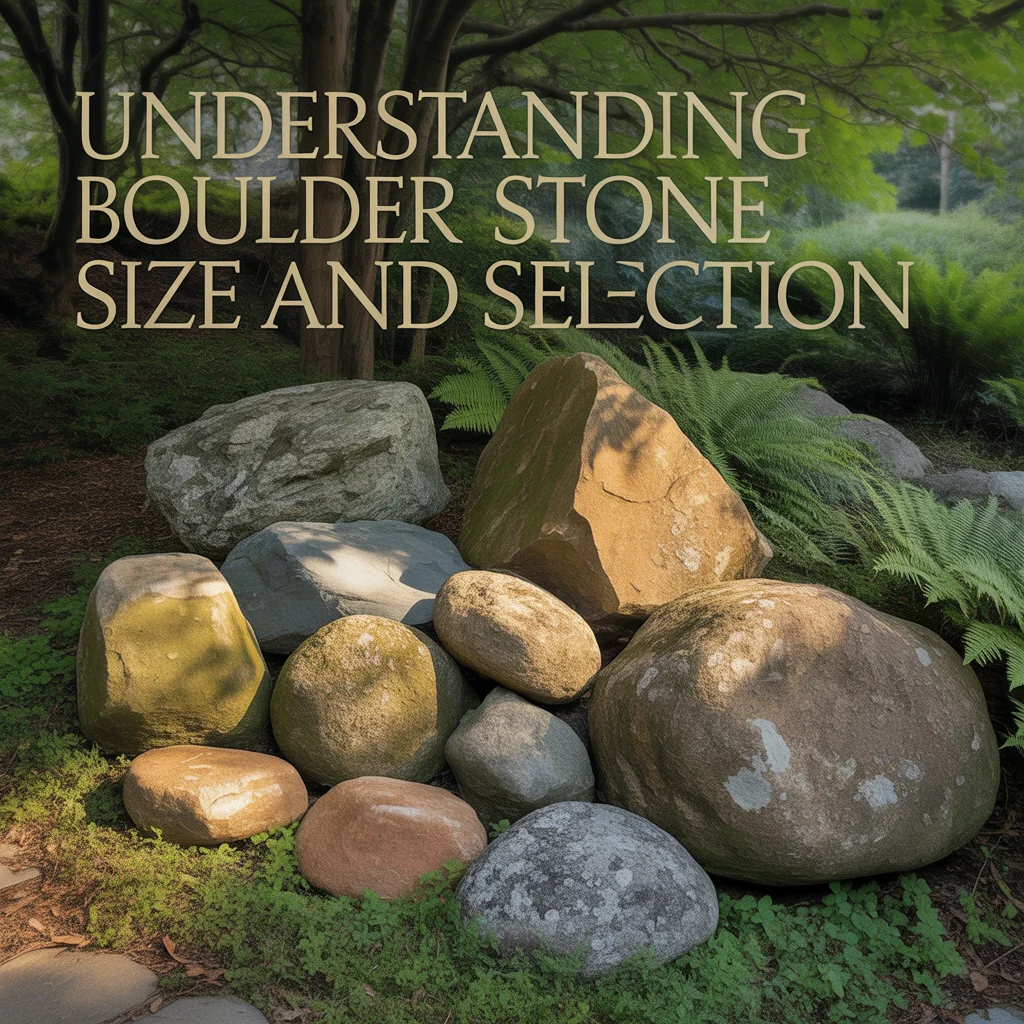
Understanding boulder stone size and selection is essential before sourcing, because the difference between a boulder, a rock, and a stone is largely one of scale, and choosing the right size for the setting determines whether the feature succeeds. I always advise choosing boulders larger than first instinct suggests, because a stone that looks impressively large on a supplier’s pallet almost always looks smaller once it is set into the ground and surrounded by planting in the garden.
Boulder vs Rock vs Stone
The distinction between a boulder, a rock, and a stone is primarily a matter of size, with boulders being the largest category of natural stone used in landscaping. A boulder is generally understood as a large stone too heavy to lift by hand, requiring machinery to move and place, which is the category that provides the dramatic scale a woodland feature needs. A rock is a smaller, often hand-movable stone suited to detail and infill. A stone is smaller still, used for paths, edging, and gravel. For a woodland garden focal feature, it is genuinely boulder-scale stone that delivers the impact.
Choosing Boulder Size for the Setting
Allowing for burial, matching scale to space, and considering access are three factors suited to choosing boulder size. Allowing for the third of the stone that will be buried means selecting a boulder noticeably larger than the visible feature you intend, since a significant portion disappears below ground. Matching scale to the space ensures the boulder is generous in a large garden and proportionate in a small one. Considering access and delivery is essential, because the route to the placement position must physically accommodate both the boulder and the machinery needed to move it.
Sourcing and Boulder Stone Price
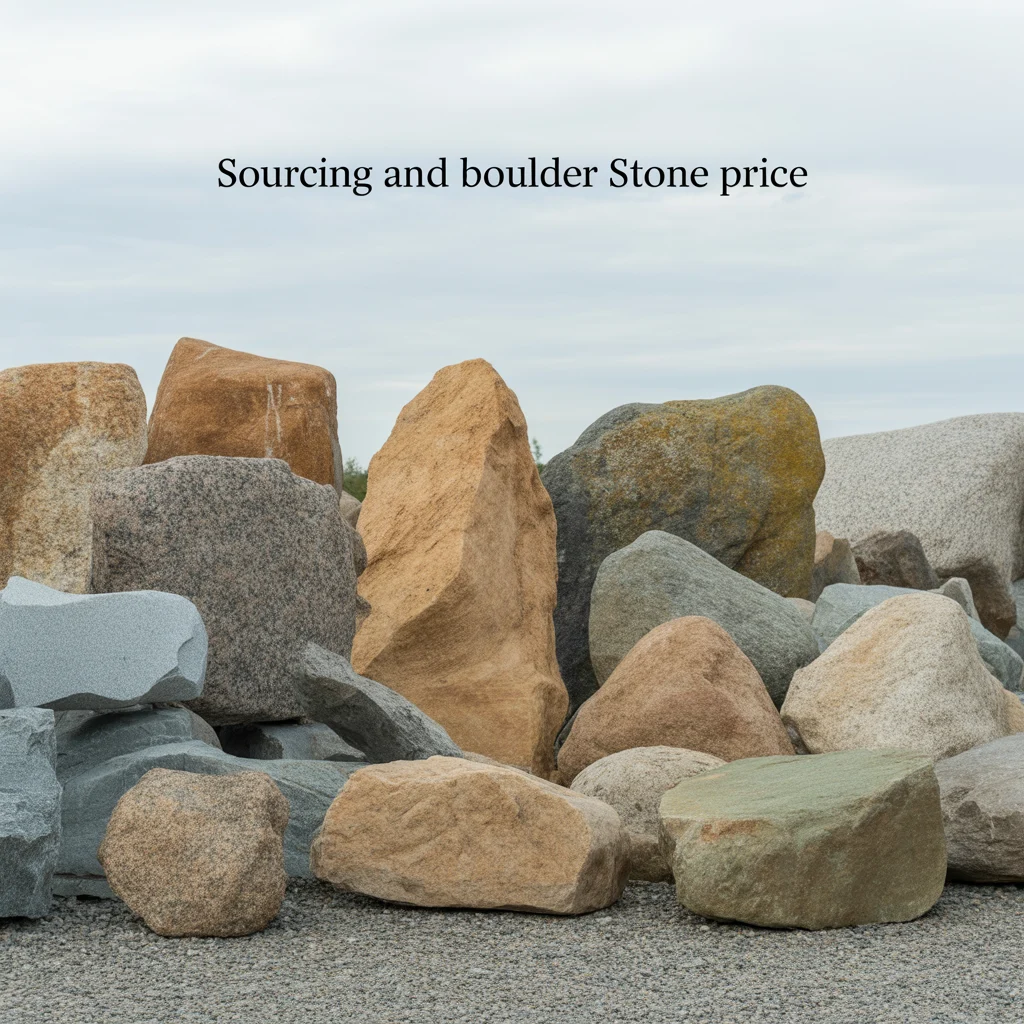
Sourcing boulders and understanding boulder stone price are the practical foundations of any woodland boulder project, since cost varies enormously with stone type, size, finish, and the distance from quarry to garden. I always source boulders locally where possible, both because local stone suits the regional landscape most authentically and because transporting heavy stone over long distances adds substantially to the boulder stone price through haulage rather than the stone itself.
Where to Source Woodland Boulders
Local stone quarries, landscape stone suppliers, and reclamation yards are three sources suited to woodland garden boulders. Local stone quarries provide the most authentic regional stone at the most reasonable price, since local geology matches the natural landscape and haulage distances are short. Landscape stone suppliers offer a curated selection of boulders by type and size with delivery and sometimes placement services. Reclamation yards occasionally provide characterful weathered or moss-aged boulders with instant established appearance, which can be worth a premium for a feature stone.
Factors Affecting Boulder Stone Price
Stone type, size and weight, and delivery distance are three factors that affect boulder stone price. Stone type drives cost, with common local stone being most affordable and specialist or decorative stone commanding a premium. Size and weight increase price steeply, since larger boulders require more material, larger machinery, and greater handling effort. Delivery distance can become the dominant cost for heavy stone, which is why local sourcing so often gives both the best price and the most authentic result. Professional placement is a further cost to budget for on larger boulders.
Professional Boulder Placement and Installation
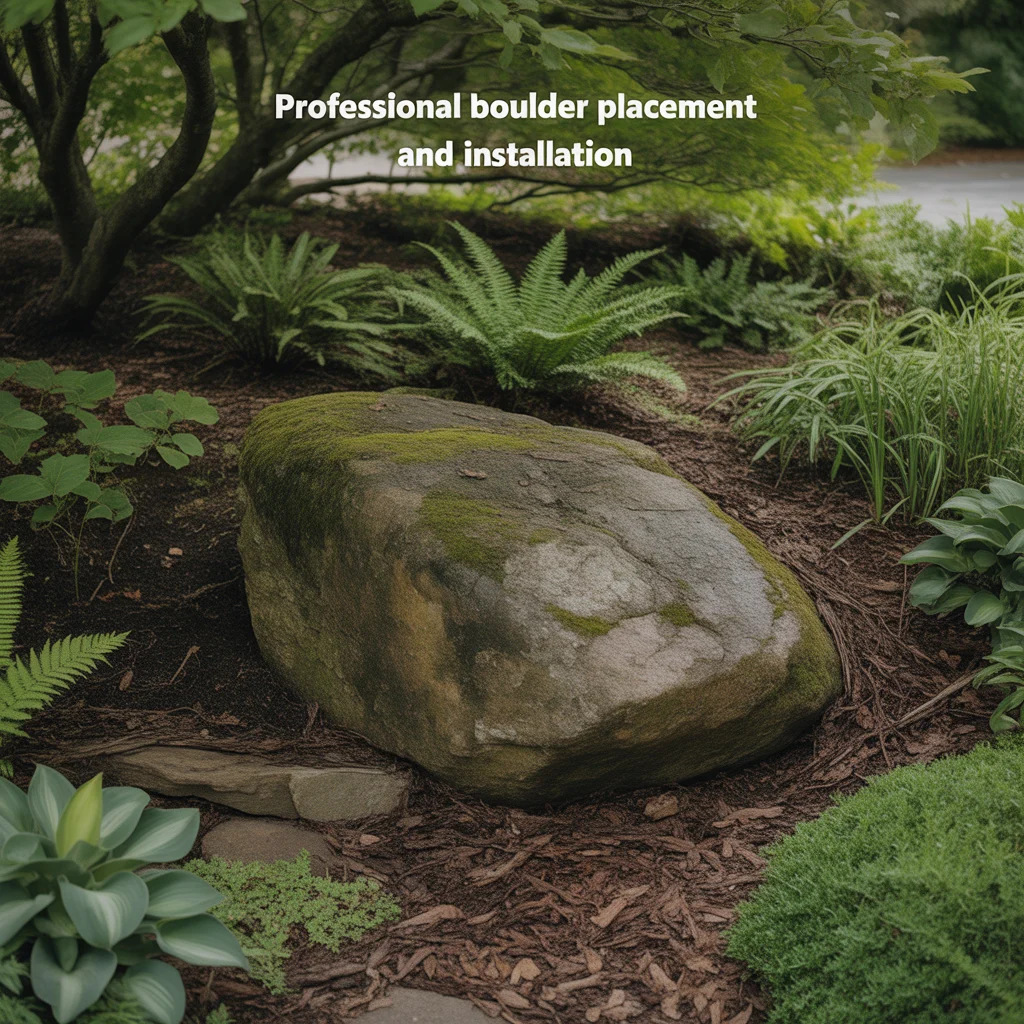
Professional boulder placement and installation are necessary for any boulder beyond hand-movable size, because large stone demands machinery, skill, and an understanding of how to set a boulder so it looks natural and sits safely. I work with an experienced machine operator for all large boulder placements, because the difference between a boulder that looks born from the earth and one that looks dumped on it comes down to skilled handling in the final moments of setting the stone.
When Professional Installation Is Required
Boulder weight, site access, and safe handling are three factors that determine when professional installation is required. Boulder weight beyond what can be safely moved by hand requires an excavator or crane and the operator to run it. Site access determines the machinery that can reach the placement position and whether specialist equipment is needed for a confined woodland setting. Safe handling of multi-tonne stone is a genuine hazard that demands proper lifting equipment, trained operators, and correct technique to protect both people and surrounding trees.
Setting a Boulder to Look Natural
Partial burial, grain orientation, and a settled base are three techniques professional installers use to set a boulder naturally. Burying the lower portion of the stone makes it appear to emerge from the ground rather than rest on it. Orienting the grain or strata consistently with the ground and any neighbouring stones gives geological credibility. Settling the base firmly into an excavated seat so the boulder sits solid and immovable, with soil and planting worked tight against it, completes the natural placement and ensures the stone is safe.
Boulders for Wildlife Habitat in Woodland Gardens
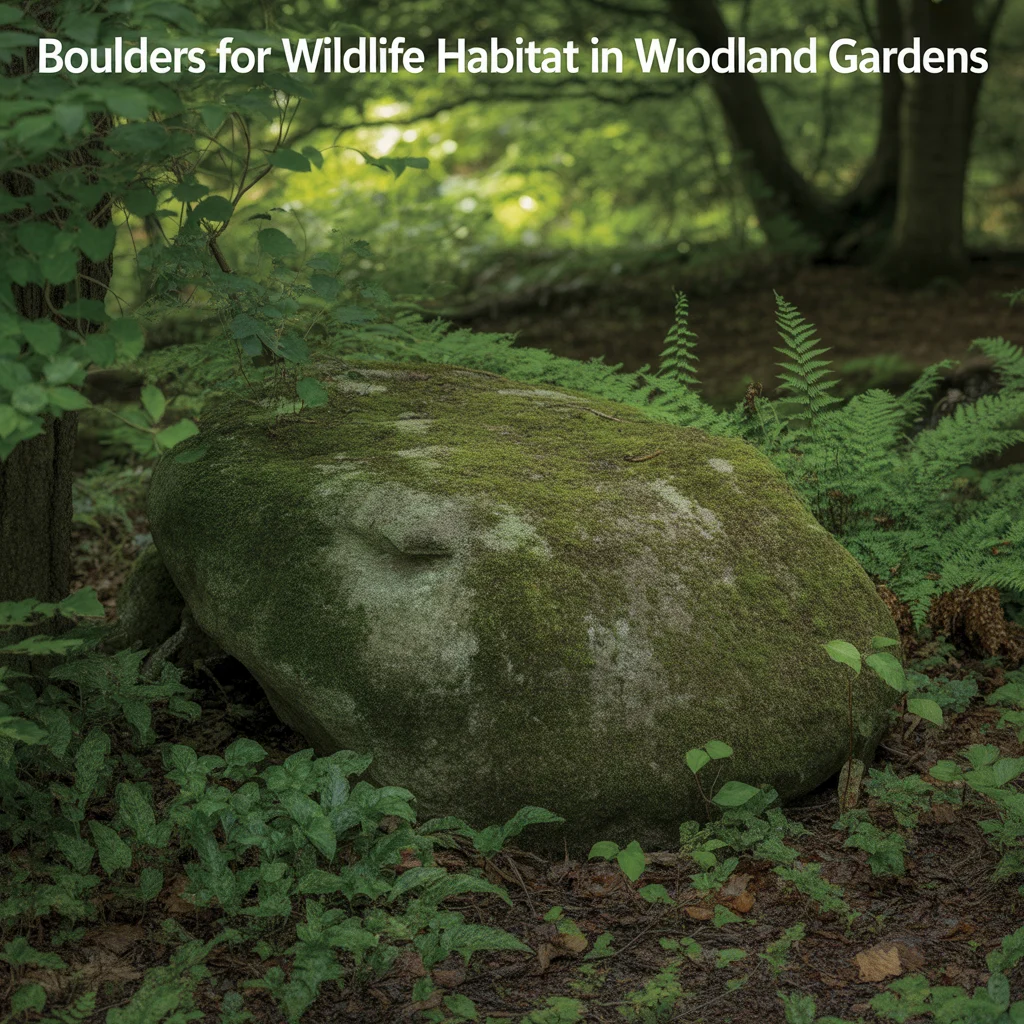
Boulders for wildlife habitat use the niches, crevices, and microclimates that large stone creates to support woodland biodiversity, making a boulder feature ecologically valuable as well as beautiful. I set a boulder grouping with deliberate gaps and damp shaded bases, and within a couple of seasons the stones were sheltering invertebrates, providing basking and refuge spots, and supporting the moss and lichen that form the base of a small ecosystem on the rock itself. Anyone looking to pair this kind of habitat feature with a water element will find further design ideas in these natural woodland gardens with water feature integration.
Wildlife Value of Woodland Boulders
Crevice shelter, microclimate creation, and moss and lichen habitat are three wildlife benefits provided by woodland boulders. Crevice shelter in the gaps between and beneath stones provides refuge for invertebrates, amphibians, and small creatures. Microclimate creation occurs as the boulder holds warmth, casts shade, and traps moisture, providing varied conditions that support different species. Moss and lichen habitat develops on the stone surfaces over time, supporting the invertebrates and the food web that depend on these primitive plants.
Enhancing Boulder Wildlife Value
Damp shaded gaps, log and leaf litter, and native planting are three enhancements suited to a wildlife boulder feature. Leaving damp shaded gaps between stones rather than mortaring them solid provides the crevices wildlife uses. Adding log and leaf litter around the boulder base extends the habitat and feeds the soil ecosystem. Planting native woodland species around the stone supports the local insects and wildlife that have evolved alongside them, maximizing the ecological value of the feature.
Combining Boulders With Moss, Hostas, and Woodland Planting
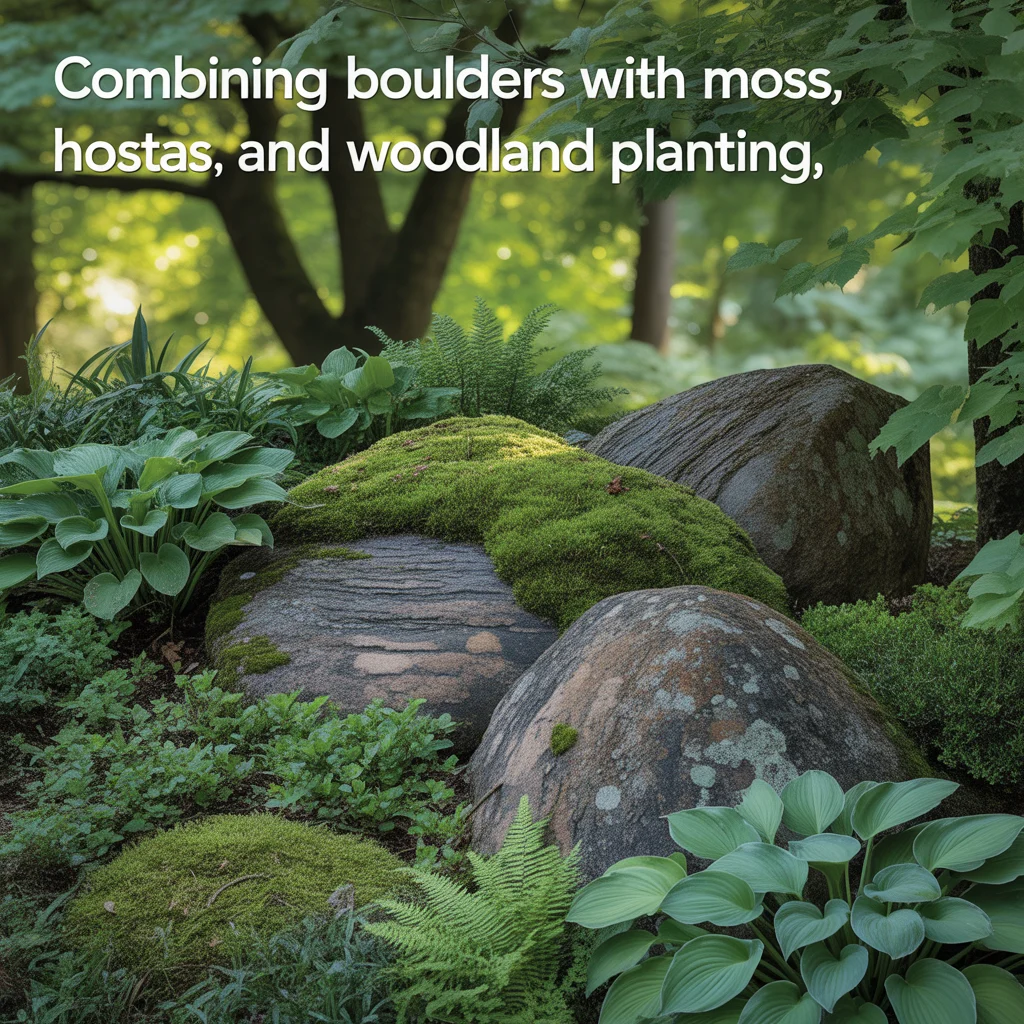
Combining boulders with moss, hostas, and layered woodland planting creates the complete naturalistic boulder feature, where the stone is fully integrated into a rich, four-season planting scheme that makes it look permanently established. I plan all my woodland boulder features as integrated planting compositions rather than isolated stones, because a boulder reaches its full potential only when moss softens its surface, hostas anchor its base, and ferns and woodland flowers knit it into the surrounding garden.
Planting Partners for Woodland Boulders
Hosta sieboldiana, moss, and Tiarella cordifolia are three planting partners suited to woodland boulders. Hosta sieboldiana provides bold blue-green leaves that anchor the boulder base with strong architectural foliage from spring through autumn. Moss carpeting the stone surface and the surrounding ground supplies the soft green continuity that makes the feature look ancient. Tiarella cordifolia, foam flower, provides a low woodland ground cover with delicate spring flowers that flows around the boulder base and naturalizes the stone into the planting.
Building a Four-Season Boulder Feature
Spring bulbs, summer foliage, and winter structure are three seasonal layers suited to a woodland boulder feature. Spring bulbs and woodland flowers around the boulder base provide early colour as the garden wakes. Summer foliage of hostas and ferns reaches full size to embed the stone in lush green planting through the main season. Winter structure from evergreen ferns, the moss-covered stone itself, and the bare architectural form of the boulder ensures the feature remains a strong focal point even when the deciduous planting has died back.
Related
Best ground cover plants for shaded woodland stream edges
How to add woodland garden lighting along a stream at night
woodland gardens with ferns planted along stream banks
Frequently Asked Questions
What are the best boulders for a woodland garden?
Weathered granite, layered sandstone, and lichen-encrusted limestone are among the best boulders for a woodland garden because all three weather attractively in shade, accept moss and lichen readily, and read as authentic natural geology when properly set. Weathered rounded granite provides the most ancient, glacial appearance and naturalizes with moss beautifully, sandstone offers warm tones and natural strata that suit streamside and slope settings, and limestone provides a paler, cooler stone for alkaline soils and brighter shaded corners. The single most important selection rule is to choose one stone type and use it consistently, ideally matched to the local geology, because mixing different rock types destroys the natural illusion that makes a woodland boulder feature convincing.
How big should boulders be for a woodland garden?
Boulders for a woodland garden should be larger than first instinct suggests, because a significant portion of every boulder is buried and the surrounding planting reduces the apparent size of the visible stone once it is set in the garden. A genuine focal boulder needs to be true boulder-scale, meaning too heavy to move by hand and requiring machinery to place, since smaller hand-movable rocks rarely deliver the dramatic naturalistic impact a woodland feature needs. When choosing size, allow for the roughly one-third of the stone that will be set below ground, match the scale to the space so the boulder is generous in a large garden and proportionate in a small one, and always confirm that the access route can physically accommodate both the stone and the machinery to move it.
What is the difference between a boulder, a rock, and a stone?
The difference between a boulder, a rock, and a stone is primarily one of size, with a boulder being the largest category of natural stone used in landscaping, generally too heavy to lift by hand and requiring machinery to move and place. A rock is a smaller, often hand-movable stone suited to detail, infill, and smaller features, while a stone is smaller still and used for paths, edging, gravel, and walling. For a woodland garden focal feature it is genuinely boulder-scale stone that provides the dramatic scale and visual anchor the design needs, which is why boulder projects almost always involve delivery and professional placement rather than the simple hand-setting possible with smaller rocks and stones.
How do you place a boulder so it looks natural?
A boulder is placed to look natural by burying its lower third in an excavated seat, orienting its grain or strata consistently with the ground and any neighbouring stones, and planting ferns and woodland species tight against its base. Burial is the most important step, because a boulder resting on the soil surface always looks delivered while a partially buried one appears to emerge from the earth as if it has been there for thousands of years. Setting the grain consistently gives geological credibility, grouping any additional stones in odd numbers with a single dominant boulder creates a natural cluster, and working soil and tight planting against the base completes the integration so the stone reads as discovered rather than placed.
How much do boulders cost for a woodland garden?
Boulder cost for a woodland garden varies considerably with stone type, size and weight, and the distance from quarry to garden, with delivery and placement frequently adding as much to the total as the stone itself. Common local stone is the most affordable option and also the most authentic, since regional geology matches the natural landscape and short haulage distances keep transport costs down, while specialist decorative stone and long-distance delivery increase the price substantially. Beyond the stone and delivery, larger boulders require professional placement with machinery, which is a further cost to budget for, so the most economical and natural-looking approach is usually to source boulder-scale stone from a local quarry or landscape supplier and have it professionally set into the garden.